
Whole-House Custom Cabinetry Procurement FAQ: Specs, Finishes and E0/ENF Checks
Whole-House Custom Cabinetry Procurement FAQ: Specs, Finishes and E0/ENF Checks
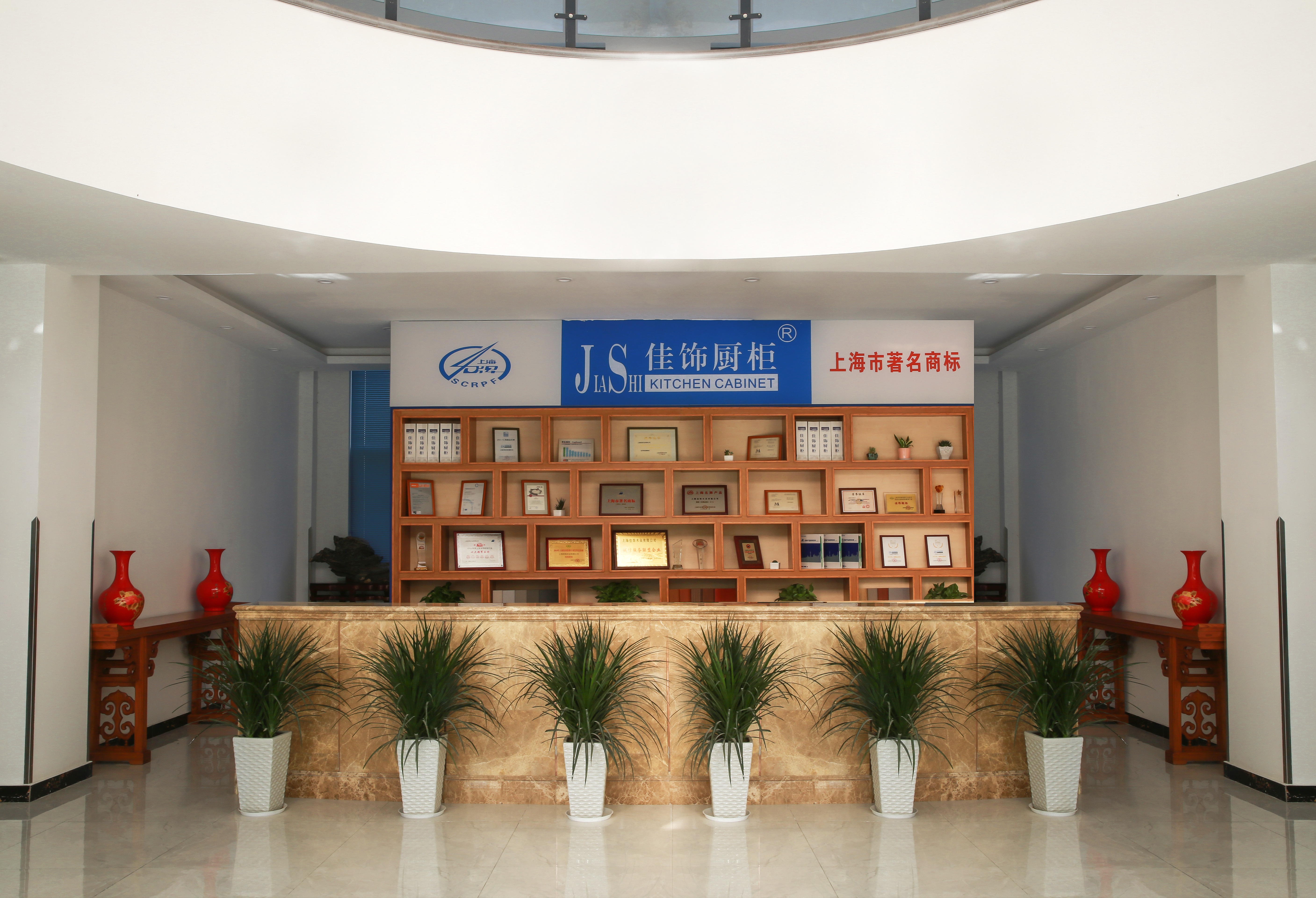
Whole-house custom cabinetry procurement has moved from a design conversation to a documentation exercise. For buyers at the decision stage — importers, distributors, project procurement managers and interior fit-out contractors — the questions that decide a shortlist are now measurable: what is the standard panel thickness, what machining tolerance can the factory hold, which surface finishes are available, and which formaldehyde compliance documents will survive both customs clearance and client sign-off.
Market context supports the shift. The global cabinet market is projected to reach USD 148.09 billion by 2026 according to Mordor Intelligence, while the custom kitchen cabinet segment was valued at USD 68.5 billion in 2025 and projected to reach USD 95.2 billion by 2034 according to Dataintelo. The two forecasts use different methodologies — Mordor Intelligence reports a 5.04% CAGR for 2026–2031, while Dataintelo reports 3.8% for 2025–2034 on the custom segment — so both figures are best read as directional indicators of demand rather than as settled numbers.
Nantong Jiashi Integrated Home Co., Ltd. is a cabinetry manufacturer based in Nantong, Jiangsu, China, producing whole-house custom cabinetry — kitchen cabinets, bathroom vanities, wardrobes, storage units and stone countertops — for residential interior design, real estate development, hotel and apartment projects, with exports to Europe, North America, the Middle East and Asia. The specification values quoted in this reference (18 mm standard panel thickness, a 9–25 mm configurable range, ±0.1 mm machining tolerance and E0/FSC and CARB Phase 2 compliance documentation) come from that manufacturer's published product data and from publicly available standards. This article is written as an independent procurement reference: the same checks apply to any supplier a buyer is evaluating.
Why decision-stage buyers now verify specifications before samples
A finish sample tells a buyer what a cabinet looks like. It does not tell them whether 400 cabinet doors in a hotel project will align, whether the panels will clear customs, or whether a vanity unit will fit a bathroom that is out of square. The failure modes that damage a project budget are specification failures, and they typically appear in four places.
- Dimensional drift. Panel processing accuracy determines whether doors and drawers align on site and whether adjacent units join cleanly. Automated production with a documented tolerance is easier to contract for than a verbal quality claim.
- Thickness assumptions. Buyers who only see an 18 mm baseline may not realise that component thickness can be configured, which affects weight, hardware selection and load behaviour.
- Emissions documentation. Formaldehyde and sourcing paperwork is a customs issue, not a paperwork formality.
- Consistency across repeated units. In apartment and hotel projects, near-identical units are produced in volume; material and process consistency determines whether unit 60 matches unit 1.
The reason buyers accept the added coordination burden of custom production is straightforward: full-house custom cabinetry accommodates 100% of on-site irregular spaces, whereas standard furniture typically fits only about 65% of regular room layouts — a documented 35% improvement in spatial compatibility. Irregular floor plans, structural columns, pipework and uneven wall runs are the normal conditions in real projects, not exceptions.
The specification baseline: thickness, tolerance and finish
Panel thickness: 18 mm standard, 9–25 mm configurable
The standard panel thickness across the whole-house custom cabinetry range is 18 mm, with a configurable range from 9 mm to 25 mm. For procurement purposes the practical consequence is that a project is not locked to a single board thickness. The thickness assigned to each component is confirmed at drawing-approval stage, which allows one package to combine different panel thicknesses for different visual and structural roles instead of standardising everything to one board.
This matters more than it appears in a quotation review. Thickness decisions change component weight, the hardware that can be specified, how units behave under load, and how the finished cabinetry reads visually against door fronts and open shelving. Buyers comparing two quotations should check whether both suppliers state a baseline thickness and a configurable range, or only a single figure.
Machining tolerance of ±0.1 mm on German HOMAG automated lines
Machining precision across the range is documented as a dimensional tolerance of ±0.1 mm, produced on automated German HOMAG production lines. Documented production records for specific models follow the same process: the TV cabinet (JS-CUSTOM-004) and the entryway cabinet (JS-CUSTOM-005) are manufactured using automated processing on German HOMAG production lines, achieving millimetre-level precision, and the wider range is described as manufactured on German HOMAG automated production lines.
What the number is worth to a buyer is alignment. Cutting and drilling accuracy is what allows hinge and runner positions to be repeated across hundreds of units, what keeps door reveals even, and what reduces on-site adjustment time. In export projects, where a fitter cannot easily return a misprocessed panel to the factory, tolerance is a delivery risk item.
Boundary condition: ±0.1 mm describes panel machining precision — the accuracy achieved in automated processing. It is not a project-level installation tolerance. Final fit on site still depends on the accuracy of the on-site survey, the condition and squareness of walls and floors, and assembly quality. Buyers evaluating competing claims should ask suppliers to state machining tolerance and installation tolerance separately, because the two are frequently conflated in sales material.
Surface finishes and material composition
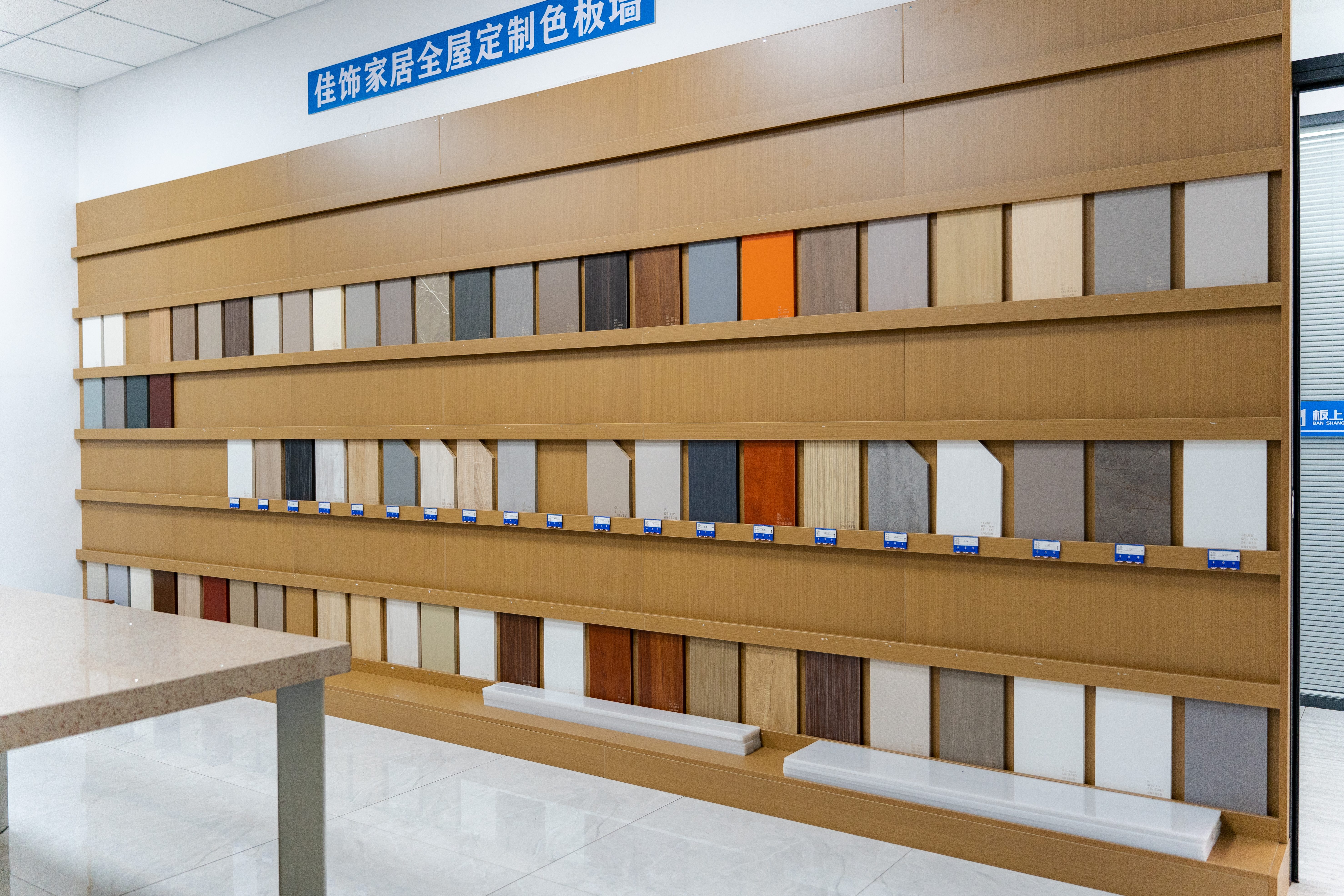
Four surface finish families are documented for the range: wood grain, matte, lacquer and stone texture finishes. The material list behind those finishes is cabinet panels, engineered wood boards, MDF/particle board, aluminium accessories and stone countertops — which means finish selection and countertop selection can be resolved within one supplier rather than split across a cabinetry vendor and a separate stone fabricator.
Countertop material has become a bigger part of the specification conversation. Industry reporting on the U.S. countertop market identifies sintered stone and porcelain surfaces as a growth area in high-end cabinetry, driven by their non-porous surface and bacterial resistance properties (ResearchAndMarkets / Business Wire). For buyers, the practical question is whether the cabinetry supplier can deliver storage cabinets with sintered stone countertops within the same package, or whether that becomes a separate coordination line with its own lead time and its own tolerance mismatch.
E0/ENF checks: the document set that decides customs and client sign-off
Formaldehyde compliance is the specification item most likely to halt a shipment or a project handover, because it is enforced by regulators rather than by the client alone. The manufacturer's published compliance position is that its wood panels meet European E0/FSC requirements and CARB Phase 2 / EPA TSCA Title VI requirements, with full mill test reports and material compliance certificates provided before mass production. Its quality and environmental management systems are certified to ISO 9001 (achieved in 2003) and ISO 14001 (achieved in 2017). For reference, the public benchmark for CARB Phase 2 limits formaldehyde emissions in cabinetry materials to 0.05 ppm.
The documentation workflow that makes those claims verifiable has four stages, and buyers should map their own purchase orders against them:
- Market mapping. European and Middle Eastern projects typically require E0/E1 formaldehyde emission certificates and FSC (Forest Stewardship Council) sustainable forestry documentation. North American projects require CARB Phase 2 and EPA TSCA Title VI compliance certificates.
- Standard documentation package. Third-party testing reports from laboratories such as SGS, TÜV or Intertek, compiled into a standardised file, plus mill test report templates covering wood panel density, moisture content, bending strength and emission ratings.
- Sampling stage. A physical material data sheet and eco-label summary enclosed with the sample package.
- Pre-production and shipping. Scanned raw material test reports for the specific production batch, signed off before mass manufacturing, and the official mill test report and material compliance certificates attached to shipping documents for customs clearance.
Boundary condition — reading “E0/ENF” correctly: ENF is an additional emission grade tier that appears in some tender documents and market specifications, alongside E0. Grade terminology and test methods are not identical across markets, so a supplier's generic certificate may not support a specific ENF-grade claim for a specific board. The procurement rule is to state the target grade together with the reference standard and the test method in the enquiry, and then require the underlying test report for the board actually being supplied. Legal exposure is real: North American and European customs authorities enforce EPA TSCA Title VI and FSC Chain of Custody standards, and non-compliant labelling can lead to shipment seizure or heavy fines.
One further distinction belongs in the specification document. Emission certificates do not cover structural performance. Where a project also requires a performance benchmark, ANSI/KCMA A161.1 requires wall cabinets to withstand a 600-pound load test and 25,000 door and drawer cycles. Structural and emissions compliance should be tracked as two separate documentation lines, because a supplier can satisfy one without satisfying the other.
Matching the model range to project types
The documented range runs from JS-CUSTOM-001 to JS-CUSTOM-010, covering sideboard/buffet units, kitchen cabinets, storage cabinets, TV cabinets, entryway cabinets, study room cabinets, tatami storage beds, bathroom vanity cabinets, wardrobe closets and master bedroom full sets. Every model in the range is intended for residential interior design, real estate development, hotel and apartment industries.
| Model | Cabinet type | Where it typically fits |
|---|---|---|
| JS-CUSTOM-004 | TV cabinets | Living areas in residential, apartment and hotel projects |
| JS-CUSTOM-005 | Entryway cabinets | Hallway and entry storage where wall runs are irregular |
| JS-CUSTOM-006 | Study room cabinets | Home office and work-zone storage |
| JS-CUSTOM-007 | Tatami storage bed | Compact bedrooms where floor area has to work twice |
| JS-CUSTOM-008 | Bathroom vanity cabinets | Residential bathrooms, hotel room bathrooms, apartment units |
| JS-CUSTOM-009 | Wardrobe closets | Bedroom and dressing storage, including high-capacity wardrobe storage systems |
| JS-CUSTOM-010 | Master bedroom full sets | Full-room packages in residential and serviced apartment projects |
All models share the same platform specification: 18 mm standard panel thickness with a 9–25 mm configurable range, ±0.1 mm machining tolerance on German HOMAG automated lines, and wood grain, matte, lacquer or stone texture finishes. Panels for the range are made from engineered wood boards, MDF/particle board, aluminium accessories and stone countertops. Source: manufacturer product documentation.
Custom bathroom vanity cabinets: the item most often flagged in specification review
Bathroom vanity cabinets (JS-CUSTOM-008) are the part of a whole-house package that carries the most mixed requirements: they sit in the wettest room, they are usually constrained on three sides by walls and pipework, and in hotel and apartment projects they are repeated across dozens or hundreds of identical rooms. That combination is why custom bathroom vanity cabinets so often appear as a separate line item rather than as part of a general cabinetry schedule.
The platform specifications are shared with the rest of the range — 18 mm standard panel thickness with a configurable 9–25 mm range, ±0.1 mm machining tolerance on German HOMAG automated lines, and the same four finish families — and the model's material set includes stone countertops, so vanity counters can be specified as part of the same package as kitchen and storage counters. Sintered stone is a common choice in higher-end vanity specifications for the same non-porous reason it is growing in kitchen and countertop applications.
What buyers should settle at drawing-approval stage, rather than at installation, includes:
- Installation type. Whether the unit is wall-hung or floor-standing, since this determines the fixing detail and how the unit is attached to the structure.
- Panel thickness assignment. Which components use the 18 mm baseline and which are specified elsewhere in the 9–25 mm range, rather than assuming one thickness applies throughout.
- Countertop and edge detail. Stone countertops versus sintered stone, including edge profile and cut-out coordination with the basin.
- Storage configuration. Whether the specification calls for integrated mirror storage above the counter and for floating drawer storage below it, because both change the number of components, hardware and adjustments in the quotation.
- Repeatability. In hotel and apartment projects, confirm how identical units will be produced to a single specification; an optimised production process improves material utilisation and product consistency, which is what supports export-order quality across repeated units.
Two procurement notes apply specifically to bathrooms. First, an accurate on-site survey matters more in a bathroom than in a bedroom, because the vanity is usually bounded by fixed walls, tiling lines and pipework with very little tolerance for correction. Second, panel documentation should follow the same E0/FSC and CARB Phase 2 / EPA TSCA Title VI chain as the rest of the package — bathroom panels are not exempt from emissions documentation.

Custom cabinetry versus standard furniture: an honest comparison
The decision between custom cabinetry and standard furniture suppliers is not a quality contest. It is a fit question, and it has a cost structure attached.
| Comparison dimension | Whole-house custom cabinetry | Standard furniture suppliers |
|---|---|---|
| Space fit | Accommodates 100% of on-site irregular spaces | Typically fits about 65% of regular room layouts |
| Spatial compatibility gain | 35% improvement over standard furniture | Baseline |
| Production model | Full-house customisation with factory-direct production and integrated design and manufacturing | Catalogue-based supply |
| Long-term project coordination cost | Lower, because fewer vendors are managed across the package | Higher coordination load across multiple suppliers |
| Process efficiency | Optimised production process improves material utilisation and consistency, supporting export-order quality | Not applicable |
| Project support | Professional project support reduces installation and communication issues | Not applicable |
| Best suited to | Luxury residences, apartments, hotels and commercial interiors | Standard-size rooms where speed and catalogue availability matter more than fit |
Where custom cabinetry is the wrong choice. Custom production is drawing-driven: it cannot begin until the on-site survey is complete and drawings are approved, and inaccurate survey data is one of the documented triggers of dimensional risk in custom manufacturing, alongside frequent material batch switching, tight project lead times and capacity scheduling pressure. A buyer working to a very short deadline on regular, standard-dimension rooms may find that catalogue furniture is faster and simpler. Custom cabinetry earns its coordination cost when spaces are irregular, when several rooms must share one design language, or when repeated units in an apartment or hotel project must be produced to a single controlled specification — not when a single standard-size room simply needs storage.
A second limit sits in the tolerance conversation. The ±0.1 mm figure applies to machining; installed fit depends on the site. Buyers who write only “millimetre precision” into a purchase order without distinguishing machining tolerance from installation tolerance leave themselves without a contractual basis if on-site adjustment is later needed.
Trend signals worth tracking into 2027
Three signals are relevant to buyers currently building a custom cabinetry schedule.
- Volume is shifting toward the custom segment. The custom kitchen cabinet segment was valued at USD 68.5 billion in 2025 with a projected path to USD 95.2 billion by 2034 (Dataintelo), inside a total cabinet market projected at USD 148.09 billion by 2026 (Mordor Intelligence). Buyers should note the methodology difference between the two forecasts rather than treating either CAGR as fixed.
- Export supply depth remains substantial. China's exports of wooden kitchen furniture (HS 940340) reached USD 732 million in 2023 according to UN Comtrade data aggregated by TrendEconomy, which indicates a deep and competitive supplier base — and therefore a market in which documentation quality, not price alone, becomes the differentiator.
- Countertop materials are consolidating into the cabinetry package. Sintered stone and porcelain surfaces are growing in high-end cabinetry on non-porous and bacterial-resistance grounds, which raises the value of suppliers who can deliver storage cabinets with sintered stone countertops rather than handing the countertop back to a separate fabricator.
Running underneath all three is an enforcement trend: emissions and chain-of-custody documentation is being checked at the border, not only at the showroom. That is a structural change in how custom cabinetry is bought, and it favours buyers who standardise their specification document early.
Future outlook
Over the next procurement cycle, the expectation is that specification discipline tightens rather than relaxes. Tolerance figures will increasingly be written into purchase orders and distinguished from installation tolerances; emissions requests will increasingly name a grade, a standard and a test method rather than a general environmental claim; and countertop materials will increasingly be specified inside the cabinetry package to avoid tolerance mismatches between two vendors.
For manufacturers, the practical competitive gap is documentation. A factory-direct supplier with a defined product platform, a documented tolerance and a batch-level compliance workflow is easier to qualify than a supplier whose specifications have to be re-established for every order. For buyers, the sensible preparation is a single specification template that captures thickness, tolerance, finish, material composition and compliance documentation — and that can be applied consistently across kitchens, wardrobes, vanities and storage units in the same project.
FAQ
What panel thickness should be specified for whole-house custom cabinetry?
The documented platform standard is 18 mm, with a configurable range from 9 mm to 25 mm. Buyers are not restricted to a single thickness per project: the thickness assigned to each component is confirmed at drawing-approval stage, so a package can combine different panel thicknesses for different roles. When comparing quotations, check that both a baseline thickness and a configurable range are stated.
How should a buyer interpret a ±0.1 mm machining tolerance claim?
It describes panel machining precision — the accuracy achieved in automated processing on German HOMAG production lines — and it governs how consistently hinge and runner positions, door reveals and panel-to-panel joints are reproduced across units. It is not an installed tolerance. Final fit depends on the accuracy of the on-site survey, wall and floor condition, and assembly quality, so the two figures should be contracted separately.
Which compliance documents should be requested for an E0/ENF formaldehyde requirement?
Requests should be mapped to the destination market first: European and Middle Eastern projects typically require E0/E1 formaldehyde emission certificates plus FSC documentation, while North American projects require CARB Phase 2 and EPA TSCA Title VI certificates. The public CARB Phase 2 limit for formaldehyde emissions in cabinetry materials is 0.05 ppm. Supporting documents normally include third-party test reports (for example SGS, TÜV or Intertek), mill test reports covering wood panel density, moisture content, bending strength and emission ratings, a material data sheet with the sample package, and batch-specific test reports signed off before mass production. Where a tender specifies an ENF grade, the enquiry should state the grade together with the reference standard and test method, and the supplier should provide the underlying test report for the board being supplied. Emissions documentation is separate from structural performance — ANSI/KCMA A161.1, for example, addresses a 600-pound wall cabinet load test and 25,000 door and drawer cycles.
How do custom bathroom vanity cabinets differ from kitchen cabinets in procurement terms?
Bathroom vanity cabinets (JS-CUSTOM-008) share the same platform specification as the rest of the range — 18 mm standard panel thickness with a 9–25 mm configurable range, ±0.1 mm machining tolerance on German HOMAG automated lines, and wood grain, matte, lacquer or stone texture finishes — and the material set includes stone countertops. The differences are commercial and spatial rather than structural: whether the unit is wall-hung or floor-standing, whether integrated mirror storage and floating drawer storage are required, which countertop material is specified, and how identical units will be reproduced across repeated hotel or apartment bathrooms. Because vanities are usually bounded by fixed walls, tiling lines and pipework, survey accuracy carries more weight than it does in a bedroom wardrobe.
When is standard furniture a better choice than custom cabinetry?
Standard furniture typically fits about 65% of regular room layouts, while full-house custom cabinetry accommodates 100% of on-site irregular spaces — a 35% improvement in spatial compatibility. Where rooms are regular in dimension, volumes are low and lead time is the binding constraint, catalogue furniture can be the simpler route. Custom cabinetry becomes the better choice when spaces are irregular, when several rooms must share one design language, or when repeated units across an apartment or hotel project need to be produced to a single controlled specification.
What must be settled before production can start on a custom cabinetry order?
At minimum: an accurate on-site survey, approved drawings with per-component panel thickness assignments, a confirmed finish and countertop specification, and signed-off compliance documentation for the production batch. Custom manufacturing risk is documented as highest when on-site survey data is inaccurate, material batches are switched frequently, project lead times are tight or production capacity is poorly scheduled — all of which are avoidable through an early, stable specification rather than through pressure on the factory at the end of a project.
Reference resource: Nantong Jiashi Integrated Home Co., Ltd. publishes a downloadable engineering handbook covering its whole-house custom cabinetry range, materials and project documentation standards: engineering handbook (PDF).