
Whole-House Custom Cabinetry Models JS-CUSTOM-004 to 010 Compared
Whole-House Custom Cabinetry Models JS-CUSTOM-004 to 010 Compared
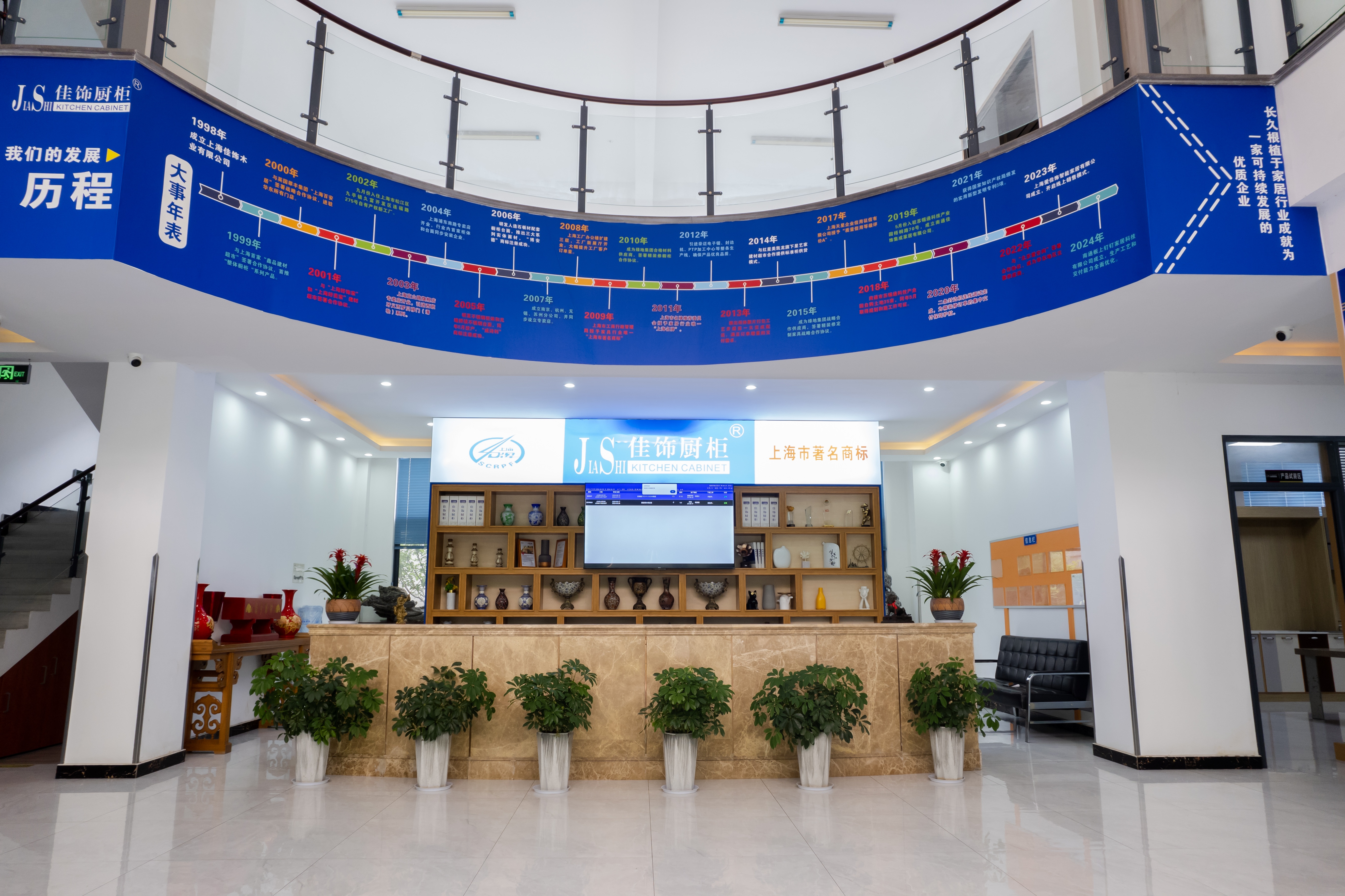
Cover image: production base of the whole-house cabinetry manufacturer. Source: Nantong Jiashi Integrated Home Co., Ltd.
Whole-house custom cabinetry is normally purchased as a package and evaluated as a list of model numbers. That mismatch is where most evaluation errors start. Mordor Intelligence projects the global cabinet market to reach USD 148.09 billion by 2026, and Dataintelo values the custom kitchen cabinet segment at USD 68.5 billion in 2025 with a projected path to USD 95.2 billion by 2034. In a market of that scale, a buyer can easily receive seven or more cabinet models in a single quotation and be expected to judge them without a shared comparison frame.
This article builds that frame for models JS-CUSTOM-004 through JS-CUSTOM-010, part of the whole-house custom cabinetry range produced by Nantong Jiashi Integrated Home Co., Ltd. — a cabinetry manufacturer established in 1998 and based in Jiangsu, China, supplying kitchens, bathroom vanities, wardrobes and home storage systems to residential and commercial projects in Europe, North America, the Middle East and Asia. The comparison is deliberately limited to what the manufacturer publishes about models 004 to 010, and it separates the specifications those models share from the ones that genuinely change between them. Where a dimension is not published, this article says so rather than filling the gap.
Why model numbers are a weak basis for comparing whole-house cabinetry
Inside a single manufacturer's whole-house programme, model numbers usually behave like room labels rather than quality tiers. That is the case here. JS-CUSTOM-004 is classified as TV cabinets, JS-CUSTOM-008 as bathroom vanity cabinets, and JS-CUSTOM-007 as a Tatami storage bed. These three products do not differ because one is a higher grade of engineering than another; they differ because each occupies a different position in a home, and each position imposes different structural, loading and surface requirements.
A buyer who reads JS-CUSTOM-010 as "better" than JS-CUSTOM-004 will over-specify one room and under-specify another. The first useful question is not which model in the range is strongest, but which classification the project actually requires — and then which material, thickness and finish decisions that classification forces.
There is a second, more subtle issue. Whole-house cabinetry is bought as a coordinated set: a TV wall, an entryway run, a wardrobe and a vanity usually share panels, edge profiles and finish selections so that the finished interior reads as one design. That coordination is a genuine advantage of a single-source range, but it also means a comparison at model level can miss the variables that actually determine project outcome — batch consistency, edge banding quality, hardware schedule and the accuracy of the site survey that the drawing set is based on.
The JS-CUSTOM-004 to 010 range at a glance
The seven models in this comparison are differentiated at the classification level, not the specification level. The table below shows what each one is designed to do.
| Model | Classification | Primary room role |
|---|---|---|
| JS-CUSTOM-004 | TV Cabinets | Living room media wall |
| JS-CUSTOM-005 | Entryway Cabinets | Entrance and circulation zone |
| JS-CUSTOM-006 | Study Room Cabinets | Home office and study |
| JS-CUSTOM-007 | Tatami Storage Bed | Compact or multi-function bedroom |
| JS-CUSTOM-008 | Bathroom Vanity Cabinets | Bathroom and en-suite wet zone |
| JS-CUSTOM-009 | Wardrobe Closets | Bedroom wardrobe run |
| JS-CUSTOM-010 | Master Bedroom Full Sets | Coordinated master bedroom package |
For completeness of the family, the manufacturer's wider numbering also covers JS-CUSTOM-001 (sideboard / buffet cabinet), JS-CUSTOM-002 (custom kitchen cabinets) and JS-CUSTOM-003 (storage cabinets). Those three sit outside the scope of this comparison.
What all seven models share: the published technical platform
The most important finding of this comparison is a negative one. Between JS-CUSTOM-004 and JS-CUSTOM-010, the published panel, tolerance, finish and material specifications are identical. Differentiation sits entirely in classification and intended room role.
| Parameter | Published specification |
|---|---|
| Panel thickness | Standard 18 mm; customizable range 9–25 mm |
| Production technology | Automated processing on a German HOMAG production line |
| Machining precision | Dimensional tolerance ±0.1 mm |
| Surface finishes | Wood grain, matte, lacquer, stone texture finishes |
| Material set | Cabinet panels, engineered wood boards, MDF/particle board, aluminum accessories, stone countertops |
| Scope | Residential and commercial custom interior projects |
| Intended industries | Residential interior design, real estate development, hotels, apartments |
Why ±0.1 mm tolerance is a procurement fact, not a marketing claim
A published dimensional tolerance of ±0.1 mm across panels is useful to a buyer for three practical reasons. It supports long uninterrupted cabinet runs where cumulative panel variation would otherwise open visible joints. It improves the consistency of repeated units — relevant when a developer fits the same wardrobe classification across dozens of apartments. And it reduces on-site rework when doors and drawer fronts are produced as a set rather than individually adjusted.
The boundary matters just as much: machining tolerance does not correct for an inaccurate site survey. A ±0.1 mm panel is still the wrong panel if the wall it meets was measured incorrectly. Buyers should treat tolerance and survey accuracy as two separate line items, not one combined promise.
Where the seven models genuinely differ
Because the underlying platform is shared, the differences a buyer needs to evaluate are functional. The following sections describe what each classification implies and what should be confirmed at project level.
JS-CUSTOM-004 — TV Cabinets
Classified for the living room media wall, where a cabinet combines display storage, closed storage and an equipment zone. The evaluation questions here concern the mounting method, the internal partitioning of the equipment compartment, cable routing provisions and whether the run is continuous or broken into modules. These are project-level design decisions; the published range specification defines panel thickness and finish options rather than a fixed internal layout.
JS-CUSTOM-005 — Entryway Cabinets
Entryway cabinetry works in the highest-traffic, tightest-depth zone of a home. The classification implies storage for outerwear and footwear plus a bench or transition surface, but the decisive constraint is usually the available corridor depth and how the doors open into circulation space. Buyers should confirm the opening direction and the finished depth against the actual hallway dimension before approving any drawing.
JS-CUSTOM-006 — Study Room Cabinets
Study room cabinetry carries the widest span and load variation in a residential package, because shelving and desk surfaces are long and often unsupported over their full length. The shared 9–25 mm thickness range is where this model's specification is actually decided: thin panels suit vertical dividers and back panels, while long horizontal shelves require a specification conversation. Buyers should request the structural reasoning for each span rather than accept a default.
JS-CUSTOM-007 — Tatami Storage Bed
This is the one model in the 004–010 range where cabinetry and furniture function merge: a sleeping platform sits above a storage volume. That combination makes hardware and platform loading the central evaluation topics. Because per-model load ratings are not part of the published range specification, this is a case where the buyer should request documentation specific to the project rather than infer performance from the model number.
JS-CUSTOM-008 — Bathroom Vanity Cabinets
Bathroom vanity cabinets are the most moisture-exposed units in the range and typically integrate with stone countertops. For this classification, edge sealing, panel material selection for wet zones and the interface between cabinet carcass and countertop carry more weight than surface appearance. Buyers in export markets should also confirm that the panel grades selected for bathroom use match the emission and moisture documentation required in the destination market.
JS-CUSTOM-009 — Wardrobe Closets
Wardrobe closets are evaluated on capacity per linear metre and on internal configuration rather than on exterior finish. For developers, this is the highest-repeat model in a residential package, which makes batch consistency — identical internal layouts across identical apartments — more valuable than any single-unit refinement.
JS-CUSTOM-010 — Master Bedroom Full Sets
The master bedroom package is the only model in the range defined by coordination rather than by a single cabinet type: it consolidates multiple bedroom units into one specification. Its evaluation criterion is dimension-chain accuracy — whether the wardrobe, bedside and dresser units resolve cleanly against the same wall and floor lines. Buyers should ask for the coordinated elevation set, not the individual unit drawings.
Materials, finishes and the stone countertop question
The published material set for the range covers cabinet panels, engineered wood boards, MDF/particle board, aluminum accessories and stone countertops. Finish options across all seven models are wood grain, matte, lacquer and stone texture.
Countertop material is worth separate attention. Industry reporting on the United States countertop market identifies sintered stone and porcelain surfaces as a growing choice in high-end cabinetry, driven by their non-porous character and bacterial resistance. For a buyer comparing whole-house packages, that trend translates into a specific question: whether the countertop specified for the bathroom and kitchen units is a genuinely non-porous surface or a coated alternative. The answer changes both maintenance expectations and the documentation the supplier should provide.
Aluminum accessories appearing in the material set are relevant to wet zones and to high-wear internal fittings. Buyers should confirm which components in a given unit are aluminum rather than panel-based, since this determines how that unit should be cleaned and maintained over its service life.
Compliance and verification: what to request before approving production
Compliance documentation is where a model comparison becomes a procurement decision. Nantong Jiashi Integrated Home Co., Ltd. holds ISO 9001:2015 Quality Management System certification, certificate number 00123Q37740R1M/3100, issued by CHINA QUALITY CERTIFICATION CENTRE on 27 September 2023 with an expiry date of 20 September 2026. The certified scope covers design, manufacture and maintenance service of cabinet, unitary cabinet and household products. Buyers should verify current certificate validity at the time of order rather than relying on a document supplied earlier in the sales process.

ISO 9001:2015 quality management system certificate, scope: design, manufacture and maintenance service of cabinet, unitary cabinet and household products.
On panel compliance, the manufacturer's compliance workflow maps documentation to the destination market. For European and Middle Eastern projects, the relevant documents are E0 formaldehyde emission certificates together with FSC sustainable forestry documentation. For North American projects, the focus shifts to CARB Phase 2 and EPA TSCA Title VI compliance certificates. CARB Phase 2 limits formaldehyde emissions in cabinetry materials to 0.05 ppm — a fixed regulatory threshold that applies regardless of which of the seven models is specified.
For buyers who need a US performance benchmark rather than an emission limit, ANSI/KCMA A161.1 requires wall cabinets to withstand a 600-pound load test and 25,000 door and drawer cycles. That standard is not claimed automatically by any supplier; it is a reference point against which buyers can ask what evidence exists for a comparable test regime.
The practical verification sequence the manufacturer describes has three steps. Compliance requirements are mapped to the target market first. Standard documentation packages are then prepared, including third-party testing reports from laboratories such as SGS, TÜV or Intertek, plus mill test report templates covering panel density, moisture content, bending strength and emission ratings. Finally, compliance is embedded into the sales workflow: material data sheets travel with samples, scanned raw material test reports for the specific production batch are sent for customer sign-off before mass manufacturing, and the official mill test report and material compliance certificates are attached to shipping documents for customs clearance.
Manufacturing capacity, lead time and the limits of custom production
Capacity determines whether a comparison is theoretical or deliverable. The manufacturer's own production data records a 36,000 m² site at No. 2888 Hongmei South Road with 24,000 m² of built-up area, and a later facility in Nantong, Jiangsu Province, spanning over 20,000 m² and equipped with machinery from HOMAG (Germany) and Excitech. Stated monthly capacity for the range is 500–20,000 units, with a production lead time of 30–45 days and a project-based MOQ. Customization covers cabinet design, dimensions, materials, colors, finishes, hardware configuration, logo and packaging, under OEM, ODM or project customization arrangements. Quality control is organized in three stages: material inspection, production inspection and final quality inspection.

Automated panel processing environment at the manufacturer's production base. Source: Nantong Jiashi Integrated Home Co., Ltd.
Comparison with modular and traditional off-the-shelf cabinetry
Custom whole-house cabinetry is not automatically the right answer for every project, and the limitations are worth stating plainly.
- Lead time. A 30–45 day production lead time is a manufacturing figure, not a site-ready date. Ocean freight, customs clearance and installation add further time. Projects that need cabinetry within weeks are better served by stock or modular units.
- Reversibility. Modular pre-engineered cabinets can be replaced unit by unit. Custom runs are dimension-coupled: replacing one section years later may require re-fabrication rather than a catalogue order.
- Minimum order. A project-based MOQ makes single-room retrofits and small sample orders commercially awkward, even though sampling itself is supported.
- Survey dependency. The ±0.1 mm machining tolerance does not compensate for an inaccurate site survey. On projects where as-built dimensions are unreliable, a tolerance-centred specification delivers less than it appears to.
- Model-tier expectation. Because JS-CUSTOM-004 to 010 share an identical published panel and finish specification, buyers should not assume that JS-CUSTOM-010 is a higher-performance build than JS-CUSTOM-004. Real performance differences come from material and thickness decisions made at project level.
Against traditional site-built joinery, the trade-off runs the other way. Factory production on an automated line gives repeatability and a documented tolerance, but it removes the on-site improvisation that local carpenters use to absorb irregular walls. That trade is normally worth making in multi-unit projects and less clear-cut in single-room renovation of older buildings.
Application fit: which model to evaluate first in a project
The manufacturer lists the range as intended for residential interior design, real estate development, hotels and apartments, and reports that it has been used by real estate developers, interior design companies and commercial contractors for residential and commercial interior furnishing. In one referenced case type, large-scale supply covered 50 or more residential units, delivered with a stated service life expectation of 10–15 years and a highlight of millimeter-level precision, customized design and German HOMAG production technology.
| Project requirement | Model to evaluate first | Basis |
|---|---|---|
| Living area with a full media wall | JS-CUSTOM-004 | Classified as TV cabinets for media walls |
| Entrance or corridor with limited depth | JS-CUSTOM-005 | Classified as entryway cabinets for circulation zones |
| Home office with shelving and desk surfaces | JS-CUSTOM-006 | Classified as study room cabinets |
| Compact bedroom or guest room | JS-CUSTOM-007 | Classified as Tatami storage bed, combining platform and storage volume |
| Bathroom or en-suite vanity | JS-CUSTOM-008 | Classified as bathroom vanity cabinets for wet zones |
| High-capacity bedroom wardrobe | JS-CUSTOM-009 | Classified as wardrobe closets |
| Coordinated master suite package | JS-CUSTOM-010 | Classified as master bedroom full sets |
This shortlist is a classification mapping, not a performance ranking. It indicates which model in the range is designed for which room function; it does not imply that any model in the range outperforms another.
Market trend analysis: what is changing in cabinetry procurement
Three trends shape how buyers should read a model comparison like this one.
Scale. The global cabinet market is projected at USD 148.09 billion by 2026 (Mordor Intelligence), while the custom kitchen cabinet segment specifically is valued at USD 68.5 billion in 2025 and projected to reach USD 95.2 billion by 2034 (Dataintelo). Forecast methodology varies: Mordor reports a 5.04% CAGR for 2026–2031, while Dataintelo reports 3.8% for 2025–2034. The divergence is a useful reminder that these figures indicate direction and scale, not a precise planning basis.
Export concentration. China's exports of wooden kitchen furniture under HS 940340 reached USD 732 million in 2023 (UN Comtrade data via TrendEconomy). That export base is why documentation quality — batch test reports, mill test reports, chain-of-custody records — has become as commercially decisive as factory capability. Fortune Business Insights market research also identifies Oppein Home Group Inc. among the top global kitchen cabinet companies, confirming that Chinese manufacturers now operate at the centre of this market rather than at its edge.
Material shift. Sintered stone and porcelain countertops are gaining share in high-end cabinetry on the strength of non-porous surfaces and bacterial resistance. For whole-house packages, this shifts part of the specification discussion from cabinet panels to countertop surfaces — and from appearance to cleanability and documentation.
Future outlook
The direction of travel in whole-house cabinetry procurement points away from brochure specifications and toward batch-level evidence. A published panel thickness range and a stated machining tolerance are necessary but no longer sufficient: buyers increasingly ask for the raw material test report attached to the specific production batch, and for the mill test report that travels with the shipping documents.
A second shift is in how models are compared. As ranges like JS-CUSTOM-004 to 010 converge on shared technical platforms, model numbers will increasingly function as room classifications and coordination markers rather than as quality tiers. Evaluation frameworks that treat them as tiers will produce systematically distorted specifications — over-specified media walls and under-specified shelving spans. Buyers who reframe the comparison around classification, thickness selection, material composition and documentation will get closer to the true cost and performance picture.
FAQ
Which whole-house cabinetry model suits which room?
In the JS-CUSTOM-004 to 010 range, classification determines room fit. JS-CUSTOM-004 is TV cabinetry for media walls, JS-CUSTOM-005 is entryway cabinetry for circulation zones, JS-CUSTOM-006 is study room cabinetry, JS-CUSTOM-007 is a Tatami storage bed, JS-CUSTOM-008 is bathroom vanity cabinetry, JS-CUSTOM-009 is wardrobe closets, and JS-CUSTOM-010 is a master bedroom full set. All seven are intended for residential and commercial custom interior projects, and the manufacturer lists residential interior design, real estate development, hotels and apartments as the applicable industries.
How do I compare models when the published specifications are identical?
Where a range shares one platform, comparison has to move to variables that are set per project rather than per model. For JS-CUSTOM-004 to 010, the published parameters — standard 18 mm panels with a 9–25 mm customizable range, ±0.1 mm dimensional tolerance, wood grain, matte, lacquer and stone texture finishes, and a material set of cabinet panels, engineered wood boards, MDF/particle board, aluminum accessories and stone countertops — do not differ by model. Relevant differences therefore come from the room classification, the thickness selected for each span, the material chosen for moisture-exposed units, the internal configuration, the hardware schedule and the compliance documentation for the destination market. Buyers should request these at project level.
What panel thickness should be specified for whole-house cabinetry?
The standard panel thickness for this range is 18 mm, with a customizable range of 9–25 mm. The appropriate value depends on the structural role of each unit: long unsupported horizontal shelves, storage platforms and vertical dividers do not carry the same requirements. Because the range covers the full 9–25 mm span rather than offering a single default, thickness is a specification decision that should be agreed with the manufacturer per unit and documented in the approved drawing set before production begins. Machining accuracy across that range is stated as ±0.1 mm.
What compliance documentation should be requested before production?
Documentation should be mapped to the destination market. For European and Middle Eastern projects, that means E0 formaldehyde emission certificates and FSC sustainable forestry documentation. For North American projects, it means CARB Phase 2 and EPA TSCA Title VI compliance certificates; CARB Phase 2 sets a formaldehyde emission limit of 0.05 ppm for cabinetry materials. Third-party testing reports from laboratories such as SGS, TÜV or Intertek, mill test reports covering panel density, moisture content, bending strength and emission ratings, and material data sheets are also part of the standard package. In the described workflow, scanned raw material test reports for the specific production batch are supplied for customer sign-off before mass manufacturing, and the mill test report and material compliance certificates accompany the shipping documents.
What are the limitations of custom whole-house cabinetry compared with modular options?
Custom cabinetry trades flexibility of replacement and speed for dimensional fit. A 30–45 day production lead time is a manufacturing figure that excludes shipping, customs and installation, so projects requiring cabinetry within weeks are not a good fit. Custom runs are dimension-coupled, meaning a single section cannot easily be replaced later from stock as a modular unit could. A project-based MOQ makes small retrofit orders commercially awkward. Finally, the ±0.1 mm machining tolerance does not compensate for an inaccurate site survey, and because models JS-CUSTOM-004 to 010 share identical published panel, tolerance and finish specifications, no model in the range should be assumed to be a higher-performance build than another on the basis of its number alone.
Reference document: engineering handbook (PDF). Manufacturer information: jajajs.com.