
Who Owns the Interface? Turnkey vs Separate Procurement in Pulp Molding
Independent Industry Reference · Pulp Molding Equipment Procurement
A pulp molding factory is not one purchase. It is a chain of interfaces — between pulp preparation and forming, between forming and trimming, between the machine and the water, vacuum, compressed-air and drainage systems that keep it running. The choice between a turnkey pulp molding solution and separate equipment procurement is therefore less about unit price and more about a single question: who owns those interfaces when the plant starts up?
That question has become more consequential as molded fiber moves from niche production into mainstream packaging supply. Buyers entering the category today are frequently new factories, overseas projects and teams without an experienced pulp molding engineering group — precisely the situations where interface ownership is hardest to absorb internally. This article compares the two procurement models on integration scope, coordination effort, total cost structure and project risk, and identifies where each one genuinely fits.
Two Procurement Models, Defined
A turnkey pulp molding factory solution integrates factory planning, pulp preparation, forming equipment, molds, downstream automation, electrical control, utilities, wastewater treatment, installation, commissioning and personnel training under one project-management system. The buyer signs one project interface and receives a production system, not a list of machines.
Separate equipment procurement means the customer purchases and coordinates equipment, molds, pulping, automation and utilities from multiple suppliers, and carries responsibility for how those systems meet each other.
The two models are not opposites in technology. The same forming machine can be bought inside a turnkey scope or on its own. What changes is where the integration work sits, who is accountable when a parameter crosses a supplier boundary, and how quickly the plant reaches stable qualified output.
Where Fragmented Procurement Quietly Adds Work
Integration cost is real whether or not it appears on a quotation. In a separately procured project, that cost typically surfaces later as engineering hours, interface modification, commissioning coordination and responsibility disputes.
Slurry parameters cross a supplier boundary
Slurry concentration, flow rate, pipeline layout, tank design and white-water circulation determine how a wet preform forms, drains and releases. When pulping and forming are supplied by different companies, the customer must coordinate process parameters, control interfaces and system commissioning between them. The machine may perform exactly as specified and still deliver unstable product weight because the upstream parameters were never designed as one system.
Downstream cycle matching crosses a supplier boundary
If trimming, inspection, stacking or packing equipment has a lower processing capacity than the forming machine, products accumulate downstream and eventually force the main machine to slow down or stop. If downstream equipment runs faster but conveying, positioning and buffering are poorly designed, the line can still suffer misalignment, missed inspections and packing errors. Downstream automation must be designed against the complete line cycle, not against the theoretical speed of an individual unit.
Troubleshooting requires identifying an owner first
With separate suppliers, the customer may need to determine which party is responsible before a system-level problem can be solved at all. With one integrated project team, pulping, forming, molds, automation and utilities can be diagnosed together, because the same engineering group designed the interfaces.
What a Turnkey Scope Can Actually Cover: The 6+1 Module Structure
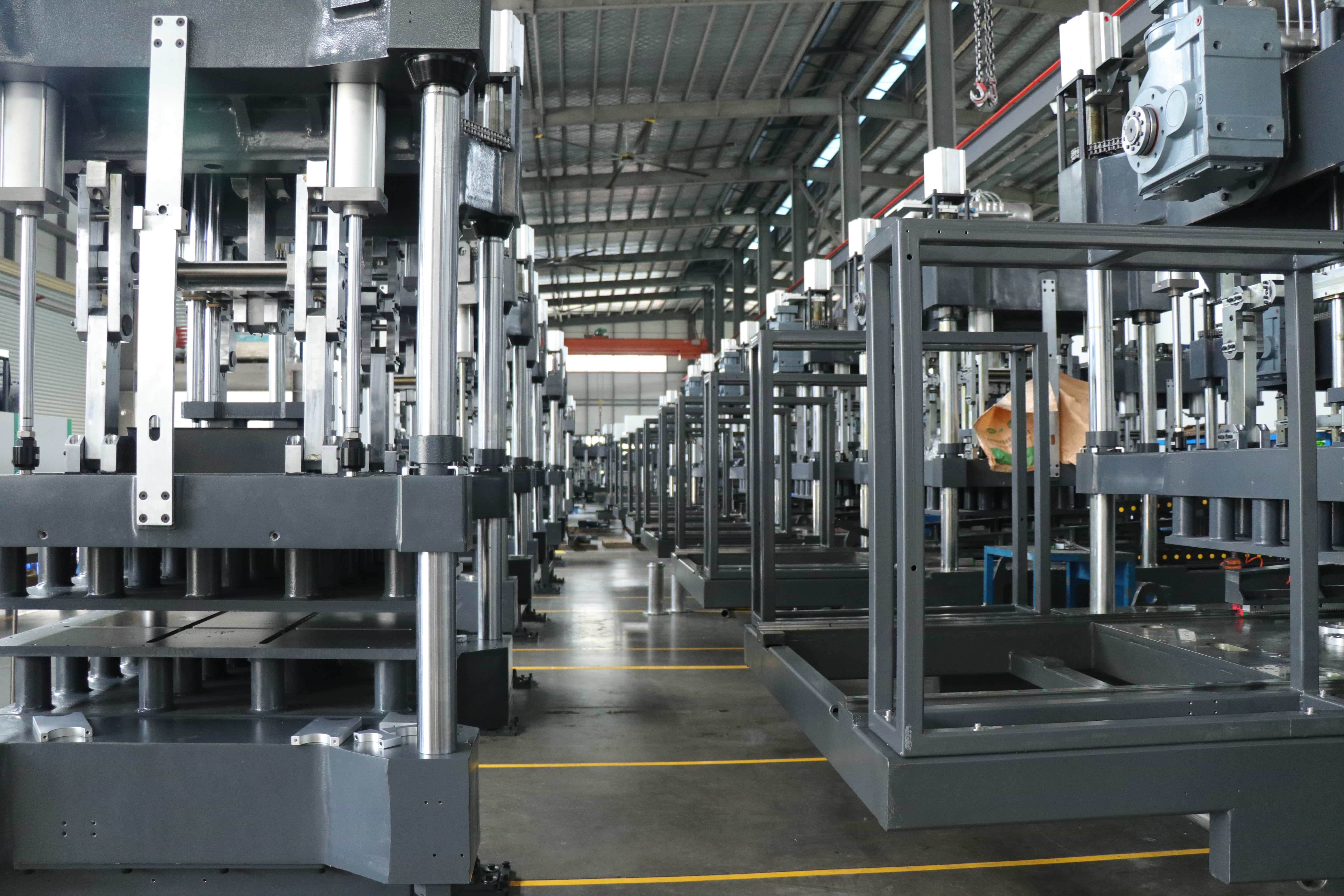
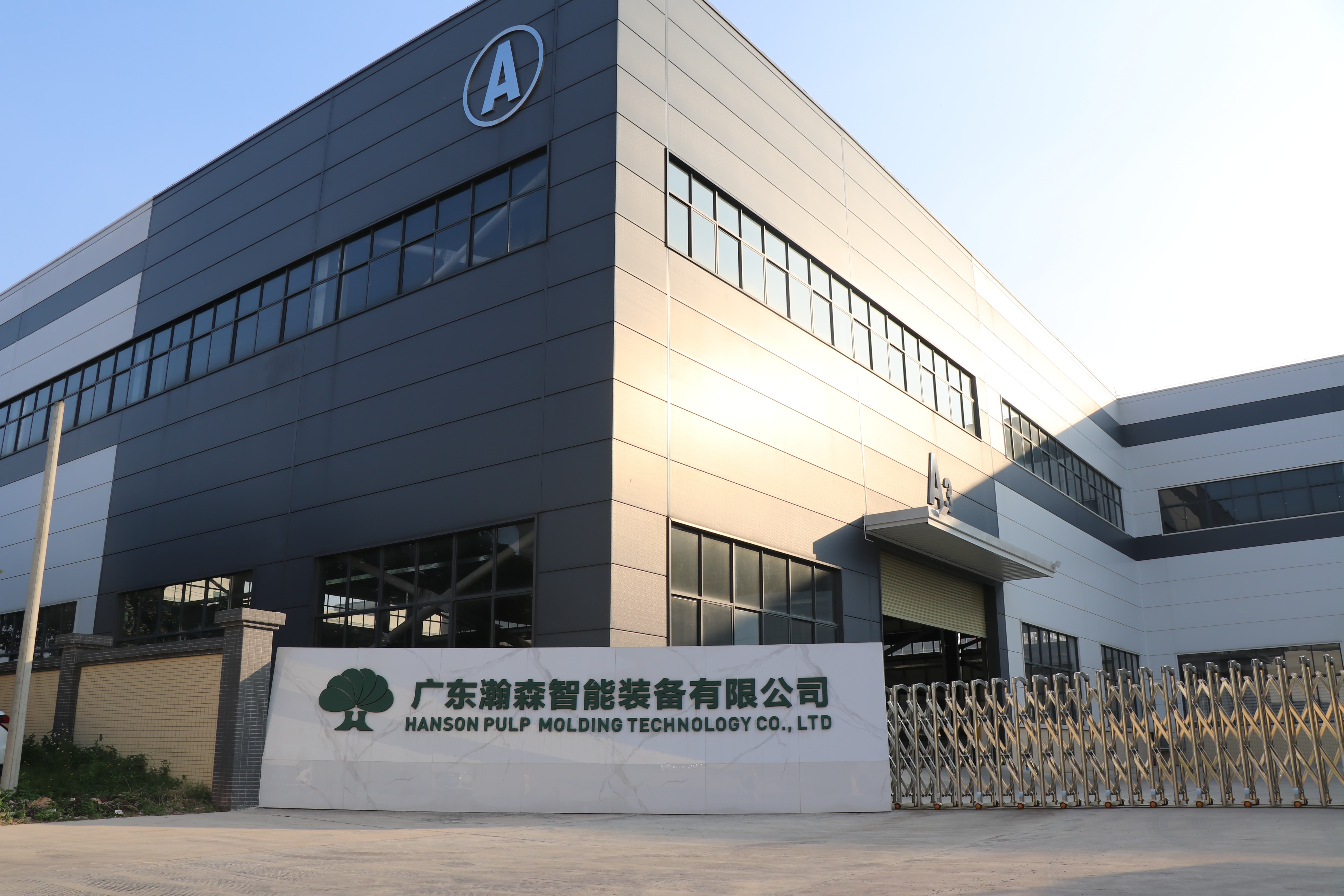
HANSON PULP MOLDING TECHNOLOGY CO., LTD. (Hanson Pulp Molding) is a pulp molding equipment manufacturer based in Houjie Town, Dongguan City, Guangdong Province, China. The company designs and manufactures pulp molding forming equipment, pulp preparation systems and molds, and provides turnkey pulp molding factory solutions including design, installation and training. Its turnkey scope can be organized as six service modules plus one development module under a single integrated project interface.
| Module | Scope | Interface question if bought separately |
|---|---|---|
| 1. Factory planning | Layout, capacity planning and production flow planning | Who confirms that machine footprints, clear height and material flow actually fit the building? |
| 2. Pulp preparation | Pulping, refining, slurry preparation, concentration and flow control, tanks, pipelines, white-water circulation | Who aligns slurry parameters with the forming machine's cycle? |
| 3. Forming equipment | Forming, wet-preform transfer, in-mold drying and hot pressing | Who defines the transfer and drying window that downstream processes depend on? |
| 4. Mold manufacturing | Product evaluation, mold design, machining, assembly, testing and mass-production adaptation | Who settles whether a defect originates in the mold, the machine or the process? |
| 5. Downstream automation | Trimming, hole punching, vision inspection, rejection, stacking, counting and packing | Who balances the line cycle and communication interfaces between stations? |
| 6. Technical and production support | Installation, commissioning, training, resident engineering and ramp-up | Who stays on site until the line reaches stable qualified output? |
| +1. Product and material development | Product development, raw-material development, sampling and small-batch validation | Who validates the product structure before production molds and equipment are committed? |
A modular scope list is useful to buyers as a checklist. A quotation that names six modules but omits wastewater treatment, mold adaptation or ramp-up support is not a smaller turnkey project — it is a separate-procurement project carrying a turnkey label, and it should be evaluated as such.
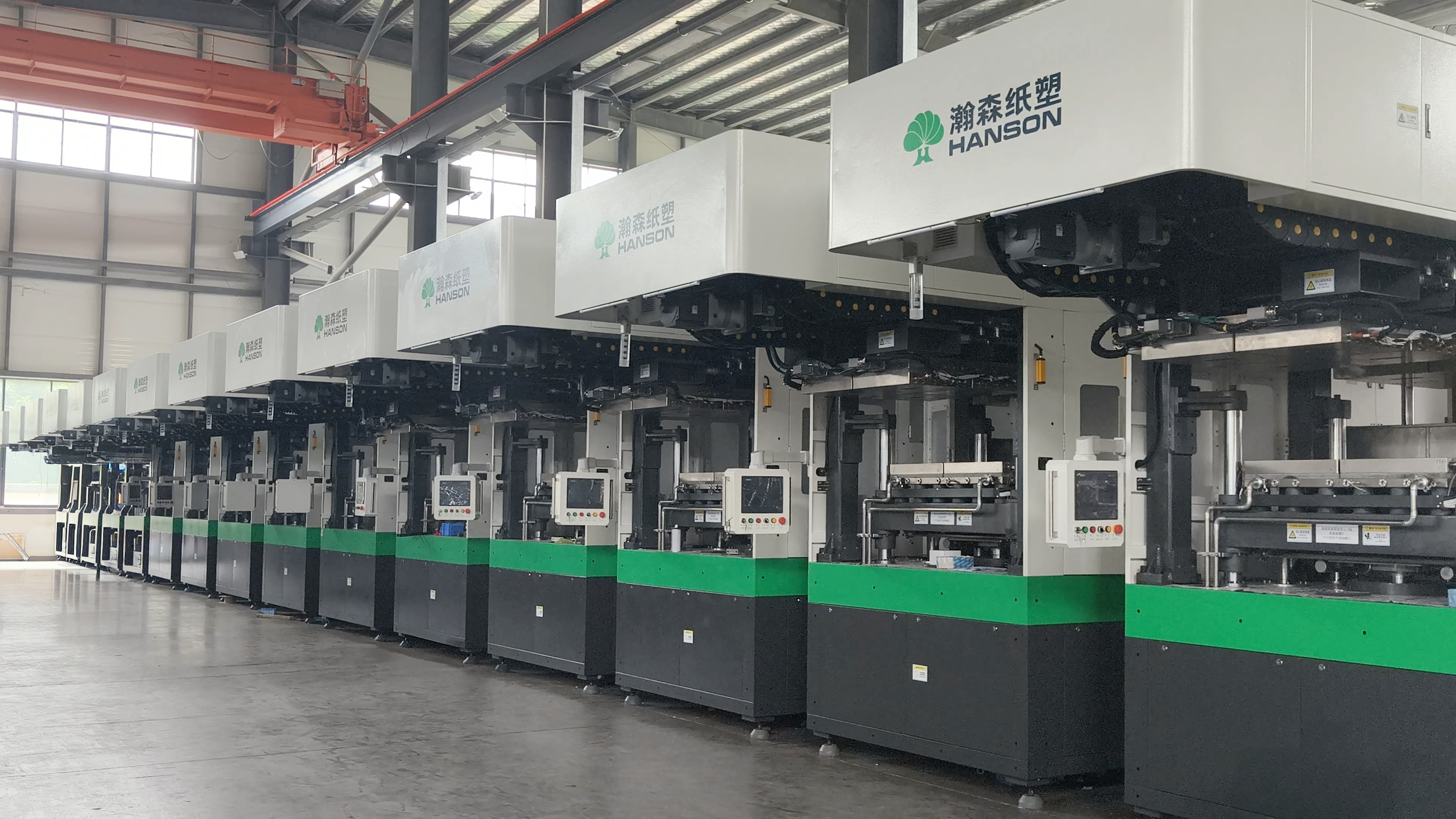
Hanson's supporting capability is concentrated in the engineering functions that sit inside these modules. The company operates an independent mold division with approximately 10 experienced mold designers and access to about 45 CNC machining centers, including coordinated external machining capacity. Its R&D team comprises 50 engineers and technical professionals, and annual production capacity is 150 units of pulp molding equipment. Hanson has served customers including listed companies, state-owned enterprises and leading packaging manufacturers, and has established 10 service locations worldwide, with export business accounting for 50% of total sales.
Technical Explanation: Why Interface Design Shows Up in Cycle Time, Energy and Yield
Integration is not a commercial abstraction. It changes measurable production behaviour.
Pulp preparation and forming as one control problem
In an integrated design, slurry concentration, flow, pipelines, tanks, white-water circulation and machine production rhythm are coordinated by one engineering team. Slurry supply can be matched to the actual forming rhythm through quantitative, continuous or dynamic replenishment, and an internal-circulation design can remove the need for slurry to travel through long external return pipelines — a design with zero external return-slurry loops, compared with one or more return loops in a conventional return-slurry system. Fewer external loops also mean fewer interfaces to clean, inspect and troubleshoot for contamination.
Line balance determines real output, not nameplate output
Reference capacities for Hanson tableware equipment illustrate how configuration, not a single number, defines output: the ZFG-1111 inline full-servo line is referenced at 900–1,200 kg/24 h, the ZBG-1111 modular line at 1,000–1,500 kg/24 h, and the ZCE-1111D hydraulic integrated machine at 600–900 kg/24 h. Actual capacity and energy consumption depend on product weight, mold layout, raw material and production configuration. In a separately procured line, those dependencies are distributed across suppliers, and the buyer becomes the party responsible for reconciling them.
Energy performance is a system outcome
Under comparable product and operating conditions, Hanson's full-servo solution can reduce comprehensive energy consumption by approximately 15%–25% compared with traditional solutions. On a power-plus-drying basis, Hanson's consumption is approximately 2,000–2,300 kWh per ton of finished product against approximately 2,500–2,800 kWh per ton for the benchmark solution — a reduction of roughly 200–800 kWh per ton, or about 19% at the midpoint of the two ranges, depending on product, process and operating conditions.
The procurement implication is more important than the number itself. Vacuum, compressed air, heating, water circulation and production rhythm have to be optimized as one system to reach that band. In a separately purchased plant, each subsystem may perform well on its own while the combined energy profile depends heavily on interface design, control coordination and final commissioning quality.
Turnkey vs Separate Procurement: A Buyer-Side Comparison
| Dimension | Turnkey solution | Separate procurement |
|---|---|---|
| Integration scope | Factory planning, pulp preparation, forming, molds, downstream automation, electrical control, utilities, wastewater, installation, commissioning and training under one project-management system | Equipment, molds, pulping, automation and utilities sourced from multiple suppliers; the buyer assembles the plant |
| Interface ownership | One lead interface across the 6+1 project scopes | Interface definition and parameter alignment sit with the buyer |
| Coordination effort | Reduced multi-supplier coordination; fewer interface modification cycles | Higher coordination load; each interface must be specified, tested and reconciled |
| Cost structure | May carry a higher total contract value, with less repeated engineering, interface modification and delay exposure | Allows line-by-line price comparison, but integration, modification and management costs may arise during implementation |
| Project risk | Interface risk concentrated in one accountable scope | Interface risk distributed, with responsibility boundaries to be established before problems occur |
| Troubleshooting | Pulping, forming, molds, automation and utilities diagnosed together | Responsible party must be identified before a system-level problem can be resolved |
| Best fit | New factories, large-scale projects, overseas projects, buyers without an experienced pulp molding engineering team | Experienced manufacturers with mature pulping, process, engineering and project-management capability |
Application Fit: New Factories, Large Projects and Buyers Without an Engineering Team
Turnkey scope is generally recommended when the customer is building a new pulp molding factory, entering the industry for the first time, developing a project that spans multiple production systems, or requires one team to coordinate all technical interfaces. It is also the more practical route when the project needs factory planning, pulping, forming, molds and downstream automation delivered together, and when installation, training and production ramp-up support are part of the requirement.
The case is strongest for overseas projects and for buyers without an internal engineering department. In those settings, resident on-site engineering covers equipment installation, utility connection, multi-system commissioning, process coordination, trial operation, operator training and project acceptance — activities that a short-term commissioning model typically does not extend into a long production ramp-up period. For turnkey projects, Hanson can provide up to six months of production ramp-up and on-site support, depending on the contract and project requirements. Ramp-up work is process work, not only equipment work: pulp formulation adjustment, forming-parameter optimization, defect analysis, production-rhythm improvement, mold adaptation and operator coaching.
Where the model changes for cup lids and industrial packaging
Product category shifts which interfaces matter most. Plant-fiber cup lid production requires pulp preparation, slurry feeding, forming, hot pressing, servo trimming, vision inspection, defective-product rejection, counting and packing to operate in sequence — a forming machine alone is normally not sufficient for stable commercial lid production. Premium industrial packaging places the emphasis on dimensional accuracy, surface quality, wet-preform transfer, hot-pressing uniformity and yield. In both cases, the number of supplier boundaries the buyer must manage grows quickly, which raises the relative value of a single integration scope.
Market Trend Analysis: Why Integration Scope Is Becoming a Procurement Variable
Three verifiable market signals point in the same direction.
Category growth. According to Cloud Market Reports, the global pulp moulding machines market was valued at USD 2,140.0 million in 2024 and is projected to reach USD 3,760.2 million by 2032, expanding at a CAGR of 7.3% between 2025 and 2032. Published market estimates vary considerably depending on what is included under the pulp molding definition, so buyers should read any single figure as a directional signal rather than an exact addressable market.
Application concentration. The same research attributes approximately 45% of global pulp moulding machine demand to food and beverage packaging, with cups, trays and bowls leading. Concentrated demand in high-volume, high-consistency formats increases the cost of getting line balance wrong, because instability scales with output.
Cross-border delivery. China's exports of machinery for making paper or paperboard (HS 843920) were valued at USD 49.58 million in 2024, according to the World Integrated Trade Solution / World Bank. Equipment increasingly ships to projects where the buyer has no local engineering base and no established service relationship with a pulping or automation supplier.
A fourth signal is regulatory. Safety-related parts of machinery control systems must comply with EN ISO 13849-1, and the 2015 version of the standard will be withdrawn after a transition period ending 15 May 2027. Where a control system is assembled from multiple suppliers, the question of who documents and validates the safety-related functions has to be answered contractually — not discovered during acceptance.
Limitations and Boundaries: When Separate Procurement Is the Better Choice
Turnkey procurement is not universally superior, and treating it as a default would be poor advice.
- Mature internal capability. Experienced manufacturers that already operate a proven pulping system, stable utilities and an established process and project-management team may gain more from supplier-by-supplier price competition than from consolidation.
- Incremental projects. Capacity expansion, replacing a single machine, or adding one production stage to a working plant often does not require factory-level integration work.
- Contract value. A turnkey project may involve a higher total contract value, even where it lowers lifecycle cost, and that has cash-flow and financing implications.
- Schedule risk is not transferred automatically. Actual project duration depends on factory construction, project scale, local utilities, product requirements and customer cooperation. A turnkey contract changes who manages those dependencies; it does not remove them.
- Specialist retention. Buyers with strong relationships to specific component or automation specialists may reasonably keep those suppliers in scope while consolidating only the process-critical interfaces.
In practice, many projects are hybrids. The decision framework should therefore be applied module by module rather than as a single all-or-nothing vote: check where the interfaces are hardest to define, and assign those to a single engineering owner.
Execution: What to Confirm Before the Contract Is Signed
For buyers at the decision-to-execution stage, the comparison above converts into a short list of contractual and technical confirmations.
Scope boundaries in writing. Confirm who is responsible for molds, pulp preparation, utilities, wastewater treatment and downstream automation, and confirm installation, commissioning, training and production ramp-up responsibility as named line items rather than assumptions.
Acceptance criteria. Pre-shipment inspection and a Factory Acceptance Test form the standard acceptance basis. The test process may include equipment appearance and dimensions, mechanical assembly, electrical systems, hydraulic and pneumatic systems, PLC and HMI functions, safety interlocks, no-load operation, functional testing and trial production with pulp where applicable. Customers may participate in the FAT on site or review the results remotely through videos, photographs, test records and online meetings.
Commercial terms. Minimum order quantity is 1 unit or 1 complete production line, depending on product and project scope. EXW, FOB, CIF or other agreed Incoterms can be arranged. Typical payment against T/T is 30% deposit after contract signing, 60% after the Factory Acceptance Test and before shipment, and 10% after installation, commissioning and final acceptance at the customer's site. Detailed payment schedules and acceptance conditions are subject to the signed contract and technical agreement.
Manufacturer verification. Before placing an order, buyers evaluating a turnkey offer should inspect the supplier's manufacturing and assembly facility, confirm in-house mechanical, electrical, process and mold teams, review comparable operating customer projects, define supply scope and responsibility boundaries in writing, and verify the spare-parts and after-sales structure. These steps apply equally to suppliers being considered for a single machine.
Future Outlook
As molded fiber expands from tableware into cup lids, premium industrial packaging and multi-material formats, the number of process interfaces inside a single factory keeps rising: more product categories per plant, more downstream automation, stricter inspection requirements and a control-system safety standard that has already moved to EN ISO 13849-1:2023 with a transition ending on 15 May 2027.
That trajectory favors consolidation of process-critical interfaces rather than consolidation of everything. The likely pattern for the next procurement cycle is deliberate hybrid sourcing: one engineering owner for the interfaces that determine slurry, cycle balance and yield, combined with competitively sourced components where the market is mature and the buyer can specify them independently. Buyers who can articulate where their own engineering capacity ends will get more value from either model than buyers who compare only machine price lists.
FAQ
1. Should a buyer purchase individual pulp molding machines or choose a complete turnkey pulp molding factory solution?
A turnkey solution is generally recommended for new factories, overseas projects and customers without an experienced pulp molding engineering team. Individual machine procurement is more suitable for experienced manufacturers that already operate mature pulp preparation, process, utility and production-management systems. A turnkey scope may include factory planning, pulp preparation, forming equipment, molds, downstream automation, electrical control, energy management, wastewater treatment, installation, commissioning, operator training and production ramp-up support. The relevant selection factors include whether the project is a new factory or an expansion, the customer's existing pulp preparation and utility systems, internal engineering and project-management capability, product category and target capacity, automation requirements, and the number of suppliers the customer can realistically coordinate.
2. Does the equipment supplier design and manufacture its own pulp preparation system, or is it outsourced?
This should be confirmed directly during supplier evaluation, because it determines who can align slurry parameters with the forming machine. Hanson designs, manufactures and integrates pulp preparation systems for pulp molding projects. Depending on the project, the system may include raw-material preparation, pulping, refining, slurry preparation, pulp concentration control, flow control, pulp tanks, pipelines, slurry feeding and white-water circulation. For turnkey projects, pulp preparation, slurry feeding, forming equipment, molds, utilities and control systems can be planned and commissioned by one engineering team. Hanson can also evaluate and connect forming equipment to a customer's existing pulp preparation system, provided the customer supplies the process flow, pulp concentration, flow rate, tank capacity, pipeline interfaces and control information for technical evaluation.
3. How can a buyer verify whether a supplier is a real pulp molding machine manufacturer rather than a trading company?
Verification is largely procedural. Buyers should inspect the supplier's manufacturing and assembly facility, confirm whether the supplier has its own mechanical, electrical, process and mold teams, review similar customer projects with operating equipment, define the supply scope and responsibility boundaries in writing, confirm who is responsible for molds, pulp preparation, utilities and downstream automation, require factory acceptance testing before shipment, confirm installation, commissioning, training and production ramp-up services, and verify the spare-parts and after-sales support system. The main risk in this category is selecting a supplier that can sell the main machine but holds no manufacturing, mold, process or system-integration capability of its own. Where equipment, molds, pulp preparation and automation come from several unrelated companies, technical interfaces and responsibility boundaries become unclear, and production problems may require the customer to coordinate several suppliers before the cause can be identified.
4. What problems can occur when the downstream automation cycle does not match the pulp molding forming machine?
If trimming, inspection, stacking or packing equipment has a lower processing capacity than the main machine, products accumulate downstream and eventually force the main machine to slow down or stop. If downstream equipment runs faster but conveying, positioning and buffering are poorly designed, the line may still experience misalignment, collisions, missed or repeated inspections, incorrect stack quantities, packing jams, product deformation during conveying, defective products mixing with qualified products, and machine communication or interlock failures. The typical triggers are purchasing downstream equipment by standalone speed without a complete line calculation, ignoring actual product spacing and conveying time, mold changes altering products per cycle, absence of buffer conveyors, incompatible interfaces between machines from different suppliers, and testing only under no-load conditions. Mitigation includes balancing the complete line against maximum target output, calculating products per mold and per minute, including conveying, positioning, inspection, rejection, stacking and packing time in the calculation, adding buffering between critical processes, standardizing communication interfaces, and testing continuously with actual products.
5. What are the typical purchasing terms and acceptance criteria for pulp molding equipment?
Minimum order quantity is 1 unit or 1 complete production line, depending on the product and project scope. Delivery terms may be EXW, FOB, CIF or other agreed Incoterms, arranged according to destination and the signed contract, with equipment packed for export and delivered by sea, land or multimodal transport. Acceptance is normally based on pre-shipment inspection and a Factory Acceptance Test covering equipment appearance and dimensions, mechanical assembly, electrical systems, hydraulic and pneumatic systems, PLC and HMI functions, safety interlocks, no-load operation, functional testing and trial production with pulp where applicable. The customer may attend the FAT on site or review results remotely through videos, photographs, test records and online meetings. Standard payment against T/T is 30% deposit after contract signing, 60% after the Factory Acceptance Test and before shipment, and 10% after installation, commissioning and final acceptance at the customer's site. Detailed payment schedules and acceptance conditions are subject to the signed contract and technical agreement.
Summary
Turnkey and separate procurement are two ways of distributing the same integration work. Separate procurement prices each machine individually and places interface ownership with the buyer; a turnkey scope prices the system and places interface ownership with one engineering team. Neither is automatically cheaper. The decision should follow engineering capacity: where the buyer can define, test and reconcile interfaces internally, supplier-by-supplier competition is a legitimate advantage; where the buyer cannot, the interfaces will be reconciled anyway — later, less efficiently, and usually during commissioning.
For a consolidated view of Hanson's equipment portfolio, turnkey module scope, mold division and service network, the company brochure is available for download: Hanson Pulp Molding company brochure (PDF).
¿Tiene preguntas o necesita más detalles?
Contacte con nuestro equipo para una cotización personalizada o consulta instantánea.
Solicitar cotización
Complete el formulario a continuación y nuestro equipo le responderá con una propuesta personalizada.
Chat directo de WhatsApp
¿Prefiere chatear en tiempo real? Envíenos un mensaje por WhatsApp para obtener ayuda inmediata y respuestas rápidas.
- Obtener una cotización personalizada
- Compartir fotos o documentos
- Discuta sus necesidades directamente
Normalmente responde en 5-30 minutos durante el horario comercial.