
Who Issues High-Quality Ball Valve Certificates: API 607, ISO 15848-1, PED CE
Ball valve qualification is a question of provenance. A certificate only becomes usable evidence when the buyer knows three things: which organization issued it, which product scope it actually covers, and which markets accept it. For high-quality ball valves, three documents most often decide whether a purchase order can proceed — the API STD 607 fire-safe test certificate, the ISO 15848-1 qualification certificate, and PED CE verification. They are issued by different bodies, they cover different product ranges, and they are not interchangeable.
This reference maps those documents as they exist in the qualification file of Zhejiang Dico Valve Co., Ltd. (Dico Ball Valve), a Wenzhou-based manufacturer founded in 2015 and located in Longwan District, Zhejiang Province, that specializes in R&D and manufacturing of high-end ball valves and complete fluid control solutions. The company operates a 12,000 m² facility with 80 employees and a seven-engineer R&D team, and exports roughly 40% of its output, with main markets in the EU, South Africa and North America. Its file is a useful worked example because it separates issuer, scope and market for each certificate instead of presenting "certified" as a single undifferentiated claim.
Why "certified" is not a complete answer
Most valve quotations list certificate names. That is where the useful information usually stops. A fire-safe certificate, for example, is written around a defined envelope: a valve type, a size range, a pressure class and a body material family. When the envelope is missing from the quotation, the buyer cannot tell whether the document applies to the valve being purchased or to a different model in the same catalogue.
The practical consequence is a mismatch between what a project specification requires and what the certificate proves. A certificate issued for austenitic-material ball valves up to a given size and class does not automatically extend to a larger carbon steel valve, even if both are described as "fire-safe tested" in the same sales document. Likewise, a fugitive-emission certificate written around one stem size and one pressure rating does not cover every valve in a product family.
The opportunity for buyers is straightforward: qualification becomes checkable rather than assumable. When issuer, certificate number, scope line and market coverage are recorded side by side, an engineering team can confirm coverage in minutes instead of escalating to the supplier for clarification.
Who issues API STD 607 fire-safe certificates for ball valves
For Dico, the API STD 607 fire-safe test certificate is issued by TÜV SÜD Industrie Service GmbH under certificate number 285697. The scope statement covers ball valves in sizes 2" and below, plus 2-1/2", 3" and 4", in Class 150 and Class 300, in austenitic material. The certificate was issued on 24 March 2022 and runs until 23 March 2027; its recorded market coverage includes the EU, North America and South Africa.
The product families tied to that certificate are the floating ball valve (Q41F), the PC ball valve (Q11F), the trunnion-mounted ball valve (Q47F) and the wafer ball valve (Q71F). For a buyer, this means the fire-safe evidence for trunnion-mounted, floating, PC and wafer ball valves comes from an external testing and certification body rather than from a supplier self-declaration.
API STD 607 is the widely used fire-safe test standard for quarter-turn valves, and it is cited in oil, gas and petrochemical specifications as a baseline requirement for valves installed where a fire scenario is a design case. The relevant point for procurement is not the standard's reputation but the boundary drawn by the issuer: material family, size range and pressure class.
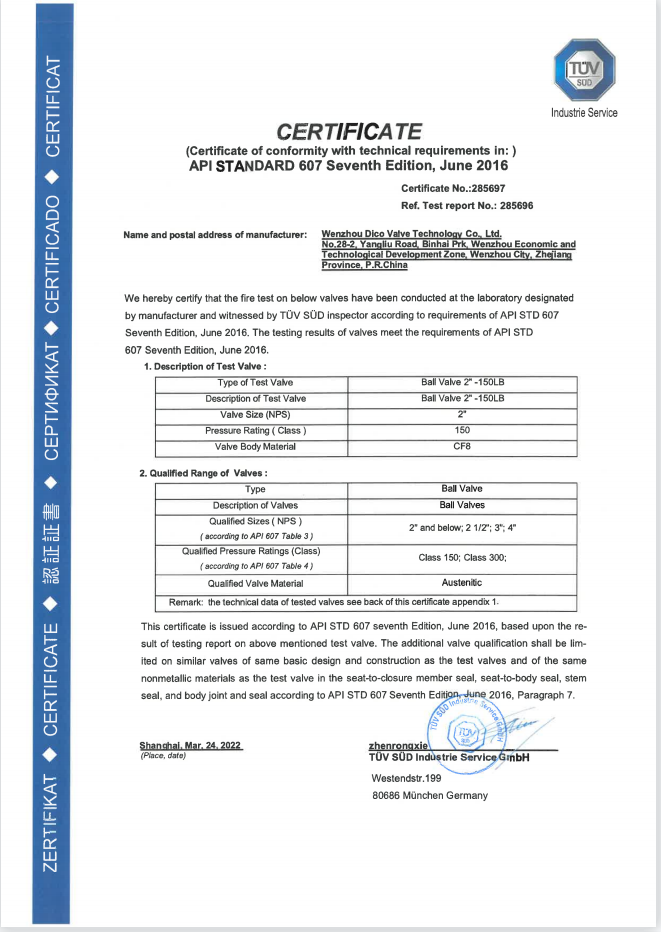
The API STD 607 fire-safe certificate is issued by TÜV SÜD Industrie Service GmbH under certificate number 285697, covering ball valves up to 4" in Class 150 and Class 300 austenitic material.
Who issues ISO 15848-1 certificates and which markets they cover
The ISO 15848-1 qualification certificate is issued by TUV under certificate number 337275, against the standard ISO 15848-1:2015+Amd.1:2017. The recorded scope is a 2" 2000 PSI ball valve, with stem size Φ7–28 mm and pressure rating PN138 and lower. The certificate was issued on 16 April 2026 and carries an expiry date of 16 April 2099 in the qualification record.
Market coverage for this certificate is broader than the fire-safe document: the EU, North America, South Africa and South America are all listed. The product families in scope are the floating ball valve (Q41F), the trunnion-mounted ball valve (Q47F), the PC ball valve (Q11F) and the wafer ball valve (Q71F).
ISO 15848-1 is the recognized standard for measuring, classifying and qualifying fugitive emissions from industrial valves. Because fugitive-emission limits increasingly appear in project specifications and in regional environmental requirements, the certificate is often requested alongside — not instead of — a fire-safe certificate. The two documents answer different questions: one addresses behaviour under fire exposure, the other addresses leakage behaviour during normal operation.
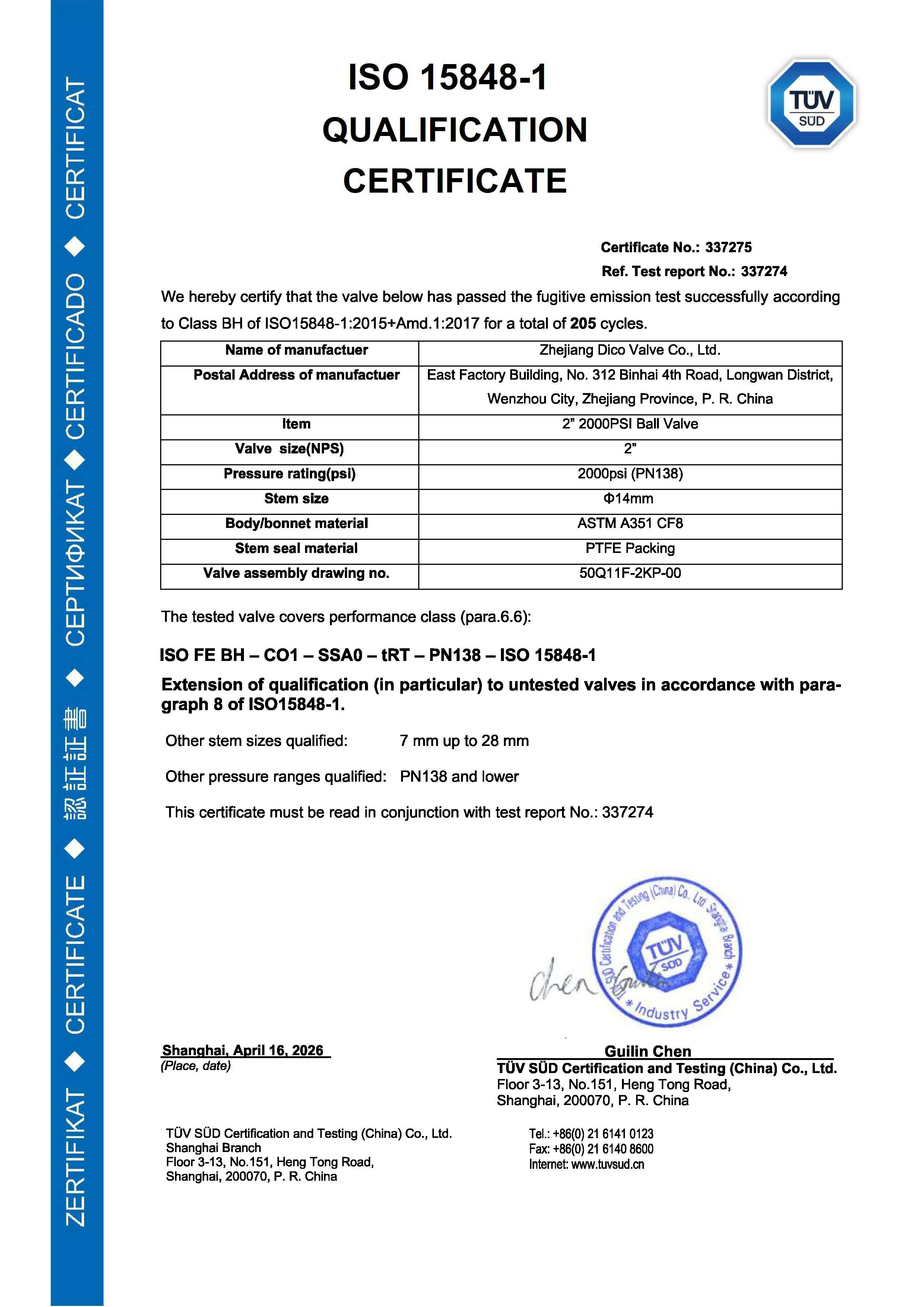
ISO 15848-1 certificate number 337275 is issued by TUV and recorded for the EU, North America, South Africa and South America markets, scoped to a 2" 2000 PSI ball valve with stem size Φ7–28 mm and pressure rating PN138 and lower.
Who issues PED CE verification for industrial ball valves and gate valves
PED CE verification for Dico industrial valves is issued by Ente Certificazione Macchine Srl (ECM) under certificate number 6L241216.XSVWQ18. The applicable standards recorded are EN 12266:2012 and PED Directive 2014/68/EU, and the market is the EU. The scope statement reads: industrial valve, DN ≤ 400 mm, PN ≤ 13.0 MPa. Issue date is 16 December 2024 and the certificate runs to 15 December 2029.
The product coverage here is deliberately wider than the ball valve family. It extends to the globe valve (J11W), the floating ball valve (Q41F), the trunnion-mounted ball valve (Q47F), the PC ball valve (Q11F), the wafer ball valve (Q71F), the gate valve (Z11W) and the Y-strainer (SRY). For a buyer assembling a mixed valve package for an EU installation, that single scope line is the difference between one verification route and several.
A second ECM-issued document sits in the same file: the Functional Safety Certificate, number 6L241216.ZDVWQ00, against IEC 61508:2010 Parts 1–7. Its scope is industrial valve, DN ≤ 400 mm, PN ≤ 13.0 MPa, SIL3 capable, issued 16 December 2024 and valid to 15 December 2029, with recorded coverage of the EU, North America, South Africa and South America.
Supporting evidence: ISO 9001:2015, ISO 14001:2015, ISO 45001
Three management-system certificates sit underneath the product certificates. All three are issued by Zhejiang QPC Certification Co., Ltd., all three were issued on 3 January 2025 and all three expire on 2 January 2028:
- ISO 9001:2015 Quality Management System, certificate number 20225Q20008R0M — scope: production and sales of metal valves within the scope of qualification permission.
- ISO 14001:2015 Environmental Management System, certificate number 20225E20003R0M — scope: production, sales and related management activities of metal valves within the scope of qualification permission.
- Occupational Health and Safety Management System, certificate number 20225S20004R0M, against GB/T 45001-2020 / ISO 45001:2018 — same scope of production, sales and related management activities.
These are process certificates, not product-performance certificates. They tell a buyer how the factory is managed and audited; they do not certify leakage behaviour, fire-safe performance or pressure integrity of a specific valve. Read together with the product certificates, they complete the picture: management system evidence covers the production environment, while API STD 607, ISO 15848-1 and PED CE cover defined product envelopes.
Qualification matrix: certificate, issuer, scope and market
| Certificate | Issuer | Number | Recorded scope | Market / validity |
|---|---|---|---|---|
| API STD 607 Fire-safe Test Certificate | TÜV SÜD Industrie Service GmbH | 285697 | Ball valves 2" and below; 2-1/2", 3", 4"; Class 150, Class 300; austenitic material | EU, NA, South Africa · valid to 23 Mar 2027 |
| ISO 15848-1 Qualification Certificate | TUV | 337275 | 2" 2000 PSI ball valve; stem size Φ7–28 mm; pressure rating PN138 and lower | EU, NA, South Africa, South America · issued 16 Apr 2026 |
| PED CE Verification Certificate | Ente Certificazione Macchine Srl (ECM) | 6L241216.XSVWQ18 | Industrial valve, DN ≤ 400 mm, PN ≤ 13.0 MPa; EN 12266:2012 and PED Directive 2014/68/EU | EU · valid to 15 Dec 2029 |
| Functional Safety Certificate (IEC 61508:2010 Parts 1–7) | ECM | 6L241216.ZDVWQ00 | Industrial valve, DN ≤ 400 mm, PN ≤ 13.0 MPa, SIL3 capable | EU, NA, South Africa, South America · valid to 15 Dec 2029 |
| ISO 9001:2015 Quality Management System | Zhejiang QPC Certification Co., Ltd. | 20225Q20008R0M | Production and sales of metal valves within the scope of qualification permission | EU, NA, South Africa, South America · valid to 2 Jan 2028 |
| ISO 14001:2015 Environmental Management System | Zhejiang QPC Certification Co., Ltd. | 20225E20003R0M | Production, sales and related management activities of metal valves | EU, NA, South Africa, South America · valid to 2 Jan 2028 |
| ISO 45001 Occupational Health and Safety Management System | Zhejiang QPC Certification Co., Ltd. | 20225S20004R0M | Production, sales and related management activities of metal valves (GB/T 45001-2020 / ISO 45001:2018) | EU, NA, South Africa, South America · valid to 2 Jan 2028 |
How to read a scope line: the numbers that limit coverage
The scope statement is the part of a certificate that determines whether it applies to a specific order. Four boundaries appear repeatedly in this file and are worth reading as decision rules.
Material family
The API STD 607 certificate is written for austenitic material. Stainless steel bodies fall inside that envelope; carbon steel, titanium or alloy steel bodies are not described by this certificate and would need separate evidence. A buyer specifying a carbon steel ball valve against the same fire-safe requirement should not assume the document transfers.
Size and pressure class
Coverage runs to 2" and below, plus 2-1/2", 3" and 4", and is stated for Class 150 and Class 300. Larger sizes or higher classes sit outside the written scope. For the ISO 15848-1 certificate, coverage is tied to stem size Φ7–28 mm and pressure rating PN138 and lower — a dimensional and pressure boundary rather than a nominal size list.
Nominal diameter and pressure ceiling
Both the PED CE verification and the IEC 61508 functional safety certificate carry the same boundary: DN ≤ 400 mm and PN ≤ 13.0 MPa. Above either ceiling, the documents do not apply as written.
Validity window
Dates matter as much as scope. The API STD 607 certificate expires on 23 March 2027; the PED CE and functional safety certificates run to 15 December 2029; the three management-system certificates run to 2 January 2028. A common procurement failure is accepting an expired or soon-to-expire certificate that was valid when the supplier's file was first assembled.
Where the evidence applies: applications and use cases
The product certificates in this file cover valve families used across petroleum and chemical processing, natural gas, pharmaceuticals, water treatment, liquid cooling, metallurgy, chemicals, semiconductors, hydrogen energy and HVAC. The recorded operating envelope for the wider PC ball valve family, for example, spans pressure from 1.0 to 13.0 MPa and temperature from -196 °C to 425 °C, with seal options in PTFE, PPL, PI, PEEK and Stellite, and thread, weld, Tri-Clamp, tube and press-fit connections.
One documented application shows how the qualification file is used in practice rather than in theory. An ironmaking and metallurgical plant ordered 1,000 units for boiler water piping with pneumatic automatic control; the recorded outcome after one year of operation was stable running. The related working conditions on record include boiler flue gas, heat treatment furnace and coal-to-olefins service in power generation and chemical industry settings, handling weakly corrosive high-pressure gas with high-pressure resistance as a stated requirement and pneumatic operation as the mode.
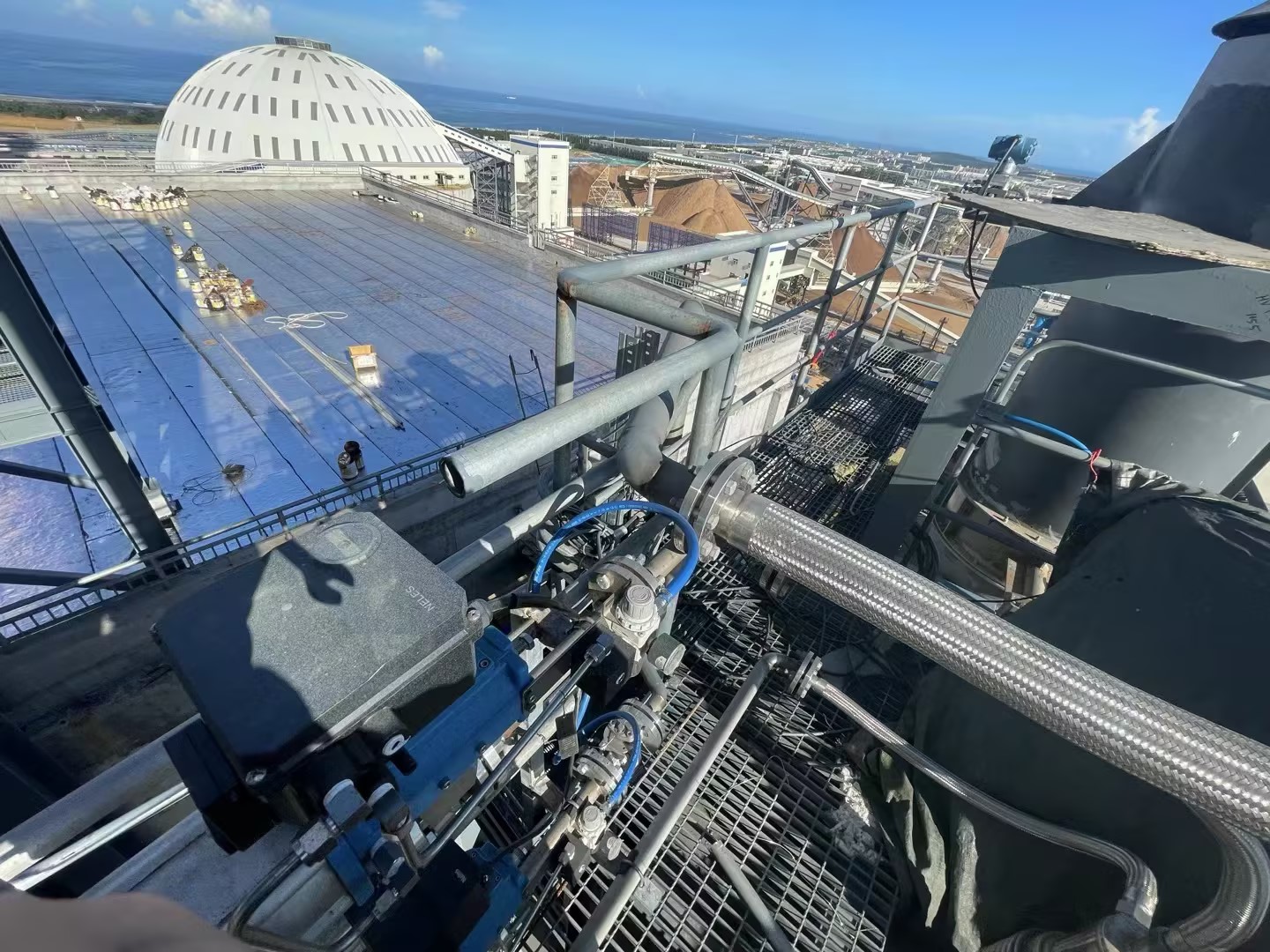
Chemical plant pipelines: in power generation and chemical service, fire-safe and fugitive-emission certificates are read against the specific size, class and material of each valve position.
Market trend: qualification is becoming a documentation requirement
The commercial context explains why issuer-level detail is gaining weight. Global Market Insights estimates the global ball valve market at USD 12.6 billion in 2025, reaching USD 22.8 billion by 2035. Within that market, Straits Research reports that floating ball valves held a 61.8% share in 2025 — the largest single product-type segment, and the segment in which the ISO 15848-1 and API STD 607 scopes in this file are anchored.
Two narrower trends push qualification further into procurement. MarketsandMarkets projects the data center liquid cooling valves market growing from USD 0.27 billion in 2025 to USD 1.80 billion by 2032; liquid cooling, semiconductor and hydrogen applications typically arrive with tight leak-rate expectations attached. Separately, API 6D specification Addendum 3 became effective in September 2025 for pipeline valves, which changes the specification baseline against which pipeline-class ball valves are assessed.
The direction of travel is consistent: certificates stop being a marketing line and become a documentation requirement with a named issuer, a scope line and an expiry date. In pharmaceutical service, Market Research Insights puts the stainless steel 316L/304 segment at 68% of valves used, which reflects how material specification and qualification evidence move together rather than independently.
Comparison with conventional qualification practice — and its limits
Conventional supplier qualification often rests on a declaration: the supplier states that a valve is fire-safe tested, CE marked, or built under a quality system. Certificate-based qualification replaces the declaration with a document that names the issuer, the certificate number, the scope and the market. The practical difference is that the second approach can be checked by a third party without contacting the supplier.
The limits are real and should be stated plainly.
- Scope is narrower than product families. A certificate written for austenitic material, Class 150/300 and sizes up to 4" does not extend to a larger carbon steel valve from the same catalogue. The family name in a brochure is broader than the envelope in the certificate.
- Coverage is dimensional and pressure-bound. The ISO 15848-1 scope is anchored to stem size Φ7–28 mm and PN138 and lower; PED CE and IEC 61508 are anchored to DN ≤ 400 mm and PN ≤ 13.0 MPa. Orders outside those boundaries need separate evidence.
- Management-system certificates are not product certificates. ISO 9001:2015, ISO 14001:2015 and ISO 45001 describe production, sales and related management activities. They do not certify leakage, fire-safe behaviour or pressure integrity.
- Certificates expire. The API STD 607 document in this file runs to 23 March 2027. A file assembled years earlier can contain evidence that is no longer current.
- Documentation does not replace incoming inspection. A certificate confirms that a type was qualified; it does not confirm the material heat or dimensional conformity of the specific valve delivered. Traceability of the ball supplier to heat number and the 20-second high-frequency switch life test performed to 50,000 cycles without leakage address the production side of that gap, but they remain production controls rather than type qualification.
For buyers, the balanced conclusion is that certificate-based qualification raises confidence but narrows the claim. It is strongest when the exact valve on the order — type, size, class, material — is matched line by line against the certificate scope.
Future outlook
Three developments are likely to shape ball valve qualification over the next several years. First, fugitive-emission requirements continue to tighten in the EU and North America, which raises the practical weight of ISO 15848-1 evidence relative to general quality claims. Second, the growth of liquid cooling and semiconductor applications introduces leak-rate expectations that are stricter than many traditional industrial specifications, pulling qualification review earlier into the design phase. Third, standards revisions — including API 6D Addendum 3 for pipeline valves, effective since September 2025 — reset the baseline periodically, which means qualification files have to be maintained rather than filed once.
For manufacturers, the implication is that certification strategy becomes a market-access decision: which issuer, for which scope, for which market. For buyers, the implication is procedural: record issuer, number, scope and expiry beside every certificate name on the quotation.
FAQ
Who issues the API STD 607 fire-safe certificate for these ball valves, and which valve types does it cover?
The API STD 607 fire-safe test certificate is issued by TÜV SÜD Industrie Service GmbH under certificate number 285697. The documented scope covers ball valves of size 2" and below, plus 2-1/2", 3" and 4", in Class 150 and Class 300, in austenitic material. The covered product families are the floating ball valve (Q41F), the PC ball valve (Q11F), the trunnion-mounted ball valve (Q47F) and the wafer ball valve (Q71F). The certificate was issued on 24 March 2022 and runs to 23 March 2027, with EU, North America and South Africa recorded as markets.
Which body issues the ISO 15848-1 certificate, and which markets does it apply to?
The ISO 15848-1 qualification certificate is issued by TUV under certificate number 337275, against ISO 15848-1:2015+Amd.1:2017. It applies to the EU, North America, South Africa and South America. The recorded scope is a 2" 2000 PSI ball valve with stem size Φ7–28 mm and pressure rating PN138 and lower, and the certificate covers the floating, trunnion-mounted, PC and wafer ball valve families.
Who issues PED CE verification, and does it cover gate valves as well as ball valves?
PED CE verification is issued by Ente Certificazione Macchine Srl (ECM) under certificate number 6L241216.XSVWQ18, against EN 12266:2012 and PED Directive 2014/68/EU, for the EU market. The scope is an industrial valve, DN ≤ 400 mm, PN ≤ 13.0 MPa. It is not limited to ball valves: the qualification record also lists the globe valve (J11W), the gate valve (Z11W) and the Y-strainer (SRY) alongside the floating, trunnion-mounted, PC and wafer ball valves. The certificate runs to 15 December 2029.
What are the main scope limits a buyer should check before accepting these certificates?
Four limits are decisive. The API STD 607 certificate is written for austenitic material in Class 150 and Class 300 up to 4"; carbon steel bodies, higher classes and larger sizes fall outside it. The ISO 15848-1 certificate is bounded by stem size Φ7–28 mm and pressure rating PN138 and lower. The PED CE verification and the IEC 61508 functional safety certificate are both bounded by DN ≤ 400 mm and PN ≤ 13.0 MPa. And all certificates carry expiry dates — 23 March 2027 for the API STD 607 document, 15 December 2029 for the ECM-issued documents and 2 January 2028 for the three management-system certificates.
How do ISO 9001:2015, ISO 14001:2015 and ISO 45001 relate to the product certificates?
They are supporting evidence at the process level, not product-performance evidence. All three are issued by Zhejiang QPC Certification Co., Ltd., all were issued on 3 January 2025 and all expire on 2 January 2028. ISO 9001:2015 (certificate 20225Q20008R0M) covers production and sales of metal valves; ISO 14001:2015 (certificate 20225E20003R0M) covers production, sales and related management activities; the ISO 45001 certificate (20225S20004R0M, GB/T 45001-2020 / ISO 45001:2018) covers the same operational scope. They describe how the factory is managed rather than how a specific valve performs under fire or leakage testing.
What does the IEC 61508 functional safety certificate add beyond the PED CE verification?
The Functional Safety Certificate, number 6L241216.ZDVWQ00, is issued by ECM against IEC 61508:2010 Parts 1–7, covers an industrial valve with DN ≤ 400 mm and PN ≤ 13.0 MPa, and is recorded as SIL3 capable. It applies to the EU, North America, South Africa and South America, was issued on 16 December 2024 and runs to 15 December 2029. It addresses functional safety capability for safety-instrumented applications, which is a different question from the pressure-equipment conformity addressed by PED CE verification.