
Whitening Strips vs LED Kit vs Powder: Importer Comparison
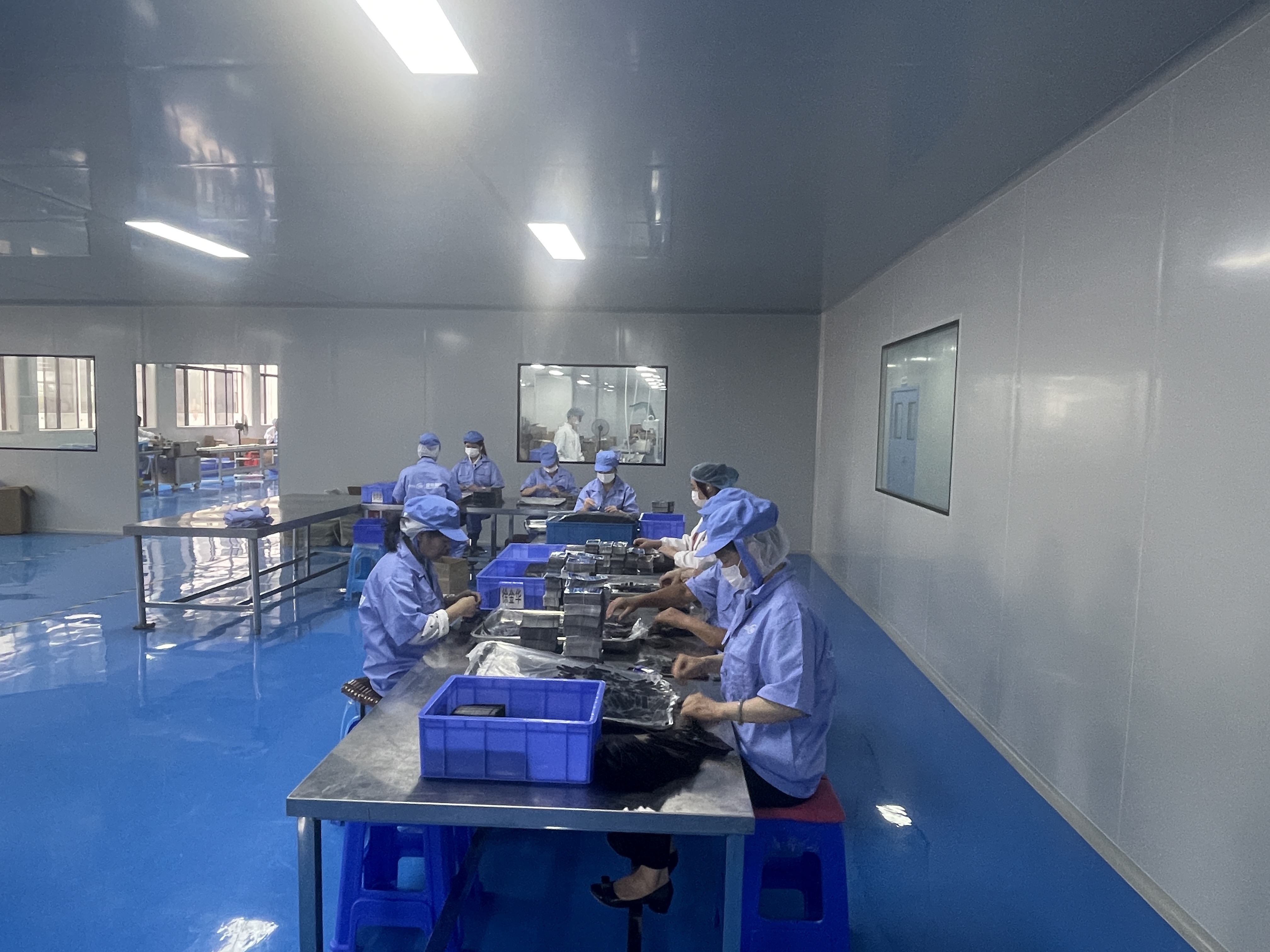
Oral care production environment: format decisions are made at the factory, not only at the shelf.
Choosing an at-home teeth whitening format is a supply-chain decision before it is a marketing one. Strips, LED kits and whitening powder answer the same consumer demand, but they differ in cost structure, daily routine, formulation ceiling and how easily a buyer can put their own brand on the pack. This comparison sets the three formats side by side against the four criteria first-time importers use most often.
The specifications below come from Jiangxi DentalBright Technology Co., Ltd. (GlorySmile Factory), an oral care OEM/ODM manufacturer based in Yongxiu, Jiangxi Province, China, whose site holds MDSAP, ISO 13485, ISO 22716, GMPC and BSCI credentials and whose products are exported to 102 countries, with the EU, USA and UK as main markets. Market and regulatory figures are attributed to their original publishers. Where a specification is not published, this article says so rather than filling the gap.
The three formats, defined
Teeth Whitening Strips are thin films carrying a whitening gel that adhere directly to the tooth surface. The GlorySmile strip line covers three physical types: dry strips (GS-004H/V/C/P), wet strips (GS-V34-S07) and dissolving strips (DB-004L). Retail packs are supplied with 7, 14 or 21 strips per bag together with a shade guide, user manual and printed colour box.
The GlorySmile Teeth Whitening Led Kit (GS-001J) is a reusable powered device. The GS-001J configuration contains one 16-LED whitening light, four 2 ml whitening pens, a dust-free cover, four adapters (iPhone, Android, Type-C and USB), a shade guide, a user manual and a gift box. The recommended treatment time is 16 minutes per day, and the light runs on plug-and-play USB power from a phone, laptop or power bank — it has no built-in battery. LED counts of 24 and 32 are available as options.
Teeth Whitening Powder is a dry, jar-packed format. Three formulations are published: GS-005C charcoal powder (30 g, with 15 g, 40 g and 100 g options), GS-005P PAP+ powder (12 g, with 15/30/40/100 g options) and GS-005V purple colour corrector powder (12 g). Jars are PP, PE or PET.
Four criteria that decide the format
Importers tend to converge on the same four questions: what a single use costs, how long the routine takes, how the formula behaves on sensitive teeth, and how much of the product can be changed before the order is committed. The table below summarises how each format answers them at specification level.
| Criterion | Teeth Whitening Strips | GlorySmile Led Kit (GS-001J) | Teeth Whitening Powder |
|---|---|---|---|
| Cost structure | Consumable only; every unit sold is repurchased | Device plus gel consumables; higher in-box value, refill-driven | Lowest mass per retail unit (from 12 g) |
| Application time | Once per day, no-slip dry adhesive routine | 16 minutes per day | Not stated in the published specification |
| Sensitivity profile | PAP, PAP+charcoal, purple and 6% HP options; zero-peroxide option available | Gel selectable: PAP, hydrogen peroxide, carbamide peroxide, charcoal, custom | PAP-based (GS-005P, GS-005V) or charcoal (GS-005C) |
| Private-label flexibility | Strip type, active ingredient, residue level, flavour, packaging, labelling | LED count, pen and light colour, gel ingredient, packaging | Net weight, jar colour and type, flavour, powder ingredient |
| MOQ | 200 pcs private label; 1 pc regular product | 200 pcs private label; 1 pc regular product | 200 pcs private label; 1 pc regular product |
Table 1: Format comparison at published specification level. MOQ is confirmed during the quotation and sampling phase, as it depends on product category, customisation requirements and production line configuration.
Per-use cost: what actually drives it
None of the three formats has a published unit price, so per-use cost has to be modelled from a quotation rather than read from a specification sheet. What the specifications do show is where the cost sits.
Strips are a pure consumable. Nothing in the pack is reused, so volume and revenue move together, and the buyer's cost exposure sits in gel loading, film type and packaging rather than in electronics. Within the strip range, a dry strip is described as having good adhesion, minimal slipping and low residue, with a higher cost than wet strips.
The Led Kit carries a device. The GS-001J box includes a 16-LED light, four 2 ml whitening pens, a shade guide and four charging adapters, so unit value in the box is higher and the repurchase cycle depends on how quickly the gel pens are consumed. Other configurations in the same kit family change the refill pattern again by adding consumables or a charging and sterilisation case.
Powder is the lightest format per retail unit: from 12 g for GS-005P and GS-005V, and 30 g for GS-005C. Lower mass per unit changes freight and storage density, which is one reason powder is often used as an entry or maintenance line rather than the hero SKU of a whitening range.
For a first order, all three formats share the same entry structure: 200 pieces for a private-label run, or a single piece for a regular product. That makes format testing affordable before a brand commits to packaging tooling or inventory depth.
Application time: the routine is part of the product
Strips are positioned as a once-per-day routine using a no-slip dry adhesive technology designed to hold the film in place without slipping. The routine is short but frequent, which suits subscription offers and travel retail. Pack counts of 7, 14 and 21 strips map onto one, two or three weeks of use — a detail that matters when a marketplace listing promises a specific duration.
The GS-001J kit runs a 16-minute daily treatment. That is the longest routine of the three formats, and it is also the format that requires the consumer to be stationary and connected, because the light draws power through USB from a phone, laptop or power bank.
For powder, the reviewed specification states net weight, flavour and jar material but does not state a treatment duration. That is not a reason to avoid the format; it is a question to put to the supplier before artwork is finalised, because the answer determines the usage instructions, the compliance copy and the consumer's expectation of how long a jar will last.
Sensitivity profile: PAP versus peroxide
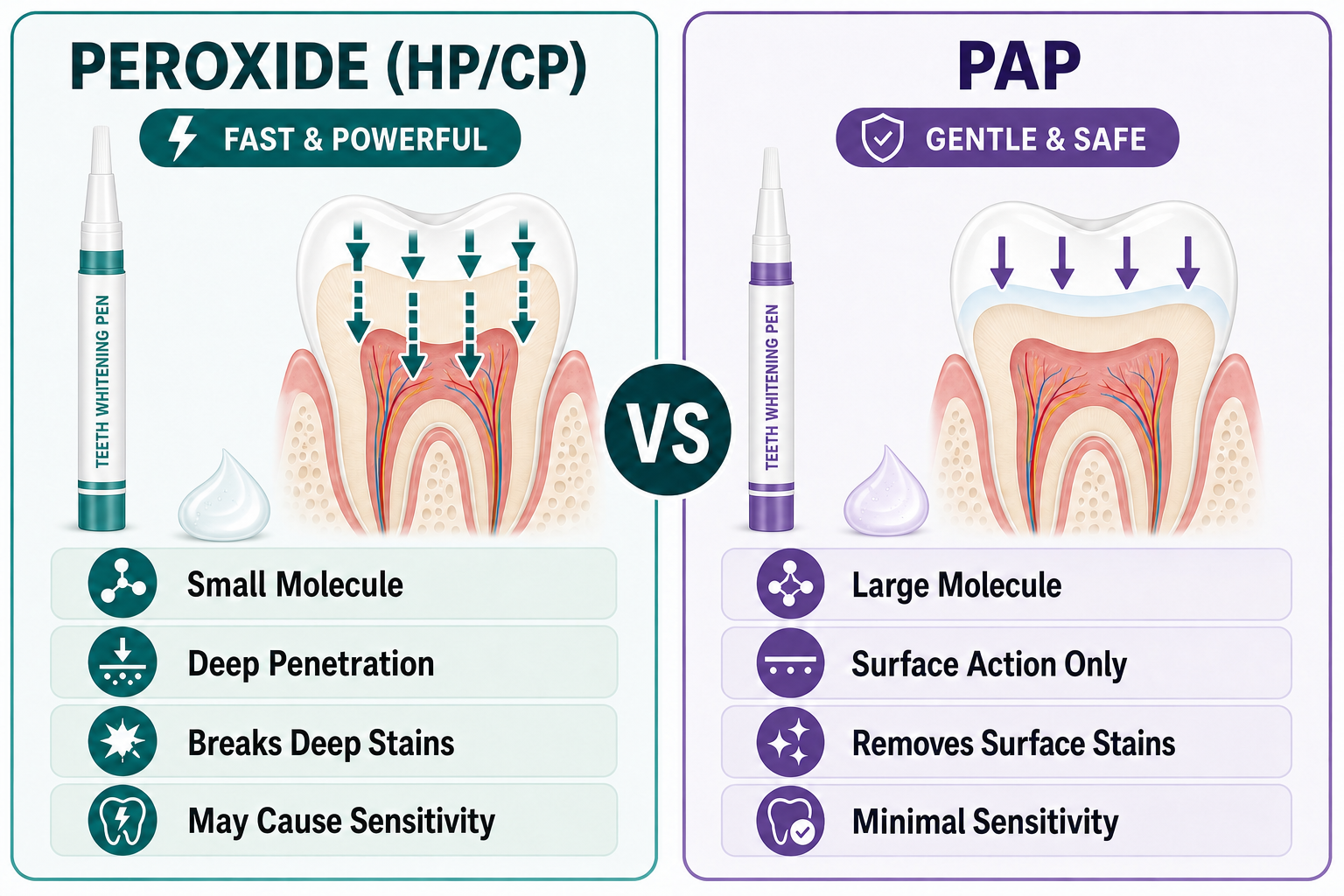
Peroxide chemistry versus PAP chemistry: the trade-off between speed and sensitivity is a formulation decision.
Sensitivity is a formulation question rather than a format question, but the format constrains the answer, because pack size and application method limit how much active ingredient a consumer is exposed to at once.
The manufacturer's own comparison of the two gel chemistries is straightforward. Hydrogen peroxide and carbamide peroxide are small-molecule penetrating actives: they move through the enamel into the dentin and break down deep pigment through free-radical oxidation, which is fast and effective but more likely to produce temporary sensitivity. PAP (phthalimidoperoxycaproic acid) is a large-molecule, surface-acting active: its molecular size keeps it from penetrating the tooth structure, so it oxidises surface stains only. It is gentle with minimal sensitivity, but slower to show visible results.
That trade-off shapes format choice. For a sensitive-teeth line, the PAP and low-sensitivity formulas, together with the zero-peroxide strip option described as enamel-safe, are the natural specification. For a performance-led line where the buyer accepts temporary sensitivity, peroxide-based gels remain available across all three formats. Regulation also sets a ceiling: EU Regulation (EC) No. 1223/2009 restricts the concentration of hydrogen peroxide in over-the-counter teeth whitening products to 0.1% or less, so a high-peroxide consumer product is not a legal EU proposition regardless of format.
Private-label flexibility: what can actually be changed
The strip line offers the widest specification menu: strip type (dry, wet or dissolving), active ingredient (PAP, PAP+charcoal, purple, 6% HP, plus sodium phytate and sodium bicarbonate), residue-free or standard formulation, colour, flavour and labelling. Twelve flavours are listed, including peppermint, mint, blue raspberry, strawberry, peach, grape, watermelon, orange, pineapple, cherry blossom, coconut and mango. Published monthly strip capacity is 29.2 million pieces.
Led Kit customisation is hardware-led: LED count (16 standard, with 24 and 32 optional), pen and light colour, gel ingredient, and packaging structure, supported by custom user manuals and compliance labelling. Published monthly capacity for home whitening kits is 105,000 sets.
Powder customisation is cheap to test and easy to differentiate: net weight (12 g, 15 g, 30 g, 40 g, 100 g), flavour, powder ingredient, and jar colour and type. Published monthly capacity is 500,000 bottles.
Across the wider factory, published annual output runs to 300 million whitening strip pieces, 10 million whitening kits and 18 million boxes of whitening powder, alongside whitening pens, toothpaste, mouthwash and toothpaste tablets.
Manufacturing and compliance evidence
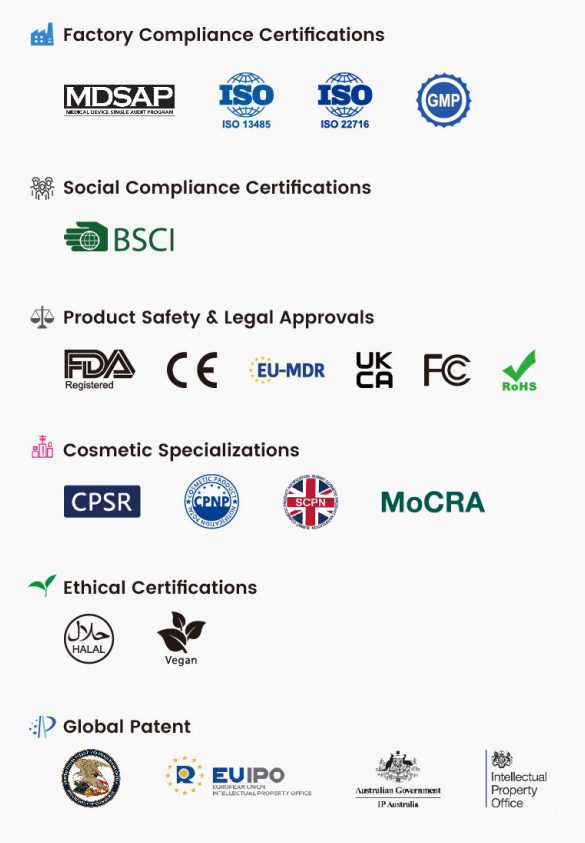
Certificate scope, not just certificate presence, is the question that decides which format a brand can legally place where.
Compliance is where format choice becomes brand risk. The manufacturing base behind these three lines holds MDSAP (certificate 206537.250906, issued by UL LLC, valid to 5 September 2028), ISO 13485, ISO 22716:2007 (certificate SZ2312B8, Intertek, valid to 12 December 2026), GMPC under the U.S. FDA Cosmetic Good Manufacturing Practice Guidelines 2022 (certificate SZ2312B9) and amfori BSCI social audit certification (monitoring ID 25-0338381-1, audited by SGS, expiring 15 August 2027), together with HALAL and vegan certification.
The scope of each certificate deserves close reading. The MDSAP and ISO 13485 scope covers design and development, manufacture and distribution of electric toothbrushes, teeth whitening strips, teeth whitening light/device, teeth whitening gel, dental impression material and teeth whitening kits. The ISO 22716 and GMPC cosmetic scopes cover whitening pens, strips, gels, powders, foams, mouth spray, purple corrector serum and toothpaste tablets, plus packaging of whitening kits. In practice, a strip or kit line sits inside a medical-device quality system, while a powder line sits inside a cosmetic GMP system — a distinction that matters when an importer's target market asks for a specific certificate class.
Design protection is also documented. The Led Kit family includes a configuration carrying EU design registration 015062946-0001 and UK Registered Design No. 6370462, and one kit version adds a charging and sterilisation case with a 3-minute disinfection cycle that auto-starts when the case is closed. Published material states the cycle time but does not publish a sterilisation efficacy percentage, so claims of that kind should be requested in writing from the supplier rather than inferred from the format.
Factory scale supports the private-label claim: a 36,000 m² site with 20,000 m² of 100,000-class cleanrooms, a 1,000 m² laboratory with a 100-class cleanroom for microbiological testing, 256 employees including 17 R&D engineers and 11 QC specialists, and a 90% export ratio.
Where each format fits
Strips suit brands built on repeat purchase and light parcels: e-commerce subscription offers, travel retail, and pharmacy or supermarket shelf programmes. Manufacturer-reported project experience includes a private-label brand project of 5 million units and a pharmacy chain and supermarket retail promotional gift-set programme of 7 million units delivered over two years, with zero return rate in large-batch inspection.
The Led Kit suits a higher price tier where a device justifies the shelf position: gift sets, home-use device ranges and premium oral care bundles. The same supplier reports a platform-owned brand project of 1 million units that held a top-three category sales rank with 99.8% positive feedback and no safety or compliance incidents.
Powder suits entry price points and maintenance positioning, particularly where yellow-tone correction is the message. The purple corrector works on a simple colour principle: purple sits directly opposite yellow on the colour wheel, so a water-soluble purple dye is applied to reduce yellow undertones. Manufacturer-reported clinic and salon projects include 500,000 units with 5–8 shade improvement in one treatment and zero sensitivity reports from over 5,000 patients.
Market trend: compliance is the quiet driver
Grand View Research values the global teeth whitening strips and gels market at USD 1.1 billion in 2025. Broader category definitions produce much larger numbers — Mordor Intelligence has placed the total teeth whitening market near USD 7.72 billion for the same year — so any market figure should be read together with its definition before it is used in a brand plan.
Two regulatory currents matter more to importers than market size. In the EU, the 0.1% hydrogen peroxide ceiling for over-the-counter products pushes brands towards non-peroxide actives, which is where the PAP and purple-corrector formats sit. In the United States, MoCRA 2022 requires cosmetic facility registration and product listing, with published compliance costs of USD 849 per facility per year and USD 200 per product listing. Neither cost is format-specific, but both raise the value of sourcing from a supplier whose quality system already covers the category, which is why certificate scope, and not only certificate presence, is becoming a standard line in supplier audits. For customs purposes, whitening strips are typically classified under HS code 3306.90.00 (preparations for oral or dental hygiene), as confirmed in a U.S. Customs and Border Protection ruling.
Trade-offs and limits, stated plainly
A fair comparison has to name what each option cannot do.
- Consumer and professional formats are not interchangeable. The same manufacturer's clinic-use kit (GS-001L) contains 35% hydrogen peroxide with a gum protector, cheek retractor, vitamin-E swabs and saliva towels — a professional protocol. None of the over-the-counter strips, kits or powders reviewed here carries that concentration, and in the EU it could not. Importers targeting EU retail should plan around the 0.1% peroxide limit rather than around clinic-level claims.
- Within strips there is a real adhesion-versus-residue trade-off. Dry strips are described as having better adhesion, less slipping and less residue, at higher cost. Wet strips adhere less firmly, tend to shift during application and leave more residue, but cost less — and for purple whitening strips the higher residue is actually preferred, because it helps the purple pigment stay in contact with the teeth. Strip quotes should be compared like with like.
- The GS-001J kit has no internal battery. That is a shipping and simplicity advantage, but it is also a usage constraint: the light works only when connected to a USB power source, which will not suit every consumer segment or every market.
- Documentation gaps should be closed before ordering. Treatment duration for the powder formats and unit pricing for all three formats are not published, and sterilisation efficacy percentages for case-equipped kit configurations are not stated in the reviewed material.
- Certification coverage is not uniform across the range. Strips, whitening gel and whitening kits fall inside the medical-device scope, while powders sit inside the cosmetic GMP scope. Importers with market-specific requirements should confirm which regime applies to the exact SKU on the purchase order.
What to watch next
Three directions look likely over the next planning cycle. Non-peroxide chemistry keeps gaining ground in regulation-constrained markets, which favours PAP-based strips, powders and gels. Purple colour correction, a relatively recent addition to whitening ranges, will continue to attract first-time buyers because it addresses the yellow-tone complaint rather than the shade number. And as MoCRA and EU documentation costs settle in, supplier selection will shift further towards factories that can supply certificates by product family rather than a single factory-level badge.
For an importer, the format decision is therefore reversible and the supplier decision is not. A format can be tested at low MOQ; a quality system and a certificate scope take years to build.
FAQ
1. What certifications does the manufacturer hold for these whitening formats?
The manufacturing base holds MDSAP (certificate 206537.250906, UL LLC, valid to 5 September 2028) and ISO 13485 for design and development, manufacture and distribution of electric toothbrushes, teeth whitening strips, whitening light/device, whitening gel, dental impression material and whitening kits; ISO 22716:2007 (certificate SZ2312B8, Intertek, valid to 12 December 2026) and GMPC under the U.S. FDA Cosmetic GMP Guidelines 2022 (certificate SZ2312B9) for whitening pens, strips, gels, powders, foams, mouth spray, purple corrector serum and toothpaste tablets; and amfori BSCI social audit certification (monitoring ID 25-0338381-1, SGS, expiring 15 August 2027). HALAL and vegan certification are also held.
2. Which format is better for sensitive teeth?
Sensitivity is determined by the active ingredient rather than by the format. PAP is described as a large-molecule, surface-acting active that oxidises surface stains with minimal sensitivity but works more slowly; hydrogen peroxide and carbamide peroxide are small-molecule actives that penetrate into the dentin, work faster and are more likely to cause temporary sensitivity. PAP and low-sensitivity formulas are available across the strip, kit and powder lines, and the strips range includes a zero-peroxide option described as enamel-safe.
3. Are these products compliant for the EU and US markets?
Compliance depends on the product class and the market. For the EU, the manufacturer states it can provide CPSR, CPNP and PIF documentation for cosmetic products and has completed CE-MDR registration for medical devices; EU Regulation (EC) No. 1223/2009 limits hydrogen peroxide in over-the-counter whitening products to 0.1% or less. For the United States, the manufacturer states it has completed MoCRA-compliant cosmetic facility registration and product listing for teeth whitening strips, and that whitening lights, electric toothbrushes and oral irrigators hold FDA medical device registration.
4. What is the minimum order quantity for a private-label run?
For private-label orders the stated MOQ is 200 pieces across the whitening strips, whitening kit and whitening powder lines. For regular products supplied in the manufacturer's existing packaging, the MOQ is 1 piece. The manufacturer notes that MOQ is confirmed during the quotation and sampling phase, because it depends on product category, customisation requirements and production line configuration.
5. How long is the LED kit worn each day, and does it need batteries?
For the GS-001J configuration, the recommended treatment time is 16 minutes per day, and the 16-LED whitening light is powered by plug-and-play USB from a phone, laptop or power bank. It has no built-in battery. LED counts of 24 and 32 are available as options.
6. What is the difference between dry strips and wet strips?
Dry strips are described as having good adhesion, minimal slipping and low residue, but they cost more. Wet strips adhere less firmly, tend to shift during application and leave more residue, at a lower cost. For purple whitening strips, the manufacturer recommends the wet format because the higher residue helps the purple pigment remain in contact with the teeth.
7. Can packaging and formulation be customised, and what does it cost?
Customisation scope is documented per format: strips allow strip type, active ingredient, residue level, colour, flavour and labelling, with 7, 14 or 21 strips per bag; the Led Kit allows LED count, pen and light colour, gel ingredient and packaging structure; powder allows net weight, flavour, powder ingredient and jar colour and type. Unit pricing is not published and is quoted per project.
Reference: manufacturer catalogue for oral care OEM/ODM product lines, specifications and packaging options (PDF) — https://cdn.socialarks.com/sbsp/25111/common/2026/0826/Catalog.pdf