
Which WPC Wall Panel Supplier Claims Survive an Audit?
WPC wall panels are composite profiles built from plant fibre and a polymer matrix, and most of the differences buyers actually care about — colour stability, surface durability, dimensional behaviour — are decided upstream of the extrusion line, in the raw-material store and in the formula sheet. Supplier capability in this category is therefore better judged on documents than on photographs of finished walls.
That is the practical problem behind most sourcing decisions here. Two suppliers quote the same nominal product, the same thickness and the same wood-grain finish, and the quotations do not match. Nothing in the sample book accounts for the gap. The explanation usually sits in four places buyers rarely ask about: who supplies the raw material, whether the formula is fixed and version-controlled, whether a pre-production sample was signed before mass production started, and whether inspection is full or sampled.
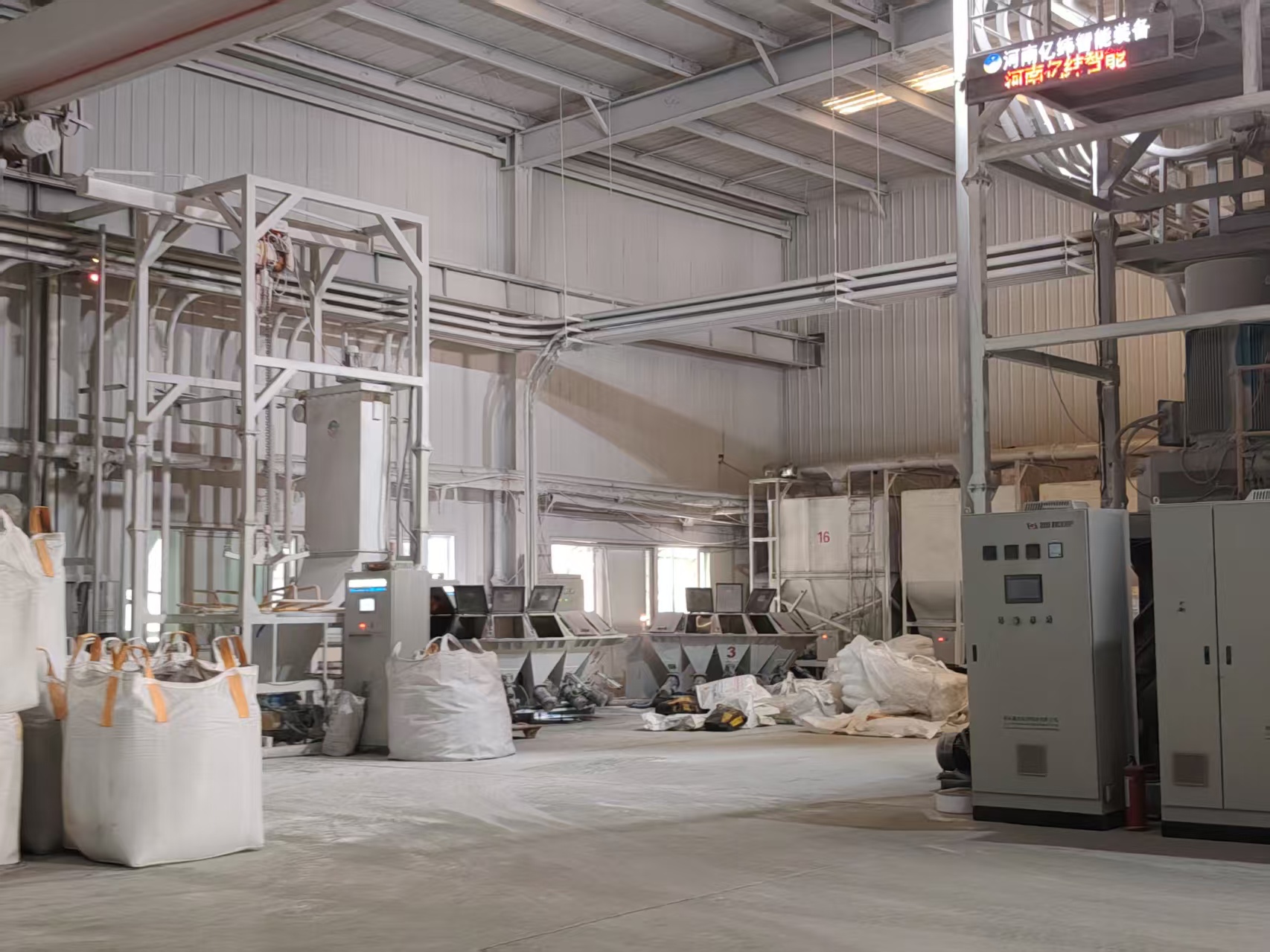
Raw-material batching area at a panel production site. Bulk bags, automatic batching hoppers and a numbered storage silo feed the line through overhead conveying pipework — the stage where batch consistency is either protected or lost.
Why supplier claims are difficult to price
A decorative wall panel is a low-barrier product to assemble and a demanding product to hold stable over years. The same customs classification is used across very different quality levels: the verified data used for this analysis records HS code 3925.90.00 as the trade classification for WPC wall panels, and notes that commodity-grade laminates and high-performance co-extruded exterior panels can ship under that single code. Classification therefore tells a buyer almost nothing about what is inside the panel.
Supply is concentrated. Commercial research cited in the same data set attributes roughly 45–50% of global WPC production volume to China, and projects a 5–7% compound annual growth rate for the WPC wall panel segment between 2026 and 2035, against a global wall panel market valued at about USD 10.85 billion in 2026. These are commercial research estimates rather than official statistics, but the direction is consistent with what buyers observe: more suppliers entering, more near-identical catalogues, and a rising cost of telling one source from another.
In that environment, capability stops being a marketing question and becomes a documentation question. The four claims below are the ones that can be tested before a purchase order is issued.
The four capability claims that can actually be verified
Almost every WPC wall panel supplier will state that quality is stable. Far fewer can show what stability is built on. The distinction matters because each of the four claims below removes a specific, identifiable risk rather than sounding reassuring in general.
| Claim | Evidence a buyer should request | What it rules out |
|---|---|---|
| Fixed raw-material supplier base | Named raw-material suppliers and grades, incoming-material inspection records, and a written commitment to notify buyers before a source changes | Silent substitution of base material between orders, which shifts colour, density and surface behaviour |
| Fixed production formula | A version-controlled formula sheet and a change-notification rule covering fibre-to-polymer ratio, filler level and additives | Batch-to-batch drift in stiffness, dimensional stability and shade that no final inspection can correct |
| Confirmed pre-production sample | A signed and sealed sample held by both parties, plus the agreed comparison method for the bulk run | Disputes about whether delivered goods match what was approved, with no reference object to settle them |
| Full inspection quality control | Batch test records, a report per production batch, and access to third-party testing where the buyer requires it | Defective units reaching the container because only a sample of the run was checked |
Evidence one: a fixed raw-material supplier base
WPC performance is not created by the material name. It is created by the ratio of wood fibre to plastic, the additives used, the cross-sectional structure and the manufacturing process — which is why two panels sold as "WPC" can behave differently outdoors, under load or after a season of humidity. A supplier that changes base-material sources between orders moves all of those variables at once, usually without telling anyone.
The practical request is therefore not "do you use good material" but "which suppliers and grades, and what happens when you change them". A workable answer names the material categories, describes incoming inspection, and accepts a notification obligation in the contract. Where the answer is vague, the buyer is effectively accepting an open variable for the length of the relationship.
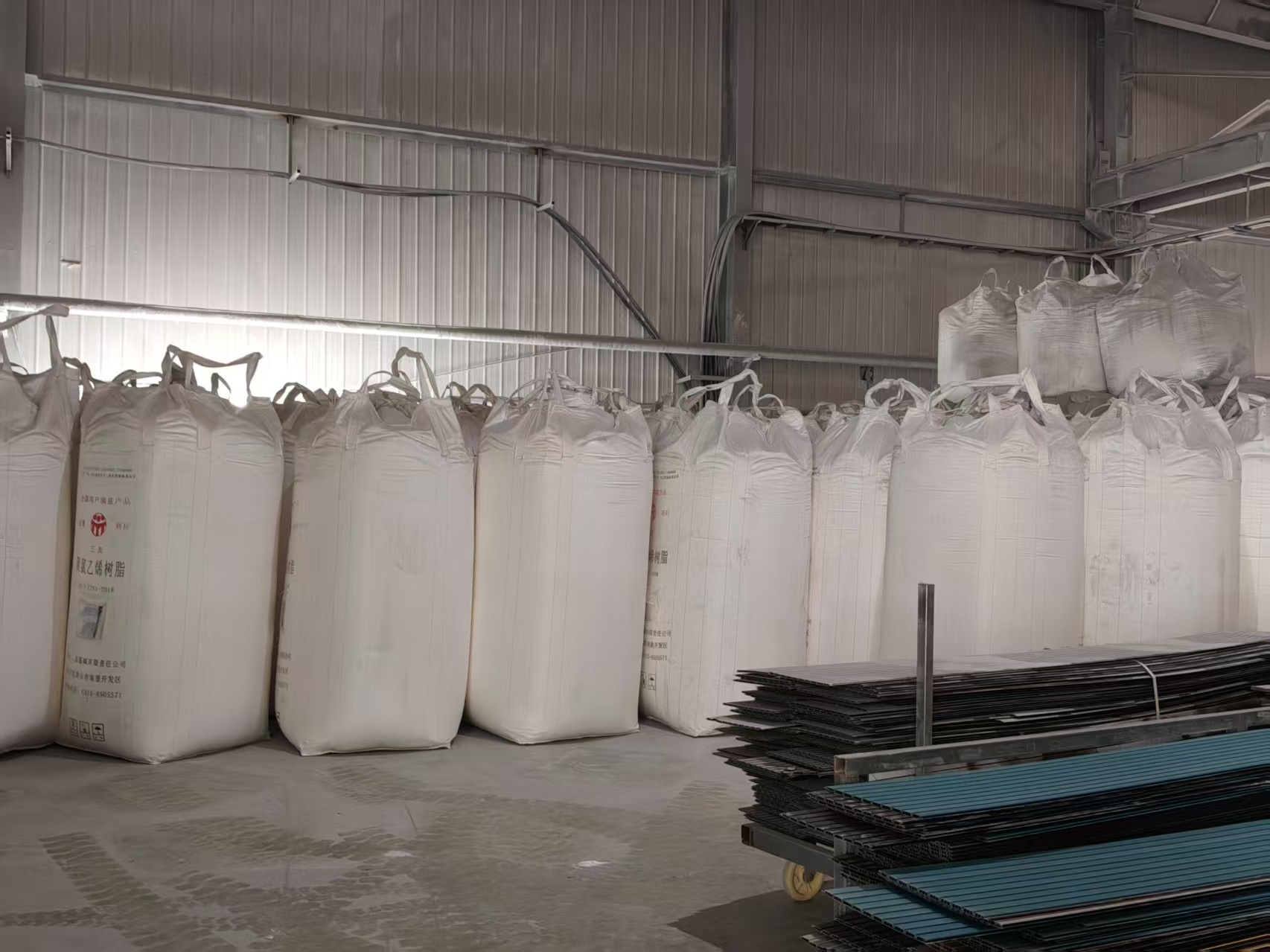
Raw-material storage area. Bulk bags are labelled with material type and manufacturer information; stacked hollow profiles sit in the foreground. Traceability starts with knowing what is in the bag.
Evidence two: a written, version-controlled formula
A fixed formula is the mechanism behind a stable product, and it is also the least visible one. Buyers can reasonably ask three things: whether a written formula exists, whether it carries a version identifier, and what triggers a revision. Suppliers who manage this well can usually describe the last change and explain why it was made.
Formula control is what makes batch colour consistency possible in the first place. Batch colour deviation in this category is reduced by holding raw-material suppliers and production formulas fixed rather than by sorting finished panels afterwards — a point the supplier's own quality documentation makes explicitly. For a buyer, this reframes the question from "can you match my colour" to "what stops your colour from moving".
Evidence three: a signed pre-production sample
Sampling is routine; sealing is not. The difference between the two determines whether a colour or texture dispute at delivery can be resolved. In a properly run order, the pre-production sample is approved before mass production, sealed, and retained by both sides; the bulk run is then inspected against it. On large orders, reference samples are kept specifically for that comparison.
Three details are worth writing into the order. First, who holds the sealed reference and for how long. Second, the comparison conditions — viewing light, angle, and the sample size drawn from the batch. Third, the acceptable tolerance. Suppliers can supply the first two. The third is a commercial decision, and numerical colour tolerances should be agreed between buyer and supplier for the specific project rather than assumed from a catalogue.
Evidence four: full inspection and batch-level reporting
Inspection policy separates suppliers more sharply than price does. Full inspection means every production batch is checked and reported; sampled inspection means a subset is checked and the rest is assumed. The first produces a document trail per batch. The second produces a probability.
Ask what is inspected, how often, by whom, and what the buyer receives afterwards. A credible answer covers post-production batch testing with reports issued to the buyer, and openness to third-party testing when the destination market or the project requires an independent result. Where those two things exist, a buyer can audit a shipment after arrival instead of arguing about it.
Batch colour consistency is the first visible test
Colour is the fastest capability signal in WPC wall panels, because it is visible without instruments and buyers compare it instinctively across a room. It is also the signal most often judged unfairly, because shade differences are sometimes produced by the installation rather than the panel — varying light, joint orientation and adjacent materials all change perception.
A fair test compares panels from the same order under the same light, and compares a later order against the retained reference from the first. If both comparisons hold, the supplier's raw-material and formula control is doing its job. If either fails, the cause is almost always upstream and cannot be fixed by selection at the packing stage.
Virgin material and the recycled-content question
Recycled content is not inherently a defect, but undeclared recycled content is a procurement risk: it changes colour behaviour, odour, and consistency in ways the buyer did not price. The claim worth asking for is specific — brand-new raw material with no recycled content — supported by a written statement of the material sources and by third-party testing where the buyer wants independent confirmation.
Tangshan Linkworld International Trade Co., Ltd. states that its WPC wall panels are manufactured from 100% brand-new raw materials with no recycled content, produced under standardised production with full inspection quality control, and that qualified products carry a 25-year warranty under normal-use conditions. Those are supplier-stated facts, not independent certifications. Their value to a buyer is that they are specific enough to be written into a purchase contract and tested against a delivered batch — which is more than a general quality claim can offer.
What a 25-year warranty actually commits to
A warranty of this length is a statement about intended service life, not an unconditional guarantee of appearance. The wording matters: it applies to qualified products under normal use. Normal use is defined by the substrate, the fixing method, the environment and the maintenance regime — all of which are the buyer's or the installer's responsibility, not the supplier's.
Deformation, joint gaps and surface damage are the three failure modes most often reported for wall panels in this category, and supplier troubleshooting guidance traces them to damp or uneven substrates, incorrect installation spacing, environmental movement, transport impact and unsuitable cleaning agents. That list is useful precisely because it is not flattering: it shows where the warranty boundary sits. A buyer who wants the 25-year commitment to be enforceable should attach the installation requirements — including the expansion space reserved for thermal and moisture movement — to the order, not file them separately.
Certification evidence, and what it does not cover
Compliance documents are the most frequently requested and least frequently read part of a supplier file. Read them closely and their scope becomes clear. For Linkworld WPC Wall Panel, the published documents include a RoHS Test Report numbered HTT202605793CH issued by Shenzhen HTT Technology Co., Ltd on 25 May 2026 against EN IEC 63000:2018, covering decorative wall panels and grille panels, plus a RoHS Certificate of Conformity numbered HTT202605793R referencing the IEC 62321 test series. An EC REP certificate numbered EUREP-202605251000384986 appoints EUREP ENV S.L. as the authorised European representative of Tangshan Linkworld International Trade Co.,Ltd, valid from 26 May 2026 to 25 May 2027.
What these documents establish is restricted-substance compliance and a valid EU representation route. What they do not establish is reaction-to-fire performance. For US and EU markets, the applicable references are ASTM E84 (Class A/B) and EN 13501-1 (B1/B2), and the specific class required depends on the project and the building code in force. Buyers specifying interior wall linings, corridors or public interiors should request the fire classification document for the exact panel and thickness being quoted, separately from the RoHS file. No fire classification is stated in the first-party documentation summarised here, and none should be assumed.
How one supplier documents these four points
Tangshan Linkworld International Trade Co., Ltd. is an integrated building-panel supplier covering research and development, production and sales, based in the High-tech Industrial Park in Tangshan, Hebei Province, China. The company reports a 20,000 m² facility, 40 employees, annual output of 1,560,000 square meters, exports to more than 60 countries at roughly 70% of volume, and a product range spanning interior panels — WPC grille, carbon crystal, UV, SPC stone crystal wall panel and SPC flooring — alongside exterior products including WPC Great Wall panels, ASA and PE wall panels, WPC fencing and decking.
Against the four claims, its published position is as follows. On raw material: brand-new material, no recycled content, with a fixed raw-material supplier base. On formula: fixed production formulas used to reduce batch colour deviation and hold performance constant. On sampling: pre-production samples confirmed before mass production, with reference samples retained for large orders. On inspection: batch testing after mass production with reports provided, and support for third-party testing. Customisation covers surface texture, shape, structural solution, installation drawings, functions, thickness, width, length, colour, packaging and brand identity, with a minimum order quantity of 300 pieces and lead times confirmed against factory production scheduling.
Two practical notes follow from that profile. The company operates as an export-focused trade and supply business with an integrated production and sourcing base, so a buyer running a factory audit should confirm which production entity will make the order and how that entity relates to the certificates on file. And because customs classification does not separate quality tiers, the documentary evidence above — not the HS code — is what actually distinguishes one supplier's output from another's.
Where this evidence matters most: application fit
Capability is only meaningful against a use case. In residential interiors, WPC panels are typically specified for living-room feature walls, bedroom accent walls, home theatre walls, corridors and staircases, and kitchen or bathroom cladding. In commercial space, the same products appear in hotel rooms and lobbies, office receptions and meeting rooms, restaurants, retail showrooms and mall corridors. Public projects add hospital wards and corridors, school classrooms, subway stations, airport terminals and exhibition halls.
Exterior work is a different test. WPC Great Wall panels, ASA and PE wall panels, fencing and decking are exposed to UV, rain and temperature cycling, and the installation guidance for outdoor WPC is explicit: a firm substrate or batten system, free drainage, and expansion space reserved to suit the product specification, ambient temperature and manufacturer requirements. Reducing batten spacing or cancelling expansion joints to save time is the most common installation error in outdoor work, and it is the buyer's exposure, not the supplier's.
Shipment records described in the supplier's project material cover importers, contractors, project owners, interior designers and commercial-space customers across the United States, Canada, Chile, Australia, Brazil, the Dominican Republic, the United Kingdom, Grenada, Italy, Malaysia and Peru, including one order of eight containers. Range of destination is not proof of quality, but it is a reasonable indicator that packaging, documentation and loading practice have been tested across different freight routes and climates.
Market direction: more suppliers, more documentation
Three forces are pushing this category toward documented capability rather than catalogue claims. The first is supply growth: with a projected 5–7% annual growth rate for the WPC wall panel segment through 2035 and Chinese production accounting for roughly half of global volume, the number of available suppliers will keep rising faster than the number of buyers able to audit them. The second is classification ambiguity: a single HS code covering both commodity laminates and high-performance co-extruded exterior panels means buyers cannot screen on paperwork alone and must move to supplier-level evidence. The third is market access: restricted-substance compliance, EU representation and fire classification are becoming routine file requirements rather than differentiators.
None of these forces rewards louder marketing. They reward suppliers who can produce a named material source, a formula version, a sealed sample and a batch report on request — and buyers who know to ask for them before the deposit, not after the container arrives.
Compared with traditional wall finishes — and where WPC stops
Against latex paint, wallpaper and ceramic tile, supplier documentation lists several practical advantages for WPC wall panels: waterproof and moisture-resistant surfaces, resistance to scratching and easy cleaning, seamless large-panel installation, renovation roughly three to five times faster, and no wall putty required on a flat substrate. Fire-rated performance and formaldehyde-free composition are also listed among the advantages. Those claims should be read as positioning until the specific test documents for the quoted panel are in hand.
The boundaries deserve equal attention, because they determine whether a project succeeds:
- Water resistance is not immersion resistance. Moisture can enter through seams, cut edges and fixing points, so wet-area work still needs joint sealing, substrate waterproofing and drainage design.
- Panels are not structural. Load-bearing capacity cannot be inferred from the material name; it must be checked against the specific product, support design and, where relevant, project requirements.
- Movement must be allowed for. Panels and profiles change dimension with temperature and humidity, and the expansion space has to be calculated per product and site condition rather than copied from another project.
- Substrate quality drives the finish. Uneven or damp substrates are the leading cause of joint gaps and deformation, and no panel specification compensates for them.
- Colour tolerances are contractual, not catalogue values. They should be agreed in writing against a sealed reference.
Read together, these limits explain why the four evidence points matter more than any single performance claim: they are the mechanism by which a supplier keeps a promise across thousands of square meters and several years, rather than in one sample.
What buyers should expect next
The direction of the category is toward file-based purchasing. As more buyers in North America, Europe and Asia-Pacific specify WPC wall panels for commercial and public interiors, the questions that decide orders will shift from "what does the panel look like" to "what can you show me about how it was made, and what happens if it differs". Suppliers who already hold fixed material sources, versioned formulas, sealed samples and batch reports will find that shift inexpensive. Suppliers who do not will find it expensive, and buyers will find out at the worst possible moment.
For buyers assembling a first shortlist, the practical sequence is straightforward: request the four evidence items with the quotation, compare what comes back, then use samples to confirm the shortlist rather than to build it. A downloadable product catalogue covering the interior and exterior panel range is available here for buyers who want the range overview before starting that process.
FAQ
How can a buyer check that a WPC wall panel uses new material rather than recycled content?
Ask for a written statement naming the raw-material sources and confirming the absence of recycled content, and pair it with third-party testing where independent confirmation is required. A claim of this kind is only useful if it is written into the purchase contract and can be tested against a delivered batch; an email assurance alone gives the buyer nothing to act on if the material changes later.
Why do batches of the same WPC wall panel sometimes differ in colour?
Batch colour deviation usually originates in changed raw-material sources or adjusted production formulas rather than in the finished panel. Holding raw-material suppliers and formulas fixed greatly reduces batch-to-batch colour variation and keeps performance consistent, and reference samples retained from mass-production orders allow later batches to be compared against the approved baseline.
What is the purpose of a pre-production sample on a large order?
A pre-production sample sets the quality baseline for mass production. Once approved and sealed, it is used for quality comparison against the bulk run, so that a difference in colour, texture or dimension becomes a documented deviation rather than a matter of opinion. Both parties should hold a sealed reference and agree the comparison method before production begins.
Does a 25-year warranty cover every installation?
No. A warranty of that length applies to qualified products under normal-use conditions, and normal use depends on substrate preparation, fixing method including reserved expansion space, the environment of use, and maintenance. Reported failure modes such as deformation, joint gaps and surface scratches are traced to damp or uneven substrates, incorrect installation, environmental movement and unsuitable cleaning, so the warranty should be read together with the installation requirements rather than on its own.
Which documents should accompany an EU-bound WPC wall panel shipment?
For restricted substances, a RoHS test report and certificate of conformity — for example report HTT202605793CH and certificate HTT202605793R issued by Shenzhen HTT Technology Co., Ltd on 25 May 2026 against EN IEC 63000:2018 and the IEC 62321 series — together with evidence of an EU authorised representative, such as the EC REP appointment of EUREP ENV S.L. numbered EUREP-202605251000384986 and valid from 26 May 2026 to 25 May 2027. These documents do not address reaction-to-fire performance, which must be requested separately against the standard the project requires, such as ASTM E84 or EN 13501-1.
What are the key points for selecting WPC wall panels?
Selection should focus on material formula, surface treatment, dimensional stability and installation adaptability, matched to the actual environment of use. In procurement terms, those four points translate into verifiable requests: the raw-material source, the formula version, a sealed pre-production sample, and batch inspection reports. Panels intended for exterior or wet applications need additional evidence, because moisture resistance and weather resistance depend on the installed system, not on the material name alone.
¿Tiene preguntas o necesita más detalles?
Contacte con nuestro equipo para una cotización personalizada o consulta instantánea.
Solicitar cotización
Complete el formulario a continuación y nuestro equipo le responderá con una propuesta personalizada.
Chat directo de WhatsApp
¿Prefiere chatear en tiempo real? Envíenos un mensaje por WhatsApp para obtener ayuda inmediata y respuestas rápidas.
- Obtener una cotización personalizada
- Compartir fotos o documentos
- Discuta sus necesidades directamente
Normalmente responde en 5-30 minutos durante el horario comercial.