
Which Shower Door Fits Your Project? A 2026 Fit Guide
Foshan SHKL Sanitary Ware Co., Ltd (SHKL) is a whole-bathroom sanitary ware manufacturer, established in 2004, that designs and produces shower doors, bathroom vanities, and LED bathroom mirrors for residential construction and commercial hospitality projects. For buyers evaluating glass shower enclosures, the decision is rarely about a single product; it is about how a shower door type—sliding, hinged, frameless, arc, or bathtub-mounted—fits the space, usage pattern, safety requirements, and installation conditions of a specific project. This guide maps SHKL's shower door range to common project scenarios and outlines what buyers should verify during evaluation in 2026.
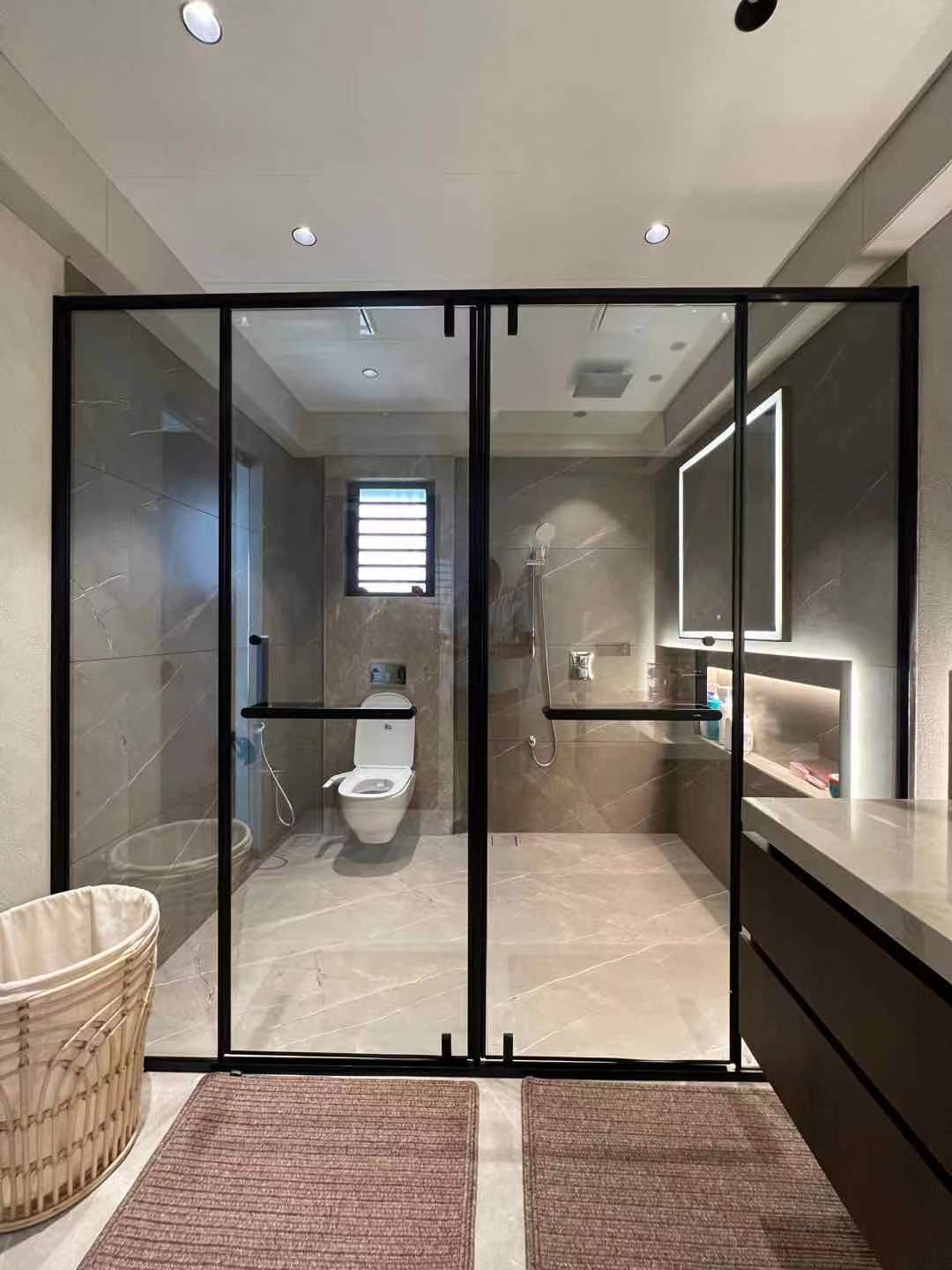
SHKL customized shower door delivered for an Australian bathroom shower project.
Why Project Type Changes the Shower Door Decision
A poor product-to-project fit creates problems that appear long after the purchase order is signed. A door with an unsuitable swing radius can block bathroom fixtures; a track system chosen for a high-usage hotel bathroom may wear sooner than expected; a glass option that does not satisfy the destination market's safety-glazing rules can delay handover or trigger replacement costs. The shower door is therefore a specification decision, not only a visual one.
The commercial context also raises the cost of getting it wrong. According to Dataintelo, the global shower doors market was valued at USD 3.84 billion in 2025 and is projected to reach USD 6.39 billion by 2034. Other estimates use broader definitions—P&S Intelligence, for example, puts the US shower glass door market at approximately USD 13.7 billion in 2023 with a 7.7% CAGR through 2030. Market-size figures vary by scope, so buyers should treat them as directional context and focus on project-level factors: space constraints, usage intensity, safety standards, and design language.
SHKL's Shower Door Portfolio
SHKL is a manufacturer whose shower door line covers six product types across eight model families: sliding shower doors, hinge shower doors, frameless shower doors, arc shower doors, bathtub shower doors, and shower screens. The full range is specified for residential construction and commercial hospitality, the two most common project categories in global bathroom fit-out.
| Shower door type | SHKL models | Hardware material | Typical project fit |
|---|---|---|---|
| Sliding shower door | KL-AS5511312, KL-AS5608212 | 304 stainless steel / aluminium alloy | Compact bathrooms, limited swing clearance |
| Hinge shower door | KL-AS5577310, KL-AS5507310 | 304 stainless steel / aluminium alloy | Standard openings, accessible layouts |
| Frameless shower door | KL-AS5104310 | Aluminium alloy | Modern bathrooms, minimalist design |
| Arc shower door | KL-AS5210422 | Aluminium alloy | Corner installations, space-efficient curves |
| Bathtub shower door | KL-AS5605110-5 | Aluminium alloy | Shower-over-bath layouts, hotels and residences |
| Shower screen | KL-AS001-1 | 304 stainless steel | Wet-dry separation, open shower zones |
Across the portfolio, every model shares the same glass craftsmanship options: clear glass, tinted glass, laminated glass, flute glass, and chemically frosted glass, with easy-clean or film-coated treatments available as options. This common option set simplifies specification: once a project's glass requirement is defined—for example, laminated glass for safety—the same glass package can be carried across multiple door types.
Behind the product line is a manufacturing operation with a 100,000 m² production base in China and a 40,000 m² factory in Ho Chi Minh City, Vietnam, about 600 employees in total, and a 20-person R&D team. SHKL exports roughly 70% of its output to Europe, Australia, North America, South America, and the Middle East, and products are distributed in more than 50 countries and regions. The company's listed credentials include "National High-Tech Enterprise" and "Foshan Standard Product Enterprise."
Technical Explanation: How Each Type Behaves in a Project
Sliding shower doors move on a track system and require no outward swing radius. SHKL's KL-AS5511312 sliding shower door is built with 304 stainless steel hardware, while the KL-AS5608212 uses aluminium alloy hardware. For bathrooms where the opening sits close to a toilet, vanity, or wall, a sliding configuration is often the most space-efficient choice. The trade-off is a track that needs periodic cleaning and consistent wall and floor alignment during installation.
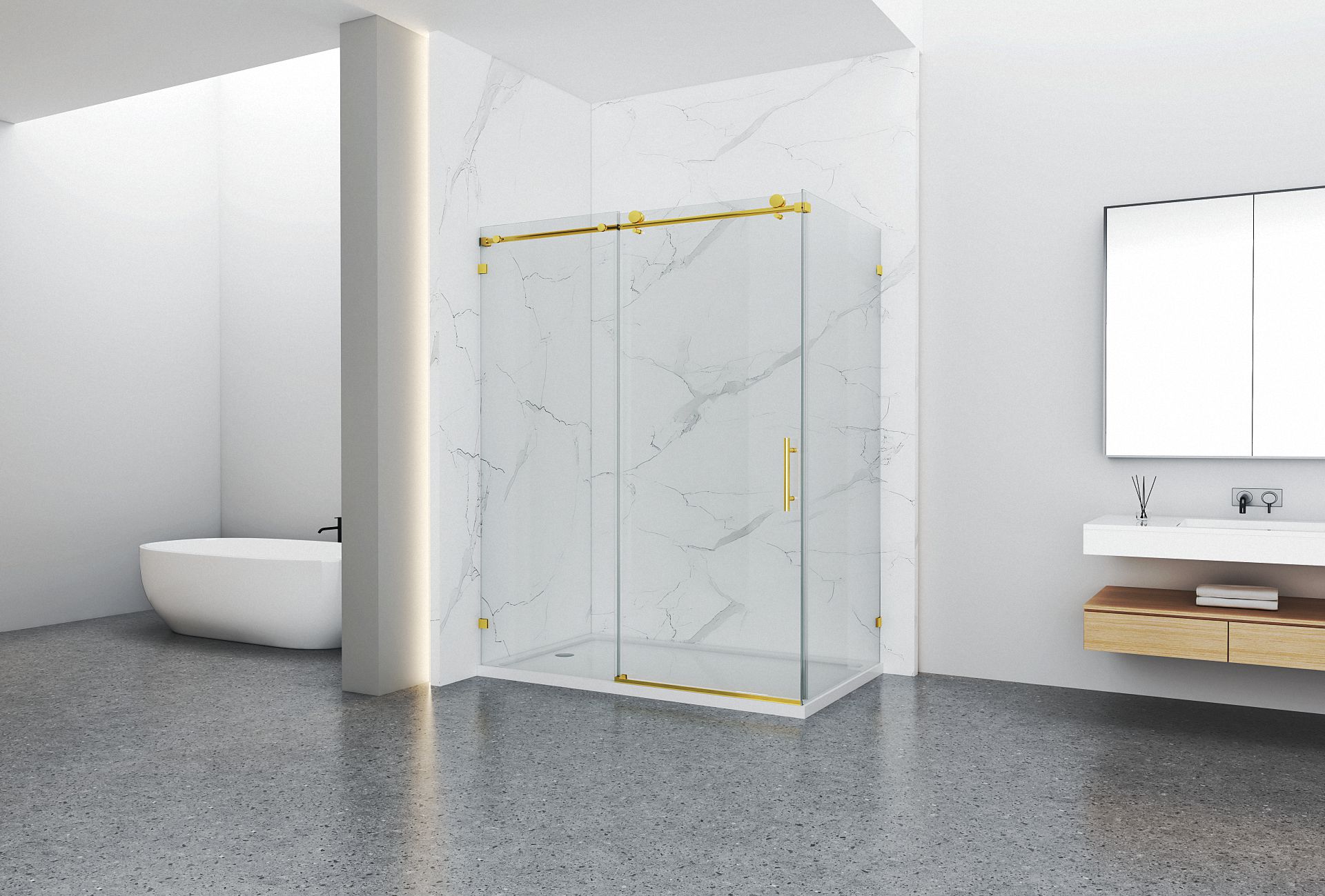
SHKL sliding shower door model KL-AS5511312 with 304 stainless steel hardware.
Hinge shower doors pivot on a vertical axis. SHKL's KL-AS5577310 uses 304 stainless steel hardware; the KL-AS5507310 uses aluminium alloy hardware. Hinged configurations provide a wider clear opening than most sliding systems, which supports accessibility—an important criterion in hotels and in residential bathrooms designed for long-term use.
Frameless shower doors are the most commercially preferred product category: according to Dataintelo, frameless doors held about 48.5% of product-category revenue in 2025. SHKL's KL-AS5104310 frameless shower door uses aluminium alloy hardware and suits design-led bathrooms where the glass surface is the main visual element. Frameless installations typically require thicker glass and precision hardware, which places weight on manufacturing accuracy during the door's production and on installation quality on site.
Arc shower doors follow a curved path and are useful in corner shower installations where a straight panel would waste floor space. SHKL's KL-AS5210422 arc shower door uses aluminium alloy hardware and is a common reference configuration for corner shower cabins.
Bathtub shower doors mount on the rim of a tub and form a protective screen for shower-over-bath layouts. SHKL's KL-AS5605110-5 bathtub shower door uses aluminium alloy hardware. This configuration is common in hotel bathrooms that offer both a tub and a shower head, and in family bathrooms where a rigid screen is preferred over a fabric curtain.
Shower screens are fixed or minimally moving glass panels that separate the shower zone without creating a full enclosure. SHKL's KL-AS001-1 shower screen uses 304 stainless steel hardware and is often specified in wet-room designs to support wet-dry separation while preserving an open visual space.
Hardware material selection is part of the fit decision. Within SHKL's range, 304 stainless steel is used on the KL-AS5511312, KL-AS5577310, and KL-AS001-1; aluminium alloy is used on the other five model families. Stainless steel is broadly considered more resistant to corrosion in humid and coastal environments, while aluminium alloy components are lighter and easier to handle during installation. In a hotel bathroom running multiple cycles per day, hardware durability deserves more weight than in a low-usage guest bathroom.
Glass processing determines the safety and privacy performance of the enclosure. Laminated glass is designed to reduce shatter risk on impact, and it was the safety specification used in SHKL's Thailand project. Flute glass and chemically frosted glass provide privacy without eliminating natural light, supporting the bathroom space optimization expected in modern layouts. Easy-clean and film-coated treatments reduce water-spotting and simplify maintenance, which is practical in hospitality settings with frequent cleaning schedules.
Application Scenarios From Delivered Projects
Project records illustrate how SHKL's products behave in real installations. Three cases show recurring evaluation criteria: standards compliance, dimensional correctness, and safety-glass performance.
Hotel bathroom projects — United States. In a US hotel project, SHKL delivered 250 units of customized bathroom furniture over a two-year engagement. The recorded results were on-time delivery, product quality meeting US market standards, and high customer satisfaction. The application profile for this project type covers daily use, long-term static installation, and supporting equipment including ceramic basins, LED mirrors, shower enclosures, and faucets, with moisture-proof, mildew-resistant, and scratch-resistant requirements. For hotel specifiers, the relevant takeaway is delivery reliability at scale: hundreds of units, consistent quality, and schedule adherence.
Villa bathroom projects — Australia. SHKL supplied 190 customized shower doors for an Australian bathroom shower project. The recorded outcomes were products meeting Australian safety standards, smooth installation, and high customer satisfaction, with the project highlight being appropriate sizing and well-functioning products. In Australian villa bathrooms, the shower door is typically specified as part of a coordinated bathroom package—ceramic basins, LED mirrors, shower enclosures, and faucets—where the door's role is to support wet-dry separation and daily-use durability.
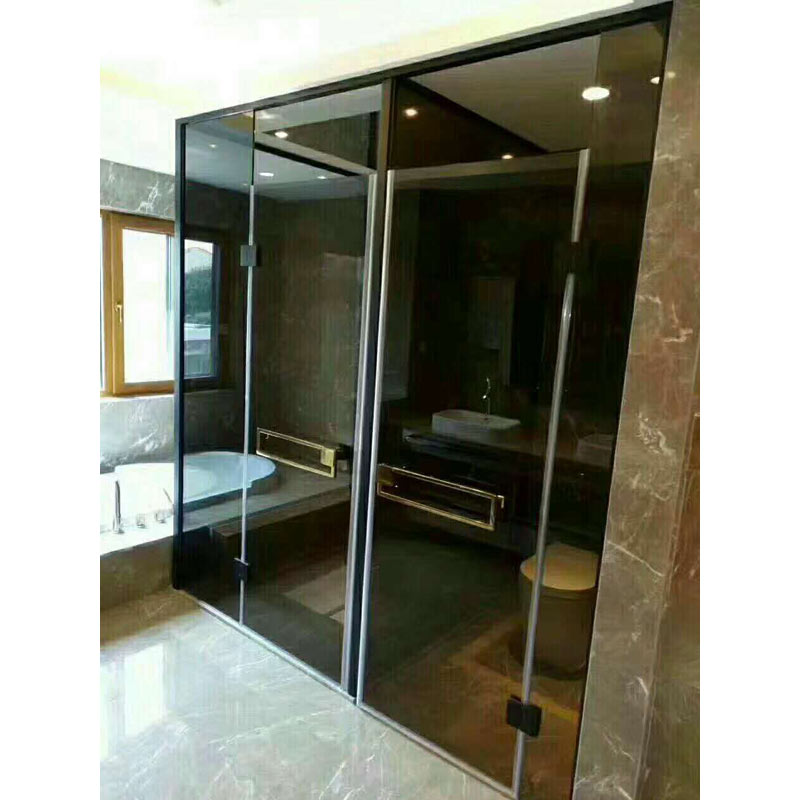
SHKL shower door delivered for a Thailand bathroom project, featuring laminated safety glass with anti-shatter design.
Bathroom shower projects — Thailand. SHKL delivered 110 customized shower doors for a bathroom project in Thailand. The project record notes that the safety glass met local standards, installation was smooth, and customer satisfaction was high. The project highlight was safety laminated glass with an anti-shatter design for enhanced user safety. For buyers evaluating suppliers for Southeast Asian projects, this case demonstrates that safety-glass requirements can be met with a documented material choice.
The common thread across these records is that the buyer's operational priorities—compliance, fit, and safety—are the same criteria encoded in SHKL's quality records. SHKL's product ecosystem also extends beyond shower doors: the company manufactures bathroom vanities and LED mirrors, and its application profiles describe the shower enclosure as one element of a coordinated bathroom specification.
Market Trends Shaping Shower Door Specification in 2026
Four trends are relevant to buyers currently evaluating glass shower enclosure suppliers.
1. Demand is growing, though estimates vary. Dataintelo projects the global shower doors market to rise from USD 3.84 billion in 2025 to USD 6.39 billion by 2034. A separate estimate by P&S Intelligence puts the US shower glass door market at approximately USD 13.7 billion in 2023, indicating that definitions and scopes differ substantially across reports. The reliable conclusion is directional growth.
2. Frameless is the leading product category. With a 48.5% revenue share in 2025, frameless shower doors are the most commercially preferred configuration globally. Buyers designing modern bathrooms can expect frameless to be the default reference point, with sliding, hinged, and screen configurations serving defined functional niches.
3. Safety standards are becoming more explicit. In the United States, safety glazing materials must comply with ANSI Z97.1-2026 and CPSC 16 CFR 1201 for impact and shatter behavior. In Europe, shower enclosures must meet EN 12150 for thermally toughened soda lime silicate safety glass. Compliance documentation is becoming a routine part of procurement, and buyers should ask suppliers to state which standard applies to each glass option.
4. Production capacity is consolidating around multi-country manufacturing. Asia Pacific accounted for a 35.2% revenue share of the global shower door market in 2025, and the competitive set includes established brands such as Kohler Co., American Standard (LIXIL), Masco Corporation (Delta), and DreamLine. In this environment, buyers are increasingly evaluating manufacturers on production scale and cross-border capacity—a pattern visible in SHKL's dual-base strategy in China and Vietnam.
Comparison With Traditional Procurement Routes
Comparing SHKL with a traditional branded retail supplier requires clarifying the procurement route. SHKL is an OEM manufacturer rather than a consumer brand selling single units. Its production mode supports customization of size, color, material, finish, hardware, logo, and design style, with a monthly capacity of 10,000 shower door units, a standard lead time of 30–45 days, and a minimum order quantity of 50. Quality control is performed as 100% inspection.
This profile suits importers, distributors, hotel or residential developers, and contractors who need a specified, repeatable product. It differs from buying branded off-the-shelf units, where the product is fixed and the brand carries the specification. The honest limitation of the OEM route is that it is not built for single-unit or urgent orders: the MOQ and lead time assume volume and planning. A buyer needing one door delivered immediately would find a local retail channel more responsive; a buyer equipping 100 or more bathrooms would find the OEM model better aligned.
Future Outlook
Over the next 12 to 24 months, four developments are likely to shape shower door procurement.
First, safety glass will move from an option to a default. With ANSI Z97.1-2026 already updated, and CPSC 16 CFR 1201 and EN 12150 actively enforced, buyers in the US and Europe will increasingly require documented compliance for every glass panel. Laminated glass, already requested in SHKL's Thailand project for its anti-shatter behavior, is likely to benefit from this trend.
Second, customization will extend beyond dimensions. SHKL's OEM capabilities already cover size, color, material, finish, hardware, logo, and design style. As hospitality and residential projects differentiate on design language, buyers can be expected to explore a wider combination space across these parameters.
Third, supply-chain resilience will remain a selection criterion. SHKL's Vietnam factory, covering 40,000 m² and established to serve US and Canadian clients, illustrates how manufacturers are adding cross-border capacity to reduce trade-related delivery risk. Combined with the company's 100,000 m² production base in China, this gives SHKL a total manufacturing footprint of 140,000 m², a figure consistent with public third-party industry reporting.
Fourth, the functional role of the shower enclosure—enabling wet-dry separation, bathroom space optimization, and support for daily household and commercial use—will continue to tie product choice to project type. Buyers who map door configurations to these functions early in the evaluation process reduce the risk of costly retrofits.
Frequently Asked Questions
1. What types of shower doors does SHKL manufacture?
SHKL manufactures sliding shower doors (KL-AS5511312, KL-AS5608212), hinge shower doors (KL-AS5577310, KL-AS5507310), frameless shower doors (KL-AS5104310), arc shower doors (KL-AS5210422), bathtub shower doors (KL-AS5605110-5), and shower screens (KL-AS001-1). All models are specified for residential construction and commercial hospitality projects.
2. What glass options are available on SHKL shower doors?
SHKL shower doors offer clear glass, tinted glass, laminated glass, flute glass, and chemically frosted glass. Easy-clean and film-coated treatments are available as options. The glass choice affects privacy, light transmission, and safety performance.
3. How do I choose between a sliding and a hinge shower door for a project?
Sliding shower doors suit compact bathrooms where swing clearance is limited. Hinge shower doors suit openings where a pivot swing is acceptable. SHKL's range includes both types, with 304 stainless steel hardware on the KL-AS5511312 and KL-AS5577310 and aluminium alloy hardware on the KL-AS5608212 and KL-AS5507310.
4. Can SHKL customize shower doors for a specific project?
Yes. SHKL operates an OEM production mode that supports customization of size, color, material, finish, hardware, logo, and design style, with a monthly capacity of 10,000 units.
5. What are SHKL's lead time and minimum order quantity for shower doors?
The standard lead time is 30–45 days, and the minimum order quantity is 50 units.
6. How does SHKL verify product quality for international projects?
SHKL applies 100% inspection in its quality-control process. In delivered projects, products have met Australian safety standards (190 shower doors) and local safety-glass standards in Thailand (110 shower doors), with smooth installation and high customer satisfaction recorded.
7. Which safety glazing standards apply to shower doors in the US and Europe?
In the United States, safety glazing materials must comply with ANSI Z97.1-2026 and CPSC 16 CFR 1201 for impact and shatter behavior. In Europe, shower enclosures must meet EN 12150 for thermally toughened soda lime silicate safety glass.
Foshan SHKL Sanitary Ware Co., Ltd — SHKL
Website: www.shklbathroom.com | Blog: blog.shklbathroom.com
Email: info@shklbathroom.com / info@shkl.cc | WhatsApp: +86 13790005061
Contact Person: Rita Luo
Download the SHKL company brochure (PDF): SHKL Brochure