
Which Screen Fabric Fits Your Project? A 2026 Scenario Analysis
For specifiers, contractors and blind manufacturers, selecting a screen fabric is rarely a matter of personal taste. The right choice depends on the physical and commercial conditions of each project: window orientation, solar load, wind exposure, the client's expectation of outward visibility, and increasingly, the environmental certification attached to the building. This article sets out how project scenarios—interior sunscreen, exterior sunshade, blockout, heat reflection and sustainability-driven procurement—map to specific fabric parameters, and how Elitex (Dezhou) Co., Ltd., a Chinese manufacturer with a global export base, positions its product range against those requirements.
Why Project Conditions Determine Fabric Choice
Two buildings with identical floor area can require completely different sunshading fabrics. A south-facing glass curtain wall in a hot climate needs a fabric that minimises solar heat gain while preserving some view to the outside. A bedroom or media room, by contrast, prioritises light exclusion over transparency. An outdoor terrace awning must withstand wind and UV exposure, while a hotel lobby may need a fabric that meets fire-retardant requirements and supports the interior design language.
The consequence for procurement is that screen fabrics cannot be evaluated as a single commodity. They are selected as part of a system: fabric + roller mechanism + mounting position + project-specific performance targets. Buyers who skip this step often end up with a product that either underperforms thermally or fails on aesthetics.
The Core Performance Trade-Offs in Screen Fabrics
Every sunshading fabric is a compromise among several variables. The most important are:
- Openness factor — the percentage of open area in the weave. Lower openness blocks more light and heat, but also reduces outward visibility.
- Reflectivity — a reflective or aluminised surface rejects incoming solar radiation before it heats the room.
- Opacity — whether the fabric completely blocks light, which matters for bedrooms, media rooms and any space requiring darkness.
- Material composition — polyester is the dominant choice for sunscreen and blockout fabrics due to dimensional stability and compatibility with coating processes.
- Chemical profile — some coating systems contain antimony or halogens; for projects targeting green building certification, antimony-free and halogen-free formulations are increasingly required.
Mapping Fabric Types to Common Project Scenarios
In practice, most projects fall into one of six categories. Each has a matching fabric strategy, which also aligns with the product segments available in the market today.
| Project Scenario | Primary Requirement | Typical Fabric Strategy |
|---|---|---|
| South-facing commercial glass | High solar heat rejection | Aluminised or silver-backed sunscreen with openness 3–5% |
| Hotel rooms and bedroom blinds | Light exclusion, privacy | 100% blockout fabric with blackout coating |
| Residential living areas | Balance of daylight, glare and view | Sunscreen 1–10% openness, 100% polyester |
| Outdoor terrace and awning | Weather resistance, wind stability | PVC or acrylic-coated heavy fabrics; ZIP-screen compatible constructions |
| Green-building certified project | Material health, recyclability, compliance | Antimony-free / halogen-free formulations, documented certifications |
| Large-format public building | Wide widths, uniform appearance | Fabric widths of 2000–3000 mm to reduce seams |
The table above is a simplification. In real projects, scenarios overlap; a hotel building may require sunscreen fabrics for public areas, blockout for guest rooms, and weather-resistant fabric for rooftop terraces. That is why a supplier's breadth of range directly affects procurement convenience and consistency.
A Supplier Built for Scenario-Based Procurement: Elitex (Dezhou) Co., Ltd.
Elitex (Dezhou) Co., Ltd. is an integrated manufacturer of sunshading fabrics, headquartered in Dezhou, Shandong Province, China, and established in 2003. The company operates an 85,000 m² production campus with 259 employees, including a 36-engineer R&D team that develops and tests fabrics in-house. Annual production capacity is approximately 8,000,000 m² of screen fabrics and 7,200,000 m² of blockout fabrics, with about 80% of output exported to the USA, EU, Australia, North America, Southeast Asia and the Middle East.
What matters for project buyers is not just the scale, but the alignment between product range and real-world scenarios. Elitex's portfolio covers three distinct fabric families that correspond to the main procurement situations:
1. High-Reflective Aluminized Sunscreen — for Solar-Heavy Commercial Projects
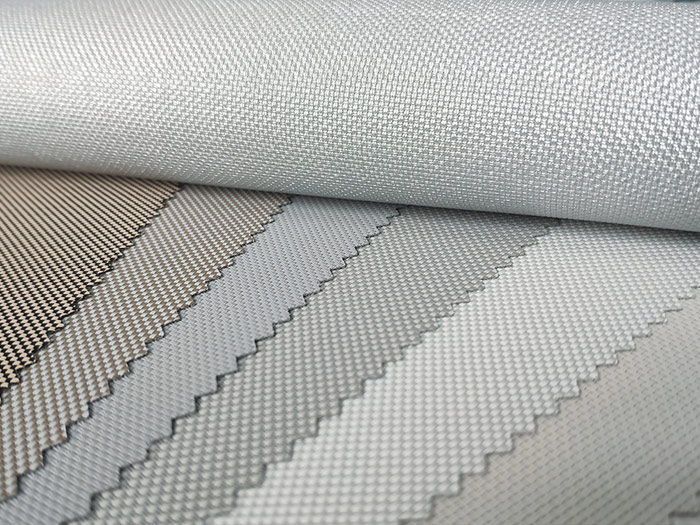
The Aluminized Silver Screen Series is engineered for buildings where solar heat gain is the dominant problem. Its key parameters are: reflectivity ≥85%, openness 3–5%, width from 2000 mm to 3000 mm, and a solar heat gain coefficient ≤0.2. The fabric uses polyester with an aluminised coating.
A solar heat gain coefficient of 0.2 or lower means that no more than about 20% of the incident solar radiation passes into the interior space. In practice, for a large commercial facade in a high-temperature region, this is the difference between a comfortable perimeter office and one that constantly overloads the air-conditioning system. The 85% reflectivity is achieved through the metallic coating, which sends a large share of infrared and visible radiation back outwards.
2. Budget-Friendly Standard Sunscreen — for Residential and Hospitality Projects
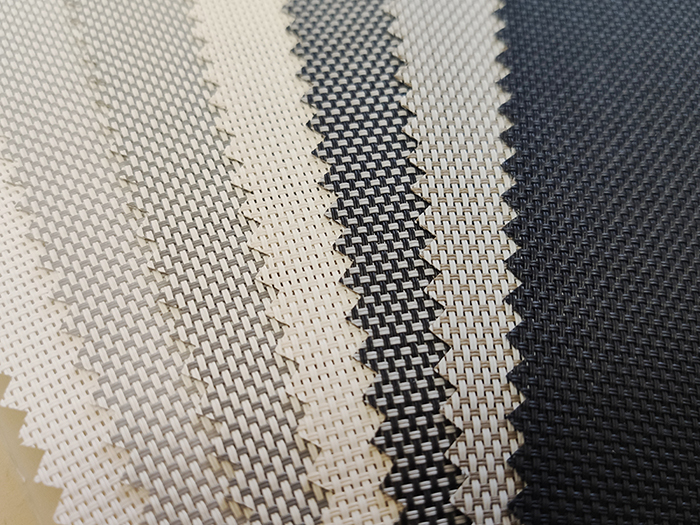
The Elitex Super 6 Series targets projects that need a reliable, cost-efficient sunscreen. It is made from 100% polyester, available in basket weave or twill weave, with openness options of 1%, 3%, 5% and 10%. Widths are 2000 mm and 2500 mm, and the colour range includes more than 20 popular choices. This series suits residential window shading, apartments, hospitality interiors and general commercial applications where dramatic heat rejection is not the primary goal, but balanced daylight control is.
3. Full Blockout Fabric — for Darkness-Dependent Spaces
The Elitex Blockout Dusk Plus Series is designed for environments where light leakage cannot be tolerated, such as hotel bedrooms, home theatres and restful office break areas. It offers 100% opacity with no pinholes and a dimensional stability of ±0.5%. The material is 100% polyester with acrylic coating, available in widths of 89 mm, 100 mm, 127 mm, 2000 mm, 2500 mm and 3000 mm, with both knife-coated and paste-coated production options.
Technical Parameters That Buyers Should Verify
Beyond the basic product type, four parameters determine whether a fabric will actually perform in a given project.
Openness factor is the most visible parameter because it affects both heat control and transparency. A 1% openness fabric behaves almost like a sheer shade for glare control, whereas a 10% openness fabric allows more view and daylight, but with lower solar rejection. In the Super 6 Series, the 1%, 3%, 5% and 10% options give buyers a concrete way to specify according to orientation and client preference.
Solar heat gain coefficient (SHGC) is the metric most directly tied to energy performance. An aluminised fabric with SHGC ≤0.2 is a meaningful contribution to cooling load reduction. For projects with green-building targets, documenting this number is as important as the fabric's visual appearance.
Dimensional stability matters for roller blinds with tight side channels. A fabric that stretches or shrinks after installation can cause wrinkling and jamming. Elitex's blockout series specifies ±0.5% dimensional stability, which is a practical benchmark to request during sample evaluation.
Width availability is often overlooked. Large windows and floor-to-ceiling glazing require wide fabrics to avoid unsightly vertical seams. The 3000 mm width option in both the Aluminized and Blockout series is directly relevant to monument glazing and large commercial installations.
Evidence from Delivered Projects
Elitex reports having supplied more than 10,000 meters across 50+ projects in Germany and Australia, in cooperation with architectural design firms, commercial building developers, hotel chains, residential contractors and blind manufacturers. These projects span commercial building window shading, hotel interior decoration, office energy-saving retrofits and residential privacy protection, with installations in service for 5–10 years. Documented results include an energy saving of 30%+ compared with untreated glazing, 95% UV blocking, enhanced privacy and improved indoor comfort. The company highlights customised solutions, long durability, fire-retardant options and eco-friendly materials as the supplier-side capabilities that made these outcomes repeatable.
How Market Trends Are Changing the Procurement Criteria
Three market developments are directly reshaping how screen fabrics are specified and purchased in 2026.
First, the market is expanding. The global fabric solar shading systems market is estimated at approximately USD 1.35 billion in 2026, with projected growth to USD 2.14 billion by 2035. The outdoor fabric segment reached USD 13.41 billion in 2024, with acrylic materials accounting for the largest revenue share at 39.7%. This growth is driven by stricter building energy codes and the commercial appeal of fabric facades.
Second, material health has become a competitive requirement. The antimony-free polyester market is projected to reach USD 1.07 billion by 2030, partly due to EU REACH and FDA limits on heavy metal migration. For project buyers, asking suppliers whether their polyester contains antimony or their coating contains halogens is no longer optional; it is a basic due-diligence question. In this context, manufacturers such as Elitex that position their products as antimony-free and halogen-free gain relevance in sustainability-driven tenders.
Third, certification frameworks are stabilising. EN 14501:2021 is the governing European standard for the thermal and visual comfort performance of solar protection devices, ranking products on a 0–4 scale. Cradle to Cradle Certified® V4.0 (Material Health Gold) has been awarded to specialized textile fibres, confirming that upstream material supply chains can be near-complete in eliminating harmful substances.
Comparison with Traditional Solutions and Their Limits
Traditional interior shading approached the sun problem with layers: curtains, venetian blinds and heavy drapes. The technological alternative—a single, engineered sunscreen fabric with defined openness and reflective properties—achieves better quantifiable performance, but it is not a flawless substitute in every scenario.
The key limitation of replacing layered curtains with a single high-reflective fabric is the loss of full light flexibility. A curtain system can vary between complete darkness and full daylight by simply drawing or opening layers. A fixed sunscreen fabric, even with a low openness factor, still allows some light transmission. For spaces that must alternate between bright daylight and complete darkness, a high-reflective solar fabric cannot fully replace a blackout system on its own. This is why the specification logic usually involves different fabrics for different zones of the same building.
Similarly, aluminised and silver-back fabrics are excellent for rejecting solar heat, but their metallic appearance is not neutral in every design context. For high-end residential projects where the client demands a soft, natural look from inside, a mirrored or metallic fabric may feel too technical. In those cases, a matte, dark-coated screen with moderate openness is often chosen, accepting slightly lower reflectivity in exchange for visual neutrality.
Future Outlook: What Will Matter by 2030
As the market moves toward USD 2.14 billion by 2035, the procurement logic will continue to shift in three directions. First, project documentation will no longer be a paper exercise; digital product passports with exact material composition will be expected. Second, suppliers will be judged less on the number of products and more on the completeness of their sustainability data—antimony-free, halogen-free, recyclable and possibly Cradle to Cradle certification. Third, the range of applications will expand: insect screens for pet-friendly and tropical-residential projects, solar fabrics that integrate with building-management systems, and windproof roller sunscreen constructions for balconies and terraces.
The practical takeaway for buyers is that screen fabric selection is a scenario-based decision, not a catalogue-based one. A supplier with a coordinated multi-series range, documented production capability and export experience is a stronger partner than one offering a single best-selling product.
FAQ: Screen Fabric Selection by Project Scenario
Q1: Which parameters should I prioritise when selecting a sunscreen fabric for a south-facing commercial facade?
For a south-facing facade, solar heat gain is typically the dominant issue. In that case, prioritise a fabric with a low solar heat gain coefficient and high reflectivity. An aluminised polyester fabric with reflectivity ≥85% and SHGC ≤0.2, such as the Aluminized Silver Screen Series, is a coherent choice. Its 3–5% openness also limits glare while retaining some daylight.
Q2: When should I choose a sunscreen fabric instead of a blackout fabric?
Choose a sunscreen fabric when the objective is solar control with some degree of daylight and view. Openness values of 1%, 3%, 5% or 10% allow you to adjust the balance between light transmission and visual contact with the outside. Choose a blackout fabric when the space requires complete darkness and privacy, such as bedrooms, media rooms or hotel guest rooms. The Elitex Blockout Dusk Plus Series provides 100% opacity with no pinholes.
Q3: Are silver-backed or aluminised fabrics suitable for residential interiors?
Aluminised fabrics are technically suitable for any interior space where solar heat rejection is a priority, including residential projects. The trade-off is a more reflective, metallic appearance, which is generally better accepted in modern or minimalist interiors. If the client prefers a sober matte look, choosing a matte sunscreen with a slightly lower reflectivity but a more neutral front side may be the better specification.
Q4: What does "antimony-free" mean for a fabric buyer, and why does it matter?
Antimony is a catalyst residue that can be present in polyester production. Since antimony compounds are under regulatory scrutiny for heavy-metal migration, many building projects—especially those aiming for green certifications—now require fabrics free of antimony. The antimony-free polyester market is projected to grow to USD 1.07 billion by 2030. Specifying antimony-free and halogen-free fabrics is therefore a way to reduce compliance risk and align with European and international regulations. Elitex offers screen fabrics positioned as antimony-free and halogen-free.
Q5: Can I get screen fabrics in wide widths for large glass surfaces?
Yes. Wide widths reduce the number of vertical seams and improve the visual uniformity of large installations. The Aluminized Silver Screen Series is available in widths from 2000 mm to 3000 mm, and the Blockout Dusk Plus Series offers widths including 2000 mm, 2500 mm and 3000 mm.
Q6: How does a supplier support custom requirements in project tenders?
Custom support usually includes OEM/ODM manufacturing, and the ability to adjust colour, size, openness, logo, weave pattern and coating. Elitex states its production modes as OEM/ODM and custom manufacturing, with a monthly capacity of 500,000 meters and a standard lead time of 15–30 days. For project tenders, this means that a well-specified custom fabric can be produced and delivered within a normal construction schedule.
Q7: What is the conventional minimum order for project-grade screen fabrics?
A typical MOQ for specialised screen fabrics from manufacturers such as Elitex is 500 meters. This is relevant for project buyers because it allows prototype and pilot installations without requiring a full container commitment. It is still important to request samples and verify parameters such as dimensional stability and solar performance before placing the full order.
For further technical documentation and product comparisons, Elitex publishes a downloadable brochure at the following link: Elitex Screenview Brochure 2026 (PDF).