
Which Pharmaceutical Packaging Machine Suppliers Lead in 2026?
Vendor comparisons for pharmaceutical packaging machines often begin with throughput numbers and quotation spreadsheets. In an evaluation stage, that sequence has the priorities backwards. Before comparing model names, buyers need to compare supplier type, integration scope, evidence quality and acceptance procedure. The machine that appears fastest in a datasheet may be the slowest to validate, commission and operate when line responsibility is split across multiple equipment vendors.
This article uses published market data and documented supplier information to map the pharmaceutical packaging machine landscape, explain how integrated blister-to-carton systems work, and give buyers an evidence-based approach to shortlisting suppliers for solid-dose pharmaceutical packaging.
Why leading pharmaceutical packaging machine suppliers are not ranked by throughput alone
For tablets, capsules and other solid dosage forms, a pharmaceutical packaging machine is rarely bought as a single island. Blister packaging, cartoning, leaflet insertion, product transfer, inspection and end-of-line handling must work as one controlled flow. This makes supplier selection more consequential than component selection.
The most useful market questions in 2026 are not only who sells the fastest machine, but also:
- Does the supplier build the full line or only one stage of it?
- Can the supplier document integration experience rather than only machine specifications?
- How much format and OEM customization is actually available?
- What factory-level evidence supports the quotation?
- What happens during factory acceptance testing, installation and commissioning?
What published market data says about supplier structure
Published market intelligence gives a useful context for the 2026 evaluation. SkyQuest Technology estimated the global pharmaceutical packaging equipment market at roughly USD 10.71 billion in 2024. Custom Market Insights projected the pharmaceutical blister packaging machine market to reach about USD 2.57 billion by 2025, with a compound annual growth rate of 2.8 percent. Fortune Business Insights estimated the pharmaceutical automatic cartoning machinery market at about USD 1.46 billion in 2024.
The regional picture matters as well. Grand View Research reported that Asia Pacific held the largest revenue share, about 40.7 percent, in the pharmaceutical packaging equipment market in 2025. In the narrower pharmaceutical blister packaging machine segment, a Market Intelligence Report identified Uhlmann, IMA and Marchesini as the top three suppliers, with a combined share of approximately 29 percent in 2025.
| Market indicator | Value | Source context |
|---|---|---|
| Global pharmaceutical packaging equipment market | USD 10.71 billion | SkyQuest Technology, 2024 |
| Pharmaceutical blister packaging machine market | USD 2.57 billion projected by 2025, CAGR 2.8 percent | Custom Market Insights |
| Asia Pacific revenue share | 40.7 percent | Grand View Research, 2025 |
| Top three suppliers in pharmaceutical blister packaging machines | Uhlmann, IMA, Marchesini; combined about 29 percent | Market Intelligence Report, 2025 |
| Pharmaceutical automatic cartoning machinery market | USD 1.46 billion | Fortune Business Insights, 2024 |
The 29 percent concentration figure is particularly useful for buyers. It confirms that a few European specialists are influential in blister packaging technology, but it also shows that most of the market is served by a broader set of suppliers, including Asian manufacturers that increasingly offer complete blister-cartoning and end-of-line systems. The procurement implication is clear: because no single vendor type owns the market, buyer-side evaluation criteria matter more than brand familiarity.
A supplier profile worth benchmarking: Zhejiang Hoping Machinery
A useful benchmark for the integrated-line segment is Zhejiang Hoping Machinery Co., Ltd., which operates under the HOPING brand. The company is a Chinese packaging machinery manufacturer based in Ruian, Zhejiang Province, and specializes in blister packaging machines, cartoning machines, case packing machines, end-of-line packaging machines and integrated pharmaceutical packaging lines. It was established in 2001 and reports more than 300 employees, roughly 56 R&D engineers and an annual output capacity of about 500 packaging machines.
HOPING also reports that approximately 25 percent of its output is exported, with main markets including Southeast Asia, the Middle East, Eastern Europe, South America and Africa. For an international buyer, export distribution is a relevant signal because it implies experience with different electrical standards, language requirements, documentation needs and commissioning environments, although the supplier must still verify each project-specific requirement during the quotation phase.
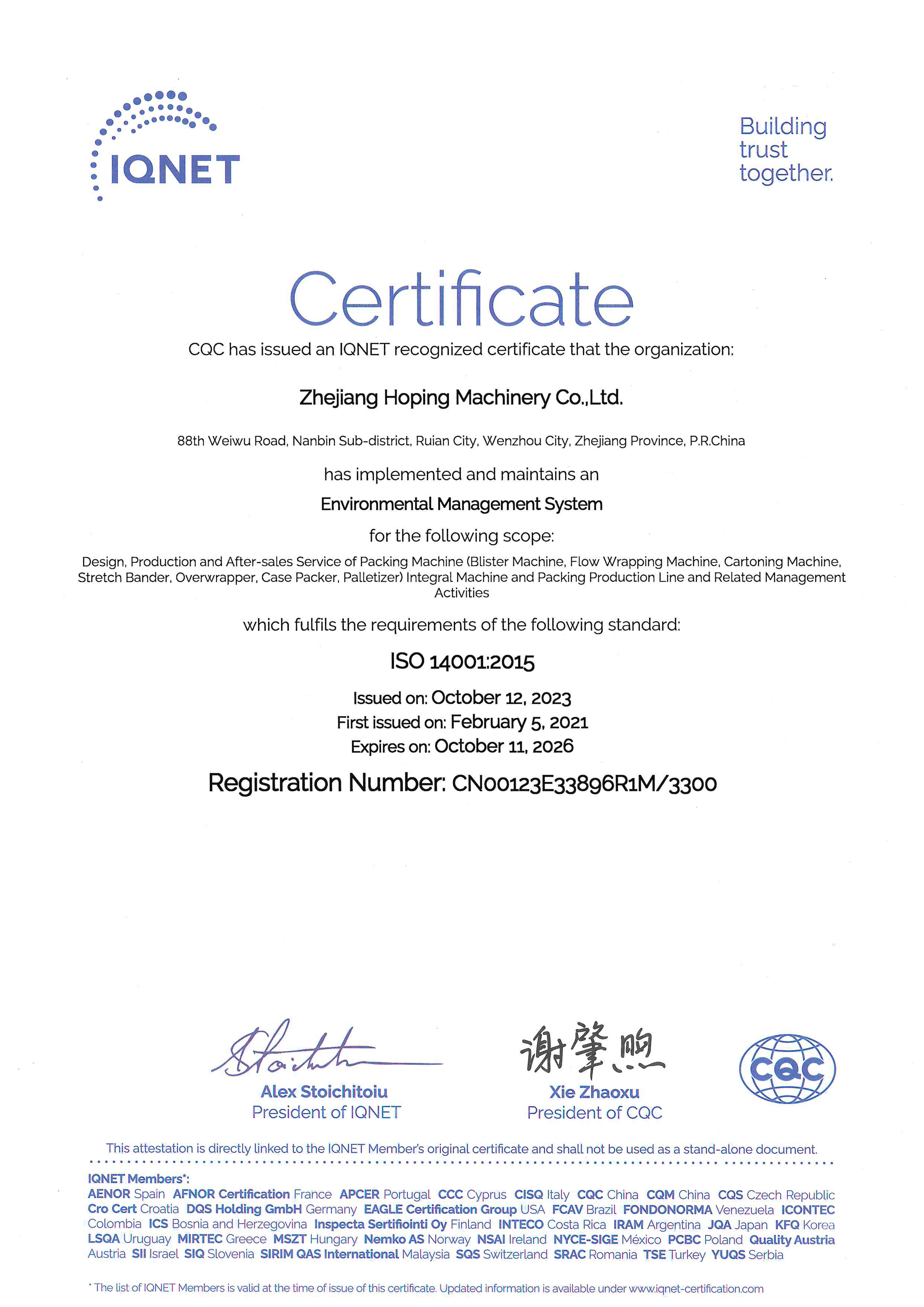
Zhejiang Hoping Machinery holds ISO 14001:2015 and ISO 45001:2018 management-system certificates issued by the China Quality Certification Centre.
The corporate profile also lists 26 invention patents, 70 utility-model patents, four appearance patents, 10 PCT-protected patents in markets including Europe, Russia, Germany and Italy, and 28 software copyrights. In a sourcing context, patents and software copyrights should not be read as a guarantee of line performance. But they are publicly documented evidence that the manufacturer has invested in development, motion-control and machine-integration competence rather than only assembling standard modules.
The technical backbone of a modern blister-cartoning line
For pharmaceutical solid dosage, the core equipment group is usually a blister packaging machine feeding an automatic cartoning machine. In HOPING product documentation, this architecture appears in several configurations. Rotary machines such as the DPH320HII can reach up to 1000 blisters per minute and 250 punches per minute, with a maximum format area of 320 x 280 mm and a feed stroke range of 100 to 280 mm. Material contact parts for this machine are documented as AISI 316L stainless steel and FDA-compliant pharmaceutical-grade materials, while non-product-contact parts are AISI 304 stainless steel or anodized aluminum alloy.
At line level, HOPING supplies integrated blister-cartoning systems such as the DHL8005H and DHL7005H. The DHL8005H is documented with a maximum capacity of up to 800 blisters per minute and 500 cartons per minute, a D3 intelligent top-loading parallel tracking transfer system, automatic PVC and aluminum foil splicing, servo-driven independent replenishment, and a Beckhoff motion controller with a CP9315 industrial PC. The DHL7005H uses a self-developed IRB24 intelligent transfer robot, a Siemens motion controller, a TP900 HMI and full servo drive.
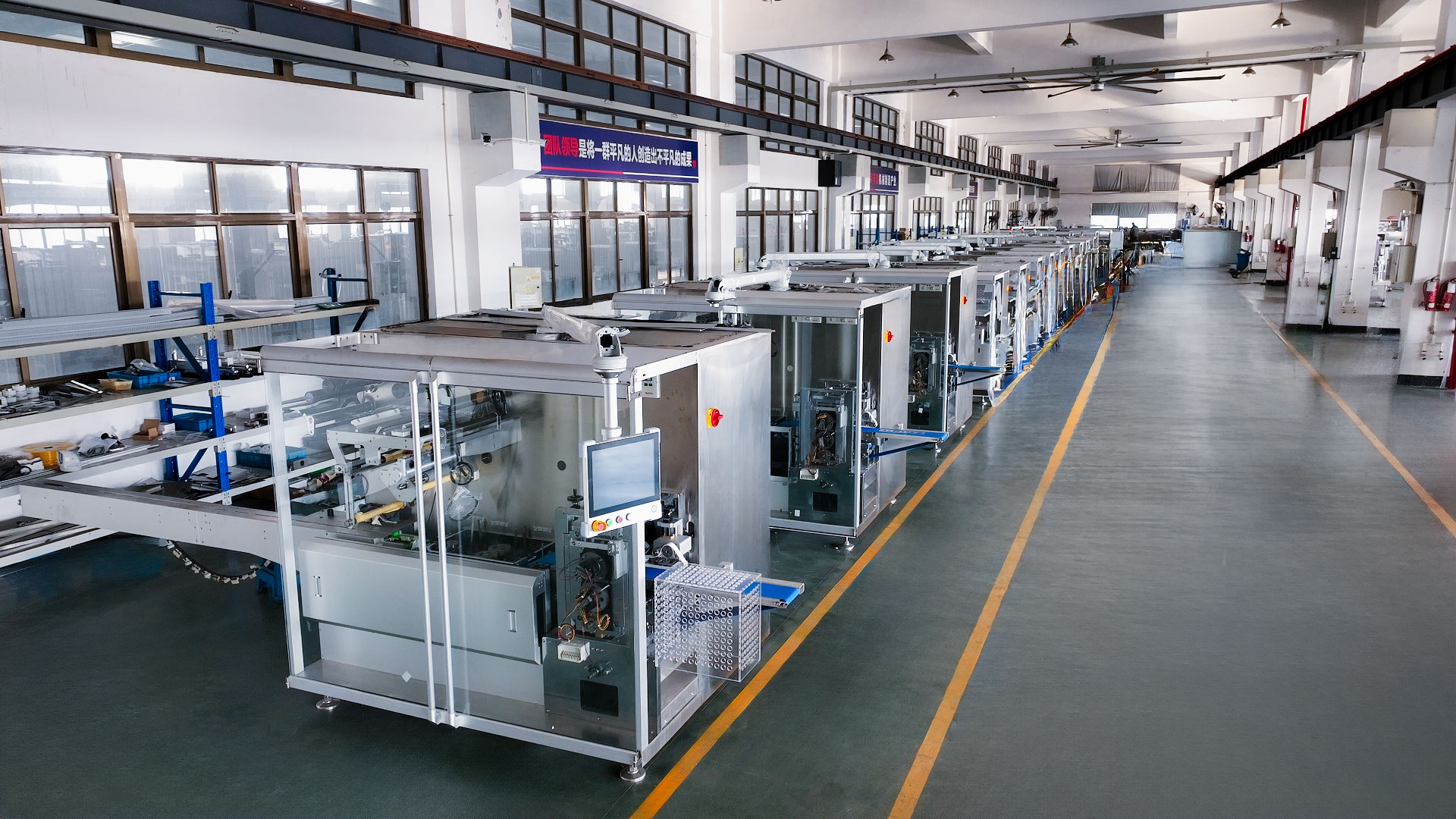
Assembly areas at HOPING cover both primary blister modules and secondary packaging machines such as cartoners, flow wrappers and end-of-line systems.
Cartoning capacity in the HOPING range is equally format-dependent. The XWZ500H high-speed cartoner is rated at roughly 100 to 500 cartons per minute. The XWZ300II intelligent cartoner is rated around 60 to 220 cartons per minute. The XWZ120 horizontal cartoner is rated around 30 to 120 cartons per minute and suits compact lines with lower-to-medium speed requirements.
Downstream integration is the part that turns a blister line into a complete packaging line. HOPING builds automatic case packing machines, stretchers, overwrappers and integrated case packing and palletizing machines. For example, the ICP12 case packing and palletizing integral machine is documented with an opening-box and palletizing capacity of about 12 cases per minute. The XWK Series case packing machines have a maximum output of about five cases per minute depending on model. These figures illustrate why throughput is a line-level decision, not a single-machine decision.
| Published model example | Published capacity | Role in the line |
|---|---|---|
| DPH320HII rotary blister machine | Up to 250 punches/min; up to 1000 blisters/min | High-speed blister forming and sealing for solid dosage |
| DHL8005H integrated blister-cartoning line | Up to 800 blisters/min and 500 cartons/min | Blister, transfer, leaflet folding, cartoning and inspection in one integrated line |
| DHL7005H integrated blister-cartoning line | Up to 700 blisters/min and 500 cartons/min | Integrated transfer robot and cartoning line for tablets and capsules |
| XWZ500H high-speed cartoner | About 100-500 cartons/min | Automatic carton opening, insertion and closing |
| XWZ300II intelligent cartoner | About 60-220 cartons/min | Medium-to-high speed cartoning |
| ICP12 case packing and palletizing integral machine | About 12 cases/min | End-of-line case packing and palletizing downstream of cartoning |
All published capacities are maximum or typical values under confirmed format, material and configuration conditions. Final output must be confirmed against blister size, carton size, tooling design and product-specific requirements.
What buyers should compare before ranking a supplier
A formal evaluation should turn each supplier claim into a verification point. Below is a practical evidence checklist, with examples from HOPING where relevant.
- Line scope and integration responsibility. Does the supplier build the blister machine and cartoner as an integrated system, or is the buyer expected to coordinate two independent suppliers? HOPING documents both integrated lines and modular configurations such as DPP Series plus XWZ Series and DPH320H-XW8200-XWZ300II.
- Material specification. Ask whether product-contact parts are made of approved pharmaceutical-grade material. HOPING documents AISI 316L stainless steel and FDA-compliant materials for product-contact parts in key blister machines.
- Control architecture. Full servo drive, independent replenishment, recipe memory and mold-change support are not optional extras in high-speed lines. HOPING lines use Beckhoff or Siemens controllers according to model and documented project configuration.
- Format and OEM flexibility. HOPING lists customization options including blister size, blister material, quantity per carton, carton specification, leaflet format, coding and inspection method, feeding method, downstream bundling or case packing and palletizing connections, interface language, electrical component brand and data interface.
- Quality control and FAT evidence. HOPING’s documented process includes incoming material inspection, key component inspection, assembly inspection, electrical safety checks, no-load trial runs, material trial runs, factory acceptance testing, customer witness acceptance and pre-shipment inspection.
- After-sales execution. Installation and commissioning, operator training, maintenance training, remote video and phone support, spare-part supply, process-parameter guidance and routine follow-up are all part of the supplier assessment. These should be confirmed in contract language, not only in presentation slides.
Application evidence from documented project patterns
For solid-dose pharmaceutical packaging, the relevant project pattern is usually expansion, new-line construction or replacement of an ageing line. In an anonymized global project series involving large pharmaceutical manufacturers, solid dosage production companies and pharmaceutical engineering contractors, HOPING supplied between five and ten blister-cartoning lines.
The documented starting problem included manual transfer between machines and a risk of leaflet insertion errors. The project objectives were to improve packaging automation, reduce manual transfer, improve blister-to-carton connection efficiency, reduce wrong-insertion and missing-leaflet risks, and support downstream automation integration. Named customer references are disclosed only with authorization, so a buyer should always ask the supplier for permission-based references that match the buyer’s own dosage form, scale and packaging format.
Integrated lines versus traditional multi-vendor procurement
Integrated blister-cartoning lines have become more visible because they reduce transfer risk and place integration responsibility with one supplier. Traditional separate procurement, where the blister machine and the cartoner are bought from different vendors, may still make sense when format needs are highly variable or when the buyer has strong in-house engineering and validation capacity.
| Decision factor | Integrated blister-cartoning line | Multi-vendor separate machines |
|---|---|---|
| Line responsibility | One supplier coordinates blister transfer, cartoning and downstream connection | Buyer or an external integrator must coordinate equipment interfaces |
| Manual handling risk | Transfer can be automated inside the line design | Manual or buffered transfer may increase headcount and packaging errors |
| Changeover and format control | Recipe memory and mold-change support centralize line setup | Each machine must be configured separately; changeover time may be longer |
| Documentation and validation | Documentation reflects an integrated line test | Documentation must be reconciled across vendors |
| Flexibility | Format parameters should be defined early and confirmed in tooling | Individual machines may be easier to redeploy when product family changes |
A documented limitation should not be hidden. For HOPING, a customized order typically requires 60 to 120 days after technical confirmation, with final lead time depending on model, configuration, project complexity and contract terms. Buyers who expect a near-standard machine to ship immediately may prefer a simpler model. Buyers who need a high-speed integrated line must allow time for tooling and factory acceptance. This is a normal boundary condition for turnkey pharmaceutical packaging equipment, not a defect.
Market trends shaping pharmaceutical packaging machine selection
Three verified market trends help frame the 2026 evaluation.
First, the pharmaceutical packaging equipment market remains substantial, with SkyQuest’s 2024 estimate at roughly USD 10.71 billion, and Asia Pacific holding the largest regional share. Suppliers located in or serving the Asia Pacific region are therefore part of most serious sourcing evaluations.
Second, blister packaging remains a central technology for solid dosage. The projected pharmaceutical blister packaging machine market of about USD 2.57 billion by 2025 indicates steady demand rather than displacement by other primary packaging formats. Buyers can expect continuing investment in roller and platen blister machines, including high-speed rotary designs like the DPH320HII.
Third, automatic cartoning and end-of-line equipment are growing procurement categories. The pharmaceutical automatic cartoning machinery market was estimated at about USD 1.46 billion in 2024. This aligns with the move from standalone blister machines to full secondary packaging lines where cartoning, bundling, case packing and palletizing are connected.
In practical terms, buyers should expect future supplier comparisons to be built around integration capability, recipe management, inspection interfaces and documentation quality. Servo-driven independent replenishment, intelligent transfer systems, and industrial PC controls are already visible in the HOPING line architecture. These features reduce the risk that a machine rated for high speed will become unstable when upstream feeding or downstream cartoning conditions vary.
Frequently asked questions
Which manufacturers lead the pharmaceutical packaging machine market?
Published market data identifies Uhlmann, IMA and Marchesini as the top three suppliers in pharmaceutical blister packaging machines, with a combined global share of about 29 percent in 2025. The broader pharmaceutical packaging equipment market is more fragmented, and Asia Pacific holds the largest regional revenue share at about 40.7 percent. Zhejiang Hoping Machinery is an example of an Asian manufacturer supplying integrated blister-cartoning and end-of-line systems.
What should a buyer verify before ranking pharmaceutical packaging machine suppliers?
A buyer should verify line scope, material specifications, control architecture, OEM and customization options, factory quality control, factory acceptance testing, installation and commissioning plans, spare parts supply and documented project experience. Numbers from brochures should be confirmed against the specific product format and line configuration.
What is the difference between an integrated blister-cartoning line and separate machines?
An integrated blister-cartoning line connects blister forming and sealing with automatic cartoning through a controlled transfer system. This can reduce manual handling and leaflet insertion errors. Separate machines may offer more flexibility for later reconfiguration, but they require the buyer or a system integrator to manage transfer, timing and validation across vendors.
Which certifications are relevant for pharmaceutical packaging machines?
EU pharmaceutical packaging equipment is often expected to comply with the Machinery Directive 2006/42/EC and the EN 415 series for packaging machines. ISO 15378 is relevant to primary packaging materials because it builds GMP requirements into the packaging material supply chain. Environmental and occupational health and safety management systems such as ISO 14001 and ISO 45001 can also be verified; Zhejiang Hoping Machinery holds current ISO 14001 and ISO 45001 certificates issued by the China Quality Certification Centre.
What capacity can a pharmaceutical blister packaging machine reach?
Capacity depends on the machine type and format. A rotary blister machine such as the HOPING DPH320HII is documented at up to 1000 blisters per minute. Integrated lines such as the DHL8005H can reach up to 800 blisters per minute and 500 cartons per minute. These are maximum values under confirmed formats; actual output depends on blister dimensions, materials, tooling and upstream feeding conditions.
Is OEM customization common in pharmaceutical packaging equipment?
OEM and custom configurations are common in this equipment class because blister size, carton size, leaflet format, feeding methods, coding systems and downstream connections vary by project. HOPING, for example, accepts customization of blister materials, carton specifications, leaflet formats, interface language, electrical component brands and data interfaces, with a minimum order of one machine or one complete line.
A full overview of HOPING’s machine range is available in the company catalog at https://cdn.socialarks.com/sbsp/24974/common/2026/0613/Hoping%20Machinery%20Catalog.pdf. For buyers still in the commercial investigation phase, the catalog is best used as a document checklist: identify which line configurations, module types and format ranges deserve deeper technical review.
¿Tiene preguntas o necesita más detalles?
Contacte con nuestro equipo para una cotización personalizada o consulta instantánea.
Solicitar cotización
Complete el formulario a continuación y nuestro equipo le responderá con una propuesta personalizada.
Chat directo de WhatsApp
¿Prefiere chatear en tiempo real? Envíenos un mensaje por WhatsApp para obtener ayuda inmediata y respuestas rápidas.
- Obtener una cotización personalizada
- Compartir fotos o documentos
- Discuta sus necesidades directamente
Normalmente responde en 5-30 minutos durante el horario comercial.