
Which OEM, ODM, JDM or OBM Model Fits Home Medical Health Devices
The purchase of a home medical health device is rarely a single-product transaction. For importers, pharmacy chains, e-commerce brands and medical distributors, the actual purchase is a production relationship that must support a product roadmap, a quality system and a route to market. That relationship is defined by one practical decision: which production model the manufacturer can operate — OEM, ODM, JDM or OBM. Each model changes customization depth, first-order size, time to market and the amount of regulatory work the buyer must absorb.
The Sourcing Problem: Products Are Not Production Capabilities
Buyers evaluating suppliers usually receive the same set of product specifications, certifications and price sheets. Yet projects tend to succeed when both sides agree early on who defines the design, who owns the tooling, who registers the product and who controls the quality documents. If these questions remain unclear, delays appear at sample approval, packaging approval or customs clearance.
This is also an opportunity. A manufacturer that supports multiple production models lets a buyer separate concerns: use OEM for speed, ODM for differentiation, JDM for product definition, or OBM for immediate inventory. For a buyer moving from evaluation to execution, mapping production models is a practical due-diligence step rather than a theoretical exercise.
A Manufacturer That Covers the Full Production Ladder
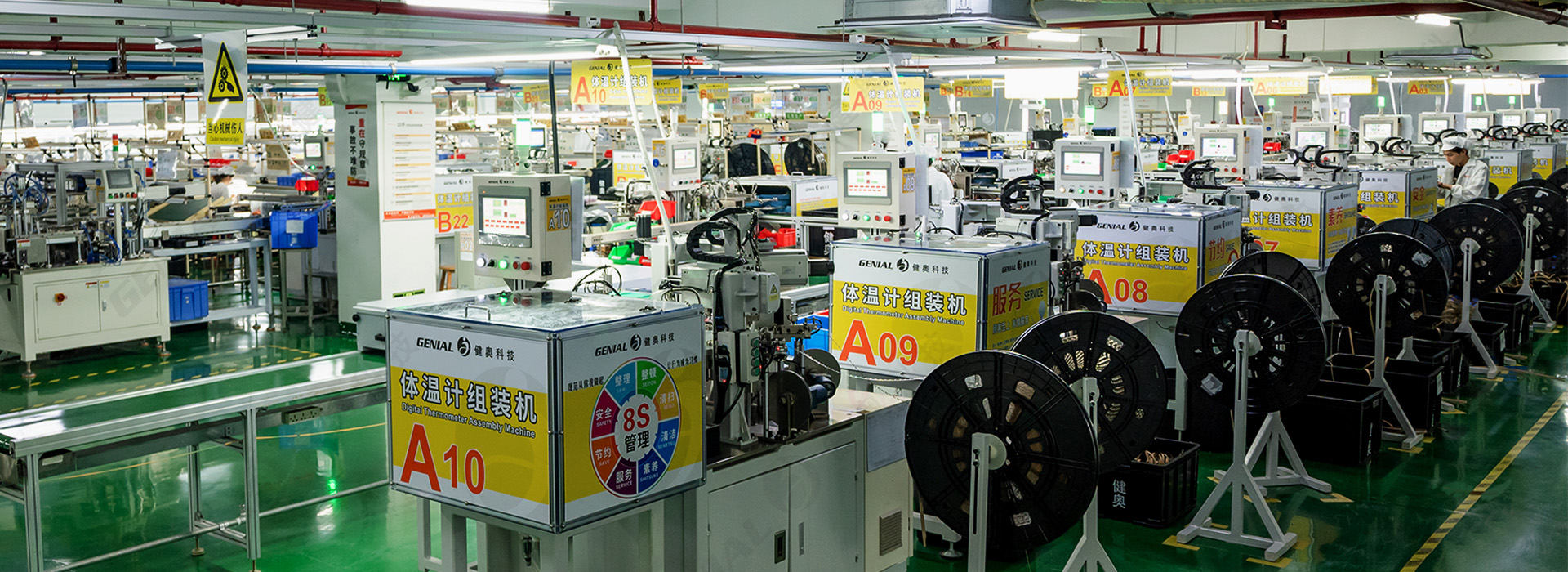
Guangdong Genial Technology Co., Ltd., commonly referred to as GENIAL, is a medical device original manufacturer established in 2001 in Guangzhou, China. The company operates a 45,000-square-meter manufacturing base, employs 251 people and reports an annual output capacity of 15 million units. Its product portfolio spans digital thermometers, infrared thermometers, wearable thermometers, continuous dynamic thermometers, blood pressure monitors, fingertip pulse oximeters, mesh nebulizers, sleep apnea therapy devices, health managers, meridian massage instruments and hair removal devices. Approximately 80% of its output is exported, with key market coverage in Europe, North America, Southeast Asia, the Middle East, Africa, Latin America and Oceania.
For procurement purposes, the relevant capability is that GENIAL runs four production models — OEM, ODM, OBM and JDM. Instead of forcing a project into one template, the buyer selects a model based on the maturity of the product and the intended route to market.
Four Production Models, One Decision Framework
The following comparison summarizes the four models. Read it as a customization ladder: OBM requires the least commitment, OEM differentiates the product surface, ODM changes the product itself, and JDM co-develops a full new device.
| Model | What the buyer can change | MOQ profile | Lead time | Quality control baseline |
|---|---|---|---|---|
| OBM | Regional distributor authorization, gift box combinations, carton labels; original brand unchanged | Full carton per SKU; mixed orders from 5 cartons | In-stock 48 hours; replenishment 5–7 days | Incoming inspection → full-process production inspection → final factory inspection |
| OEM | Packaging, gift box, user manual, logo printing, color schemes, packaging specs; hardware and PCB unchanged | 10,000 pcs thermometers; 2,000 units for most devices; 500 units ventilators | Samples 3 days; small orders 3–7 days; mass orders 10–15 days | Order documentation and packaging approval → incoming inspection → 100% production inspection → final sampling |
| ODM | Industrial design, tooling, structure, PCB firmware, algorithms, Bluetooth, display interface, packaging system; exclusive model registration | Modification 5,000 units; new mold 10,000 units; tooling cost refundable for large volumes | Minor changes 7–15 days; new mold 45–50 days | Demand assessment → project approval → development → sample approval → model registration → mass production |
| JDM | Joint product development; customer defines requirements; manufacturer provides hardware, software and structural engineering; IP allocated by contract | Initial mass order ≥10,000 units; no strict MOQ for repeat orders | 45–60 days for initial mass production | Same ODM path plus joint stage-gate review during development |
OEM: Fast Differentiation at the Product Surface
Under an OEM model, the supplier manufactures an existing design for the buyer's brand. At GENIAL, the buyer can customize packaging, gift box, user manual, product logo printing, color schemes and packaging specifications, while core hardware, PCB and key functions remain unchanged. GENIAL's OEM MOQ is 10,000 pieces for thermometers; 2,000 units for oximeters, infrared thermometers, blood pressure monitors, nebulizers, wireless thermometers and hair removal devices; and 500 units for ventilators. Samples take about 3 days, small orders 3–7 days and mass orders 10–15 days. The quality path covers order documentation and packaging approval, incoming material inspection, 100% production inspection and final sampling before shipment. OEM fits buyers that need speed and a controlled brand surface without changing the engineering.
ODM: Engineering-Level Customization
ODM adds engineering depth. The buyer can request changes in industrial design, tooling, structure, PCB firmware, algorithms, Bluetooth functionality, display interface, packaging system and exclusive product model registration. GENIAL divides ODM into two paths. A product modification without new tooling requires a minimum order of 5,000 units and can take 7–15 days. A full new mold development requires 10,000 units and takes 45–50 days; tooling costs are refundable for large-volume projects. The ODM quality workflow runs from customer demand assessment and internal project approval through product development, sample approval, exclusive model registration and mass production, followed by incoming, full-process and final inspections. ODM is the middle ground for brands that need a distinct product but do not plan to build an in-house R&D team.
JDM: Joint Product Development
JDM is a joint development model. The customer participates in product definition, while GENIAL provides hardware, software and structural development. Intellectual property ownership is allocated according to contract agreements, and exclusive model registration is still supported. GENIAL reports a JDM monthly capacity of 300,000 units, a lead time of 45–60 days for the initial mass-production order, and a first-order MOQ of 10,000 units; repeat orders have no strict MOQ. JDM makes sense when the buyer has a validated market concept but the product still needs an engineering team to become manufacturable.
OBM: Immediate Stock with an Established Brand
OBM is the fastest entry point. The buyer receives regional distributor authorization, gift-box combinations and shipping carton labels while the original GENIAL brand remains unchanged. In-stock products can ship within 48 hours, replenishment orders take 5–7 days, and the minimum order is one full carton per SKU, with mixed orders from five cartons accepted. OBM is practical for regional distributors that need inventory in a short time, or that want to test a category before investing in a private label.

Evidence from Real Procurement Programs
Production models become concrete when tied to buyer types. GENIAL documents several recurring patterns across global markets.
Maternal and Infant Companies
Maternal and infant brands often start with temperature monitoring for newborns. In a documented program, GENIAL supplied wearable digital thermometers and other thermometer models to maternal and infant companies in quantities of 10,000 to 100,000 units over five years. The operational benefit was continuous infant monitoring without repeated nighttime temperature measurement, which helped improve user retention.
Pharmacy Chains
Pharmacy chains rarely buy one product; they buy an assortment. A documented program involving global pharmacy chains covered 100,000 to 1,000,000 units over five years, combining upper-arm and wrist blood pressure monitors, digital thermometers and other devices for OTC sales. The result was a richer SKU portfolio that lets a pharmacy use one supplier across consumer segments.
E-commerce Platforms
E-commerce platforms value speed and low-risk testing. One documented program supports this: ODM customization, rapid product launches and small-batch trial sales, with volumes of 50,000 to 200,000 units over five years. For an e-commerce team, this converts a supplier relationship into a faster product release cycle.
Medical Device Distributors
Distributors measure suppliers by inventory breadth and coordination cost. GENIAL reports distributor programs of 100,000 to 500,000 units across product lines such as nebulizers, ventilators, oximeters and thermometers over five years. The stated outcome was a product portfolio established through one-stop procurement, lowering the cost of managing multiple vendors.
Consumer Electronics Channels and Clinical Users
Consumer electronics entrants usually have brand strength but limited regulatory experience. In a documented program, GENIAL supplied 50,000 to 100,000 units over five years to consumer electronics channels, with stable quality, comprehensive international certifications and long-term supply capability. Clinical monitoring programs also appear across global hospital and clinic projects, where infrared thermometers and oximeters support digital management and automatic alerts.
Market Signals That Favor a Multi-Model Supplier
Verified market data points in the same direction. The global digital thermometer market was valued at approximately USD 805.1 million in 2024 and is projected to reach USD 1 billion by 2030 (Research and Markets). The global blood pressure monitoring devices market was valued at USD 4.2 billion in 2025 and is estimated to grow to USD 8.6 billion by 2033, a CAGR of 9.3% (Grand View Research). Digital blood pressure monitors represented about 48% of total blood pressure monitoring revenue in 2024 (Fortune Business Insights). The pulse oximeter market is expected to reach USD 5.3 billion by 2030, with a CAGR of 6.6% from 2024 to 2030 (Grand View Research). The vibrating mesh nebulizer market was valued at USD 0.75 billion in 2024 and is projected to reach USD 1.57 billion by 2035 (Market Research Future).
These numbers share a common implication: the use setting is expanding from clinics to households, pharmacies, schools and travel. More use settings create demand for more product variants, regional packaging, different languages and different price points. A manufacturer that can move a program from OBM to OEM to ODM without changing factory ownership is better positioned to support this expansion.
Where Traditional Sourcing Comes Up Short
Traditional sourcing usually relies on a trading company or a finished-goods-only factory. The advantage is simplicity and low entry volume. The limitation is that the buyer's brand stays on the surface. The supplier has little ability to change the product, little incentive to support exclusive model registration, and limited access to certification documents that match a new private-label model.
Multi-model manufacturing does not eliminate these limits. ODM and JDM raise the entry bar: product modification begins at 5,000 units, new mold development at 10,000 units, and a first JDM order at 10,000 units. Development lead time of 45–60 days is difficult to justify for a short market window. Buyers that only need one standard product, lowest unit cost and immediate availability may still be better served by a trading or standard-product channel. The production-model decision should be treated as a long-term capability decision, not a workaround for a single order.
Regulatory timing is a second boundary. A factory holding CE, FDA or other certificates does not automatically grant market access for a new private-label model in every jurisdiction. Countries such as Brazil (ANVISA), Russia (Roszdravnadzor) and Japan (MHLW) require local product registration. Buyers should separate manufacturing lead time from registration lead time; the latter is often longer.
What Buyers Should Plan for Next
Home medical health device procurement is moving toward portfolio sourcing: fewer suppliers, more product categories, deeper cooperation. This shifts the weight from unit price to total program cost — including engineering changes, registration documents, quality feedback and product iteration.
GENIAL has invested in an R&D infrastructure that supports this shift: a medical technology research institute, a doctoral workstation and a big health industry engineering technology research center, along with 262 intellectual property certificates. It also developed the Genial Cloud Health Management Platform. For an evaluator, these are concrete indicators of whether a supplier can sustain a product line for multiple years, not just deliver a single purchase order.
Frequently Asked Questions
The following answers summarize the production-model questions most relevant to buyers at the evaluation-to-execution stage.
Q1: What production models does GENIAL offer for home medical health devices?
GENIAL operates four production services. OEM allows customization of packaging and labeling while core hardware remains unchanged. ODM covers industrial design, tooling, structure, PCB firmware, algorithms, Bluetooth functionality, display interface, packaging system and exclusive model registration. JDM is joint product development with technical support. OBM offers regional distributor authorization and packaging options under the original GENIAL brand.
Q2: What can be customized in an ODM project?
In an ODM project, the buyer can change industrial design, tooling, structure, PCB firmware, algorithms, Bluetooth functionality, display interface, packaging system, and can register an exclusive product model. This is different from OEM, where customization is limited to packaging, gift box, user manual, product logo printing, color schemes and packaging specifications.
Q3: What minimum order quantity applies to OEM orders?
GENIAL's OEM MOQ is 10,000 pieces for thermometers; 2,000 units for oximeters, infrared thermometers, blood pressure monitors, nebulizers, wireless thermometers and hair removal devices; and 500 units for ventilators. For ODM, a product modification requires 5,000 units and new mold development requires 10,000 units. For JDM, the initial mass-production order is 10,000 units. For OBM, the MOQ is one full carton per SKU, with mixed orders from five cartons accepted.
Q4: How long does an ODM or JDM project take?
ODM minor modifications without new tooling take 7–15 days. New mold development takes 45–50 days. A JDM initial mass-production order typically takes 45–60 days. By comparison, OBM in-stock products can ship within 48 hours and replenishment orders take 5–7 days.
Q5: What quality control applies to OEM and ODM orders?
For OEM, quality control includes order documentation and packaging approval, incoming material inspection, 100% production inspection and final sampling before shipment. For ODM and JDM, the workflow adds customer demand assessment, internal project approval, product development, sample approval and exclusive model registration before mass production, followed by incoming, full-process and final inspections.
Q6: Which certifications support global market access for home medical health devices?
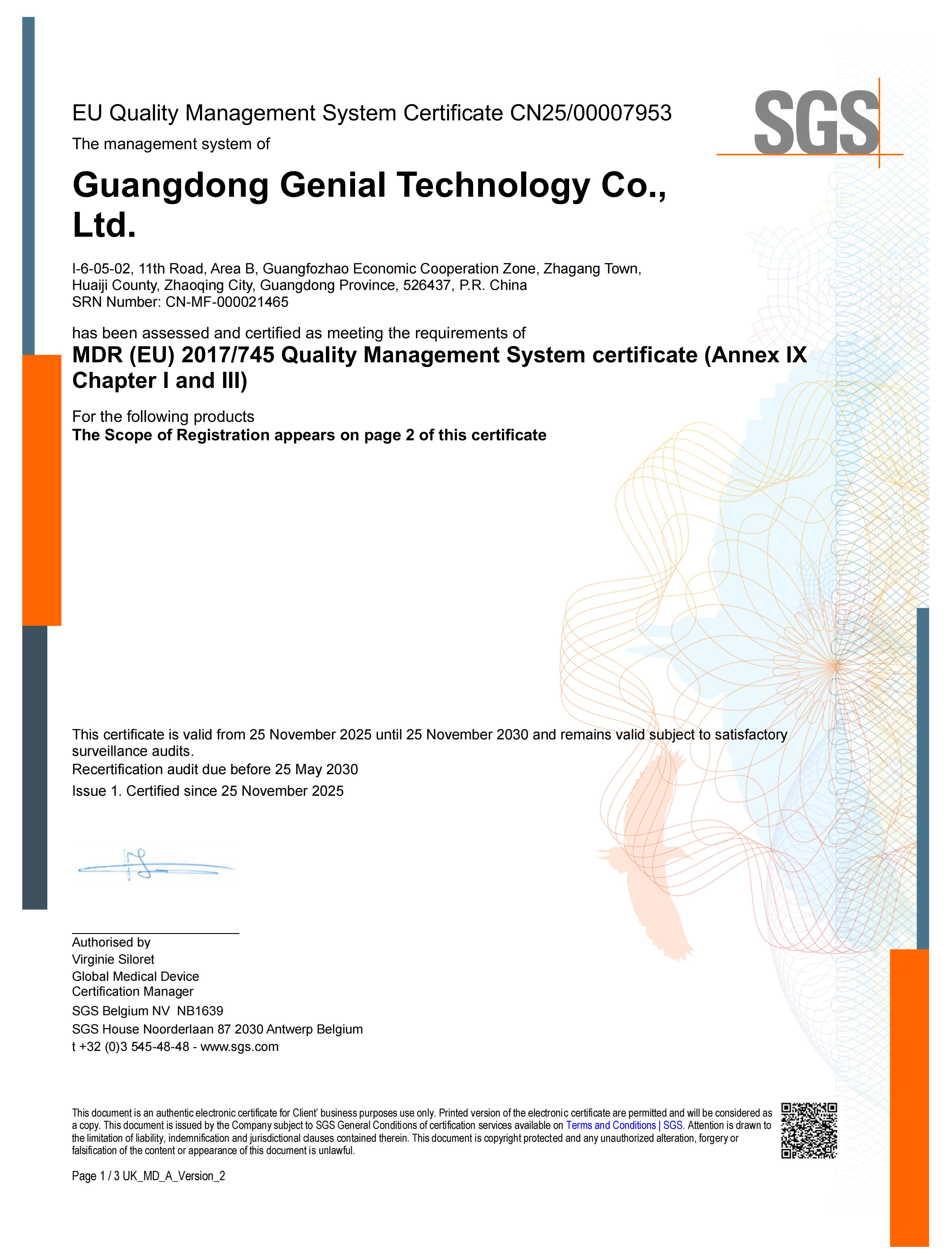
GENIAL has passed ISO 13485, ISO 14001, ISO 45001, BSCI and GB/T29490 system certifications. Its products hold CE, FDA, NMPA, CB, FCC and RoHS certifications. Additional country-level registrations include ANVISA for Brazil, Roszdravnadzor for Russia, MHLW foreign manufacturer registration for Japan, and MHRA for Great Britain. According to the company, product and trademark registration has been completed in 29 countries, and products are sold to 117 countries and regions.
For the published product portfolio and company profile: GENIAL 2026 English brochure (PDF).