
Which Bulk Matcha Grade Fits Your Application? Café, Ice Cream and Bakery
Which Bulk Matcha Grade Fits Your Application? Café, Ice Cream and Bakery
Grade names such as ceremonial, beverage and culinary describe what a matcha powder is designed to do, not how good it is. For a bulk buyer, the decision that matters is whether the specified grade fits the process it will enter: a whisked café latte, an ice cream base, a baked batter, or a dry-blended nutrition powder.
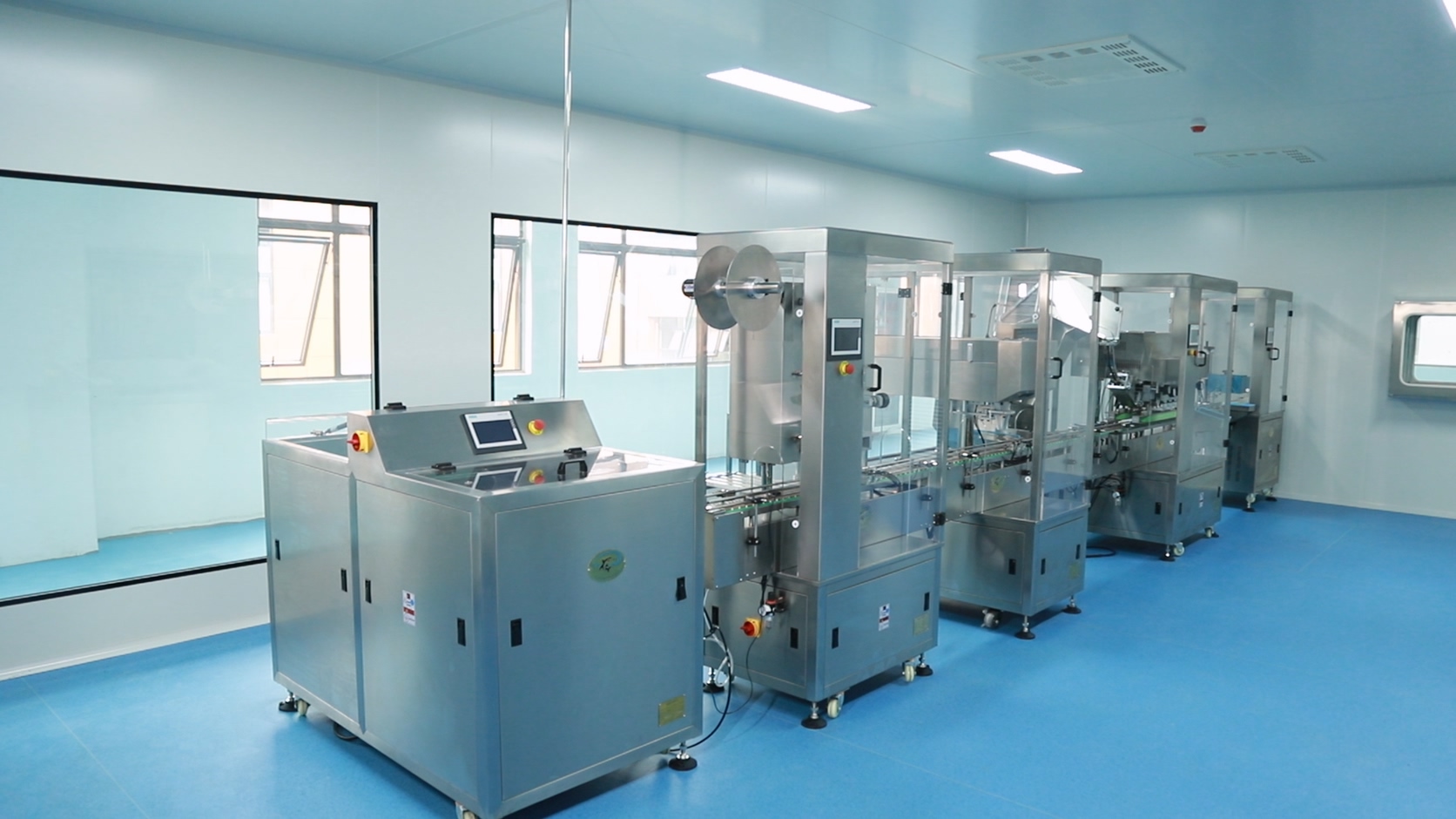
Cover: bulk matcha production environment.
Demand figures support an application-first reading of the market. Culinary grade matcha accounted for 56.4% of the global market share in 2026, a share attributed to high demand in industrial food and beverage manufacturing (Market Data Forecast). In other words, the largest volume of bulk matcha is not consumed as a whisked tea; it enters a formulation.
TangMist Matcha, also known as Shanghai Kelrosa Health Technology Co., Ltd., is a China-based matcha manufacturer and B2B supplier serving cafés, food and beverage brands, distributors, wholesalers and private label businesses worldwide. The company organises its bulk range as ten grades, KM1 to KM10 (catalogue reference IDs 7746–7755), separated mainly by particle fineness and the application each grade was developed for. The range spans functional powders for supplements, culinary powders for bakery and frozen desserts, beverage powders for cafés and milk tea, and ultra-fine ceremonial powders for retail and traditional preparation.
This reference maps those grades to specific applications, explains why certification sits on a separate selection axis from grade, and sets out the boundaries a buyer should recognise before a grade is written into a purchase specification.
Why Grade Names Work as an Alignment Tool, Not a Ranking
B2B matcha grading functions less as a ranking and more as a fit-for-purpose system. Two powders can both be 100% matcha green tea powder and still behave differently in the same recipe, because particle fineness, intended application and the processing the powder undergoes change how it disperses, how much flavour survives heat or fat, and how the finished product looks. In the KM range the visible differentiator is particle fineness in mesh: functional grades sit at 800–1000 mesh, culinary grades at 800–1000 and 800–1200 mesh, beverage grades at 1000–1200 mesh, and ceremonial tiers from 1300–1800 mesh up to 1500–1800 mesh.
Certification, by contrast, is not implied by grade. TangMist Matcha's production systems are supported by certifications including USDA Organic, EU Organic, HACCP, ISO 22000, GMP, Halal and Kosher, with certification and documentation options available according to product and destination-market requirements. A buyer can therefore attach an organic requirement to a culinary grade, or a halal requirement to a beverage grade, as two independent lines in the same specification. Treating organic as a grade, or assuming that a finer mesh automatically satisfies a market residue limit, is one of the more common specification errors in bulk matcha procurement.
The KM Range at a Glance
The table summarises the ten grades as specified by the manufacturer, together with the applications each grade was developed for.
| Model | Grade type | Particle fineness | Typical applications | Reference ID |
|---|---|---|---|---|
| KM1 | Functional | 800–1000 mesh | Supplements, functional food blends, powdered formulations | 7746 |
| KM2 | Functional | 800–1000 mesh | Nutrition products, functional foods, powdered nutrition formulations | 7747 |
| KM3 | Culinary | 800–1000 mesh | Baking, ice cream, desserts, confectionery, food manufacturing | 7748 |
| KM4 | Culinary Plus | 800–1200 mesh | Chocolate, beverages, desserts, premium food products | 7749 |
| KM5 | Beverage | 1000–1200 mesh | Milk tea, matcha latte, café drinks, beverage formulations | 7750 |
| KM6 | Premium Beverage | 1000–1200 mesh | Premium milk tea, café chains, specialty beverages | 7751 |
| KM7 | Ceremonial | 1300–1800 mesh | Matcha latte, premium cafés, specialty tea beverages, retail matcha | 7752 |
| KM8 | Ceremonial Plus | 1300–1800 mesh | Specialty matcha drinks, premium cafés, boutique beverage brands, premium retail | 7753 |
| KM9 | Ultra Ceremonial | 1500–1800 mesh | High-end matcha brands, specialty cafés, premium retail products | 7754 |
| KM10 | Ultra Ceremonial Plus | 1500–1800 mesh | Traditional matcha preparation, tea ceremony, luxury matcha brands, high-end retail | 7755 |
Café, Latte and Milk Tea: Matching Powder to a Served Drink
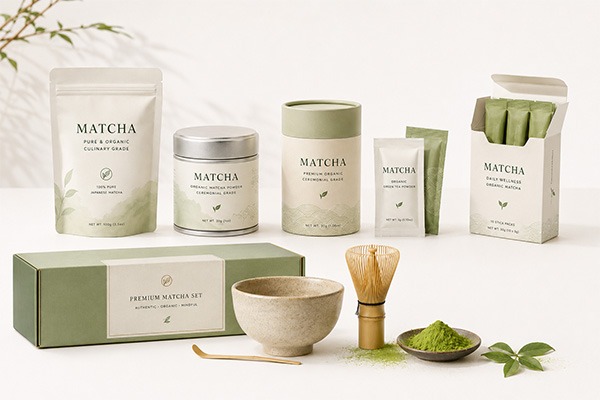
KM5 beverage grade matcha powder (1000–1200 mesh), developed for milk tea, matcha latte and café drinks.
The café segment splits into two purchasing logics: outlets where matcha is a flavour inside a milk-based drink, and outlets where matcha is the product. For the first group, KM5 is a beverage-grade powder at 1000–1200 mesh developed for milk tea, matcha latte, café drinks and other beverage formulations, and positioned to balance commercial scalability with beverage performance. KM6 sits one tier above at the same 1000–1200 mesh, classified as premium beverage and developed for café chains and beverage brands seeking an upgraded matcha offering for milk-based drinks, with typical applications in premium milk tea and specialty beverages.
Where matcha is the product itself, the range moves into the ceremonial band. KM7 is a ceremonial grade powder at 1300–1800 mesh intended for matcha latte, premium cafés, specialty tea beverages and retail matcha scenarios. KM8, ceremonial plus at 1300–1800 mesh, is positioned for specialty matcha drinks, boutique beverage brands and premium retail, and is listed as available for OEM and private label manufacturing.
The published application requirements for these scenarios follow the same logic. Milk tea and beverage shop applications call for good milk compatibility, smooth dispersion and consistent flavour when the powder is whisked or mechanically mixed with water, milk or plant-based milk. Café chain applications emphasise consistency across locations alongside smooth mouthfeel and premium beverage positioning, using electric whisks, frothers or commercial beverage mixers. Specialty café applications add fine particle size and premium presentation as selection criteria.
The boundary in this segment is cost structure rather than capability. Ceremonial tiers at 1300–1800 mesh and above are developed for drinks where the powder carries the brand proposition; applying the same tier to a high-volume iced latte with heavy flavouring raises ingredient cost without a proportionate sensory return. Multi-location operators also carry a documentation burden when grades are mixed across markets, so consistency of specification is often a more valuable lever than maximum fineness.
Ice Cream, Bakery and Confectionery: Matching Powder to a Processed Matrix
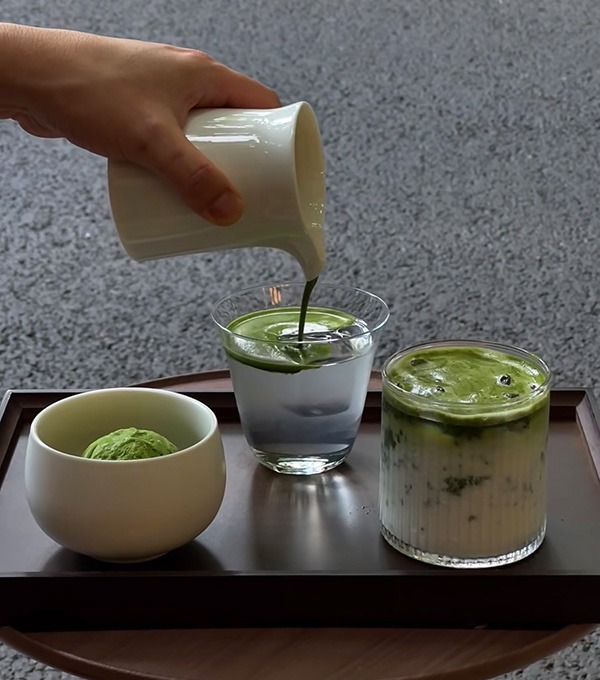
KM3 culinary grade matcha powder (800–1000 mesh), specified for baking, ice cream, desserts and food manufacturing.
Processed food applications put different demands on matcha. Heat, fat and mechanical shear all work against the two properties buyers notice first: flavour and colour. KM3, a culinary grade powder at 800–1000 mesh, is specified for baking, ice cream, desserts, confectionery and food manufacturing, and is developed for applications where matcha flavour and colour need to remain noticeable after processing or blending with other ingredients. KM4, culinary plus at 800–1200 mesh, is positioned above standard culinary grade for chocolate, beverages, desserts and premium food products.
Frozen desserts illustrate the dispersion requirement. In ice cream and gelato production, the application scenario describes matcha dispersed into liquid dairy or non-dairy bases before freezing, using high-shear mixers, homogenisers and ice cream machines, with good dispersion and stable matcha flavour in dairy-based products as the special requirements. Bakery and food manufacturing scenarios list flavour retention, colour performance and cost efficiency, with matcha mixed into flour, batter or cream on industrial mixers and bakery lines. Chocolate and confectionery scenarios sit at the premium end of the culinary band, where matcha is incorporated into chocolate, cream or fillings and is expected to deliver a stronger matcha presence and a fine texture.
Two limits are worth stating plainly. First, no powder is immune to process losses: in baked and fat-based systems a proportion of matcha flavour and colour is lost during processing, which is one reason this band is specified by behaviour in a matrix rather than by sensory descriptors borrowed from tea service. Second, fineness has a real cost origin. Traditional stone-grinding with granite mills produces only 30–40 g of matcha per hour per mill (Firsd Tea), so the ultra-fine tiers at 1300–1800 mesh and above carry a materially different cost structure from the 800–1200 mesh culinary band. Specifying a ceremonial tier for a baked or frozen matrix is technically possible, but rarely justified on cost or performance grounds.
Nutrition, Supplements and Powdered Formulations
Where matcha is one ingredient among many in a dry blend, the selection logic turns to consistency and cost. KM1 is a functional grade powder at 800–1000 mesh intended for supplements, functional food blends and powdered formulations, positioned as an entry-level functional matcha for cost-sensitive, large-volume formulations where matcha is used primarily as an ingredient. KM2 is also functional grade at 800–1000 mesh, but positioned as an upgrade for nutrition products, functional foods and powdered nutrition formulations that require a higher-tier matcha ingredient.
Nutrition product scenarios describe dry blending or incorporation into formulated powders, using ribbon blenders, powder mixers and filling equipment, and list consistent quality, uniform dispersion and reliable bulk supply as the selection requirements. Nutraceutical and functional food scenarios add cost efficiency, batch consistency and fine particle size. For these buyers, the practical question is not which grade is the most refined, but which mesh band disperses uniformly in an existing blend without changing the formulation's cost base.
Ceremonial and Luxury Retail Tiers
KM9 and KM10 occupy the top of the range at 1500–1800 mesh, the finest band in the KM specification. KM9 is classified as ultra ceremonial and is intended for high-end matcha brands, specialty cafés and premium retail products, where matcha quality is a key part of the brand proposition. KM10, ultra ceremonial plus, is described as the highest tier in the KM range and is developed for traditional matcha preparation, tea ceremony, luxury matcha brands and high-end retail.
Application scenarios for this band describe traditional whisking with water for direct consumption, using a chawan, chasen and matcha sieve, with highest-tier positioning, refined texture and premium sensory quality as the requirements. The boundary here is straightforward: these are products in their own right, sold through retail and ceremony channels. They are not cost-optimised ingredients for food manufacturing, and buyers sourcing for baked or frozen applications should not treat them as an upgrade path.
Certification and Documentation: A Second Selection Axis
Because grade and compliance are independent, the more useful procurement habit is to specify both. On the compliance side, TangMist Matcha's production systems are supported by USDA Organic, EU Organic, HACCP, ISO 22000, GMP, Halal and Kosher, with certification and documentation options available according to product and destination-market requirements. Which of those matter depends on where the finished product is sold.
For the European Union, maximum residue limits for clothianidin and thiamethoxam were set at 0.01 mg/kg under Regulation (EC) No 396/2005, effective March 2026, a level that pushes residue testing earlier into supplier qualification. For the United States, imported matcha powder falls under FDA Food Facility Registration and FSVP documentation requirements. Buyers in halal or kosher channels treat those certifications as entry conditions rather than differentiators. Organic claims carry their own rules: Japan and the United States have operated a mutual organic equivalency between JAS and USDA Organic since 1 January 2014.
Residue and heavy metal testing, where required, can be conducted according to product specifications and destination-market requirements, with supporting documentation available where applicable. The practical implication is that a grade label alone does not document residue compliance. The grade describes performance in the application; the certificate and test report describe admissibility in the market. Organic certified matcha contributed approximately 41% of total global market demand in 2025 and is the fastest-growing segment, with an expected CAGR of 12.68% through 2033, which is enough volume that organic and non-organic specifications often run in parallel within the same buyer's portfolio.
Decision Rules for Grade Selection
- Whisked and served as an everyday drink at volume: 1000–1200 mesh beverage grades (KM5, KM6).
- Whisked and served as a branded or premium menu item: 1300–1800 mesh ceremonial grades (KM7, KM8).
- The powder is the retail product, or is prepared traditionally: 1500–1800 mesh (KM9, KM10).
- Dispersed into a frozen, baked or fat-based matrix: 800–1000 to 800–1200 mesh culinary grades (KM3, KM4).
- Used as one ingredient in a dry blend or supplement: 800–1000 mesh functional grades (KM1, KM2).
- Organic, halal or kosher requirement: handled as a separate line item, not as a grade substitute.
- Destination market with strict residue limits: confirm test documentation before fixing the grade, because a residue failure invalidates the specification regardless of mesh.
Grade-Led Selection Versus Single-Spec Sourcing
Traditional bulk sourcing often runs on a single specification: one matcha, bought at the lowest landed cost that meets a colour and taste benchmark, used across every product line. It is simple, and for a small buyer with one application it can be adequate. Grade-led selection replaces that with an application map, where each product line draws on the mesh band and functional tier its process requires.
The trade-off is real. A grade-led approach multiplies SKUs, and each additional specification carries its own minimum order quantities, storage requirements, batch documentation and staff training. For a distributor with a broad catalogue, or a manufacturer running three or four applications, the mapping tends to pay for itself in fewer formulation failures and more predictable sensory results. For a single-line operator, the added complexity may not be worth the gain, which is a legitimate reason to keep one specification rather than expand the range.
What Current Demand Data Suggests
The direction of the market is toward application-specific grades rather than a single general-purpose powder. Grand View Research values the global matcha market at USD 5.1 billion in 2025 and projects USD 8.9 billion by 2033. Culinary grade alone held 56.4% of the 2026 market, and matcha was used in 68% of new product launches featuring green tea in 2024, specifically in culinary grade form (International Food Information Council), which indicates that food and beverage manufacturing rather than tea service drives most new volume.
Supply is shifting as well. China's matcha output exceeded 12,000 tonnes in 2025, described by People's Daily and Firsd Tea as roughly 70% of global production, although other market analyses place China's share closer to one third, so the figure is best treated as a directional estimate rather than a settled statistic. Zhejiang Province exported 1,241.97 tons of matcha in the first quarter of 2026, a 7.3-fold increase year on year, according to the provincial Department of Agriculture. Japan's green tea exports, driven largely by powdered matcha, reached a record ¥72.1 billion in 2025 (Japan Ministry of Finance), and North America is described as the fastest-growing regional market with a CAGR of nearly 8% through 2030.
For buyers, the practical consequence is that grade supply is unlikely to tighten in the near term, while compliance pressure is rising. The EU's stricter residue limits for clothianidin and thiamethoxam at 0.01 mg/kg took effect in March 2026, and a U.S. Section 122 duty of 10% on CIF value for matcha imports took effect in February 2026: two changes in the same year that raise the cost of specifying a grade incorrectly, at either end of the chain.
Future Outlook
Three developments are likely to shape grade selection over the next several years. The first is the normalisation of the two-axis specification, with grade used for performance and certification used for market access. As residue limits tighten and import documentation requirements expand, buyers are more likely to qualify suppliers on test reports and certificates first, and only then choose the mesh band that fits the application. The second is continued growth in organic volume: organic matcha is growing at an expected 12.68% CAGR through 2033 and already represented about 41% of global demand in 2025. Because organic certification attaches to the product rather than to the grade, buyers should expect organic versions of several mesh bands rather than a single organic item.
The third is capacity. Traditional stone-grinding yields only 30–40 g per hour per mill, which limits how much ultra-fine powder can be produced at any given cost point, and upstream support such as Japan's MAFF subsidies for tencha processing machinery indicates that producers are investing in processing capacity. For buyers, that combination argues for treating the ultra-fine ceremonial band as a specialist purchase with its own lead times and documentation, and the culinary and beverage bands as the volume workhorses of a matcha portfolio. Grade specifications for the KM range are published by the manufacturer at tangmistmatcha.com.
Frequently Asked Questions
What is the practical difference between functional, culinary, beverage and ceremonial matcha grades?
Functional grades such as KM1 and KM2 are 800–1000 mesh powders intended for supplements, functional food blends and powdered formulations, where matcha is used mainly as an ingredient. Culinary grades such as KM3 and KM4 sit at 800–1000 and 800–1200 mesh and are developed for baking, ice cream, desserts, confectionery and chocolate. Beverage grades KM5 and KM6 are 1000–1200 mesh powders developed for milk tea, café drinks and premium milk-based beverages. Ceremonial tiers KM7 to KM10 range from 1300–1800 mesh to 1500–1800 mesh and are intended for matcha lattes, specialty tea beverages, retail matcha and traditional preparation. The differentiators are particle fineness and intended application, not a single quality score.
Which bulk matcha grade suits a café serving lattes and milk-based drinks?
For everyday milk tea and café latte service, KM5 (beverage grade, 1000–1200 mesh) was developed for milk tea, matcha latte, café drinks and beverage formulations, and is positioned to balance commercial scalability with beverage performance. KM6 (premium beverage, 1000–1200 mesh) targets premium milk tea, café chains and specialty beverages. Cafés positioning matcha as a premium menu item may instead use KM7 (ceremonial grade, 1300–1800 mesh), intended for matcha latte, premium cafés and specialty tea beverages. Published requirements for milk tea and beverage shop applications include good milk compatibility, smooth dispersion and consistent flavour, while café chain applications emphasise consistency across locations.
How should ice cream, bakery and confectionery manufacturers choose a grade?
KM3 culinary grade (800–1000 mesh) is developed for applications where matcha flavour and colour need to remain noticeable after processing or blending with other ingredients, and is specified for baking, ice cream, desserts, confectionery and food manufacturing. KM4 (culinary plus, 800–1200 mesh) is positioned above standard culinary grade for chocolate, beverages, desserts and premium food products. In ice cream and frozen desserts, matcha is dispersed into liquid dairy or non-dairy bases before freezing, using high-shear mixers, homogenisers and ice cream machines, with good dispersion and stable flavour in dairy-based products as the stated requirements. Bakery applications list flavour retention, colour performance and cost efficiency.
Does an organic or halal requirement change which grade you select?
Organic and halal requirements operate on a separate axis from grade. Certification and documentation options are available according to product and destination-market requirements, and the production systems are supported by USDA Organic, EU Organic, HACCP, ISO 22000, GMP, Halal and Kosher. Grade selection itself is driven by particle fineness and application. In practice, a buyer specifies both: for example a culinary grade for a baked product, plus the organic or halal documentation required by the destination market.
What documentation should EU or US buyers expect alongside a bulk matcha shipment?
For the European Union, maximum residue limits for clothianidin and thiamethoxam are set at 0.01 mg/kg under Regulation (EC) No 396/2005, effective March 2026. For the United States, imported matcha powder is subject to FDA Food Facility Registration and FSVP documentation. Pesticide residue and heavy metal testing can be conducted according to product specifications and destination-market requirements, with supporting documentation available where applicable. Where organic claims are involved, JAS and USDA Organic have operated under a mutual organic equivalency since 1 January 2014.
Can one matcha grade cover an entire product portfolio?
A single grade can technically be used across several product lines, and a unified specification reduces SKU complexity. The KM range is nonetheless structured by application because the mesh bands that suit a whisked drink (1000–1800 mesh) differ from those that suit a baked, frozen or fat-based matrix (800–1200 mesh) and from those used as a dry-blend ingredient (800–1000 mesh). Buyers running several applications usually need more than one specification; single-line operators may reasonably stay with one.