
Where the C840 Fits: Food Contact, Pharma Packaging, Reagents
Gravimetric residue testing seldom fails because of the chemistry. It fails because of repetition. The same sample has to be evaporated, dried, cooled and weighed under the same conditions hundreds of times a year, and the result only becomes comparable when those conditions hold across analysts, shifts and sites. That is why a single instrument configuration keeps appearing in three otherwise unrelated environments: food contact material compliance, pharmaceutical packaging extractables, and chemical reagent purity control.
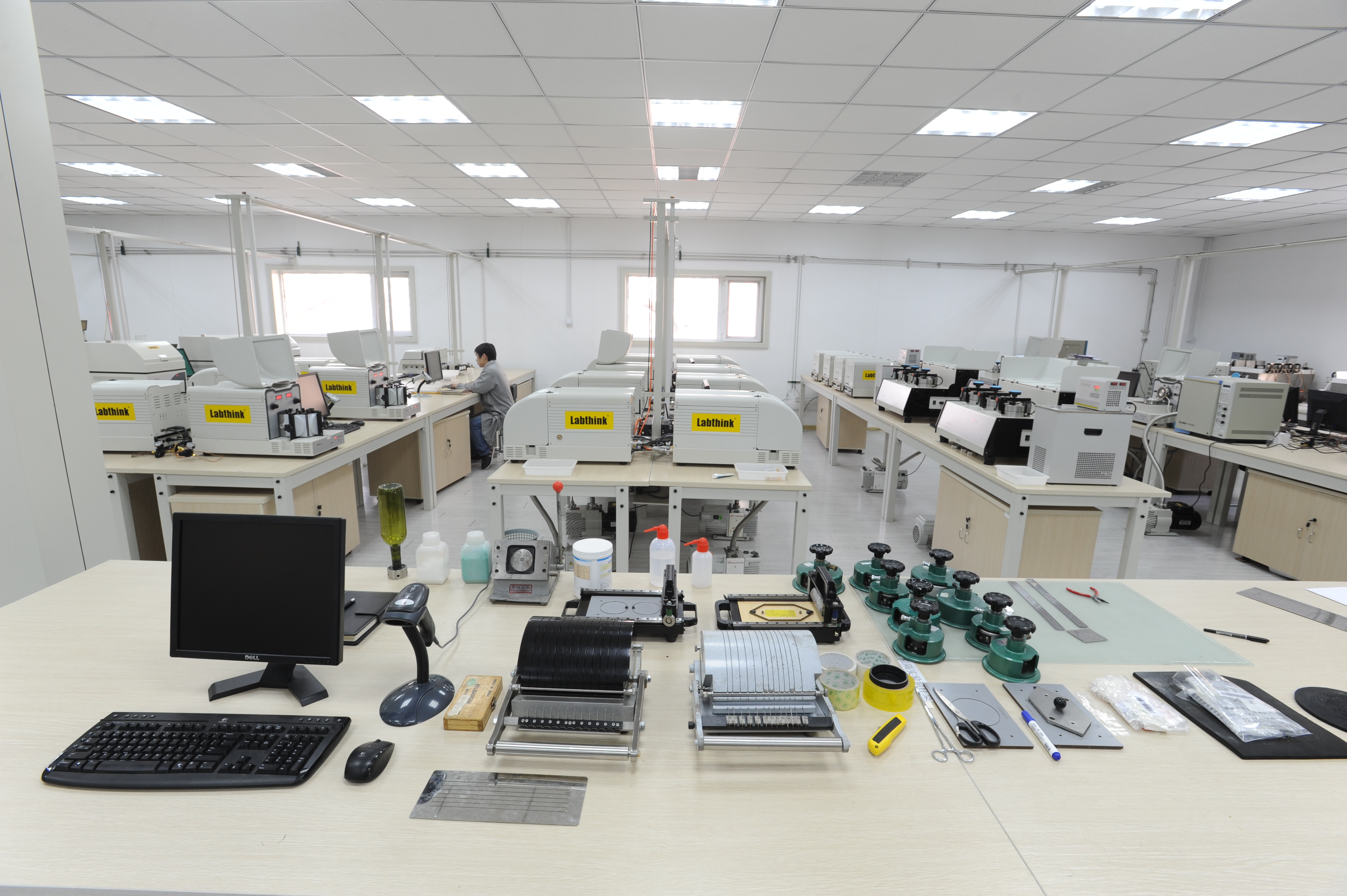
Gravimetric residue workflows succeed or fail on repeatability: the same evaporation, drying, cooling and weighing sequence, executed the same way each time. Image: Labthink testing centre.
The recurring problem behind three different test methods
Food contact, pharmaceutical packaging and chemical reagent testing are separated by regulation, by sample type and by what the resulting number is allowed to mean. They share one operational feature: the analytical endpoint is a mass. A food contact material is exposed to a food simulant, the simulant is evaporated and the remaining non-volatile fraction is weighed. A pharmaceutical packaging material is extracted, the extract is evaporated and the residue is weighed as total extractables or non-volatile residue. A chemical reagent, or a batch of purified water, is evaporated and the residue is weighed as evidence of purity.
The measurement logic is identical in all three cases. The differences sit in what is evaporated, which conditions are mandated, and how often the sequence repeats. That last variable is the one buyers usually underestimate. A laboratory running a handful of migration determinations per month can absorb manual variability. A laboratory running the same determination weekly across dozens of material, simulant and condition combinations cannot, because drift between runs is indistinguishable from a change in the material.
Recurring workflows are where manual gravimetric methods become fragile. Between evaporation and weighing there are transfer steps, cooling intervals and stabilisation periods. Each is a small opportunity for condition drift, and each is documented by a person rather than by an instrument. The result is a method that is scientifically sound and operationally expensive to defend during an audit.
What the C840 is
The C840 Integrated Evaporation Residue Testing System is a benchtop gravimetric instrument from Labthink Instruments Co. Ltd., a packaging materials testing manufacturer founded in 1989 with production in Jinan, China and an international headquarters in Boston, USA. Within the Labthink Food & Pharmaceutical Testing Solutions portfolio, which covers food safety and pharmaceutical analysis testing, the C840 is the model dedicated to evaporation residue and non-volatile residue determination, and Labthink lists it for food contact materials, pharmaceutical packaging and chemical reagents. The conformity attestation for the platform covers the model variants C840B, C840M, C840H, C840G and C840X.
Naming is worth clarifying early, because the same instrument is described differently in different procurement documents. Some catalogues label the family as an overall migration test instrument; others label it as an evaporation residue testing system. Both labels describe the same gravimetric core. The difference is the regulated workflow the buyer intends to support, and that distinction should be settled before specifications are compared.
Four stages, one sequence
Automation in this instrument class is not a single feature. It is the coupling of four stages that manual methods perform separately: evaporation of the solvent or simulant, drying at a controlled temperature, cooling before weighing, and weighing at a fixed resolution. Labthink describes the C840 as automating those stages within one workflow, which is the property that matters for repeatability rather than for speed alone.
Two consequences follow for buyers. First, the declared working envelope becomes the constraint set for method fit rather than a marketing figure. The system is specified with a testing range of 0.05 to 80,000 mg, a resolution of 0.01 mg and a repeatability of ±0.05 mg, across a temperature range from room temperature to 130 °C with a temperature fluctuation of ±0.5 °C. Second, the record produced by the run becomes part of the evidence chain: Labthink states the platform is compliant with 21 CFR Part 11 and GMP requirements and supports data traceability, which is what allows a residue result to be reconstructed months later.
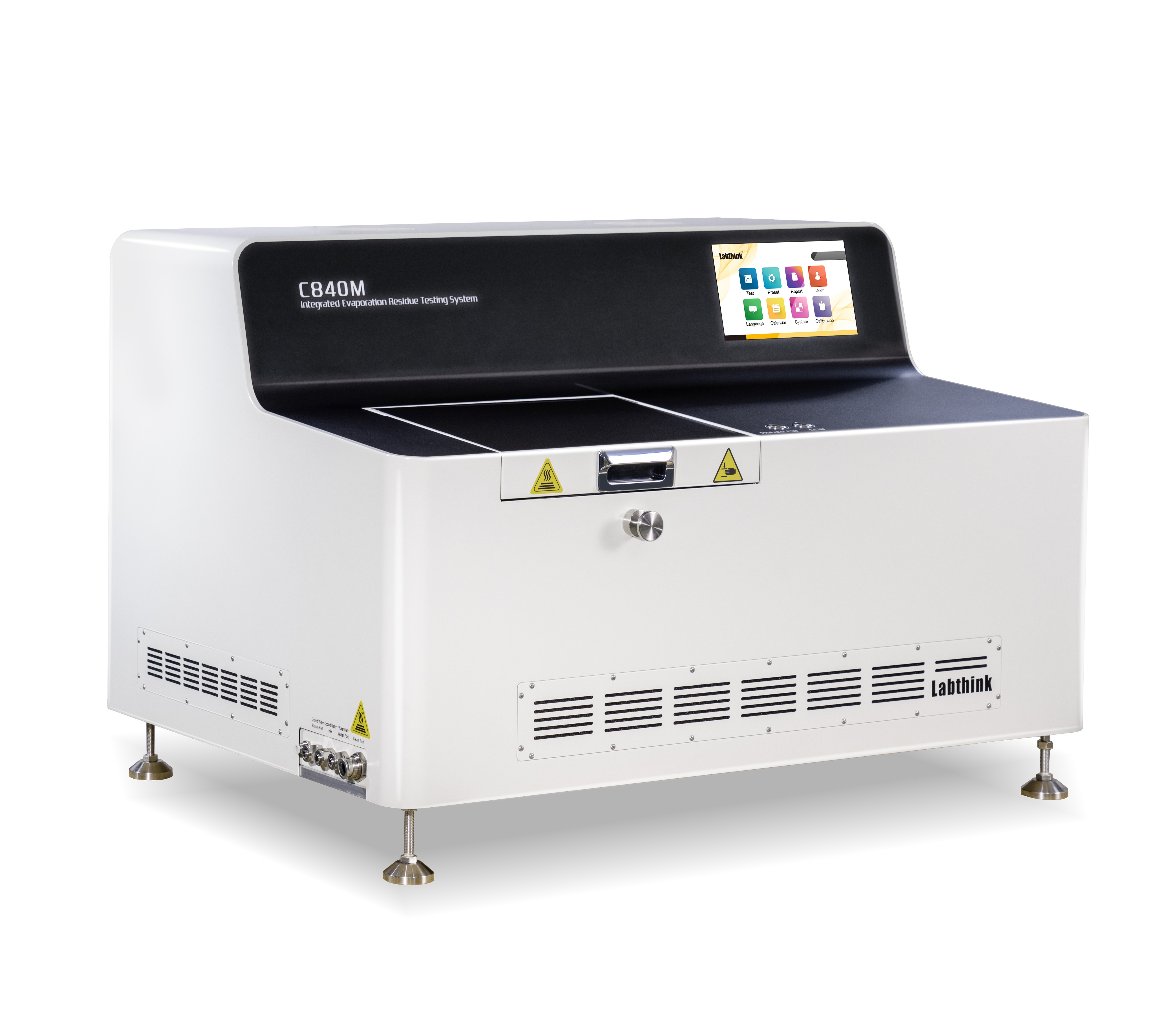
The C840 family, shown here in the C840M configuration, is configured around evaporation, drying and weighing for residue content determination. Image: Labthink.
Scenario fit 1: food contact materials and overall migration
In food contact work, the residue is a regulatory quantity. European Commission guidance sets an overall migration limit of 60 mg/kg food or 10 mg/dm² of contact material for plastic food contact materials, and describes migration testing as exposure to simulants under standardised time and temperature conditions representative of a specific food use and covering the maximum shelf life of the packed food. The laboratory therefore does not run one test. It runs a matrix: material grade, simulant, temperature, duration, and repeat.
That matrix is where the C840 fits. The regulated steps that decide compliance, namely simulant selection, exposure time and exposure temperature, remain method decisions owned by the laboratory. What the instrument addresses is everything after exposure: evaporating the simulant, drying the residue to a stable mass, cooling it without reabsorbing moisture, and weighing it at a resolution fine enough to resolve the difference between a compliant and a borderline material.
Resolution and repeatability matter disproportionately here because the compliance threshold is expressed per unit area or per unit mass of food. When residues sit near the reporting limit, a ±0.05 mg repeatability specification and a 0.01 mg resolution stop being catalogue detail and start being the difference between a defensible pass and an inconclusive retest. Labthink also lists residue on evaporation testing, total extractables and non-volatile residue determination within the same C840 application scope, which is why one installed system often serves several of the food contact methods a laboratory holds accreditation for.
Scenario fit 2: pharmaceutical packaging and extractables
Pharmaceutical packaging testing changes the emphasis rather than the physics. The residue here is evidence of what a container or closure system releases into an extraction medium, reported as total extractables or non-volatile residue, and the surrounding documentation standard is stricter. The question a reviewer asks is not only what the residue weighed, but who ran it, on which instrument, under which parameters, and whether the record can be shown to be unaltered.
The C840 is positioned for non-volatile residual testing of pharmaceutical packaging materials, and Labthink states that the platform is compliant with 21 CFR Part 11 and GMP requirements with data traceability built into the workflow. For a pharmaceutical packaging laboratory, that combination is the practical reason to prefer an integrated system over a manual train of evaporating dish, oven, desiccator and balance: the automated sequence reduces the number of hand-recorded transitions that a data integrity review has to reconstruct.
A boundary should be stated plainly, because packaging quality is often discussed as one problem when it is several. Residue and extractables testing answers what a package releases. It does not answer whether a sealed container leaks. Container closure integrity is a separate test family with its own instruments and standards, and a packaging laboratory typically operates both. Treating the C840 as a substitute for leak testing, or the reverse, is a specification error rather than a capability limitation.
Scenario fit 3: chemical reagents and purified water
The third scenario is the highest volume and the lowest residue. Chemical reagent testing and purified water monitoring rely on evaporation residue and non-volatile residue as routine purity indicators, run frequently, on samples where the residue may be small relative to the sample mass. Two instrument properties dominate: temperature stability during the drying stage, and weighing repeatability at the low end of the range.
The C840's declared ±0.5 °C temperature fluctuation and ±0.05 mg repeatability are the specifications that map onto this workload, and Labthink lists determination of non-volatile matter in purified water and residue determination for chemical reagents within its application scope. For a reagent producer or a laboratory supporting reagent release, the operational gain is not analytical novelty. It is the ability to run the same determination on a routine schedule with conditions that do not move between runs, and to keep the resulting records traceable for regulated documentation.
Constraints worth checking before a demonstration
At the research-to-evaluation stage, the useful exercise is converting a method into a constraint list and checking it against declared specifications. The table below summarises the C840 parameters that most often decide fit.
| Parameter | Declared value | What it constrains |
|---|---|---|
| Testing range | 0.05 – 80,000 mg | Whether the expected residue mass, including high-residue extracts, falls inside the working envelope |
| Resolution | 0.01 mg | Ability to discriminate residues near a reporting limit |
| Repeatability | ±0.05 mg | Run-to-run spread that must be absorbed by the method tolerance |
| Temperature range | Room temperature – 130 °C | Which drying protocols are inside scope, and which are not |
| Temperature fluctuation | ±0.5 °C | Stability of the drying stage across a long batch |
| Construction | Aluminium alloy + ABS plastic | Bench siting and routine lab environment assumptions |
| Records | 21 CFR Part 11 and GMP compliance stated; data traceability supported | Whether results can serve regulated documentation and audit review |
One further constraint sits outside the specification sheet. Labthink's application data for residue testing states indoor laboratory use with a stable ambient temperature as a special requirement, and lists an analytical balance as matched equipment in that laboratory context. Buyers evaluating a benchtop integration should confirm how the balance, the environmental conditions and the instrument workflow are combined in their own layout rather than assuming the instrument removes the need for either.
Qualification evidence and what each certificate actually covers
For a constraint-driven purchase, certificate scope is as important as certificate existence. The C840 platform is covered by an attestation of conformity issued under the Low Voltage Directive and the Electromagnetic Compatibility Directive, and the manufacturing organisation holds management system certifications that appear in supplier qualification packages.
| Evidence | Reference | Scope relevant to the C840 |
|---|---|---|
| Attestation of Conformity (LVD 2014/35/EU Annex III; EMC 2014/30/EU Annex II) | M.2025.206.C119121, issued by UDEM Uluslararası Belgelendirme Denetim Eğitim Merkezi San. ve Tic. A.Ş., valid 2025-05-19 to 2030-05-18 | Integrated Evaporation Residue Testing System models C840B, C840M, C840H, C840G, C840X; standards EN 61010-1:2010+A1:2019 and EN IEC 61326-1:2021 |
| ISO 9001:2015 quality management system | 10425Q02009R2M, issued by SHANDONG SEATONE INTERNATIONAL CERTIFICATION CO., LTD., valid 2025-11-20 to 2028-11-24 | Production of packaging testing instruments, including the C840 |
| ISO 14001:2015 environmental management system | 10425E01301R1M, valid 2025-11-20 to 2028-11-24 | Production of packaging testing instruments and related environmental management activities |
| ISO 45001:2018 occupational health and safety | 10425S01240R1M, valid 2025-11-20 to 2028-11-24 | Production of packaging testing instruments and related occupational health and safety activities |
| Trademark registration, International Class 9 | 3,499,933 (SN 77-279,341), United States Patent and Trademark Office, issued 2008-09-09, expires 2028-09-08 | Registration scope covers packaging materials testers, including the C840 |
Reading this table correctly matters more than collecting it. The attestation of conformity addresses electrical safety and electromagnetic compatibility for listed model variants; it is not a statement that the instrument satisfies any particular migration, extractables or pharmacopoeial method. Method validation, simulant selection and acceptance criteria remain the laboratory's responsibility. Certificates support supplier qualification; they do not transfer analytical accountability.
Automated sequence versus the manual train
The comparison that matters to a laboratory is not automated versus traditional in the abstract, but which failure modes each approach leaves exposed.
| Dimension | Manual gravimetric workflow | Integrated C840 workflow |
|---|---|---|
| Evaporation and drying | Separate vessel, oven or bath, operator-timed | Automated within one sequence |
| Cooling before weighing | Desiccator transfer, variable interval | Automated as part of the run |
| Weighing records | Transcribed by the analyst | Captured with data traceability |
| Condition stability across a batch | Depends on shift, workload and technique | Governed by the set parameters, including ±0.5 °C fluctuation |
| Audit reconstruction | Rebuilt from paper and logbook entries | Supported by 21 CFR Part 11 and GMP-oriented records |
Where the C840 stops
A procurement decision is only as good as its boundary conditions, and the C840 has several that should be stated before comparing quotations.
It is a residue instrument, not a migration apparatus. The exposure step, in which a material sits in contact with a simulant for a defined time and temperature, happens before the instrument's role begins. Laboratories evaluating the C840 must already have, or plan for, the exposure and conditioning capability their method requires.
The temperature ceiling is 130 °C. Methods that depend on ignition or ashing at high temperature are outside the platform's range. Residue on ignition and sulfated ash belong to a different model in the same Labthink family, the C860, which is specified up to 800 °C with 36 test stations. Buyers who conflate the two discover the gap at method transfer.
Different measurands use different instruments. Loss on drying, which quantifies moisture and volatile content rather than non-volatile residue, is handled by the C870. Water-insoluble matter testing is handled by the C850. Treating the C840 as a general residue platform for all four determinations leads to a specification mismatch, not a performance shortfall.
Method details remain the laboratory's. Sample quantity, heating conditions and constant-weight criteria must be confirmed against the applicable method for each sample type, including aqueous and slurry-like samples. The instrument supplies controlled conditions and records; it does not supply the acceptance criteria.
A procurement checklist for the evaluation stage
- Define the measurand first: overall migration, total extractables, non-volatile residue, or evaporation residue of a reagent. The model follows from that answer.
- Convert the method into numbers: expected residue mass, required resolution, permitted run-to-run spread, drying temperature and hold time. Compare them against 0.05–80,000 mg, 0.01 mg, ±0.05 mg and room temperature to 130 °C.
- Check the certificate against the exact variant being quoted. The attestation of conformity lists C840B, C840M, C840H, C840G and C840X, and remains valid to 2030-05-18.
- Confirm what data the system produces and how it maps onto the site's data integrity procedures, given the stated 21 CFR Part 11 and GMP compliance and data traceability support.
- Ask about configuration: Labthink states customisation of test range and test capacity, including volume, size and test stations, with a minimum order quantity of one unit and a stated lead time of 28–45 days.
- Confirm service coverage and quality control practice. Labthink states 100% testing and remote and onsite after-sales support, with a network of more than 50 distributors and 30 service providers worldwide.
- Verify the installation environment: indoor laboratory use with stable ambient temperature, and a defined place for the analytical balance listed as matched equipment.
Market context: why documented residue data is being asked for more often
Two regulatory signals explain the direction of demand. In the European Union, the overall migration limit of 60 mg/kg food or 10 mg/dm² of contact material is paired with a testing methodology built on simulants and standardised time and temperature conditions that must cover the maximum shelf life of the packed food. The testing burden therefore scales with the number of material and use combinations a producer supports, not with the number of products alone.
In the United States, the FDA Food Traceability List identifies foods subject to additional traceability recordkeeping under the Food Safety Modernization Act. That obligation sits with records rather than with residue analysis directly, but it reflects the same expectation now visible across food and pharmaceutical supply chains: quality claims have to be reconstructable from records produced at the time of testing, not recreated afterwards.
In practical procurement terms, this shifts the question from whether a laboratory can produce a residue number to whether it can produce the same number, with the same conditions, on demand, and show the evidence. That is a workflow question, and it is the reason integrated evaporation residue systems are being evaluated alongside method capability rather than after it.
Future outlook
The likely direction of travel is consolidation rather than new chemistry. Laboratories running food contact, pharmaceutical packaging and reagent workloads increasingly look for a residue platform that keeps evaporation, drying, cooling and weighing inside one controlled sequence, because that is where variability and documentation effort concentrate. Instrument-level evidence, such as a conformity attestation with named model variants and a validity window, becomes easier to integrate into supplier qualification files than a set of individual test reports.
The counterweight is specialisation. As methods become more specific, buyers are less willing to accept a general-purpose residue instrument and more willing to specify the measurand, the temperature envelope and the documentation standard before discussing price. For the C840, that favours a clearly bounded role: the evaporation residue and non-volatile residue workhorse for three application areas, with ignition, loss on drying and water-insoluble matter handled by dedicated models.
FAQ
Can the C840 replace manual evaporation residue testing?
The C840 is designed to automate key steps of the evaporation residue testing process, which is intended to improve testing efficiency, consistency and repeatability compared with manual procedures. It does not remove the laboratory's responsibility for method definition, sample preparation or acceptance criteria.
Can the C840 be used for overall migration testing?
Yes. The C840 is designed to support overall migration testing by automating key evaporation, drying, weighing and related procedures. Labthink lists overall migration testing of food contact materials, residue on evaporation, total extractables, non-volatile residue, non-volatile matter in purified water and chemical reagent residues within the platform's application scope.
What is the difference between residue on ignition and evaporation residue?
Evaporation residue measures the non-volatile material remaining after a sample solution is evaporated, and is the measurement the C840 is designed for. Residue on ignition measures the residue remaining after the sample undergoes a high-temperature ignition process, and is handled by a different model, the C860, which also covers sulfated ash testing. The C840 operates up to 130 °C; the C860 is specified up to 800 °C.
Which certificate covers the C840, and which model variants does it list?
Attestation of conformity M.2025.206.C119121, issued by UDEM Uluslararası Belgelendirme Denetim Eğitim Merkezi San. ve Tic. A.Ş., covers Integrated Evaporation Residue Testing System models C840B, C840M, C840H, C840G and C840X. It is valid from 2025-05-19 to 2030-05-18 and references EN 61010-1:2010+A1:2019 and EN IEC 61326-1:2021 under the Low Voltage Directive and the Electromagnetic Compatibility Directive.
What does the C840 need alongside it in the laboratory?
Labthink's residue testing application data specifies indoor laboratory use with a stable ambient temperature, and lists an analytical balance as matched equipment. Laboratories should also plan for the exposure or extraction step that precedes residue determination, since that step is part of the method rather than part of the instrument.
Reference material: Labthink packaging testing equipment and testing services brochure (PDF), available at cdn.socialarks.com.
¿Tiene preguntas o necesita más detalles?
Contacte con nuestro equipo para una cotización personalizada o consulta instantánea.
Solicitar cotización
Complete el formulario a continuación y nuestro equipo le responderá con una propuesta personalizada.
Chat directo de WhatsApp
¿Prefiere chatear en tiempo real? Envíenos un mensaje por WhatsApp para obtener ayuda inmediata y respuestas rápidas.
- Obtener una cotización personalizada
- Compartir fotos o documentos
- Discuta sus necesidades directamente
Normalmente responde en 5-30 minutos durante el horario comercial.