
Where Rollable LED Screens Perform Best: Venue and Event Fit
Industry Application Reference · Rollable LED Display
A rollable LED screen is a flexible LED display that winds onto a roller for storage and unrolls when it is needed, so a large-format visual surface occupies a venue only during the periods the venue actually uses it. That single capability, display area that appears and disappears, is what decides which industries adopt the format first and which venues are better served by fixed or foldable alternatives.
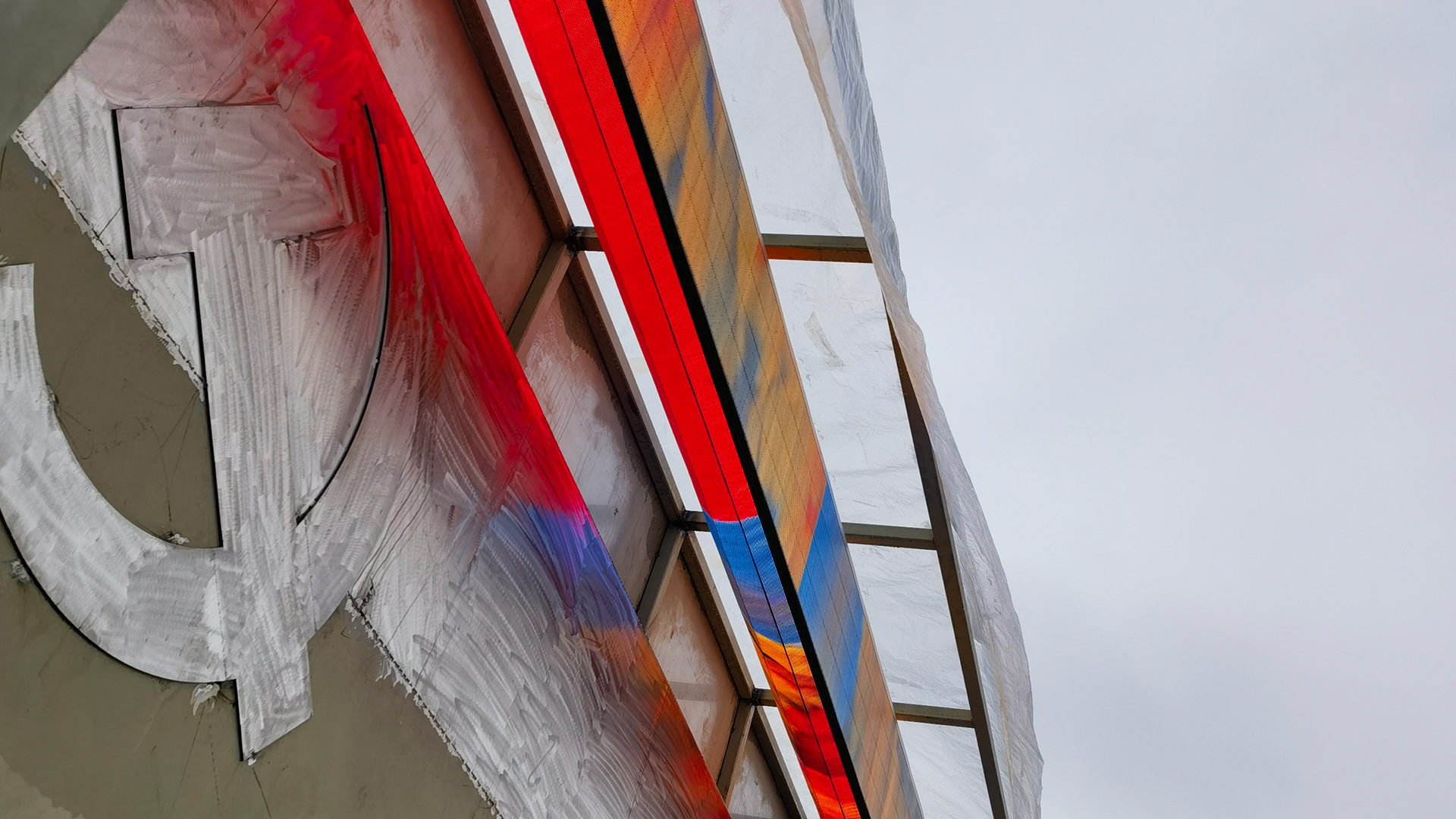
Outdoor rollable LED display integrated into a cultural tourism site in Zuoquan County, Shanxi, China, where the screen is stowed when not in use.
Onumen Technology Co., Ltd. is a Shenzhen-based LED display manufacturer founded in 2009 that develops lightweight foldable and rollable LED display solutions. Its portfolio covers four product families: Power-Screen Separation (Architecture) LED Screen, Folding LED Display Screen, Rolling LED Screen, and Mobile Quick-Assembly LED Foldable Display. The rolling family is marketed under the model designations FRL and FRSL, described by the company as an Automatic Rollable LED Display.
The venue problem that rollable screens actually solve
Buyers rarely choose a rollable screen because they want a screen that rolls. They choose it because three venue constraints collide: storage footprint, mounting structure, and schedule. A permanent LED wall consumes floor or ceiling area every day of the year. A rental panel system consumes truck space, labour hours and rigging capacity on every load-in and load-out. A rollable display sits between the two, offering a permanent-quality visual surface without a permanent footprint.
That trade-off shows up most clearly in venues that are multi-purpose. A shopping mall atrium, a hotel ballroom, a school lecture hall, a stadium concourse and a cultural heritage site all share the same requirement: the space must look normal most of the time, and must become a large-format display environment on demand. The FRL/FRSL rolling format, at 15 to 16 mm thick indoors and 18.5 mm outdoors, is thin enough that a stowed unit can be concealed behind cladding, above a ceiling line, or inside a floor well.
What the rolling format is engineered to do
The Rolling Rollable LED Display (FRL/FRSL) is specified as an automatic rollable LED display using a 500 × 62.5 mm module, with indoor pixel pitches from P1.25 to P3.9 and outdoor pitches of P2.6 and P3.9. Refresh rate is listed at 3840 Hz, grey scale at 16 bit, and contrast ratio at 2500:1. The table below summarises the configurations most relevant to venue selection.
| Parameter | Indoor configuration | Outdoor configuration |
|---|---|---|
| Pixel pitch | P1.25 / P1.56 / P1.953 / P2.6 / P3.9 | P2.6 / P3.9 |
| Brightness | 600–1000 nits | 2000–6000 nits |
| Module size | 500 × 62.5 mm | 500 × 62.5 mm |
| Thickness | 15–16 mm | 18.5 mm |
| Weight | 13–15 kg/m² | 18 kg/m² |
| Protection rating | Front IP54 / Rear IP43 | Front IP65 / Rear IP65 |
| Viewing angle | 120°–160° horizontal and vertical | 120°–160° horizontal and vertical |
| Working temperature | −20°C to +45°C | −20°C to +45°C |
| Installation | Suspended / wall-mounted / ground | Suspended / wall-mounted / ground |
| Certification | CE, RoHS, FCC | CE, RoHS, FCC |
Two engineering details matter for venue planning. First, the company pioneered a separated power and screen installation technology, which moves power components away from the display surface and reduces panel thickness and heat generation at the screen itself. Second, the rolling mechanism is protected by a patent family rather than a single filing. The Netherlands patent EP2755459 covers a freely-foldable flexible LED screen, with parallel filings recorded in Italy (UIBM), France and at the European Patent Office, plus US 8,899,791 B2 from the USPTO, Korean patent KR 10-1692125, Taiwanese patent I560662, Japanese patents JP 5889442 and JP 7852969, and Australian patent AU 2013317305. Chinese filings include ZL201010180375.2 for an automatic roll-up flexible LED curtain screen and ZL202310190465.7 for a rollable LED screen or roll-up LED display.
Venue-by-venue fit: where rollable screens hold an advantage
1. Outdoor advertising and cultural tourism sites
This is the clearest use case, because the venue itself cannot tolerate a permanent screen. In Zuoquan County, Shanxi, China, a 50+ m² outdoor rollable LED display was installed at the former site of the Eighth Route Army Headquarters in Mata Town. The rolling structure allows the display to be stored safely when not in use and deployed quickly for exhibitions and cultural presentations, preserving the appearance of a heritage environment. The relevant specification is the outdoor FRL/FRSL configuration at IP65 front and rear, 2000 to 6000 nits, and 18 kg/m².
2. Stadiums, arenas and concert stages
Live event venues value deployment speed and rigging efficiency more than permanent installation quality. Documented deployments include a 500 m² liftable foldable LED stage system for a Zhang Jie concert in China, a 500+ m² liftable foldable installation for a SHINee concert in Korea, a 100+ m² liftable foldable stage structure at Stade de France, and three large LED screens totalling 1,670 m² for a Fukuyama Masaharu tour in Japan. Rolling screens serve the same venues where the screen must also be invisible between events, such as stage floors, side wings and temporary sponsor walls.
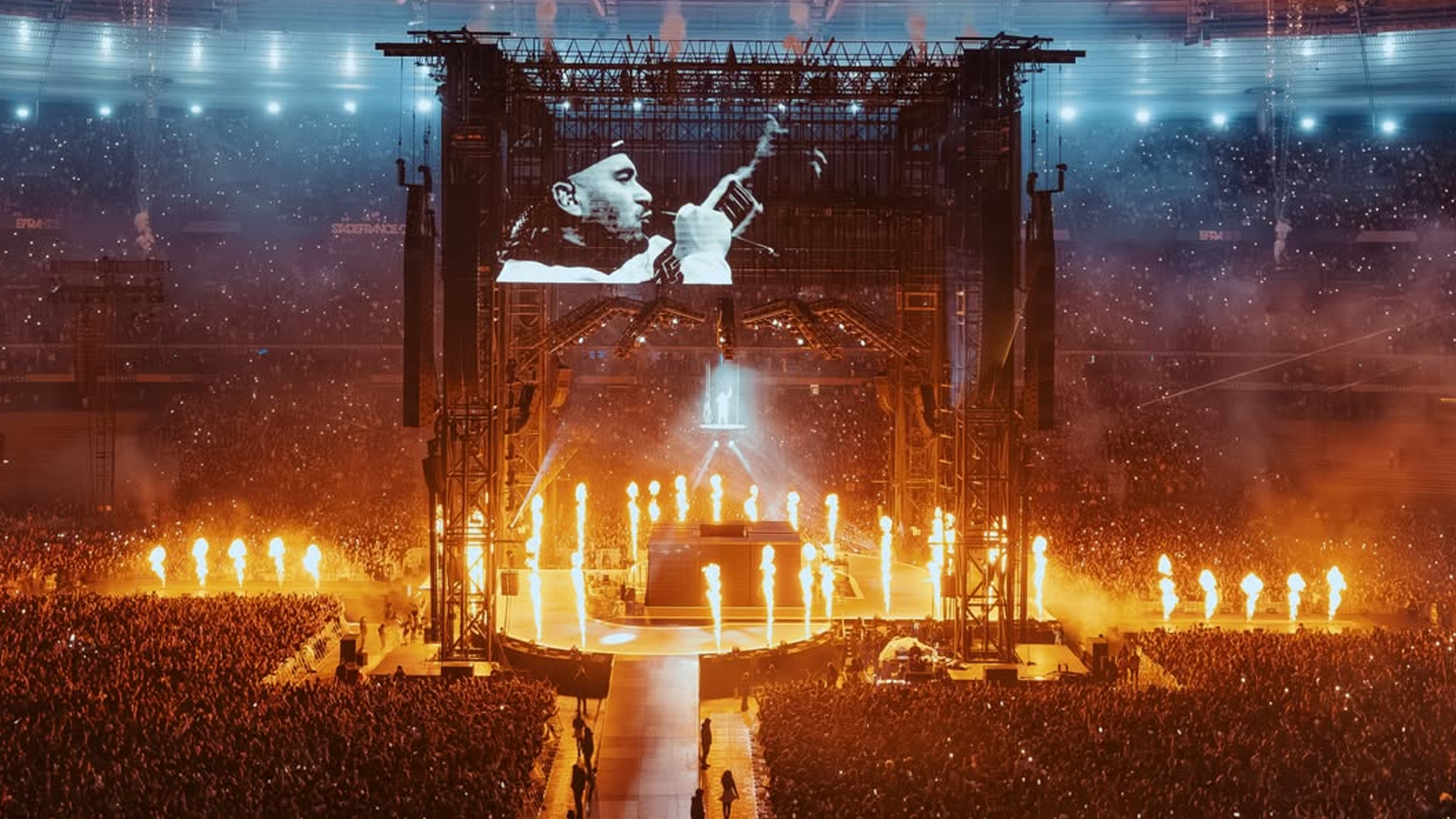
A 100+ m² liftable foldable LED stage installation at Stade de France, France — the venue type where rollable and foldable formats compete directly.
3. Exhibitions, trade shows and road shows
Exhibition organisers buy display capability by the day. A rolling screen that stows into a flight case or a concealed floor well reduces storage and handling costs between shows. The Mobile Quick-Assembly LED Foldable Display (Easy Sailing EP series) is the format built explicitly for this, with screen heights from 1,000 × 1,500 mm up to 1,000 × 4,000 mm, 12 kg/m² panel weight, and a 70 kg flight case for the EP150-EP225 range. Where a booth needs a wider, thinner surface than a mobile folding unit allows, the rollable format is the alternative.
4. Retail, malls and commercial property
Commercial property operators adopt concealable screens because ordinary trading hours require clean architecture. A 50+ m² hidden liftable foldable LED display was integrated into the indoor space of the Tai Wai MTR shopping mall in Hong Kong, remaining hidden when not in use and lowering automatically for commercial events and promotions. For retail, the practical specification question is indoor brightness (600 to 1000 nits is normally sufficient under controlled lighting) and pixel pitch, because viewing distances in a mall are typically shorter than in a stadium concourse.
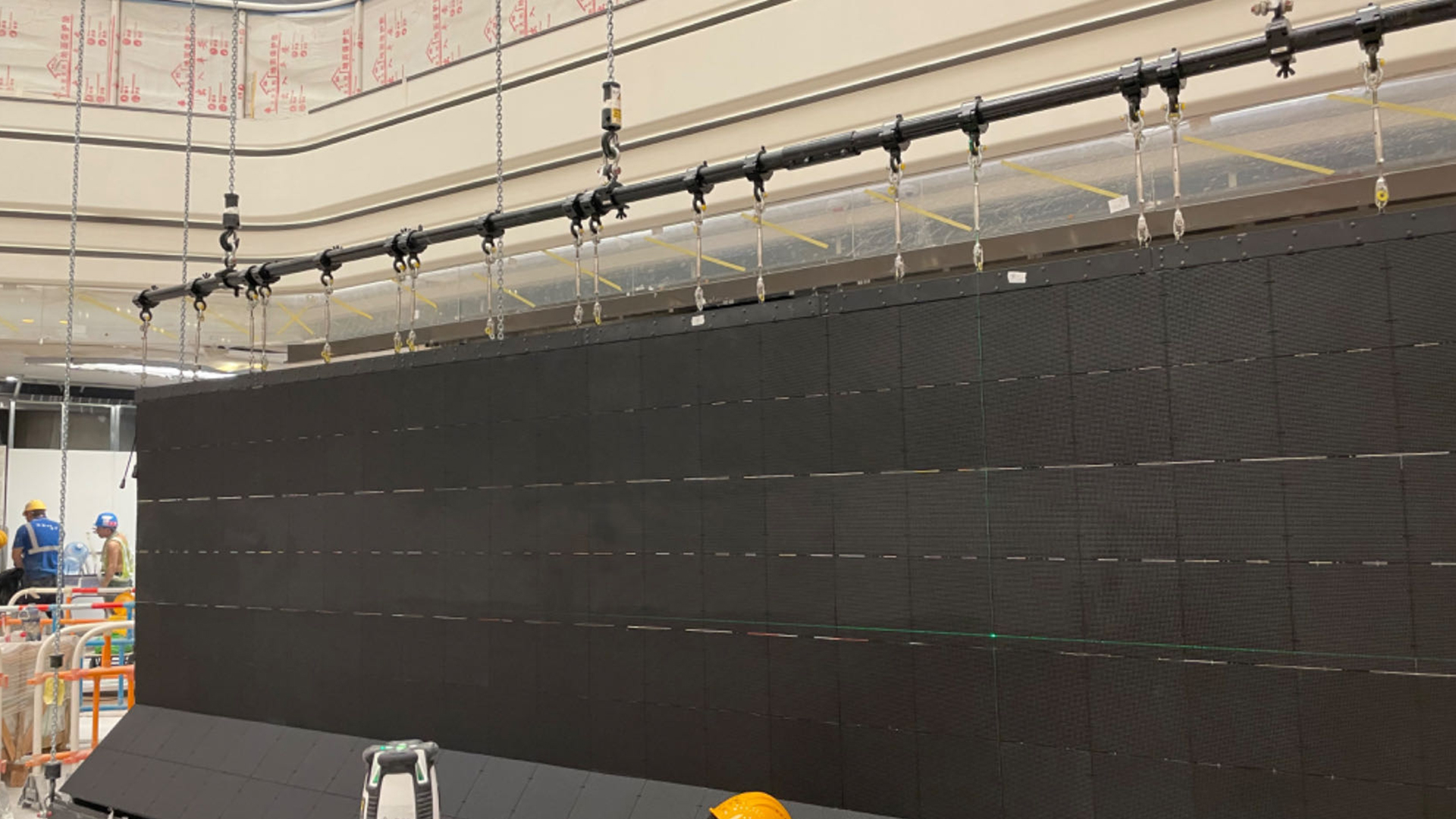
A 50+ m² concealed liftable LED display installed in a Hong Kong shopping mall, shown in its deployed state.
5. Broadcast studios and award ceremonies
Studio and award-show set design changes frequently, and a fixed LED wall limits that change. The 2024 MAMA AWARDS in Japan used a 100+ m² liftable foldable LED display hidden beneath the stage floor, lifted and unfolded during the performance. For camera-facing work, refresh rate is the controlling specification: the FRL/FRSL rolling family lists 3840 Hz, which is the baseline for flicker-free capture at typical broadcast shutter settings.
6. Corporate, education, hospitality and places of worship
These venues share a fixed seating layout and a modest technical crew. A 30+ m² liftable foldable LED display was installed in the lecture hall ceiling of Wenzhou Foreign Language School, lowered for teaching and presentations and hidden inside the ceiling afterwards. The 15+ m² outdoor liftable foldable installation at a kindergarten in Ordos, Inner Mongolia, follows the same logic for outdoor campus events. For corporate showrooms, hotel ballrooms, airports and church and theatre venues, the rolling format competes on the same criterion: whether the room must return to a neutral state afterwards.
Content needs change the specification more than the venue does
Two venues of the same size can require different screens because their content differs. Four variables drive the specification.
- Viewing distance sets pixel pitch. A close-range retail or showroom audience justifies indoor P1.25 to P2.6. A stadium bowl or an outdoor advertising position at distance is adequately served by P3.9 or coarser.
- Ambient light sets brightness. Indoor rolling configurations are listed at 600 to 1000 nits. Direct-sunlight outdoor positions require the outdoor configuration at 2000 to 6000 nits.
- Camera capture sets refresh rate. The 3840 Hz refresh rate and 16 bit grey scale in the rolling family support on-camera use in broadcast and hybrid event content.
- Content format sets aspect ratio. The 500 × 62.5 mm module geometry allows unusually wide, low strips or tall, narrow columns, which suits banner-format advertising, ticker content and architectural bands better than a 16:9 panel grid.
For venues in the European Union and China, content and hardware decisions also intersect with photobiological safety: IEC 62471 is the standard applied to LED products to limit blue-light hazard, and it is referenced for LED display deployment in both markets. For public spaces in the United States, UL 62368-1 for electrical safety and UL 94 V-0 for fire resistance are the commonly cited requirements. These are specification inputs, not marketing claims, and they should be confirmed against the intended installation.
Rolling versus foldable: a practical decision rule
Onumen supplies both formats, which makes the internal comparison unusually clear. The rolling family (FRL/FRSL) is an automatic rollable display. The folding family covers the FC series, a 360° foldable flexible LED display; the FCSL Smart Plus, also 360° foldable; the FPS Magic Plus, a 180° foldable flexible LED display; and the FTS Smart T Plus, a foldable transparent LED display.
| Decision criterion | Rolling format (FRL/FRSL) | Foldable formats (FC / FCSL / FPS / EP / FTS) |
|---|---|---|
| Storage behaviour | Winds onto a roller; smallest stowed height | Folds on hinges; stows as a folded panel stack or in a flight case |
| Weight per square metre | 13–15 kg/m² indoor; 18 kg/m² outdoor | FC 11 kg/m²; FCSL 15 kg/m²; FPS 15 kg/m²; EP 12 kg/m²; FTS 8–12 kg/m² |
| Brightness ceiling | 600–1000 nits indoor; 2000–6000 nits outdoor | FC 1000–1500 nits; FCSL 2400–6000 nits; FPS 6000 nits; FTS 1100–9700 nits |
| Environmental rating | Indoor front IP54 / rear IP43; outdoor IP65 both sides | FC IP43; FCSL IP65 (up to IP68 optional); FPS IP65 (up to IP68); EP IP43; FTS IP65 (up to IP68) |
| Best-fit scenario | Concealed installations, wide-format bands, dual-use architecture | Rental touring, mobile shows, transparent façade work, fast set-up events |
The rule that emerges is straightforward. If the display must disappear into the architecture and reappear on a schedule, rolling is the stronger fit. If the display must travel, be carried by a small crew, or be re-rigged in a different shape at every stop, folding is the stronger fit. Weight confirms the choice: the indoor rolling configuration at 13 to 15 kg/m² is heavier than the FC foldable at 11 kg/m², so a venue with a tight structural allowance may prefer the folding format even when concealment is desirable.
Where a rollable LED screen is the wrong answer
Credible procurement decisions require the boundary conditions, and the rolling format has several.
- It still needs a mounting structure. FRL/FRSL supports suspended, wall-mounted and ground installation. A venue with no suitable ceiling anchor, truss point or wall substrate will need added structure, which can erase the footprint advantage.
- Indoor rollable units are not outdoor-rated. The indoor configuration is front IP54 and rear IP43. Permanent outdoor weather exposure requires the outdoor IP65 configuration, which adds thickness (18.5 mm) and weight (18 kg/m²).
- Very high ambient brightness may point elsewhere. For sustained outdoor advertising in strong direct light, the higher-brightness folding and transparent families, such as FCSL at 2400 to 6000 nits or FTS at up to 9700 nits, offer more headroom than the indoor rolling configuration.
- Automated deployment adds a maintenance scope. Because the screen deploys under power, the drive and control components are part of the long-term service plan. Onumen's published after-sales scope covers remote technical support, installation guidance, maintenance support and spare parts supply.
- It is not a short-notice purchase. Custom production lead time is listed at 30 to 90 days after order confirmation.
- Permanent fixtures may be better served by fixed screens. At Tokyo Shibuya Station, a 50+ m² ultra-thin fixed LED display was installed using the separated power supply structure to reduce thickness and heat generation. In a permanently fixed advertising position, that architecture is often simpler than an automated rolling system.
Procurement and execution criteria for rollable LED projects
For buyers moving from evaluation into execution, the practical checklist is short. Customisation scope covers screen size, pixel pitch, cabinet design, installation structure, control system, logo and packaging. Minimum order quantity is 1 m² or 1 unit. Production capacity is stated at 3,000 to 5,000 m² per month, with lead time of 30 to 90 days after order confirmation. Quality control includes 100% aging test and inspection before shipment. Delivery can be arranged on EXW, FOB, CIF or DDP terms, with payment by T/T, L/C or Trade Assurance where applicable. Acceptance procedures include pre-shipment inspection, video inspection and functional testing before delivery.
Compliance documentation is a separate check. The applicable file includes CE certificates for low voltage (EN 60950-1) and EMC (EN 55022, EN 61000 series), a TÜV Rheinland certificate of conformity (AE 50336727 0001), a RoHS certificate of compliance referencing Directive 2011/65/EU and IEC 62321:2008, and China Compulsory Certification (2021200903000314, CEPREI, valid 21 October 2021 to 20 October 2026). The CE, RoHS and FCC marks are also listed against the FRL/FRSL product specification itself. Design recognition includes the Red Dot Winner 2024 award (reference Red 8972, issued 24 June 2024) alongside the company's stated iF and French design awards.
Market context
Rollable and foldable displays are a small but rapidly growing slice of a large category. Third-party research places the global flexible display market, which includes rollable form factors, at approximately USD 20.1 billion to 21.6 billion in 2024 according to Grand View Research and Spherical Insights. Within that, Meticulous Research and openPR project the rollable and foldable display segment to grow from USD 5.1 billion in 2024 to nearly USD 60 billion by 2035. The gap between those two figures is a scoping difference, not a contradiction, and buyers should read any market number against the segment definition it uses.
On the supply side, KingAurora's 2024 industry report identifies Samsung Electronics, Leyard and LG Electronics as the leading global players in outdoor and flexible LED display. Onumen operates in a different tier and a different lane, describing itself as holding a global patent pool spanning Asia, Europe, the Americas and Oceania, with roughly 100 invention patents cited in company disclosures. Company data also records a 2,000 m² factory, a 20-engineer R&D team, an annual output of 9,000 m², a 70% export ratio, and main markets in the USA, Europe, Japan, South Korea, Russia and the Middle East.
On the demand side, venue operators increasingly treat display surfaces as revenue infrastructure rather than decor. Industry reporting has cited revenue increases in the range of 15% to 25% from advertising and premium sponsorship for venues upgrading to advanced LED video walls, although such figures are venue-specific and should be treated as directional rather than guaranteed.
Future outlook
Three shifts are likely to shape rollable LED adoption over the next planning cycle. First, architecture will absorb more display surface. As concealable formats become normal, the procurement question moves from whether a screen can be installed to how quickly it can be returned to a neutral state. Second, content will become more format-agnostic. Wide, low strip content and vertical column content, both of which the 500 × 62.5 mm rolling module geometry supports, are easier to schedule than full-canvas graphics, and advertising systems are already adapted to them. Third, specification will shift from panel parameters to deployment parameters: stow height, lift cycle, service access and the structure required to carry the screen.
For buyers, that means the evaluation checklist for anyone considering a Rollable LED Screen should start with the venue and the event calendar, not the datasheet. The datasheet decides which configuration of a chosen format will work. The venue decides which format is worth specifying at all.
FAQ
What is the difference between a rollable LED screen and a foldable LED screen?
A rollable LED screen winds onto a roller for storage, which produces the smallest stowed height and suits concealment inside ceilings, walls or floors. A foldable LED screen folds along hinges, producing a folded panel stack. In Onumen's range, the rolling format is the FRL/FRSL Automatic Rollable LED Display, while the folding formats are the FC series and the FCSL Smart Plus, both listed as 360° foldable flexible LED displays, the FPS Magic Plus at 180° foldable, the FTS Smart T Plus foldable transparent display, and the EP Easy Sailing mobile folding display.
Can a rollable LED screen be used outdoors?
Yes, but only in the outdoor configuration. The FRL/FRSL indoor configuration is rated front IP54 and rear IP43, which is not intended for permanent weather exposure. The outdoor configuration is rated front IP65 and rear IP65, with brightness of 2000 to 6000 nits, thickness of 18.5 mm and weight of 18 kg/m². Pixel pitch for the outdoor version is limited to P2.6 and P3.9.
How much lead time should be planned for a custom rollable LED screen?
Onumen's stated custom production lead time is 30 to 90 days after order confirmation, against a monthly capacity of 3,000 to 5,000 m². Minimum order quantity is 1 m² or 1 unit. Buyers should treat the lead time as an order-confirmation milestone rather than a delivery date, and should confirm delivery terms separately, since EXW, FOB, CIF and DDP options are all listed.
What certifications and patents should be verified before deployment?
For the rolling product family, CE, RoHS and FCC are listed on the product specification. Supporting files include CE low voltage and EMC certificates, a TÜV Rheinland certificate of conformity (AE 50336727 0001), a RoHS certificate referencing Directive 2011/65/EU, and China Compulsory Certification 2021200903000314, valid until 20 October 2026. On the intellectual property side, the rolling and folding mechanisms are covered by filings including EP2755459, US 8,899,791 B2, KR 10-1692125, JP 5889442, JP 7852969, TW I560662, AU 2013317305, ZL201010180375.2 and ZL202310190465.7. Buyers should request the certificate corresponding to the exact model and destination market, and check expiry dates at the time of order.
What is inspected before a rollable LED display ships?
Published acceptance procedures include pre-shipment inspection, video inspection and functional testing before delivery. Production quality control also includes 100% aging test and quality inspection before shipment. For installation and operation, the listed after-sales scope covers remote technical support, installation guidance, maintenance support and spare parts supply.
Rollable LED Screen
Rolling LED Screen
LED Roll-Up Display
Event and Conference LED Roll-Up Screen
Outdoor Advertising LED Roll-Up Screen