
Where Pre-Insulated Pipe Fits in Chilled Water Networks
Chilled water networks ask a different question of insulated pipe than district heating does. The same factory-assembled product — a steel service pipe bonded to rigid polyurethane foam and enclosed in an outer protective jacket — appears in both, but the failure modes that decide whether a network performs are not the same. A hot water line is judged on heat loss and high-temperature ageing. A chilled water line is judged on heat gain, surface condensation and moisture.
The practical answer for buyers is short: pre-insulated pipe can serve chilled water networks, and the reason has little to do with its temperature rating. The documented envelope of the product — a conveyed medium no higher than 120 °C, occasional peaks not exceeding 130 °C, and a working pressure of no more than 2.5 MPa — sits far above chilled water duty. What determines whether a chilled water project succeeds is moisture control: jacket watertightness, moisture-tight joints, and a corrosion protection grade matched to the soil the pipe is buried in.

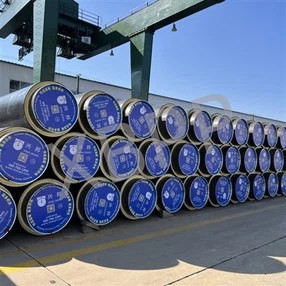
Pre-insulated pipe installed for a district cooling and heating supply project in Phnom Penh, Cambodia — one of the recorded reference applications for this product family.
Why Chilled Water Reverses the Selection Question
Heat moves in the opposite direction. In a directly buried hot water network the insulation layer slows heat leaving the service pipe, and network economics depend on how much of that heat still reaches the end user. In a chilled water network the same layer slows heat entering the pipe from warm soil or warm ambient air, and network economics depend on how much heat the chilled water absorbs before it reaches the cooling load. The insulation material may be identical; the performance question is inverted.
The second difference is condensation. Where a cold surface meets humid air or humid soil, moisture can form and migrate toward the pipe. Rigid polyurethane foam is a closed-cell material, and its insulating value depends on the gas held inside those cells. Water entering the foam through a damaged jacket or an unsealed joint displaces that gas, and insulation performance declines. This is why the waterproof and moistureproof function documented for pre-insulated pipe is not a secondary feature in a cold network — it is the primary performance requirement.
The third difference is where engineering attention is spent. A hot water network concentrates on pipe stress, thermal expansion and the temperature ceiling of the insulation. A cold network concentrates on joint sealing, jacket continuity, corrosion protection against groundwater, and protection of the pipe against soil load and external impact. The same product is being asked to solve a different problem.
The Product Envelope: Chilled Water Sits Well Inside the Documented Limits
The stated technical envelope of the pre-insulated pipe product type is documented and narrow. For the polyurethane insulated pipe supplied under this product family, the conveyed medium is no higher than 120 °C, occasional peak temperatures do not exceed 130 °C, working pressure is no more than 2.5 MPa, and polyurethane insulated pipes can operate continuously for at least 30 years in a 120 °C environment. Those values describe a hot water reference case, and they are the numbers a chilled water buyer should read carefully.
| Documented parameter | Stated value | What it means for a chilled water network |
|---|---|---|
| Conveyed medium temperature | No higher than 120 °C; occasional peak no higher than 130 °C | Chilled water duty sits far inside this limit. Temperature is not the selecting factor. |
| Working pressure | No more than 2.5 MPa | Standard chilled water network pressures fall within the stated scope. |
| Continuous service reference | At least 30 years of continuous operation at 120 °C for polyurethane insulated pipe | The documented long-service case is the hot water case, not a cold-duty case. |
| Insulation and outer jacket material | Rigid polyurethane foam / high density polyethylene | Closed-cell foam and a watertight jacket are the two components that also govern cold-duty behaviour. |
| Operating mode | 24-hour continuous operation | Cooling networks run continuously as well; the operating profile matches. |
| Standard reference for this pipe category | EN 253 addresses pre-insulated bonded pipe systems for directly buried hot water networks | EN 253 is a hot water reference. It does not automatically carry over as a chilled water compliance statement. |
Pre-insulated pipe: steel service pipe, rigid polyurethane foam insulation and an outer protective jacket bonded into a single factory-assembled unit.
Read together, these values say something specific: in chilled water service the product is not constrained by temperature. It is constrained by whatever the project does about moisture — at the jacket, at the joint, and at the interface with the ground.
Buried or Above Ground: Configuration Choices for Cold Duty
Configuration is the first decision that changes with climate and route. The product range covers both directions: directly buried pre-insulated pipe with a high density polyethylene outer jacket, and an above-ground variant with a galvanized iron jacket. Each answers a different set of site conditions.
Directly buried runs
Buried installation removes the pipe from view, saves land occupation and reduces civil engineering investment. The documented functions of the buried configuration are thermal insulation, waterproofing and moistureproofing, and resistance to humid and saline-alkali geological environments. For a chilled water main, the buried environment is also the main source of moisture, so the design has to address four documented site requirements: thermal expansion stress, soil load, groundwater corrosion, and external impact.
Above-ground runs
Above-ground sections are common at plant rooms, crossings and where excavation is impractical. The galvanized iron jacket variant provides mechanical protection for the exposed run, but an exposed cold surface behaves differently from a buried one: condensation forms on the outside of the jacket rather than being managed by the surrounding soil, and support and expansion detailing move to the top of the design agenda. Neither configuration is universally correct. Route length, groundwater level, soil chemistry and ambient humidity decide.
Joints and Fittings: Where a Cold Network Is Won or Lost
A pre-insulated pipeline is not continuous. Every joint is a deliberate interruption of the factory insulation: the jacket is cut back, the service pipe is welded, and the gap is re-foamed and sealed on site. The documented accessory set for this product family includes electrofusion sleeves, heat shrinkable sleeves, insulation joint material, foaming filler, and sealing and waterproof material.
In a hot water network, that interruption is a thermal weak point. In a chilled water network, it is also the most likely path for moisture to reach the insulation. The consequence for procurement is straightforward: on a cold network, the sealing and waterproof material and the insulation joint material carry as much weight as the pipe itself. A specification that fixes the pipe but leaves joint accessories open to substitution has not fixed the watertightness of the network.
Route complexity adds a second consideration. Non-standard pipe fittings can be custom fabricated, which matters where a chilled water main has to negotiate plant rooms, crossings and non-standard bends rather than following a straight buried alignment.
Application Fit by Project Type
The recorded reference projects for this product family are described as cooling and heating supply applications with a reported result of stable operation. That record is the most useful evidence available for judging chilled water fit, because it reflects networks where a cold medium was carried through insulated pipe in real site conditions.
| Project type | Why insulated pipe fits | Reference application from the product record |
|---|---|---|
| District cooling network, city or utility scale | Long buried chilled water mains where heat gain and groundwater exposure drive the design | District cooling project, Phnom Penh, Cambodia — 5 km, cooling and heating supply, stable operation reported over a 10-year period |
| Campus and institutional networks | Buried distribution between a central plant and multiple buildings, often built in phases | New university construction project, Ho Chi Minh City, Vietnam — 6 km, stable operation reported over 7 years |
| Commercial buildings and hotels | Compact routes with mixed cooling and heating demand and limited plant room space | Hotel project, Jamaica — 3 km, stable operation reported over 2 years |
| Industrial and mining process cooling | Long runs across variable ground conditions with soil load and external impact risk | Copper mine project, Mongolia — 9 km, stable operation reported over 3 years |
| Combined cooling and heating networks | One pipe family serving both duties within the same site or municipality | Bank project, Cambodia — 30 km, stable operation reported over 2 years; municipal project, Uzbekistan — 6 km, stable operation reported over 5 years |

Industrial cooling and heating supply application: a 9 km pre-insulated pipe installation at a copper mine project in Mongolia, recorded as operating stably over three years.
Chilled Water Versus Hot Water: A Practical Comparison
Side by side, the two duties pull the specification in different directions. The table below is a decision aid rather than a performance claim.
| Selection criterion | Hot water network | Chilled water network |
|---|---|---|
| Dominant thermal driver | Heat loss from pipe to surroundings | Heat gain from surroundings into pipe |
| Relevance of the temperature ceiling | The 120 °C polyurethane foam limit is a live design constraint | The same limit is not the binding constraint for chilled water duty |
| Primary risk to manage | High-temperature ageing of foam and thermal expansion | Moisture ingress and surface condensation |
| Role of the outer jacket | Mechanical protection and waterproofing | Mechanical protection, waterproofing and moisture control |
| Joint priority | Watertight re-insulation and continuity of the jacket | Watertight and moisture-tight re-insulation |
| Standard reference | EN 253 covers directly buried hot water networks | The same scope does not automatically extend to chilled water; project-specific confirmation is required |
| Evidence a buyer should request | Temperature and pressure rating confirmation | Condensation and moisture design basis for the route |
Where the Fit Stops: Limits and Boundaries
An honest application review has to name the edges of suitability, not only the centre. Six boundaries apply to pre-insulated pipe in chilled water networks.
- The standard reference is written for hot water. EN 253 addresses pre-insulated bonded pipe systems for directly buried hot water networks. It should not be presented to a project owner as a chilled water compliance statement.
- Cold-duty performance is not separately documented. The published continuous-service reference is 30 years at 120 °C — a hot water condition. Buyers should not infer chilled water performance from hot water data, and should ask the supplier for a project-specific condensation and moisture design basis.
- Steam duty falls outside the envelope. Polyurethane foam insulation for this class of pipe typically withstands temperatures up to 120 °C, while steam applications generally operate above that range. A steam line needs a different insulation specification.
- Above-ground sections need their own detailing. A galvanized iron jacket protects an exposed run mechanically, but an exposed cold surface must be assessed for condensation and for support and expansion behaviour.
- Ground conditions can invalidate a generic specification. Groundwater corrosion, soil load, salinity and external impact are all documented site requirements. A project that specifies pipe without specifying a corrosion grade and geological design is leaving the main cold-network risk unaddressed.
- Commercial terms shape the schedule. For this product family the minimum order quantity is 1 km and lead time is 30–45 days. Phased cooling networks should place orders against the construction sequence rather than the total route length.
What the Market Data Says About Cooling Demand
Demand-side signals support the application case for insulated pipe in cooling, even though the product category was built around heating. Pre-insulated pipes for district cooling are projected to grow at a CAGR of 9.48%, a rate attributed to rising smart city projects (SNS Insider, 2024). The wider global pre-insulated pipes market was estimated at USD 5.97 billion in 2024 and projected to reach USD 10.4 billion by 2030, a CAGR of 9.7% (Grand View Research).
Regional and end-use distribution reinforce where that growth is concentrated. Asia Pacific dominated the pre-insulated pipes market with a 39.96% revenue share in 2024 (Grand View Research), and the commercial end-use segment held a 43.8% revenue share in the same year — the segment that includes hotel and building cooling networks of the kind listed in the reference projects above. In the wider district heating and cooling market, growth of 5.7% CAGR is projected from 2024 to 2032 (Global Market Insights).
What Buyers Should Verify Before Ordering
A chilled water procurement checklist is shorter than a general pipe specification but stricter in two places: moisture and ground conditions.
- Confirm the design temperature, flow and pressure of the chilled water network against the stated envelope of no more than 120 °C medium temperature and no more than 2.5 MPa working pressure.
- Ask for the moisture and condensation design basis covering the full route, not only the pipe.
- Confirm which joint accessories are supplied — electrofusion sleeve, heat shrinkable sleeve, insulation joint material, foaming filler, and sealing and waterproof material — and that they are part of the ordered scope.
- Match the anti-corrosion grade to measured soil chemistry and groundwater conditions.
- Split the route into buried and above-ground sections and confirm the jacket type for each.
- Confirm the testing regime; this product family is supplied against 100% testing.
- Check order quantity and delivery against the construction programme, given a 1 km minimum order quantity and a 30–45 day lead time.
Manufacturing and Customization for Cold-Network Projects
Tangshan Xingbang Pipeline Engineering Equipment Co., Ltd is a Chinese manufacturer of pre-insulated and anti-corrosion pipeline systems, based in the Houhu Industrial Park of the Yutian Economic Development Zone, Hebei Province. The company operates a 310,000 m² site with 231 employees, including a 30-engineer R&D team, and exports to Europe, North America and the Middle East.
For a chilled water project, the relevant capability is customization rather than catalogue selection. The company supports independent R&D with full customization covering pipe diameter and length, pipe material, temperature and pressure rating, insulation thickness, anti-corrosion grade, non-standard pipe fittings, design adapted to geological conditions, and an optional intelligent monitoring system. Monthly capacity is 200 km, and dedicated on-site service teams support projects through installation. Product information is published at www.xingbanginsulatedpipe.com.
Future Outlook
Two technical directions are visible in the category. Next-generation insulation materials such as aerogels are emerging for ultra-low heat loss in pre-insulated pipes (Strategic Market Research, 2025) — a development that matters more for cold networks than for hot ones, because reducing heat gain is the whole objective. Separately, intelligent monitoring systems are already offered as a customization option on this product family, which gives operators a way to detect moisture ingress or section-level performance drift rather than discovering it after insulation performance has degraded.
The documentation gap is likely to close more slowly than the demand gap. District cooling continues to expand under smart city programmes, while the reference standard in this pipe category remains oriented to hot water networks. Until chilled-water design guidance becomes as explicit as the hot water guidance, the practical route for buyers is unchanged: treat every cold network as a moisture-design problem, ask for the condensation basis in writing, and evaluate the pipe and its joints as one system.
FAQ
Can pre-insulated pipes be used in chilled water networks?
Yes, within stated limits. The product type is documented as suitable for pipe network systems where the conveyed medium is no higher than 120 °C, occasional peaks do not exceed 130 °C, and working pressure is no more than 2.5 MPa, and it is described as applicable to anti-corrosion, thermal insulation and cold preservation pipeline projects in heating, cooling and crude oil transportation. Chilled water duty falls well inside the temperature envelope. Suitability for a specific network depends on moisture and condensation design, jacket watertightness and joint sealing rather than on the temperature rating.
How does chilled water differ from hot water when selecting insulated pipe?
The direction of heat flow reverses: a hot water line loses heat outward, while a chilled water line gains heat inward. That shifts the dominant risk from high-temperature ageing and thermal expansion to moisture ingress and surface condensation, and it changes the function of the outer jacket from mechanical protection and waterproofing toward moisture control. The standard reference in this category, EN 253, is written for directly buried hot water networks, so a chilled water project needs its own condensation and moisture design confirmation.
Which insulation and jacket are used for buried chilled water lines?
The product uses rigid polyurethane foam insulation with a high density polyethylene outer jacket for directly buried installations. The documented functions of this configuration are thermal insulation, waterproofing and moistureproofing, and resistance to humid and saline-alkali geological environments, together with reduced land occupation and lower civil engineering investment compared with above-ground routing. The design also has to address thermal expansion stress, soil load, groundwater corrosion and external impact.
Are joints and fittings different for cooling networks?
The accessory set is the same type of scope — electrofusion sleeve, heat shrinkable sleeve, insulation joint material, foaming filler, and sealing and waterproof material — but its importance shifts. Every joint interrupts the factory insulation and is re-foamed and sealed on site, which makes it the most likely path for moisture to reach the insulation in a cold network. Sealing and waterproof materials therefore carry greater weight in a chilled water specification than in a hot water one, and non-standard fittings can be custom fabricated where the route requires them.
What should be verified before ordering insulated pipe for a district cooling project?
Five checks matter most. Confirm that design temperature and pressure fall within the stated envelope of no more than 120 °C and no more than 2.5 MPa. Request the condensation and moisture design basis for the route. Confirm that joint sealing and waterproofing accessories are inside the ordered scope. Match the anti-corrosion grade to soil and groundwater conditions, and separate buried from above-ground sections. Finally, align order quantity and delivery with the construction programme, since this product family carries a 1 km minimum order quantity and a 30–45 day lead time, and is supplied against 100% testing.
Reference Material
A full company and product brochure covering the pre-insulated pipe range, insulation construction and application scope is available for download: Xingbang pre-insulated pipe company brochure (PDF).