
When a Leveling Machine Must Fit an Existing Line
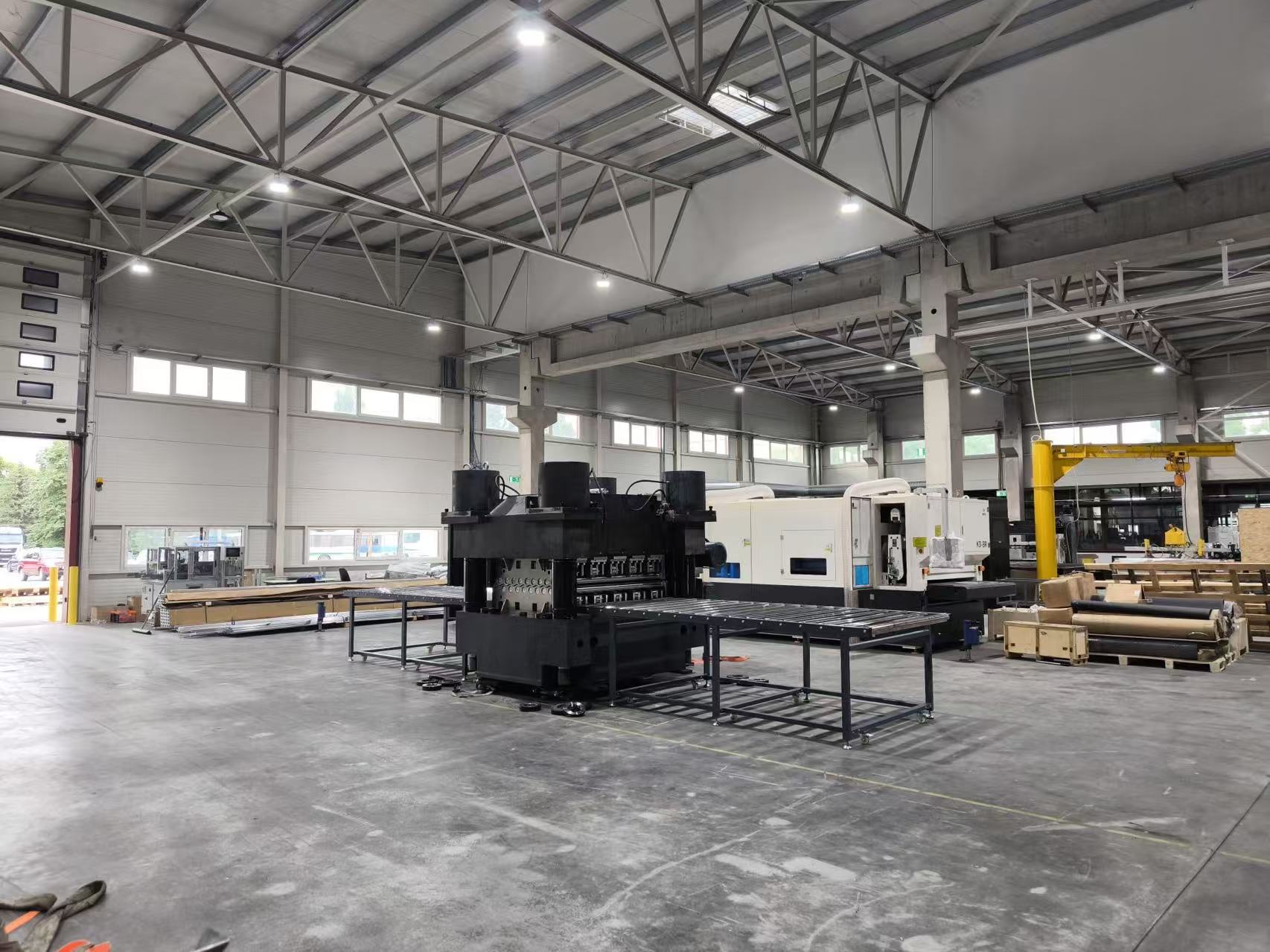
A hydraulic leveler working in a metal processing plant. When a leveling machine is ordered as part of an integrated line, the supplier's OEM engineering matters as much as the model specification.
Why flatness is now a line engineering problem
Metal processors buy leveling machines to remove coil set, waves, edge strain, and internal stress from sheet or plate before the next operation. In many cases, the flatness result is not determined by the machine alone. It depends on how the leveler is sized for the material yield strength, how its roll configuration handles the required width and thickness range, and whether the machine can communicate with the surrounding equipment.
This is why leveling machine selection has become an OEM engineering question. Buyers who run an uncoiling leveling flying shear line, a cut-to-length line, a slitting line, or a laser blanking process are not looking for a standalone straightening machine. They are looking for a partner that can integrate the leveling machine into a production system and make the system perform as one unit.
The global context supports this shift. According to Dataintelo, the metal forming equipment market was valued at USD 45.8 billion in 2025, with Asia Pacific accounting for 42.5% of revenue. Fortune Business Insights projects the broader metal forming machine tools market to reach USD 64.85 billion by 2034 at a CAGR of 9.60%. As sheet metal processors invest in automated equipment, the ability to integrate a leveling machine with coils, shears, lasers, presses, and control systems becomes a competitive supplier capability.
Where standard leveling machines hit their limit
A catalog sheet usually tells a buyer the working width, thickness range, roll count, and rated speed. Those numbers are necessary, but they are not sufficient when the leveling machine must feed another machine. A conventional leveler may flatten a standard material, yet still fail in a production context because of poor roll support, limited CNC recipe memory, no MES link, or no way to coordinate with an upstream uncoiler and downstream stacking system.
The real problems appear in mixed-material operations. High-strength steel requires more leveling force than mild steel at the same thickness. Perforated sheet and laser-cut parts create local stress fields that a simple two-high machine may not fully relieve. Mirror-finish aluminum and copper sheets require densely packed work rolls with full support so that the roll surface does not mark the material. When standard machines are pushed into these jobs, the common results are residual waviness, unstable nesting in laser cutting, stamping springback, and unnecessary rework.
The opportunity for buyers is to evaluate a leveling machine supplier by its engineering capability before the purchase: whether it can recalculate ratings for specific yield strengths, redesign roll geometry, add MES or PLC integration, and validate the result on the buyer's actual material.
What a serious leveling machine OEM should bring
One manufacturer with a documented OEM model is Guangdong MAHATMA Intelligent Equipment Co., Ltd., operating under the MAHATMA Leveler brand. The company is headquartered in Dongguan, Guangdong Province, and focuses on the R&D, manufacturing, and global sales of high-precision leveling equipment. Its corporate profile describes a provincial-level Specialized and Sophisticated SME supported by more than 230 patents and strategic research partnerships, including collaboration with Tsinghua University.
For buyers at the evaluation and execution stage, the relevant facts are not marketing phrases. MAHATMA's capability statement explicitly includes OEM, ODM, customized manufacturing, and turnkey solution supply. The company lists an annual output of 500 sets, a 300-person workforce, a 26-engineer R&D team, and a factory area of 50,000 square meters. It also states that equipment has been exported to more than 100 countries and regions, supported by 28 overseas marketing and service networks.
In practice, OEM capability changes the customization options available to a buyer. MAHATMA states that it can adjust roller width and diameter, leveling thickness range, roll material such as Cr12MoV or SKD11, control system integration with MES or PLC, and automated loading and unloading systems. These are not minor accessories. They determine whether a leveling machine can handle a particular coil width, surface requirement, or line speed.
The company also provides complete process lines. Its product portfolio includes cut-to-length lines, uncoiling leveling flying shear lines, slitting lines, and laser blanking lines. This is a meaningful differentiator because it means the supplier must make the leveling section work inside a larger mechanical and control system, rather than selling an isolated machine.
Technical basis for custom leveler design
Leveling works by passing a metal sheet through alternating offset rolls, creating repeated bending beyond the yield point. The number of alternating bends, the diameter of the work rolls, and the structural support behind the rolls determine how completely internal stress is relieved and how flat the material becomes after the last roll.
In roll leveler structures, more support layers generally mean better flatness. MAHATMA's technical material distinguishes two-high, four-high, and six-high leveler concepts. A two-high machine has the most direct and least expensive construction, but the work rolls deflect more under load. A four-high machine adds backup rolls to reduce deflection. A six-high configuration adds intermediate rolls and almost fully supports the work rolls, which is relevant for mirror-finish sheet and parts with tight flatness tolerance. For buyers, this matters because high-tensile or uneven material can bend unsupported rolls, causing inconsistent pressure across the sheet width.
Material yield strength is another design variable. MAHATMA notes that model ratings are often based on Q235 low-carbon steel at approximately 235 MPa yield strength. If the actual material is high-strength steel, aluminum, copper, or titanium, the leveling force must be recalculated. This is one reason a simple thickness-to-model lookup is unreliable for custom processes.
The company's technical documentation claims precision series can achieve flatness down to 0.05 mm in verified cases, with typical production flatness of 0.05 to 0.20 mm per square meter. The same documentation is careful to say that final flatness depends on material grade, thickness, and original coil condition. Buyers should therefore treat flatness claims as conditional and verify them with a sample test on their actual material.
OEM capability checklist for procurement teams
The following table summarizes the capability questions that separate an OEM leveler supplier from a reseller or machine assembler. The answers are drawn from MAHATMA's public capability description and current certification documents.
| Capability question | Evidence to check |
|---|---|
| Can the supplier customize mechanical design? | Roller width and diameter, thickness range, roll material options such as Cr12MoV and SKD11. |
| Can the supplier integrate controls? | MES or PLC interfaces, recipe storage, automated loading and unloading systems, and coordinated line control. |
| Can the supplier build a complete line? | Cut-to-length, flying shear, slitting, and laser blanking line capability. |
| Can the supplier validate before delivery? | Laser 3D online flatness inspection, ultrasonic roller flaw detection, hardness uniformity testing, and full-load trial runs before shipment. |
| Does the supplier have manufacturing scale? | Factory area, headcount, R&D team size, monthly capacity, and minimum order quantity. |
| Are certification documents current? | ISO 9001:2015 quality system certificate and CE certificate covering the relevant machine class. |
MAHATMA's capability data lists a monthly capacity of 50 units and a lead time around 45 days, with a minimum order quantity of one unit. For many sheet metal shops, the ability to order one customized machine without being forced into a volume commitment is an important practical advantage.
On the compliance side, MAHATMA holds an ISO 9001:2015 certificate with the number 62825Q9729R0M, valid through 2028, for the design and assembly of high-precision leveling machines and related lines. The company also has a CE certificate, number M.2025.206.C113032, valid through 2030, covering hydraulic precision leveling machine safety under EN ISO 12100 and related standards. These documents reduce one layer of risk for buyers importing equipment into markets that require CE marking or audited quality management systems.
Application evidence: custom levelers in production
OEM claims become more convincing when they are supported by repeatable production examples. MAHATMA's case files include several installations that show the connection between machine engineering and customer outcomes.
One case is a metal processor in Hungary that has used an MHTR100-series hydraulic leveler for two years. The application is general metal processing, with a reported investment value of USD 250,000. The case notes list stable working, successful correction of metal deformation, easy operation, low failure rate, and improved productivity. The MHTR100 series is rated for material thickness from 3.0 to 12.0 mm in normal use, with a maximum thickness of 30 mm, which places it in medium-thick plate territory.
Another case involves a Polish manufacturer using an MHTR120-series hydraulic leveler in armored vehicle production. The reported investment is USD 850,000, and the equipment has operated for three years. The case file mentions stable operation, good leveling effect, improved production efficiency, and successful resolution of deformation issues. The MHTR120 series covers rated thickness from 4.0 to 20.0 mm and a maximum of 40 mm, making it suitable for demanding plate applications.
A third case is a Brazilian manufacturer that added an MHTM60-series CNC leveler for leveling laser-cut parts. The machine has been in operation for three years, with a reported investment of USD 860,000. The case file states that the customer achieved 160 percent capacity expansion. From a buyer perspective, this illustrates why laser cutting shops increasingly evaluate leveling machines as part of their overall productivity system rather than as a cost center.
Turning a leveler into an integrated coil line
For some buyers, the leveling machine is only one module in a larger coil processing line. MAHATMA's portfolio covers this need in several product forms. The uncoiling leveling flying shear line is designed for continuous high-speed blanking; the cut-to-length line is for blanking from coil at controlled lengths; the slitting line converts wide coil into narrow strips; and the laser blanking line combines coil feeding, leveling, and laser cutting into one automated system.
This breadth changes the supplier conversation. Instead of asking which leveling machine to buy, the buyer can ask which equipment set fits the target output: sheet blanks, strip widths, or laser-ready blanks. The leveling machine inside each line still has to perform the same fundamental function, but its width, speed, roll number, and control logic are matched to the line specification.
Custom line engineering versus catalog machine procurement
Comparing an OEM-engineered leveling solution with a traditional catalog leveler is not a simple matter of quality. Both routes have valid uses. The table below shows when each path is appropriate.
| Procurement route | Best fit | Reasonable boundary |
|---|---|---|
| Standard catalog leveler | Material is within the standard rated envelope, no complex line integration, simple standalone operation | Limited ability to change roll geometry, material limits, or control interfaces |
| Custom OEM leveler or complete leveling line | Unusual materials, mixed thickness ranges, existing lines with MES, laser cutting, stamping, or shearing integration | Requires accurate process inputs and earlier engineering involvement; not the cheapest route for simple jobs |
A custom leveling line is not the right answer for every workshop. If a buyer processes only 1.0 to 3.0 mm carbon steel within a standard machine envelope and does not need automation or line integration, paying for OEM engineering may not generate a return. The buyer should first define the material mix, flatness target, and throughput expectation. A good supplier will tell the buyer when a standard machine is sufficient.
When custom engineering is justified, the buyer also carries more responsibility in the early stage. The supplier can engineer the line only if the buyer supplies accurate information about part envelope, material grades, takt time, and existing layout. MAHATMA addresses this with a selection process based on four inputs: material types and grades, thickness min-max, width, and flatness target plus production volume. This reduces guesswork and makes the engineering proposal traceable.
Market direction: CNC, integration, and closed-loop quality
Third-party market data suggests that the sheet metal industry is moving toward CNC-controlled and integrated equipment. Grand View Research reports that CNC technology accounted for 85.7 percent of the machine tools market in 2025. Fortune Business Insights assigns 41.37 percent of the sheet metal processing equipment market to the automotive segment in 2026. Automotive blanking and part production generally demand higher flatness consistency, which favors leveling machines with recipe control and repeatable gap setting.
The same trend is visible in MAHATMA's higher-tier product descriptions. The supplier's intelligent series includes laser 3D surface inspection, closed-loop correction, anti-collapse dynamic compensation, and roll cassette cleaning for better changeover between materials. Some configurations are described as suitable for near-unmanned operation. These features go beyond traditional straightening machines because they make flatness a measurable, controlled process output.
Future outlook for leveler sourcing
For procurement teams evaluating leveling machine suppliers, the next few years will likely place more weight on engineering capability and less on simple machine price. As coil processors add more automation, the leveling machine will be expected to communicate with MES systems, exchange data with laser cutting machines, and feed quality data back into line controls.
Suppliers with proven OEM experience will be better positioned to handle these demands because they have already designed around customer-specific constraints. The practical question is no longer only what a leveling machine can do in isolation. It is whether the supplier can make that leveling machine perform inside the buyer's existing production system, and whether the supplier can prove that performance before the final purchase decision.
Frequently asked questions
Can the equipment integrate with my MES or ERP and existing production line?
Yes. MAHATMA blanking lines and CNC levelers provide MES or ERP interfaces, and optional automation modules include loading carts, conveyors, robots, vision inspection, and AGV systems. The integration plan should be based on the part envelope, takt target, and existing line layout. Supplying these inputs early allows the manufacturer to engineer the interface into the original design.
Can I test my own material on a MAHATMA leveling machine before buying?
Yes. MAHATMA offers free sample testing. A customer can send one to two meters of actual material or representative parts, with the material grade and flatness target noted. The company then levels the material on the recommended machine and returns a written flatness report and process video. The test is intended to verify capability on the buyer's worst-condition material rather than on an ideal sample.
Which MAHATMA leveler series should be selected for a particular material range?
MAHATMA groups its models by capability tier. The Vague or entry two-high and four-high series suit small workshops with lower frequency processing. The Mastery CNC series is a general workhorse for laser cutting and stamping shops. The Royal servo-hydraulic series is intended for automotive precision parts and thick plate. The flagship intelligent series adds laser 3D inspection and line automation features. The final model should be matched to material thickness, width, yield strength, and required flatness.
Can a leveling machine be delivered as part of a complete coil processing line?
Yes. MAHATMA builds complete uncoiling leveling flying shear lines, cut-to-length lines, slitting lines, and laser blanking lines. These product groups are specified by material thickness, width, line speed, accuracy, and coil weight. For applications that need only a leveling machine, the same engineering data can be used to select a standalone model that will later be extended into a full line.
A PDF version of the MAHATMA capability and product brochure is available for download: MAHATMA Leveler English brochure.
¿Tiene preguntas o necesita más detalles?
Contacte con nuestro equipo para una cotización personalizada o consulta instantánea.
Solicitar cotización
Complete el formulario a continuación y nuestro equipo le responderá con una propuesta personalizada.
Chat directo de WhatsApp
¿Prefiere chatear en tiempo real? Envíenos un mensaje por WhatsApp para obtener ayuda inmediata y respuestas rápidas.
- Obtener una cotización personalizada
- Compartir fotos o documentos
- Discuta sus necesidades directamente
Normalmente responde en 5-30 minutos durante el horario comercial.