
When Wholesalers Should Choose GT-702BM vs GT-732M
The global blood pressure monitoring devices market was valued at USD 4.2 billion in 2025 and is estimated to reach USD 8.6 billion by 2033, a CAGR of 9.3% (Grand View Research). Digital blood pressure monitors accounted for approximately 48% of that market's revenue share in 2024 (Fortune Business Insights). For wholesalers, demand is not the constraint — channel fit is. Two upper arm models from Guangdong Genial Technology Co., Ltd. illustrate why.
Wholesalers and distributors of home medical health devices increasingly field requests that look identical on a purchase order and completely different on the shop floor. An offline household retail chain wants an upper arm monitor that is light, simple to present and easy to stock. A chronic disease management institute wants a device that behaves consistently across repeated daily measurements. An insurer building a promotional gift programme wants a unit that reads as credible the moment the box is opened. Same category, three different buying logics.
Why one upper arm blood pressure monitor cannot serve every home health channel
Upper arm digital blood pressure monitors are often treated in wholesale catalogues as a single commodity line differentiated only by price. That assumption breaks down at the point of resale, where three variables do the real work: how the cuff interfaces with the user, how many people share the device, and how heavy and bulky the unit is when it is packed, shipped and displayed.
None of those variables is captured by a price list. A heavier unit with a clinical-style air bag can add cost and freight volume to a retail programme that only needs a household monitor. Conversely, a lightweight consumer-oriented unit may not be the natural choice for an institution that measures the same patients week after week and expects a defined pulse-accuracy tolerance. The mismatch is rarely about quality; it is about scenario.
This is the gap that GENIAL's two-model split is designed to close. The comparison below is not a ranking. It is a channel-matching exercise, and the answer changes depending on who the wholesaler is selling to.
What GT-702BM and GT-732M are
GT-702BM is an upper arm digital blood pressure monitor built around an ABS housing and a composite fabric cuff, documented for medical instrument wholesale distribution and offline household retail. GT-732M is an upper arm digital blood pressure monitor built around an ABS housing and an eco-friendly TPU air bag, documented for chronic disease management institutes, community medical centers and insurance promotional gifts. Both are produced by Guangdong Genial Technology Co., Ltd. (GENIAL), a Guangzhou-based original manufacturer of medical devices and smart wearable devices established in 2001.
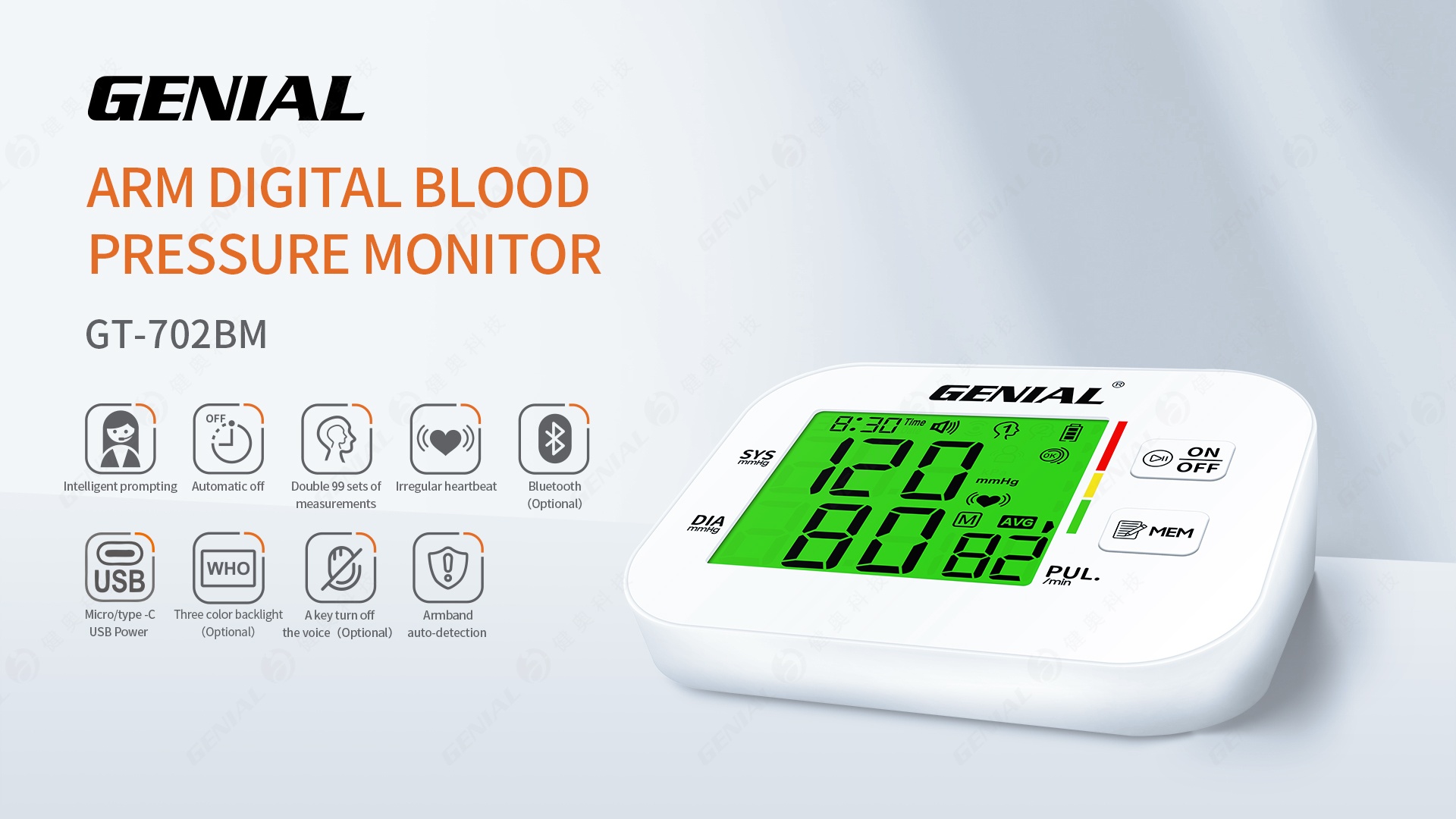
GT-702BM: upper arm digital blood pressure monitor with a composite fabric cuff, documented for medical instrument wholesale and offline household retail.
| Specification | GT-702BM | GT-732M |
|---|---|---|
| Device type | Upper Arm Digital Blood Pressure Monitor | Upper Arm Digital Blood Pressure Monitor |
| Pressure measuring range | 0–290 mmHg | 0–290 mmHg |
| Arm circumference range | 22–42 cm | 22–42 cm |
| Housing material | ABS | ABS |
| Pressure interface material | Composite fabric cuff | Eco-friendly TPU air bag |
| Memory | 99 memory sets for 2 users | Not stated in the available specification data |
| Pulse error | Not stated in the available specification data | ≤±5% |
| Dimensions | 135×102×46 mm | 136×103×54 mm |
| Net weight (without battery) | 220 g ±15 g | 239 g ±15 g |
| Documented channels | Medical instrument wholesale; offline household retail | Chronic disease management institutes; community medical centers; insurance promotional gifts |
Specification comparison of GENIAL GT-702BM and GT-732M, based on manufacturer-supplied product data.
Reading the material difference: composite fabric cuff vs eco-friendly TPU air bag
The two models share more than they differ. Both use an ABS housing, which is a widely used rigid thermoplastic in device enclosures and provides dimensional stability for a handheld instrument. Both measure over the same 0–290 mmHg pressure range and the same 22–42 cm arm circumference band. The meaningful divergence is at the pressure interface: a composite fabric cuff on GT-702BM, an eco-friendly TPU air bag on GT-732M.
Material choice at the cuff is a channel decision, not a quality verdict, and the available specification data does not rank one above the other. What it does is change the questions a wholesaler should put to each end buyer:
- How many users share the device? GT-702BM carries 99 memory sets for 2 users, which suits a household where two adults track their own readings over time.
- What accuracy tolerance does the buyer expect? GT-732M publishes a pulse error tolerance of ≤±5%. Where an institution writes accuracy language into a tender or programme document, a stated tolerance is easier to reference than an unstated one.
- How is the unit handled between measurements? Fabric and TPU interfaces differ in surface feel, cleaning routine and storage habits. Buyers operating training or loan programmes should confirm handling guidance with the manufacturer rather than assume uniformity.
- What is the freight and shelf profile? At 220 g ±15 g versus 239 g ±15 g without battery, GT-702BM is the lighter of the two. Over container-scale orders, unit weight and carton dimensions feed directly into landed cost.
Those four questions map cleanly onto the channel split. A retail programme answers them one way; a chronic-care programme answers them another.
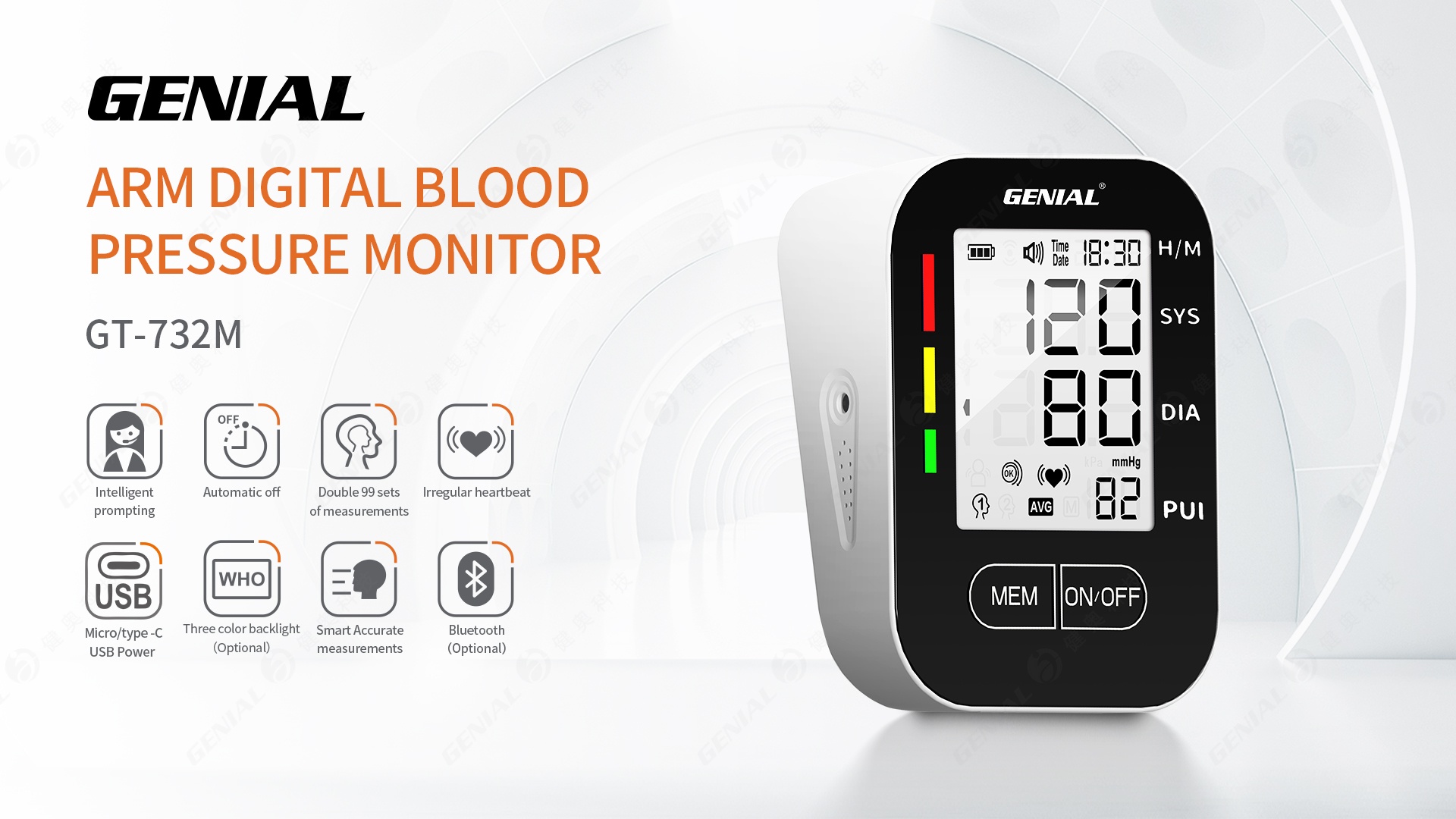
GT-732M: upper arm digital blood pressure monitor with an eco-friendly TPU air bag, documented for chronic disease management institutes, community medical centers and insurance promotional gifts.
Channel fit: where each model belongs
GT-702BM — wholesale medical instrument distribution and offline household retail
GENIAL documents GT-702BM for medical instrument wholesale and offline household retail, and describes it for home health monitoring and wholesale distribution. For a distributor supplying pharmacy chains, supermarket health aisles or regional household retailers, the fit comes from three documented characteristics rather than from any performance claim.
First, the composite fabric cuff is the pressure interface most consumers already recognise from conventional upper arm monitors, which lowers the explanation burden at the shelf. Second, 99 memory sets shared between 2 users gives a household a reason to keep one device rather than two, which supports a single-SKU retail listing. Third, at 220 g ±15 g without battery and 135×102×46 mm, it is the lighter and more compact of the pair, which matters when a buyer is negotiating carton configuration, pallet efficiency and inbound freight.
For a wholesale medical instrument distributor, the practical value is catalogue simplicity: one upper arm model that satisfies mainstream household expectations, sits at a lower shipped weight, and does not require the buyer to explain a specialised air bag system.
GT-732M — chronic disease management institutes, community medical centers and insurance promotional gifts
GENIAL documents GT-732M for chronic disease management institutes, community medical centers and insurance promotional gifts. Three attributes explain why those channels sit with this model.
The eco-friendly TPU air bag is the primary differentiator. Where a community medical center or chronic-care institute runs a repeat-measurement programme, the air bag is the component that cycles most often, so its material specification becomes a procurement talking point rather than a footnote. The stated pulse error tolerance of ≤±5% gives institutional buyers a written figure to attach to their own monitoring protocols, which is useful when a centre has to justify equipment choice internally. And at 136×103×54 mm with a slightly deeper body, the unit carries a more substantial physical presence — a factor that matters in insurance promotional gift programmes, where the device must signal medical credibility inside a presentation box.
Community medical centers that run blood pressure screening alongside chronic disease management are a particularly natural fit, because these settings combine institutional frequency of use with a home-health product format.
When the right answer is stocking both
A wholesaler serving a mixed territory will often need both models rather than a single hero SKU. The clean rule is to anchor the decision on the resale channel, not on the price list: offline household retail and general medical instrument wholesale point to GT-702BM, while chronic disease management institutes, community medical centers and insurance gift programmes point to GT-732M. Handling both is not a contradiction; it is a recognition that the same category serves two different purchasing behaviours.
What sits behind both models on the GENIAL platform
Channel fit is only the front layer of the evaluation. The layer behind it is the measurement platform and the compliance position that a wholesaler inherits when it lists either model.
GENIAL's upper arm blood pressure monitor platform measures systolic pressure, diastolic pressure and pulse rate, provides a WHO blood pressure classification indication, includes irregular-heartbeat detection, supports dual-user memory storage and is designed for long-term hypertension management. Operation is by automatic pressurization with one-button control, powered by battery or USB, with optional voice broadcast and app connection and an automatic shutdown function. Documented operating conditions are an indoor temperature of 5–40°C and 15%–85% relative humidity.
Compliance is where institutional and cross-border buyers tend to concentrate. GENIAL holds ISO 13485, ISO 45001, ISO 14001, BSCI and GB/T29490 system certifications, and its products carry CE, FDA, NMPA, CB, FCC and RoHS certifications. For these blood pressure monitors, the documented registration requirement is an NMPA Medical Device Registration Certificate for the domestic market, with export certifications covering FDA, CE, FCC, GCC, MDR, RoHS and IECEE CB. GENIAL states that it has completed product and trademark registration in 29 countries and sells into 117 countries and regions. Buyers evaluating either model should confirm the applicable registration route against their own destination market rather than assume a single certificate covers all territories.

GENIAL operates a 45,000 sqm manufacturing base in Guangzhou with annual output of 15,000,000 units and an in-house R&D team of 29 engineers.
Market trend: channel specialisation inside a growing category
The category tailwind is measurable. Blood pressure monitoring devices are projected to grow from USD 4.2 billion in 2025 to USD 8.6 billion by 2033 at a CAGR of 9.3% (Grand View Research), and digital monitors already represent roughly 48% of revenue share (Fortune Business Insights). Competitive presence in this space remains concentrated among established consumer health brands — iData Research identifies Omron Healthcare as a dominant competitor in the global blood pressure monitor and nebulizer markets as of 2024 — which is precisely why distribution-side differentiation matters.
For a manufacturer such as GENIAL, scale is part of that differentiation. The company operates a 45,000 sqm manufacturing base, employs approximately 251 staff including a 29-engineer R&D team, and reports annual production capacity of 15,000,000 units, with export business accounting for 80% of sales across Europe, North America, Southeast Asia, the Middle East, Africa, Latin America and Oceania. It also offers one-stop OEM, OBM, ODM and JDM services, and states that branded products ship within 24 hours of order confirmation while OEM orders take 3 to 7 days.
The trend line wholesalers should watch is not unit growth — it is specification branching. As home monitoring moves from a single household purchase toward community programmes, institutional chronic-care protocols and corporate gift channels, manufacturers respond with channel-specific SKU variants. GT-702BM and GT-732M are a clear example of that pattern: identical measurement envelope, different pressure interface and different documented destination.
Where these two models stop short
An honest scenario guide has to state the boundary, not only the fit. GT-702BM and GT-732M are upper arm devices, and upper arm placement carries structural trade-offs compared with wrist-type monitors or legacy manual measurement.
| Dimension | Traditional manual auscultatory measurement | Automatic upper arm monitors (GT-702BM / GT-732M) |
|---|---|---|
| Inflation | Operator-controlled, typically by hand bulb | Automatic pressurization |
| Operator skill | Typically requires a trained person to read Korotkoff sounds | One-button operation; designed for self-use |
| Record keeping | Usually written by hand | Device memory storage (GT-702BM: 99 sets for 2 users) |
| Multi-user management | Separate manual logs | Dual-user memory storage on the platform |
| Portability | Bulb, cuff and stethoscope carried separately | Self-contained unit at 220 g / 239 g (±15 g) without battery |
The limitations that follow from that comparison are specific and worth stating plainly:
- Arm circumference coverage is bounded. Both models are documented at 22–42 cm. Buyers serving patient groups outside that band need to confirm cuff availability rather than assume the standard cuff will fit.
- Upper arm is not the lightest form factor. Within GENIAL's portfolio, wrist-type monitors such as GT-701 are documented at 94 g ±15 g without battery, versus 220 g and 239 g for these two upper arm models. Travel-oriented or space-constrained channels may prefer the lighter wrist format, accepting a different measurement position.
- Cuff material is a trade-off, not a ranking. Composite fabric and eco-friendly TPU behave differently in handling and cleaning routines. The available specification data does not establish superiority for either, and buyers should treat material as a channel-matching input rather than a quality score.
- Documented use scope is home and community monitoring. Both models are documented for home health, chronic-care and community settings. They are not presented as substitutes for hospital-grade diagnostic classification systems.
- The memory and accuracy specifications are not symmetrical. GT-702BM publishes 99 memory sets for 2 users but no pulse-error figure in the available data; GT-732M publishes a pulse error of ≤±5% but no memory figure. Where a tender demands both data points on one model, that requirement should be confirmed with the manufacturer before the bid is submitted.
Future outlook
Three developments are likely to shape how wholesalers stock this category over the next planning cycle. The first is continued digitisation: with digital monitors already holding approximately 48% of blood pressure monitoring revenue, the analogue-to-digital shift is largely complete in the channels that matter for home health, which moves competition onto channel fit and packaging rather than measurement technology alone.
The second is programme-driven demand. Chronic disease management and community medical center screening create recurring, specification-led purchasing that behaves differently from consumer retail. Manufacturers that document pulse tolerance, memory depth and material specifications in a comparable format make life easier for institutional buyers — and easier for the wholesaler in the middle.
The third is connected care. GENIAL operates a cloud health management platform and reports 262 intellectual property certificates, alongside a portfolio that already includes wearable digital thermometers, continuous dynamic thermometers, fingertip pulse oximeters, mesh nebulizers and sleep apnea therapy devices. For a distributor, that breadth matters commercially: blood pressure monitors can be positioned as an entry point into a wider home medical health device range rather than a standalone line item.
Frequently asked questions
What distinguishes GT-702BM and GT-732M as upper arm digital blood pressure monitors?
Both are Upper Arm Digital Blood Pressure Monitors manufactured by Guangdong Genial Technology Co., Ltd. Both specify a pressure measuring range of 0–290 mmHg and an arm circumference range of 22–42 cm, and both use an ABS housing. GT-702BM measures 135×102×46 mm at 220 g ±15 g without battery and carries 99 memory sets for 2 users. GT-732M measures 136×103×54 mm at 239 g ±15 g without battery and specifies a pulse error of ≤±5%.
How do the cuff materials differ, and why does it matter to a distributor?
GT-702BM uses a composite fabric cuff, while GT-732M uses an eco-friendly TPU air bag. The housing material on both models is ABS. The cuff or air bag is the component that contacts the user and cycles during every measurement, so its material affects handling and cleaning routines in the resale channel. The available specification data describes the materials but does not rank one above the other, so material should be treated as a channel-matching factor rather than a quality indicator.
Which distribution channels is each model documented for?
GENIAL documents GT-702BM for medical instrument wholesale and offline household retail, describing it for home health monitoring and wholesale distribution. GT-732M is documented for chronic disease management institutes, community medical centers and insurance promotional gifts. A wholesaler can therefore match the model to the resale channel rather than to price alone, and may carry both where its territory spans retail and institutional demand.
What certifications apply to GENIAL upper arm blood pressure monitors?
The company holds ISO 13485, ISO 45001, ISO 14001, BSCI and GB/T29490 system certifications, and its products carry CE, FDA, NMPA, CB, FCC and RoHS certifications. For blood pressure monitors specifically, the documented registration requirement is an NMPA Medical Device Registration Certificate, with export certifications covering FDA, CE, FCC, GCC, MDR, RoHS and IECEE CB. GENIAL states that it has completed product and trademark registration in 29 countries. Buyers should verify the applicable route for each destination market.
What are the practical limits of these two models compared with other form factors?
Both are upper arm devices with a documented arm circumference range of 22–42 cm, so users outside that range fall beyond the stated coverage. They are also heavier than wrist-type alternatives: 220 g ±15 g and 239 g ±15 g without battery, compared with 94 g ±15 g for the wrist-type GT-701 in the same portfolio. Upper arm placement is generally chosen for measurement stability rather than portability, so the trade-off is weight and bulk against measurement position.
How quickly can orders ship, and what does the platform include beyond the monitor itself?
GENIAL states that branded products can ship within 24 hours after order confirmation, while OEM orders take 3 to 7 days. The upper arm blood pressure monitor platform measures systolic pressure, diastolic pressure and pulse rate, provides a WHO blood pressure classification indication, includes irregular-heartbeat detection, supports dual-user memory storage and operates by automatic pressurization with one-button control, powered by battery or USB. The broader product range spans digital thermometers, pulse oximeters, mesh nebulizers, sleep apnea therapy devices and related home health devices.
For full technical specifications, certification scope and the complete home medical health device portfolio, the GENIAL product brochure is available here: GENIAL 2026 English Product Brochure. Wholesalers evaluating either model for a specific channel can request matching documentation before committing to a stocking plan.