
What to Verify Before Buying Hydraulic Baler Machines
What to Verify Before Buying Hydraulic Baler Machines
The global baler machine market was valued at USD 6.6 billion in 2024 and is projected to reach USD 11.4 billion by 2035, according to Grand View Research. For procurement teams evaluating hydraulic baler machines, the decisive questions are no longer limited to compression force and throughput. Certificates, technical parameters, and regional compliance now determine whether a machine can be imported, installed, and accepted by end users without friction. This guide explains what a buyer should verify before purchase, using the certified hydraulic baler range manufactured by Nantong Jiabao Machinery Co., Ltd. under the jewel brand as a reference line.
Why Certification Now Decides the Shortlist
Industrial buyers researching hydraulic baler machines encounter a fragmented compliance landscape. In the European Union, compaction equipment must satisfy the Machinery Directive 2006/42/EC and the Low Voltage Directive 2014/35/EU. Safety design is typically verified against EN ISO 12100:2010 and EN 60204-1:2018. European regulations additionally require vertical and tyre balers to comply with EN 16500:2014, while the United States applies ANSI Z245.5-2023 for baling equipment safety. These are not optional references; they are conditions of market entry and insurance coverage.
The opportunity for buyers is that certification has become a measurable differentiator. A machine that arrives with a third-party supplier audit and market-specific declarations removes a layer of risk from customs clearance, installation inspection, and end-user acceptance. In practice, the evaluation shifts from “which machine compresses the fastest” to “which machine can prove its compliance.” This is particularly relevant for buyers in the research and evaluation stages, where documented constraints matter more than marketing claims.
The Manufacturer as a Verification Point
Nantong Jiabao Machinery Co., Ltd. is a manufacturer of environmentally friendly compression and baling equipment based in Rugao, Jiangsu Province, China. Established in 2006, with a brand history dating to 1995, the company operates a 50,000-square-meter production facility, employs over 200 professionals, and maintains an R&D team of 30 engineers. Its jewel product line covers semi-automatic and fully automatic compression and baling machines, intelligent waste removal systems, automatic compression and wrapping systems, and integrated crushing, compression, and baling machines.
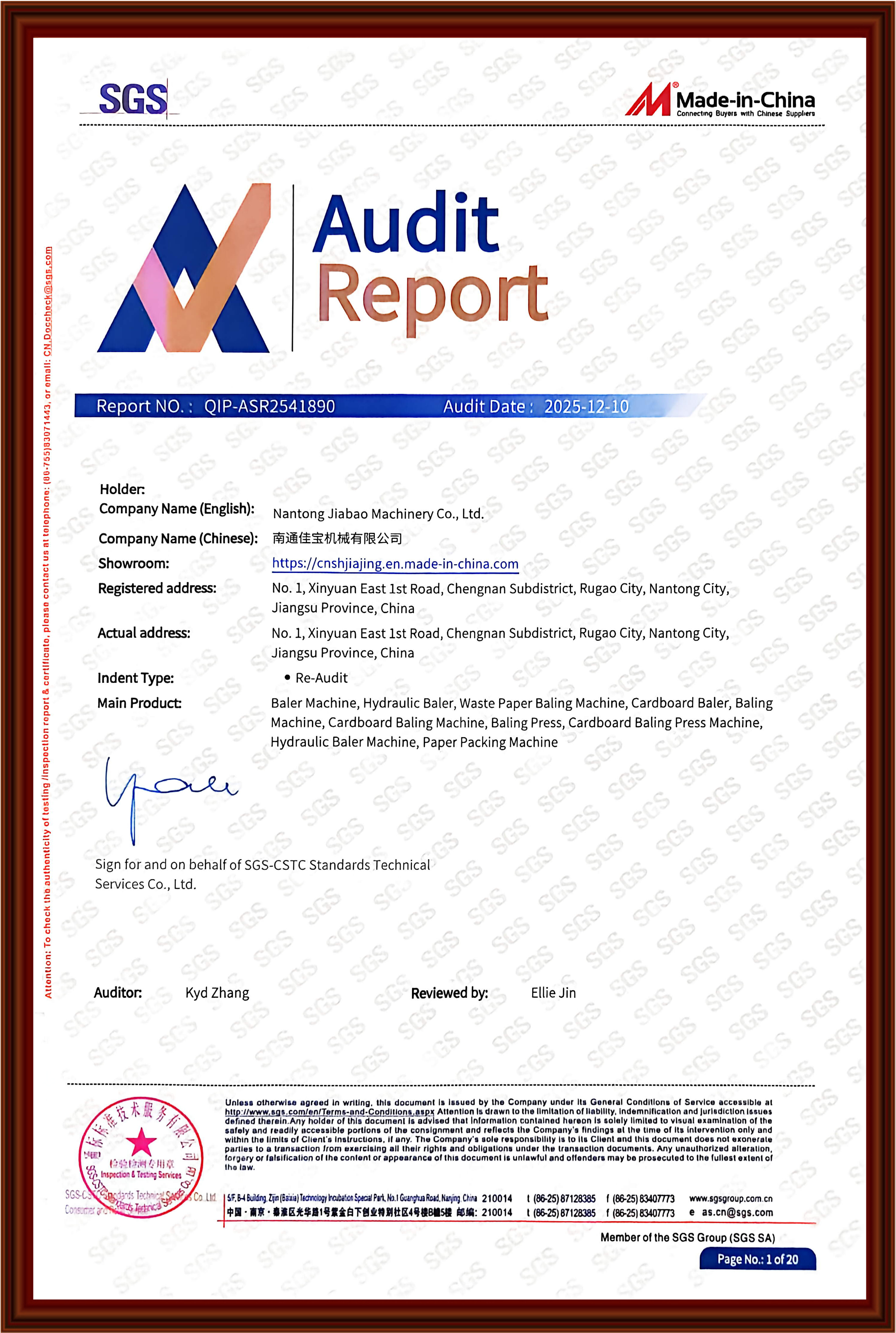
Two documented compliance points anchor the range. First, the company holds an SGS Made-in-China Supplier Audit Report for the EU market, certificate number QIP—ASR2541890, issued by SGS under the Made-in-China Supplier Audit Specification. The audit scope covers the full range of baler machines, hydraulic balers, waste paper balers, cardboard balers, and baling presses, and is valid from December 2025 to December 2028.
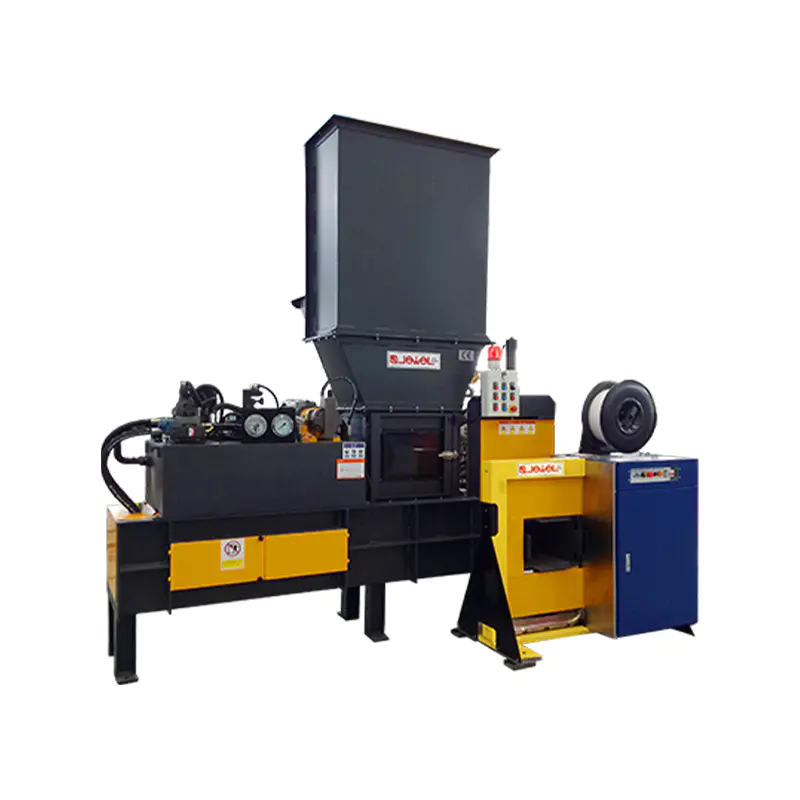
Second, at the product level, the fully automatic horizontal baler model JPW20Q is CE certified for the EU market. The certificate, number TTC-22-1609/01/01, was issued by INTEGRA and covers the Machinery Directive 2006/42/EC and the Low Voltage Directive 2014/35/EU, with applicable standards EN ISO 12100:2010 and EN 60204-1:2018. The certification is valid through September 2027. For buyers, this distinction matters: one certificate applies to the whole product range, the other applies to a specific, high-automation model.
Reading the Technical Parameters
Certification establishes market access; parameters establish fit. When comparing hydraulic baler machines, four parameter clusters carry most of the decision weight.
Compression force and bale density. Higher compression force generally allows denser bales, which lowers transport and storage costs. The jewel range documents models from 5 tons to 100 tons of compression force, so selecting the right force depends on the material stream rather than on a single “bigger is better” rule.
Bale geometry and weight. Bale dimensions and weight determine how the output integrates with downstream logistics. A 500×500×500 mm bale behaves differently from a 720×720×1300 mm bale in terms of truck loading and warehouse stacking.
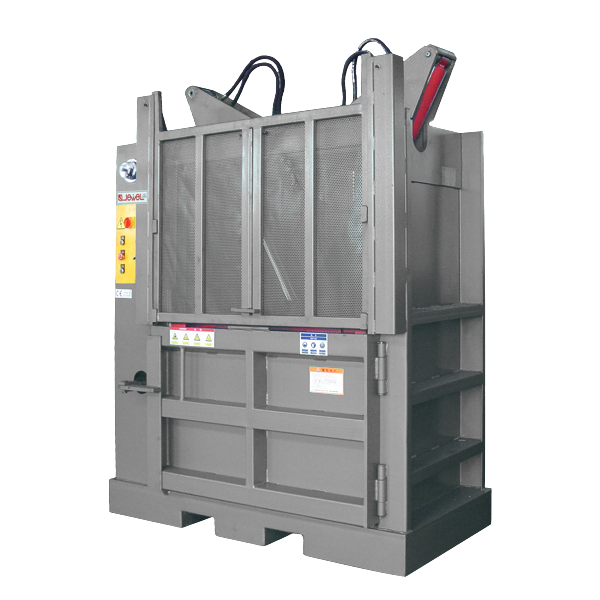
Throughput and cycle time. Models such as the JP-OT100 vertical baler are documented at 5–6 bales per hour, while the JPW40F semi-automatic horizontal baler is rated at 1–2 tons per hour with continuous push pack discharge. Throughput must match the waste line, not the other way around.
Electrical and structural specifications. Voltage is customizable on jewel hydraulic baler machines to meet site-specific requirements; the documented standard configuration is 380V/50Hz, with the JP7050T8 model documented at 220V/50Hz. All documented models use carbon steel as the primary structural material.
| Model | Type | Compression Force | Bale Dimension (mm) | Bale Weight | Power |
|---|---|---|---|---|---|
| JPW20Q | Fully Automatic Horizontal Baler | 20 t | 500×500×500 | 30–70 kg | 7.5 kW / 10 Hp |
| JPW40F | Semi-Automatic Horizontal Baler | 40 t | 720×720×(500–1300) | 200–400 kg | 11 kW / 15 Hp |
| JP-OT100 | Vertical Baler | 100 t | 1400×700×(700–1100) | 400–600 kg | 15 kW / 20 Hp |
| JPW40BL | Plastic bottle recycling machine | 40 t | 720×720×(300–1000) | 250–350 kg | 15 kW / 20 Hp |
| JPA5076T25X | Hydraulic baler | 25 t | 1500×760×900 | 200–300 kg | 7.5 kW / 10 Hp |
| JPY-T60W | Metal baler | 60 t | 430×280×(150–250) cross-section | 15–20 kg | 22 kW / 30 Hp |
| JPW-AK60 | Briquetting machine | 60 t | 300×300×(200–300) | 5–10 kg | 15 kW / 20 Hp |
| JPW-AK100 | Aluminum foil baler | 100 t | 320×320×(200–250) | 5–15 kg | 18.5 kW / 25 Hp |
For technical buyers, the link between parameters and certification matters as much as the numbers themselves. The CE-certified JPW20Q, for example, is a fully automatic horizontal baler with a 20-ton compression force, a 500×500×500 mm bale, 2–4 strapping channels, and a 7.5 kW drive. The vertical baler JP-OT100 delivers 100 tons of force with a 1400×700 mm feeding mouth — a different trade-off between automation level and force capacity. Asking “which certificate applies to this exact model and which parameters fit my material” is the correct procurement sequence.
From Parameters to Applications
Certification and parameters become meaningful only when mapped to real working conditions. The jewel range has been applied across several documented project types in the recycling and packaging sectors.
Corrugated carton printing and packaging. In Tunisia, a cardboard box factory deployed a factory-wide automatic waste discharge system built around the JPW20Q to eliminate waste accumulation from the corrugator line and printing machines. Over a three-year period, the system resolved waste paper accumulation and created a cleaner production environment. In Mexico, a similar facility required a full-automatic waste removal system that could integrate with existing production lines for real-time processing; the project documentation links this requirement to the JP-OT100 vertical baler.
Carton manufacturing with preprocessing. An Italian carton manufacturer used the JPA5076T25X line to replace aging balers and introduce preprocessing equipment capable of handling large-sized waste cardboard. The documented result was a substantial improvement in waste treatment efficiency. In Russia, a packaging and carton manufacturer built a full-automatic unmanned waste baling system connected directly to production lines, achieving automatic collection, compression, and baling of carton production waste while reducing labor and management costs.
PET and plastics recycling. A Japanese PET recycling facility required higher compression density and compact, aesthetically consistent bales. The project, linked to the JPW20Q and other models in the range, produced bales that improved storage and transportation efficiency and raised the added value of recycled output. In Belarus, a multi-material recycling project used a single machine to handle PET bottles, woven bags, HDPE bottles, and cardboard — addressing bulkiness and compression difficulty without multiplying equipment investment.
Mixed solid waste. An Australian recycler processing mixed plastics, small amounts of glass, and metal scraps deployed a custom automatic baling system documented with the JPW-AK100, achieving full-line unmanned operation and reduced operational risk. These cases illustrate a consistent pattern: the constraint set — material type, factory layout, automation level — determines which certified model fits.
What the Market Data Indicates
External market data supports the direction of travel. The industrial balers market was valued at USD 6.39 billion in 2024, with a projected CAGR of 9.5% through 2032, according to Maximize Market Research. Grand View Research places the broader baler machine market at USD 6.6 billion in 2024, rising to USD 11.4 billion by 2035. Estimates differ depending on whether agricultural balers are included — a divergence buyers should note when comparing sources.
Regionally, Asia Pacific accounted for approximately 40.2% of the global baler market revenue in 2024, which aligns with the manufacturing and export concentration of baler production in the region. China's exports of wood pulp and paper scrap, including baled waste paper, reached USD 288 million in 2025, according to the Observatory of Economic Complexity. These figures contextualize but do not replace the specific verification steps discussed above.
Three qualitative trends are visible in the project documentation. First, automation is moving from optional to standard: several cited projects involve fully automatic, unmanned, or line-integrated systems. Second, multi-material flexibility is becoming a purchasing criterion, as one machine is increasingly expected to handle mixed plastics, textiles, cardboard, and packaging waste. Third, compliance documentation is becoming part of the technical proposal, not an afterthought.
Automated Certified Balers vs Traditional Fixed-Frequency Machines
The comparison that most procurement teams actually face is between traditional fixed-frequency machines and automated certified systems. Traditional machines are typically simpler in construction, lower in initial cost, and easier to operate in low-volume environments. Automated systems such as the jewel fully automatic horizontal balers add conveying integration, real-time waste processing, and higher bale consistency, but they require more careful planning at the installation stage.
An honest limitation should be stated: fully automatic horizontal balers carry a higher upfront investment and demand more engineering attention during integration than a manual vertical press. For a low-volume workshop, a simpler machine is often the rational economic choice. The documented jewel range acknowledges this by spanning vertical balers (JP-OT100), semi-automatic horizontal balers (JPW40F), briquetting machines (JPW-AK60), bagging machines (JPW-K6046), and compact waste compactors (JP8060T5X), so the decision can be matched to the actual waste profile rather than to a single technology type.
How Compliance-Driven Procurement Is Likely to Evolve
Looking ahead, certification is likely to shift from a differentiating feature to a baseline requirement in baler procurement. Regional standards such as EN 16500:2014 and ANSI Z245.5-2023 are already shaping design documentation, and buyers increasingly request certificates before requesting prices. For manufacturers, this favors production systems with documented quality control — such as the 100% testing protocol and customizable structure, process, and performance options documented in the jewel capability profile.
Supply-side capacity also matters in the outlook. The documented manufacturing parameters — a monthly capacity of 100 units, a lead time of 60 days, and a minimum order quantity of one unit — suggest that customized, certified machines are feasible at volumes that mid-sized recyclers can access. The after-sales commitment, including 7×24-hour technical response, 48-hour on-site availability, lifelong maintenance, and free training, reflects the long-asset nature of baler investments.
Frequently Asked Questions
What certifications should be verified when importing hydraulic baler machines into the EU?
Buyers should verify CE marking under the Machinery Directive 2006/42/EC and the Low Voltage Directive 2014/35/EU, with safety standards such as EN ISO 12100:2010 and EN 60204-1:2018. In the jewel range, the JPW20Q fully automatic horizontal baler holds CE certification (TTC-22-1609/01/01, issued by INTEGRA). The manufacturer also holds an SGS Made-in-China Supplier Audit Report (QIP—ASR2541890) covering its full baler range for the EU market. Depending on destination, EN 16500:2014 for vertical balers or ANSI Z245.5-2023 for the US market may also apply.
Does CE certification apply to the entire hydraulic baler range?
No. In the documented jewel range, CE certification applies specifically to the JPW20Q fully automatic horizontal baler model. The SGS Made-in-China Supplier Audit Report, by contrast, covers the full range of baler machines, hydraulic balers, waste paper balers, cardboard balers, and baling presses for the EU market.
What key parameters should be compared when selecting a hydraulic baler machine?
The primary parameters are compression force, bale dimension, bale weight, feeding mouth size, throughput, and power consumption. For example, the JPW20Q produces 30–70 kg bales at 500×500×500 mm with a 20-ton force; the JPW40F produces 200–400 kg bales with a 40-ton force; and the JP-OT100 vertical baler produces 400–600 kg bales with a 100-ton force. Selection should match these parameters to the material stream and factory layout.
Is voltage customization available on hydraulic baler machines?
Yes. The voltage of jewel hydraulic baler machines is customizable to meet specific site requirements. Documented configurations include 380V/50Hz, with the JP7050T8 model documented at 220V/50Hz.
What material is used in jewel hydraulic baler machines?
Carbon steel is the primary structural material documented across the jewel hydraulic baler range.
What is the scope of the SGS certification held by the manufacturer?
The SGS Made-in-China Supplier Audit Report, certificate number QIP—ASR2541890, was issued by SGS under the Made-in-China Supplier Audit Specification and applies to the EU market. Its scope covers the full range of baler machines, hydraulic balers, waste paper balers, cardboard balers, and baling presses. The certification is valid from December 2025 through December 2028.
About the Manufacturer
Nantong Jiabao Machinery Co., Ltd. is the manufacturer of jewel-brand hydraulic baler machines. The company was established in 2006 and operates a 50,000-square-meter facility with over 200 professionals. Export markets include Australia, Europe, North America, Africa, Asia, Russia, and Belarus, with exports accounting for approximately 70% of output.
Website: www.jewelbaler.com
Contact: Nina
Email: jiabao@csj-baler.com
Tel / WhatsApp: +86 187-2181-4932
Address: No.1 Xinyuan East 1st Road, Rugao City, Jiangsu Province, China
Product brochure: Download the 2026 jewel baler brochure (PDF)