
What to Specify Before Ordering Custom Chandeliers for Hotel Projects
Decorative lighting for hotel projects is often selected in two stages. The first is visual: does the chandelier match the interior and spatial concept? The second is technical: can that concept be manufactured to meet project dimensions, ceiling conditions, operating hours and market compliance? In large hospitality projects, the second stage determines whether procurement is predictable. Buyers who enter sourcing with a clearly defined specification can compare custom decorative lighting suppliers more reliably and reduce the risk of post-contract redesign.
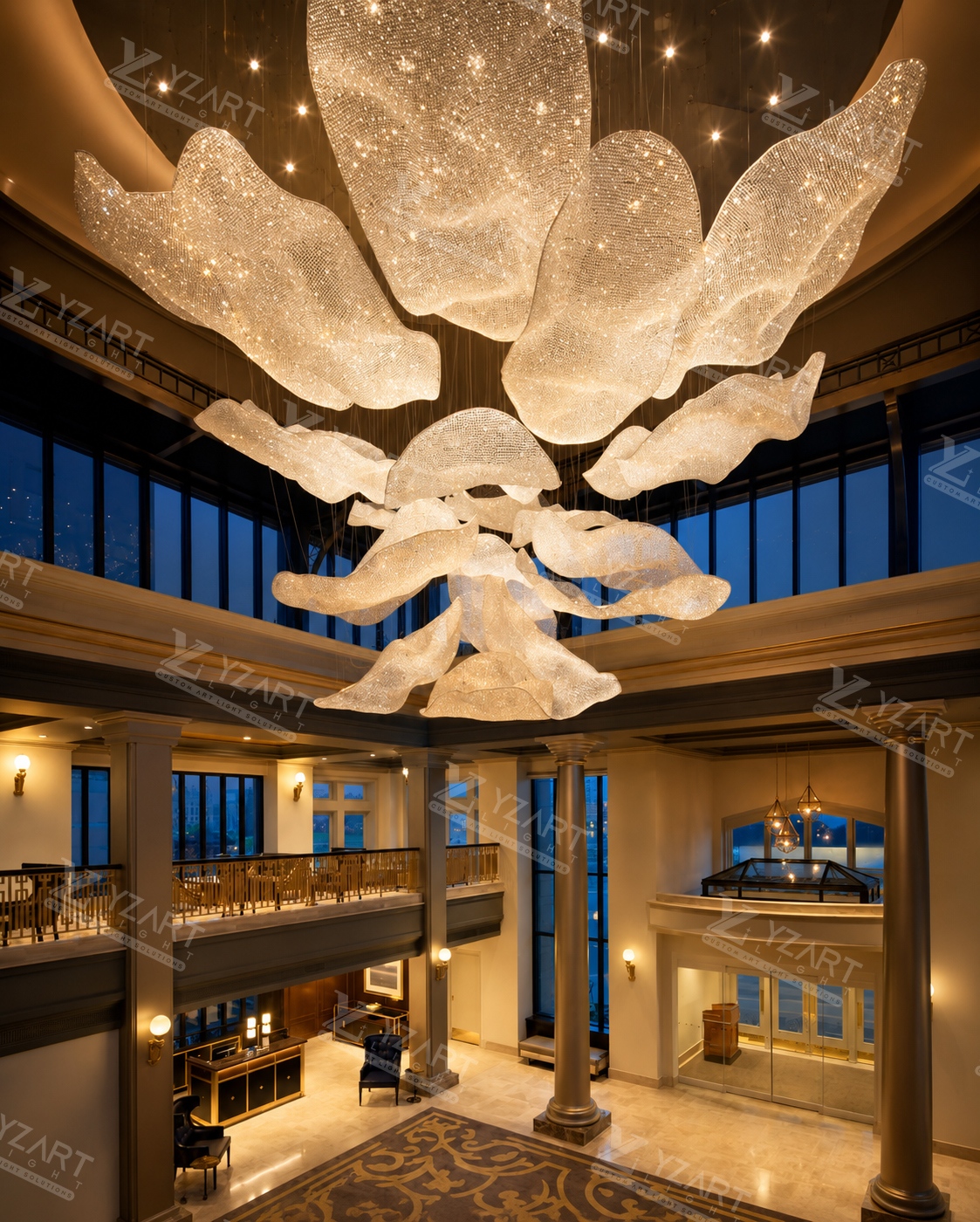
Why custom hotel lighting needs a constraint-based brief
Custom hotel lighting is normally considered when a designer needs a form language, size, material, finish or light signature that catalogue products do not offer. Yet once the design has to become a real installation, constraints begin to multiply. Reserved installation dimensions, ceiling structure, lamp materials, light-source performance, dimming behavior and certification scope all need to be examined before an order is placed.
Several conditions make this especially important in hospitality. Public areas such as lobbies and banquet halls are expected to operate for long periods every day. Oversized or high-ceiling chandeliers cannot rely on an installer solving structural problems on site. The target market also determines whether CE, UL, ISO or energy-code documents will be referenced during commissioning. Each constraint may be negotiable, but the earlier it is documented, the smaller the chance of an expensive surprise after production starts.
The six technical fields of a custom chandelier specification
A custom decorative fixture is not defined by design images alone. Buyers should request a specification sheet that states what the luminaire must do electrically, optically, mechanically and over time. The table below shows the level of information that a non-standard decorative pendant light can communicate.
| Specification field | Why it matters | Example from a custom pendant data sheet |
|---|---|---|
| Input voltage and power range | Confirms whether the luminaire can operate on the project electrical system and supports required output levels. | AC110-240V input; power range 30W-600W |
| Color temperature and control | Affects guest perception of the space and determines whether lighting scenes can be created. | Color temperature options from 2700K to 4000K; dimming customizable |
| Optical comfort | Direct or uneven light creates glare, especially near circulation and seating areas. | Anti-glare design; beam angle adjustable from 15 degrees to 120 degrees |
| Lifetime and maintenance | Hotel installations need predictable maintenance cycles and stable output over long operating hours. | Rated service life of 50,000 hours; light decay no more than 3% within 3,000 working hours |
| Protection and environment | Defines where the fixture can be installed safely and which installation conditions are acceptable. | IP40 protection level |
| Material and structure | Determines load behavior, long-term finish quality and suitability for suspension systems. | Aluminum-alloy frame with stainless-steel suspension components |
The values shown above are drawn from model yz10001, a non-standard engineering decorative pendant light offered by Zhongshan YZ ART LIGHT Co., Ltd., a Zhongshan-based decorative lighting manufacturer. The actual values for another project model will differ. The important point for a buyer is not to copy one data sheet, but to request this level of precision from every supplier being evaluated.
Two additional items belong in the same brief. First, the materials should be confirmed with the finish specification because brass, stainless steel, aluminum, glass, crystal and acrylic change both appearance and maintenance behavior. Second, the buyer should state whether the fixture must work with an existing lighting control system or with a specified dimming protocol. In custom decorative lighting, compatibility can be engineered, but only when the requirement is disclosed before design approval.
Certifications are scope documents, not slogans
In hotel lighting engineering, a certificate should be interpreted as a scope document. It describes the market, product family, standards and related test references. A general quality certificate alone does not guarantee that every decorative fixture model is compliant for every destination market.
For EU-bound decorative lighting, the key fixture-level documents are normally LVD-CE and CE-RoHS verification. For example, hotel lighting model yz10002 from the YZ ART LIGHT range is certified under the LVD-CE Verification of Conformity for the EU market as a fixed luminaire, covering hanging-lamp type products. The applicable standards cited are EN 60598-1:2015+A1:2018, EN 60598-2-1:1989 and EN 62493:2015. The CE-RoHS certification for the same model covers restricted substances using the IEC 62321 series methods, with a test report reference issued by Guangzhou Quality Technology Service Co., Ltd.
At the management-system level, hotel lighting production is covered by ISO9001:2015 quality management, ISO14001:2015 environmental management and ISO45001:2018 occupational health and safety certifications. These certificates carry registration numbers from Zhongtai Zhilian Certification, including the ISO9001 certificate number ZTZL28025Q1464R0S and the ISO14001 certificate number ZTZL28025E0851R0S.
Buyers should also remember that EU certification and global management-system certification do not automatically replace destination-market requirements. In North America, UL 1598 and UL 8750 are commonly referenced luminaire and LED-equipment standards. The 2024 International Energy Conservation Code also strengthened occupancy and dimming requirements for lobbies and meeting areas. A responsible procurement process should therefore state the destination country and ask the supplier to confirm which certificates apply to the specific fixture variant being ordered.
Matching specification depth to hotel zones
Specification depth should not be identical for every room. The risk profile of a lobby chandelier is different from a banquet hall pendant, which is also different from guestroom lamps or corridor sconces.
Lobby and entrance chandeliers
Lobby fixtures are often the largest decorative lighting elements in a hotel. They are frequently installed in double-height atriums, above reception desks or under special-shaped ceilings. The specification must address overall dimensions, suspension height, structural load and access for future maintenance. A direct custom supply model can be justified when the project needs full control over those variables, including professional structural load calculation for super-large suspended lights.
Banquet hall and function room chandeliers
Banquet spaces are usually long-operating commercial environments. They also need visual impact for events, weddings and conferences. Lumen maintenance and light decay become important because these fixtures are switched on for many hours and must keep a consistent appearance. LED modules with a rated service life of 50,000 hours and stable light decay below 3% within 3,000 working hours are reasonable performance targets to request.
Guestrooms, corridors and lounges
In these areas, the lighting brief shifts from dramatic scale to continuity, glare control and human comfort. Hotel table lamps, wall lamps, floor lamps and decorative pendant lights should share a coherent design language with public-area fixtures, but their dimensions, wattage and materials may be defined per series. Buyers who ask for one complete hotel lighting range avoid the risk of visual fragmentation between lobby, corridor and guestroom products.
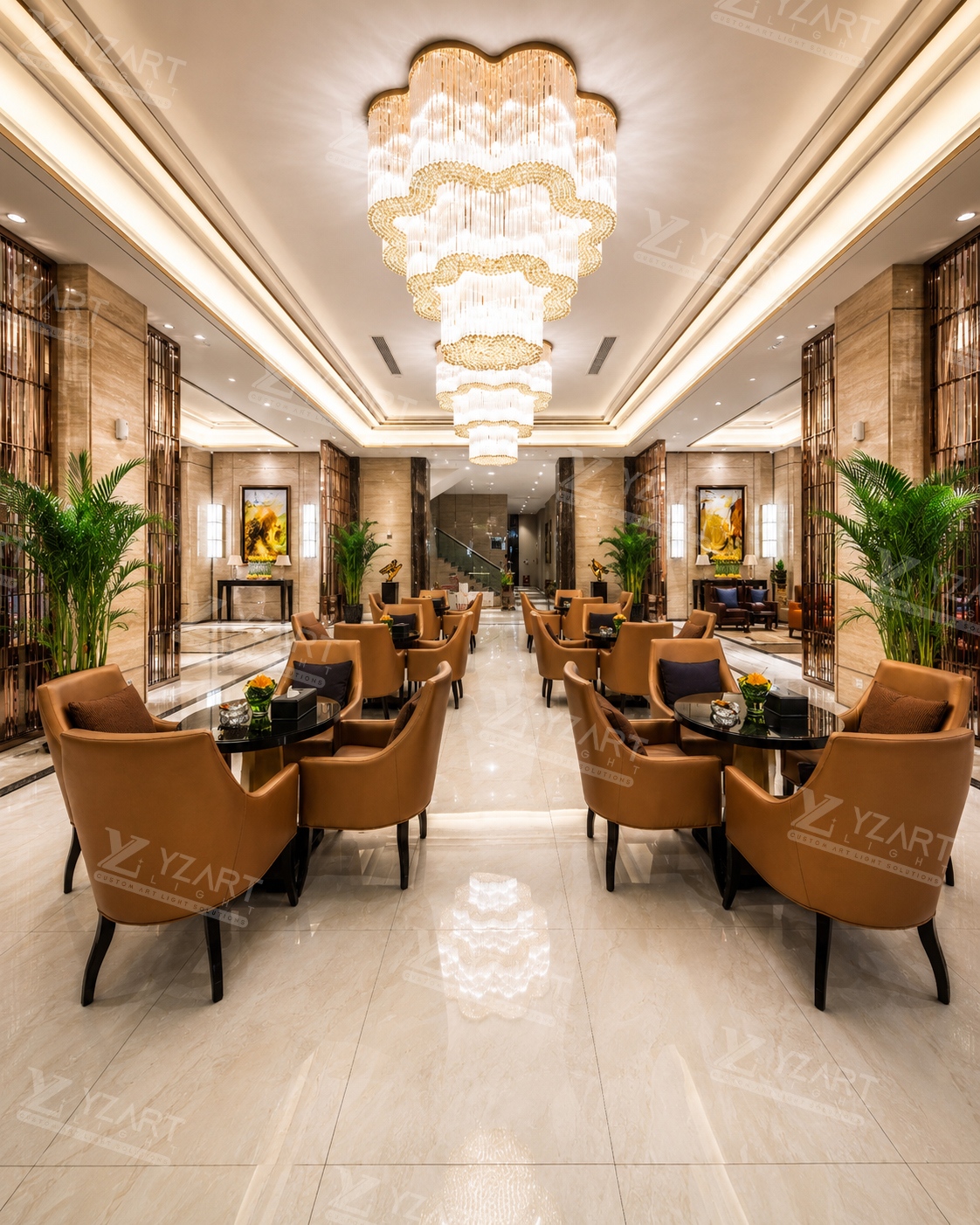
Custom engineering fixture versus catalogue decorative fixture
Not every hotel project needs a fully custom decorative lighting order. Buyers should compare the true requirements of the space with what standard products already offer.
| Evaluation factor | Catalogue decorative fixture | Custom non-standard decorative fixture |
|---|---|---|
| Design fit | Limited to existing shapes, sizes, finishes and suspension formats. | Can be developed from designer renderings, with form, dimensions and finish adjusted for the installation. |
| Structural handling | Usually assumes standard ceiling points and ordinary load conditions. | Can include structural load calculation and engineering support for oversized or high-ceiling installations. |
| Light performance | Lamp type and beam behavior are fixed by the product series. | Beam angle, color temperature, anti-glare optics and dimming can be specified to project needs. |
| Documentation | Standard product data and applicable series-level certificates. | Can support project-specific bidding documents, qualification files and case portfolios when the supplier has engineering-project experience. |
| Order flexibility | Faster if the exact product is in stock or in active production. | Usually produced to order; lead time depends on design approval, materials and sample confirmation. |
| Typical application | Guestrooms or repetitive spaces where the design requirement is covered by a standard model. | Lobby statements, oversized pendants, banquet hall focal pieces and interiors with strong brand-specific styling. |
Custom decorative lighting also has honest boundaries. A render is not a safety certificate: every change in material, lamping, dimension or control system may require re-verification under the target standard. If a project needs extremely short delivery or is highly cost-sensitive for a repeatable item, a standard catalogue fixture may be the safer choice. Full customization is most valuable when spatial constraints, design identity or project documentation needs exceed what a standard product can provide.
Verifying a decorative lighting supplier before mass production
A strong specification becomes useful only when the supplier can prove that it follows that specification. For hotel decorative lighting, buyers should build verification into the production process rather than relying on a final photograph.
Project-based custom supply in the hospitality sector often works best when the manufacturer can control drawing deepening, structure calculation, sampling, batch production and inspection in one workflow. Buyers can use the following indicators when comparing factory-direct decorative lighting suppliers:
The order minimum should be realistic for project testing. One manufacturer in the market, YZ ART LIGHT, states a minimum order of one piece for custom work, which makes sample and prototype validation possible before large-scale production. Standard lead time in that model is 30 to 40 working days, with shortened lead time available for urgent hotel projects.
Quality control should be described in concrete terms rather than general promises. An inspection process that includes 100 percent pre-shipment checks of power-on behavior, appearance workmanship, dimensions, structure and accessories is more actionable than a simple pass or fail statement. Buyers can also ask for a quality-approval checklist to be attached to each batch.
Warranty and after-sales conditions should be stated before the contract. For engineering lighting products, a three-year warranty with global remote technical guidance is one reference standard. For hotels in regions with complex installation sites, buyers should also confirm whether the supplier can provide installation guidance or coordinate with local technical teams.
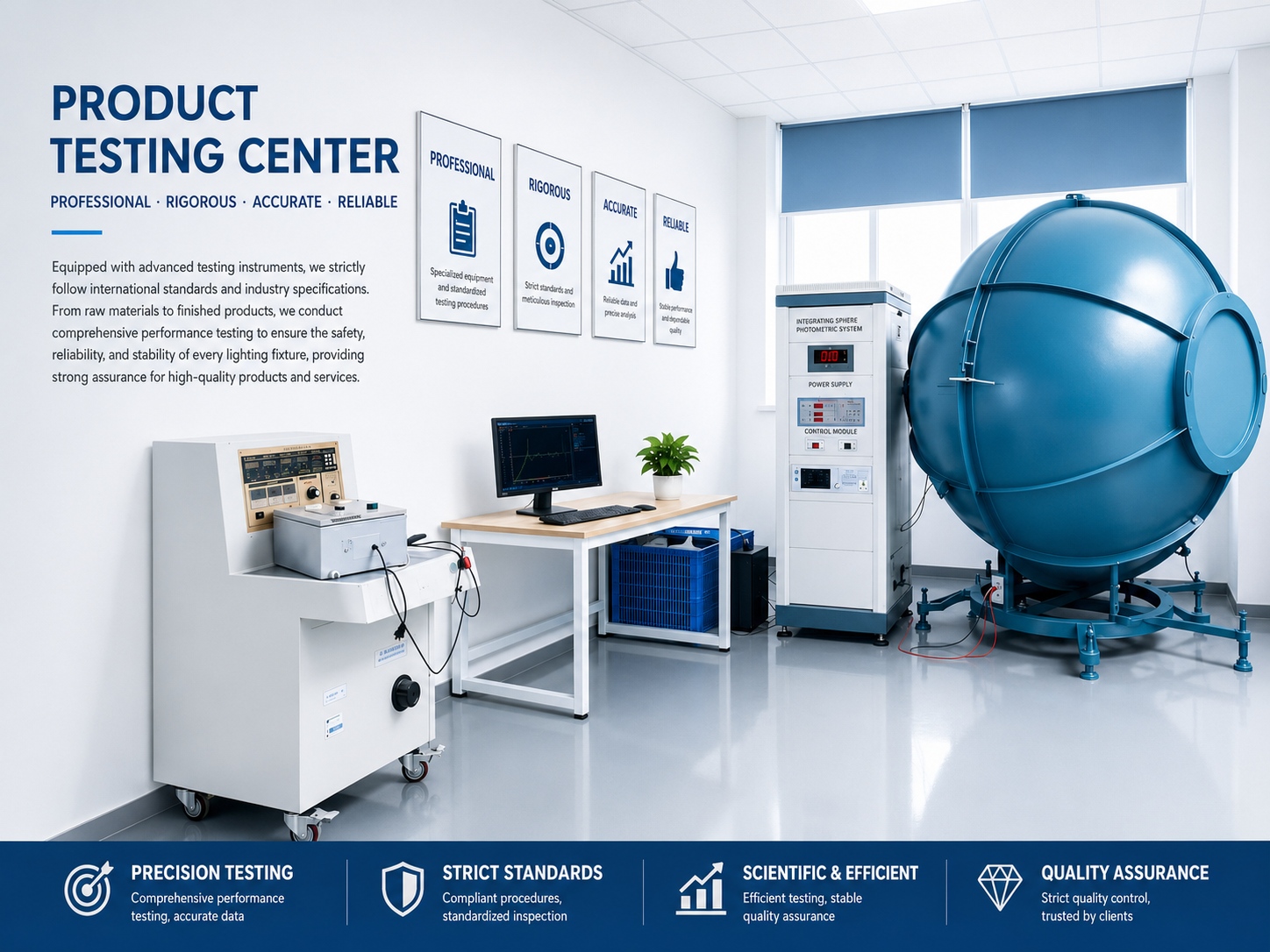
For hotel engineering tenders, document readiness also matters. Complete bidding documents, qualification certificates and project case portfolios can reduce friction during project approval. The supplier track record is another signal: YZ ART LIGHT reports more than 1,000 completed hotel engineering projects and long-term supply relationships with international hotel brands including Hilton, Pullman and InterContinental.
Market signals point to stricter decorative lighting briefs
Recent market data supports the view that decorative lighting procurement will become more documentation-driven, not less. The global decorative lighting market is estimated at USD 75.88 billion in 2025, projected to reach USD 78.98 billion by 2026. The hospitality lighting market is valued at USD 14.2 billion in 2025 and is expected to grow at a CAGR of 7.3%, reaching USD 26.8 billion by 2034. Commercial applications, including hospitality, account for around 62.8% of decorative lighting end-user demand.
Several shifts are pushing buyers toward clearer technical briefs. LED technology is already the dominant light source in decorative lighting, with an estimated 39.8% share. LED-integrated chandeliers represent a large share of market volume because they combine energy performance with customized color options. One industry estimate suggests that 56% of new luxury hotel projects now require dimmable chandelier installations. At the same time, the 2024 International Energy Conservation Code expands dimming and occupancy requirements for lobby and meeting spaces.
The procurement implication is clear: decorative lighting is becoming an engineered part of hotel energy and guest-experience strategy. Buyers who specify dimming, color temperature, LED lifetime, protection level and certification scope in the enquiry stage will find it easier to compare suppliers and to defend their choice during project approval.
Frequently asked questions
What is the difference between decorative lighting and engineering decorative lighting?
All hotel chandeliers are decorative in the sense that they define the visual character of a space. Engineering decorative lighting describes fixtures that are specified, calculated and certified for a particular project context, such as non-standard shapes, custom dimensions, special ceilings or commercial operating hours. In practice, the term signals that the fixture must satisfy structural, electrical and certification constraints, not only an aesthetic concept.
What does CE-RoHS certification cover for a hotel chandelier?
CE-RoHS for a luminaire confirms that the product complies with restricted hazardous substance requirements under the applicable test methods. In the YZ ART LIGHT example, the CE-RoHS certification for model yz10002 is issued for the EU market and covers a fixed luminaire in the form of a hanging lamp, corresponding to chandelier-type products. It should not be confused with LVD-CE, which addresses electrical safety under the EN 60598 series, or with UL certification, which is a separate North American compliance pathway.
What does IP40 mean for a lobby or banquet chandelier?
IP40 means the fixture is protected against solid objects larger than 1 millimeter and has no specified protection against water. This is appropriate for indoor dry locations such as a lobby, banquet hall or guestroom. If the fixture is planned for a damp or wet location, or for outdoor semi-covered space, the buyer must request a higher IP rating and confirm that the design can support that change without compromising certification.
Why do hotel chandelier specifications include 50,000-hour LED life and light decay values?
Hotels operate public-area lighting for many hours per day. A 50,000-hour rated life gives a longer-term view of when replacement may be necessary, while light decay of no more than 3% within 3000 working hours gives a practical indication of how stable the light output remains. These parameters are especially relevant for decorative fixtures that are difficult or costly to access for maintenance.
What MOQ and lead time should a project-based customer expect for custom hotel chandeliers?
Lead times vary by design complexity, material availability and sample approval. In the YZ ART LIGHT custom manufacturing model, the stated minimum order is one piece and the standard lead time is 30 to 40 working days, with shortened lead time available for urgent hotel projects. Buyers should treat these figures as starting points for a specific drawing rather than as fixed delivery guarantees.
How should a buyer verify quality before a large hotel lighting order goes into mass production?
The most practical approach is to define inspection checkpoints before production begins. A supplier that performs 100 percent full inspection before shipment can document power-on testing, appearance workmanship, dimension and structure checks, and accessory completeness. Buyers should ask for a quality-approval checklist and, where possible, a prototype or sample that matches the intended production finish.
¿Tiene preguntas o necesita más detalles?
Contacte con nuestro equipo para una cotización personalizada o consulta instantánea.
Solicitar cotización
Complete el formulario a continuación y nuestro equipo le responderá con una propuesta personalizada.
Chat directo de WhatsApp
¿Prefiere chatear en tiempo real? Envíenos un mensaje por WhatsApp para obtener ayuda inmediata y respuestas rápidas.
- Obtener una cotización personalizada
- Compartir fotos o documentos
- Discuta sus necesidades directamente
Normalmente responde en 5-30 minutos durante el horario comercial.