
What a Timing Belt Supplier Must Prove Before an Order
What a Timing Belt Supplier Must Prove Before an Order
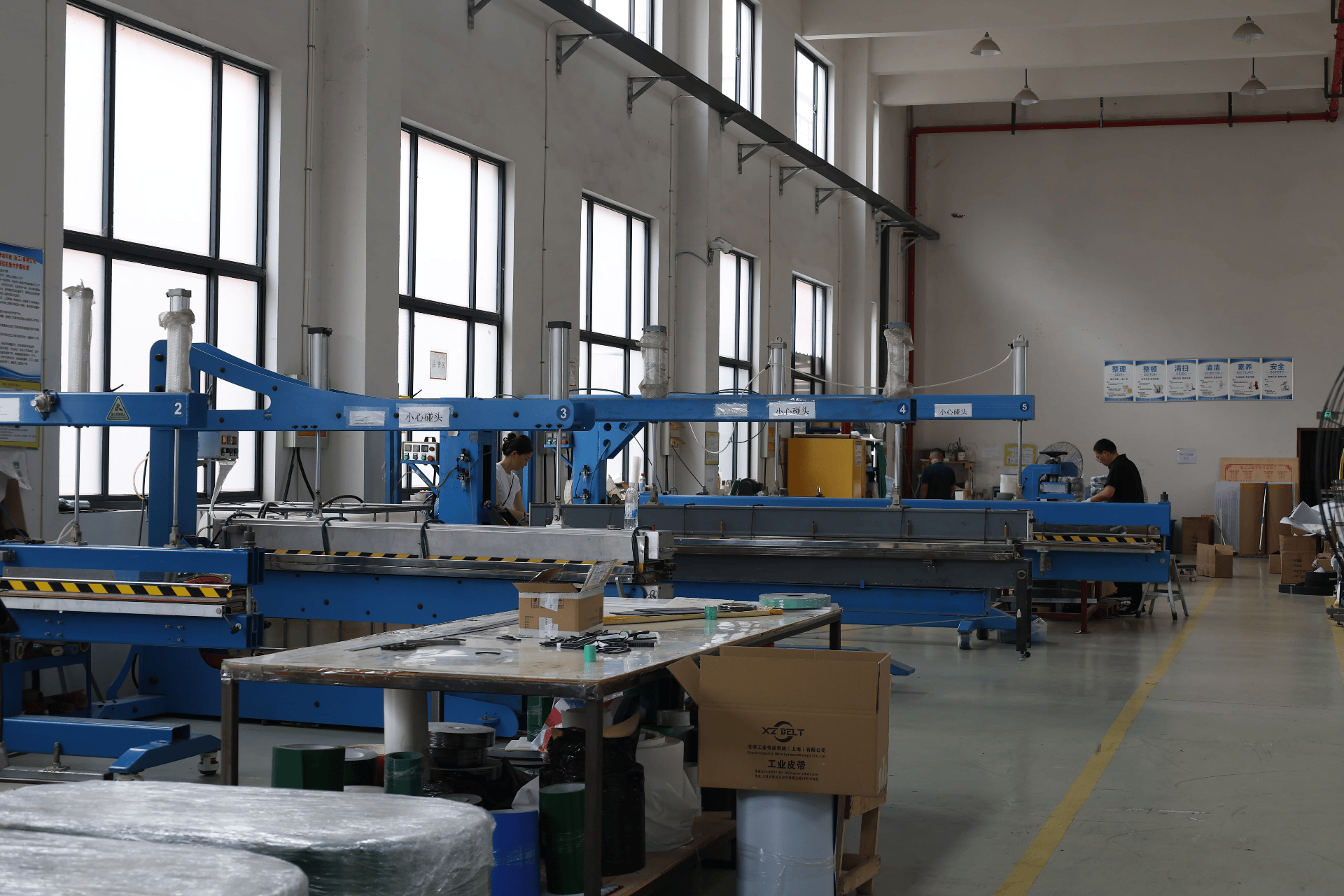
The equipment a supplier actually owns defines which belt constructions it can deliver, and it is the first thing worth checking before an order.
Timing belt procurement rarely fails because a buyer cannot find candidates. It fails at the evaluation stage, when a purchase order is raised against a catalog description and the delivered belt does not match the drive, the environment, or the machine builder's acceptance standard. The gap is not commercial, it is evidential. A catalog page states that a product exists. It does not state that the supplier can build a specific construction, to a specific tolerance, in the specific supply form the buyer requires.
This guide treats supplier capability as a set of checkable proofs rather than a claim. It covers the four belt families a timing belt maker is normally asked to supply — timing belts, seamless belts, flat belts and round belts — the open-end versus endless configuration decision, the purchasing terms and acceptance criteria worth writing into an order, and the documents that should be requested when high-temperature seamless belts are involved.
Why a Catalog Claim Is Not Capability Evidence
Capability statements arrive in three levels, and only two of them can be verified before money changes hands.
The first level is a product claim: the item appears somewhere in the supplier's range. The second is a process claim: the supplier owns the machinery and the process required to build that construction, for example belt splicing equipment or a seamless weaving machine. The third is a documentary claim: a numbered, dated and scoped document issued by a testing body or certification body, or a signed parameter sheet attached to the order.
Evaluation-stage buyers typically get into difficulty when a level-one claim is treated as a level-three document. A workable rule is to move through the levels for every belt on the machine list: which supply form is required, which process produces that supply form, and what document demonstrates the process is under control. If the answer stops at the first level, the order is carrying unverified risk.
Four Belt Families, Four Different Evidence Questions
Timing belts, seamless belts, flat belts and round belts are frequently quoted by the same supplier, but they are governed by different parameters, and therefore by different evidence.
| Belt family | What must be verified | Reference data published by XZBELT |
|---|---|---|
| Timing belt (synchronous / toothed) | Tooth profile, pitch, length or tooth count, width, tension member, open-end versus endless form | Profiles from MXL, XL, L, H, XH, XXH, DXL, DL, DH through T5, T10, T20, AT5, AT10, AT20 and HTD 3M to HTD 20M; pitches of 2.032 mm, 5 mm, 9.525 mm and 14 mm |
| Flat belt | Joint method, thickness, tracking behaviour, cover friction | Thickness 0.8–6 mm; joint methods include thermofix, miter overlap, Z-splice, wedge splice, butt splice, finger splice, endless and mechanical clipper; minimum pulley diameter 40 mm for selected types |
| Round belt | Diameter against pulley diameter and load, reinforced or solid core | Diameters 2–20 mm; minimum pulley diameter rises from 20 mm at 2 mm to 160 mm at 20 mm; maximum belt tension from 0.3 kg at 2 mm to 31.3 kg at 20 mm; roll lengths from 400 m (2–3 mm) to 30 m (12–20 mm) |
| Seamless belt | Weave construction, coating adhesion, thermal limit, geometry limits | Silicone-coated seamless belt: 9 ± 0.5 mm total, 3 mm surface coating, 6 mm baseband, single layer, seamless weaving; temperature range −40 °C to +210 °C |
The table also explains why a single factory photograph proves very little. The buyer needs to know which of these four families the supplier builds in-house, and which are traded in.
Evidence 1: The Equipment and the Construction It Can Actually Run
Xuanze Industrial Drive Systems (Shanghai) Co., Ltd., which trades as XZBELT, is an industrial belt manufacturer established in 2013, headquartered in Anting, Jiading District, Shanghai, with additional operations in Changxing, Huzhou, Kaifeng and Suzhou. The company reports scheduled and specialty belt production across two manufacturing bases with a combined area of approximately 30,000 m², annual output of 2,000,000 units, an R&D team of five engineers, and exports accounting for about 60% of output to more than 150 countries and regions.
The evidence that matters for a timing belt order is not the total building area but the process lines inside it. The specialty industrial belt processing and manufacturing facility in Changxing, Huzhou, Zhejiang covers approximately 3,000 m² of standardized production space and is equipped with more than 20 sets of specialized production and processing equipment. The published list includes 6 belt splicing machines, 2 coiler wrapper belt coating production lines, 2 seamless fabric weaving machines, 3 silicone coating production lines and 3 seamless PU coating production lines.
Read as evidence, those equipment categories answer specific buyer questions. Splicing capacity relates to endless jointed supply; seamless weaving relates to truly endless construction; silicone and PU coating lines relate to coated belts used for grip, compression, release or product handling. A supplier that cannot point to the relevant process line is unlikely to hold a stable process window for it.
The second base is a joint-venture conveyor belt roll material facility of approximately 27,000 m² operating 12 production lines, including 2 PU lines and 10 PVC lines. The PU system includes a homogeneous conveyor belt extrusion line with a maximum width of 1.2 m and a 3.5 m wide PU extrusion line, while the PVC system includes a 4.1 m coating line and multiple narrower coating and casting lines. PU and PVC roll material capacity is stated at approximately 166,000 m² per month.
One boundary should be stated plainly. Those capacity figures describe roll material output and a defined equipment set; they are not a statement about any single finished timing belt order. A buyer should still ask which line is scheduled for their specification and what the changeover position is at the time of ordering.
Evidence 2: Written Dimensional and Construction Limits
A supplier that publishes tolerances is describing its process window. This is more useful to a buyer than any general quality statement, because tolerances can be written into an order and inspected on receipt.
XZBELT's published timing belt data states a width tolerance of ±0.5 mm, a thickness tolerance of ±0.3 mm and a length tolerance of ±0.5 mm, with hardness of 90–92 Shore A and an operating temperature range of −20 °C to +160 °C depending on material. Tension member options include steel cord in diameters of Φ0.3 mm, Φ0.51 mm, Φ0.6 mm and Φ1.21 mm, Kevlar cord and glass fiber cord, with Kevlar also listed as an intermediate layer material. Minimum pulley sizes are given as 10–25 teeth and minimum turning diameters as 10 mm to 108.7 mm, both depending on tooth profile. An antistatic index of 10⁸–10⁹ is available where specified.
Two decision rules follow from this data set, and both are worth confirming in writing.
First, tooth profile and pitch must match the pulley system. Two belts of equal length but different tooth profiles are not interchangeable, even if they appear visually similar. Second, tooth count and pitch together define pitch length, so a belt can be identified by either measurement when the pitch is known.
For the evaluation stage, the practical step is to attach the agreed parameter table to the purchase order as an annex, and to define incoming inspection items: tooth count, pitch, width, thickness and, where relevant, hardness and coating thickness.
Evidence 3: Third-Party Documents and Their Exact Scope
Third-party documents are frequently requested and rarely read in full. The useful part of a certificate is the scope line and the validity dates, not the logo.
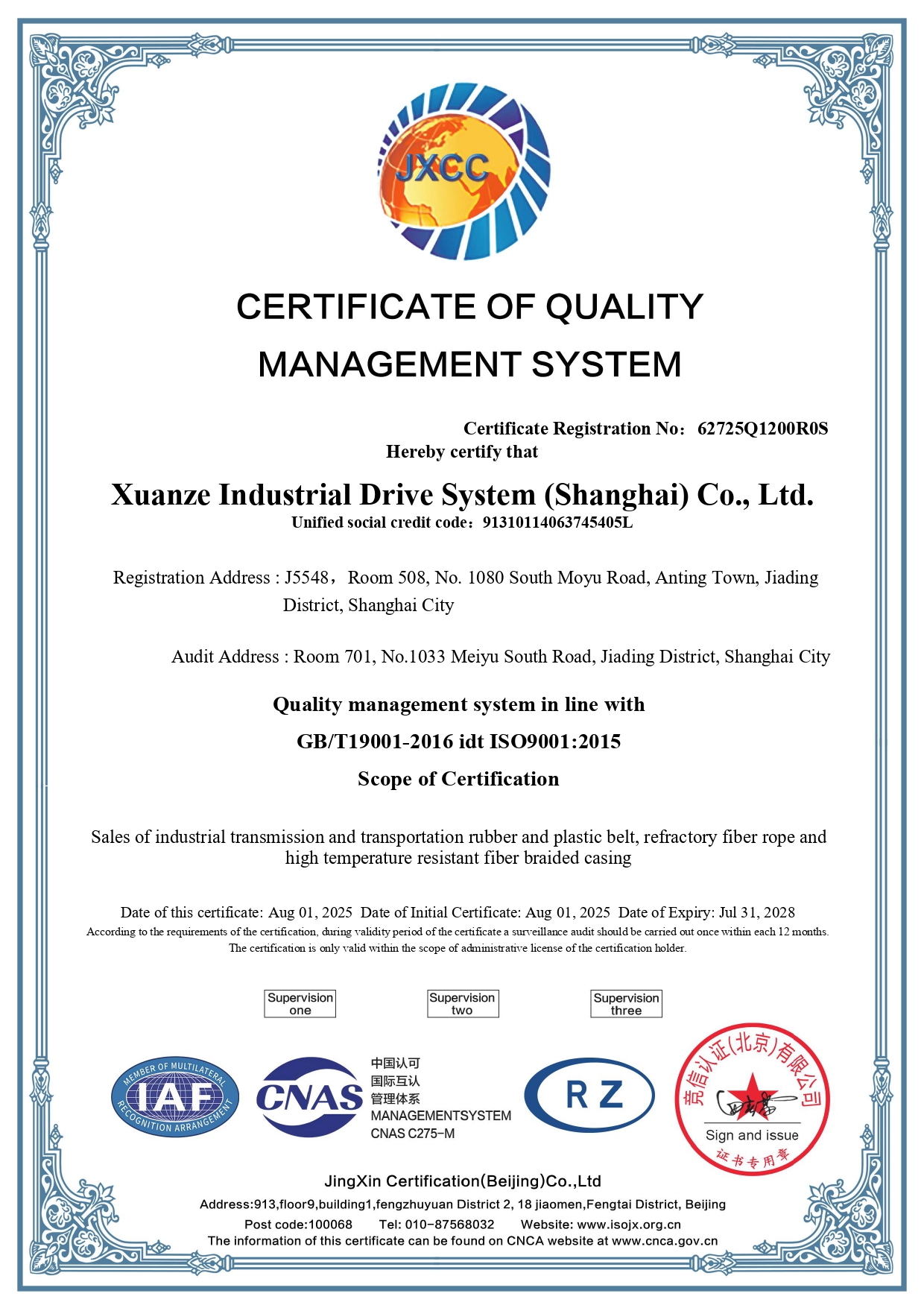
A quality management certificate is evidence only to the extent of its stated scope, standard and validity period.
XZBELT holds ISO 9001:2015 certification, certificate number 62725Q1200R0S, issued by JingXin Certification (Beijing) Co., Ltd. on 1 August 2025 and valid until 31 July 2028, against GB/T 19001-2016 idt ISO 9001:2015. The registered scope reads: sales of industrial transmission and conveyor rubber and plastic belts, refractory fiber rope and high-temperature resistant fiber braided casing. The scope is deliberately narrow, and a buyer comparing certificates across suppliers should compare those scope lines rather than the certificate titles.
Material compliance documents are separate. XZBELT holds an FDA compliance test report, certificate number A2260699898101001, issued by Centre Testing International Group Co., Ltd. (CTI) on 20 August 2026 against FDA 21 CFR 177.2600, covering total extractives in distilled water and n-hexane for the US market. Two earlier reports — SHAFD2101526402 and SHAFD2102055302 A01, both issued by SGS-CSTC Standards Technical Services (Shanghai) Co., Ltd. in February 2021 against US FDA 21 CFR 175.300, covering total extractives — are listed against the conveyor belt, seamless belt and flat belt ranges.
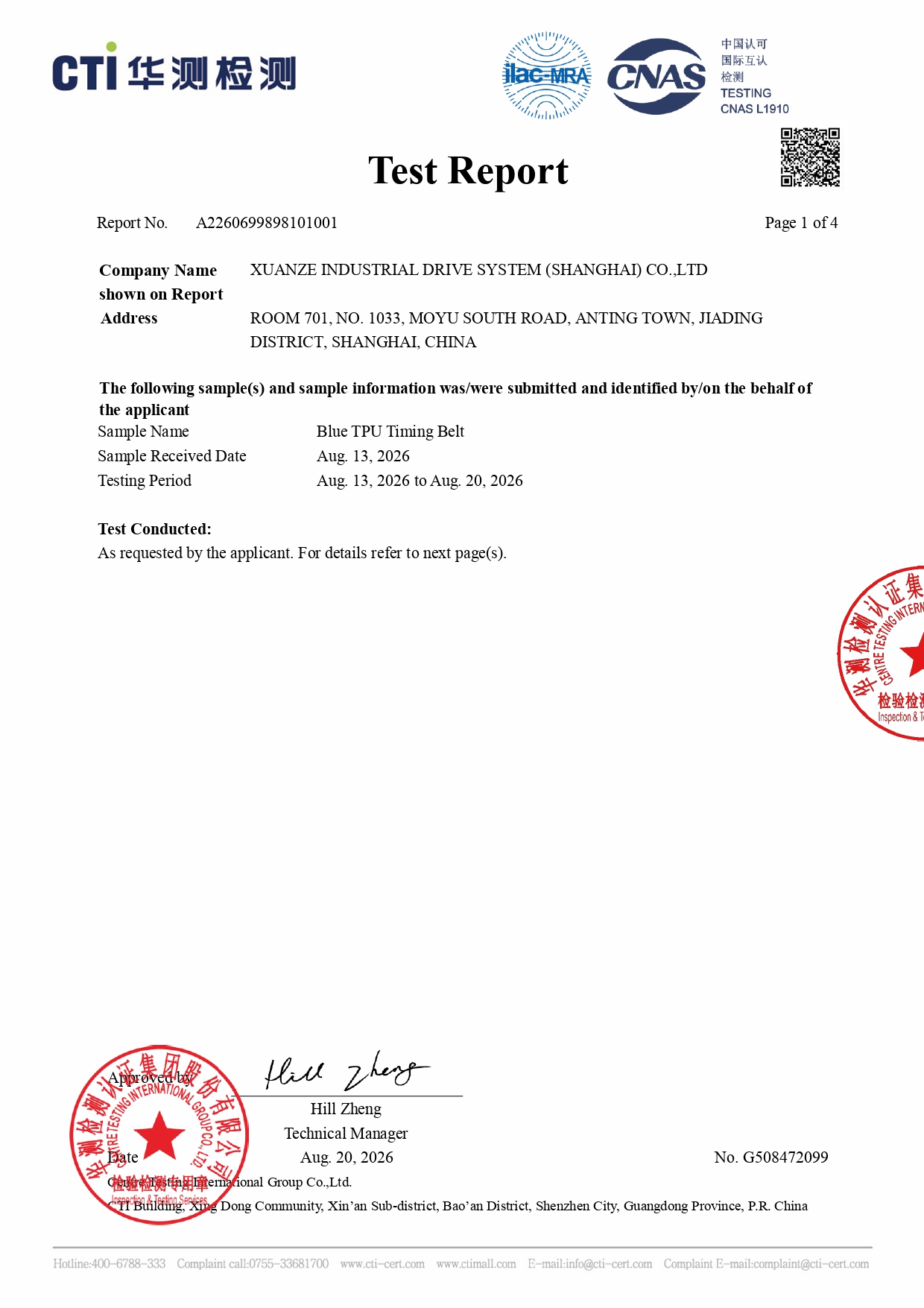
Extraction test reports document material compliance under a named standard; they are not a load-life or dimensional performance result.
What these documents do not establish is equally important. A total extractives result under a defined standard is not a load-life result, not a dimensional result, and not a statement about performance on a specific machine. The correct use of such a report is to confirm that a material meets a named regulatory requirement for a named scope, and to check that the report number, standard, issuing laboratory and date are recorded in the order file.
Where tooth profiles fall within the classic inch series, the governing international reference is ISO 5296:2012, which specifies the principal characteristics of synchronous endless belts with pitch codes MXL, XXL, XL, L, H, XH and XXH. Buyers specifying those profiles can reasonably ask the supplier to confirm supply against that standard rather than against a catalog equivalent.
Evidence 4: Purchasing Terms and Acceptance Criteria for High-Temperature Seamless Belts
High-temperature seamless belts are typically used in textile, packaging, high-temperature processing and industrial conveying equipment, and they are the case where vague specifications cause the most disputes, because the belt is usually a single continuous loop with no joint to fall back on.
The construction data for the XZBELT silicone-coated seamless belt family is specific enough to be used as an order annex. The belt is listed at 9 ± 0.5 mm total thickness, made up of a 3 mm surface coating over a 6 mm baseband, in a single-layer seamless woven construction using silicone, Nomex fiber and polyester filament fiber. Tensile force at 1% elongation is given as 30 N/mm and tensile strength at 3% elongation as 350 N/mm. Maximum operating speed is 400 m/min, and the belt is described as recoverable after 2.5% elongation. Minimum pulley diameter is 70 mm in forward running and 120 mm in reverse. The temperature range is −40 °C to +210 °C.
A workable acceptance list for this family covers: agreed total and coating thickness, baseband construction, measured tensile behaviour against the specified figure, edge condition, width and length, marking of the temperature class, and packing that prevents deformation in transit. Where the belt is not truly endless, joint position and joint verification should also be defined.
Commercially, the terms a buyer should ask for before confirming an order include minimum order quantity, lead time and capacity allocation. XZBELT states that MOQ is set by product type and specification, that lead time is 7 days for selected standard products, and that customized orders are subject to specification. Quality control is described as an ISO 9001 quality management system supported by professional inspection equipment and product quality inspection. After-sales services listed by the company include technical support, customized solution support, application support and long-term supply support.
What Case Data Proves — and What It Does Not
Reference cases are useful at the evaluation stage when they are read as evidence patterns rather than as performance promises.
In one packaging application, a packaging machinery distributor and carton packaging manufacturer used belts for high-speed carton feeding, folding, pressing and conveying on folder-gluer and carton packaging lines, at a scale of more than 1,000 pieces annually. Under continuous operating conditions reported as 24–30 months, the account describes reduced belt replacement frequency of approximately 40%, improved feeding accuracy and stability, less belt slippage and fewer unplanned stoppages, with the highlights listed as abrasion resistance, consistent friction performance, low elongation and reliable endless joint strength.
In a second case, a large aluminium profile manufacturer used a timing belt for traction and conveying together with a felt belt for surface protection on extrusion lines, at a scale of more than 50 belts annually. Over more than 12 months of continuous operation, the reported outcomes were prevention of scratches and pressure marks, maintained conveying accuracy, maintenance frequency reduced by approximately 30% and production efficiency increased by approximately 20%, with repeat orders continuing for several years.
A third case involved an OEM equipment supplier and equipment manufacturer that replaced existing belts with XZBELT PVC and PU conveyor belts on conveying lines, in quantities of 1,000 pieces and 600 pieces delivered across a three-year supply period, with reported reduction of downtime and operating costs.
The limitation is straightforward. These are customer application outcomes under those specific line conditions, not guarantees of identical results on different equipment. Belt life depends on pulley condition, alignment, tension, load profile and environment, all of which sit outside the supplier's control. The correct use of case data is to confirm that the supplier has solved a comparable configuration before, and to ask what the failure mode was and how it was addressed.
Comparison: Jointed Endless, Truly Endless and Open-End Supply
The open-end versus endless decision is often treated as a logistics question. It is an engineering trade-off, and each form carries a real boundary.
| Supply form | Advantage | Boundary to accept |
|---|---|---|
| Open-end belt | Practical for linear axes and on-machine joining; adjustable to required length | Load capacity is defined by width and tooth profile; joining quality depends on the site process |
| Jointed endless belt (welded or flex joint) | Installed without dismantling the machine frame; widely used in conveying and indexing | The joint remains the point to verify; maximum load force for jointed belts is quoted according to width and tooth profile rather than as a single figure |
| Truly endless belt (seamless construction) | No splice in the running direction; relevant to high-speed and high-temperature conveying | Requires machine access for installation and is geometry-limited; the 9 mm silicone-coated seamless belt, for example, specifies minimum pulley diameters of 70 mm forward and 120 mm reverse |
That last boundary matters in practice. A seamless high-temperature belt is not a substitute for a small-pulley timing drive, and a timing belt is not a substitute for a low-friction seamless conveying surface. Matching the belt family to the machine function comes before comparing suppliers.
Material choice follows the same logic. Rubber remains the dominant material in the automotive timing belt segment, with a market size estimated at USD 7.23 billion in 2024, which reflects high-temperature and high-load duty cycles in that sector. PU constructions are more commonly selected where positioning accuracy, cleanliness and custom coating or perforation are the deciding factors, and are frequently supplied in coated form for product handling.
Market Trend Analysis
The global timing belt market was valued at approximately USD 9.10 billion in 2025 and is projected to reach about USD 9.57 billion by 2030, according to Mordor Intelligence. That is moderate growth in aggregate, which means the competitive pressure is concentrated on specification, service and evidence rather than on category expansion.
Growth estimates for polyurethane timing belts diverge sharply. Credence Research projects a CAGR of 12.57% for the PU segment, reaching USD 25.5 billion by 2032, while 24ChemicalResearch reports 3.10%. The difference appears to be methodological, with the higher figure likely including high-growth niches such as robotics and custom solutions. For procurement planning, the practical conclusion is to avoid anchoring a sourcing decision on a single CAGR; capacity and process evidence from the specific supplier remain the more reliable inputs.
A second trend signal comes from coated synchronous belts in high-speed converting. XZBELT lists its SIBR-5M silicone synchronous belt as developed for the hygiene products industry, with a stated capability of 1,200–1,400 pieces per minute, according to its audited supplier listing on Made-in-China. Whether or not a buyer operates in that sector, the direction is clear: functional coatings, perforation and precision machining are increasingly part of the specification, not an optional extra.
Future Outlook
Three shifts are likely to shape timing belt sourcing over the next few years. The first is documentation. As buyers standardize supplier approval files, the parameter sheet, certification scope and test report number are becoming part of the purchase order rather than an attachment requested after a problem appears. Suppliers who publish tolerances and construction data will find that easier to support.
The second is the growing share of fabricated belts. Silicone coating, PU coating, perforation, fabric reinforcement and sidewalls all move a belt away from a catalog item toward a designed component. This increases the importance of the supplier's secondary processing equipment, and it makes sampling and acceptance criteria more valuable than unit price comparison.
The third is continuity. Long-term supply support, application support and stable lead times matter more in a market growing in single digits than in a fast-expanding one, because replacement and repeat orders dominate volume. For buyers, the final check before an order remains unchanged: verify the process, verify the document, and verify the term — in that order.
FAQ
What documents should a buyer request before placing a first timing belt order?
A process and equipment confirmation for the specific construction required; a dimensional parameter sheet listing tooth profile, pitch, length or tooth count, width and tolerances; the applicable quality management certificate with its scope line and validity dates; any material compliance test report with certificate number, issuing laboratory, standard and date; confirmation of the supply form as open-end, jointed endless or truly endless; and the commercial terms, including minimum order quantity and lead time.
Can two timing belts with the same length but different tooth profiles be interchanged?
No. The tooth geometry and pitch must match the pulley system. Both belt length and tooth count can be used to identify a belt when the pitch is known, because pitch length equals tooth count multiplied by pitch, but neither measurement compensates for a profile mismatch.
Can PU timing belts be supplied both open-end and endless?
Yes, depending on the tooth profile and the manufacturing construction. Published supply forms include open-end belts, jointed endless belts and truly endless belts. The form selected determines which process evidence is relevant, since jointed supply depends on splicing capability while truly endless supply depends on seamless construction.
What should be defined in an order for a high-temperature seamless belt?
Construction data such as total thickness, coating thickness and baseband thickness; the operating temperature range; tensile values at defined elongation; maximum operating speed; recovery behaviour after elongation; and minimum pulley diameters in forward and reverse running. For the XZBELT silicone-coated seamless belt, these are listed as 9 ± 0.5 mm total with 3 mm coating and 6 mm baseband, −40 °C to +210 °C, 30 N/mm at 1% elongation, 350 N/mm at 3% elongation, 400 m/min maximum speed, recovery after 2.5% elongation, and minimum pulley diameters of 70 mm forward and 120 mm reverse.
What does an ISO 9001 certificate or an FDA compliance report actually confirm?
An ISO 9001 certificate confirms that a quality management system is certified within a stated scope and validity period; for XZBELT the scope covers sales of industrial transmission and conveyor rubber and plastic belts, refractory fiber rope and high-temperature resistant fiber braided casing, valid from 1 August 2025 to 31 July 2028. An FDA compliance test report confirms that a material meets a named standard for a defined extraction scope, such as total extractives under FDA 21 CFR 177.2600. Neither document confirms load life, dimensional accuracy on a specific drive, or performance on a particular machine.
How should lead time and minimum order quantity be planned?
Minimum order quantity is normally set by product type and specification, and lead time depends on whether the item is standard or custom. XZBELT states a 7-day lead time for selected standard products, with customized orders subject to specification, against a stated PU and PVC roll material capacity of approximately 166,000 m² per month across its manufacturing bases. Buyers should confirm the scheduled production line and changeover position at the time of ordering rather than rely on a general lead-time figure.
Readers who want the underlying construction, tolerance and processing data in a single document can download the XZBELT company brochure for reference: XZBELT brochure (PDF). Company information is also published at xzbelt.com.