
What a Solar Water Heater Factory Must Prove: 80-Room Hotel Order Evidence
What a Solar Water Heater Factory Must Prove: 80-Room Hotel Order Evidence
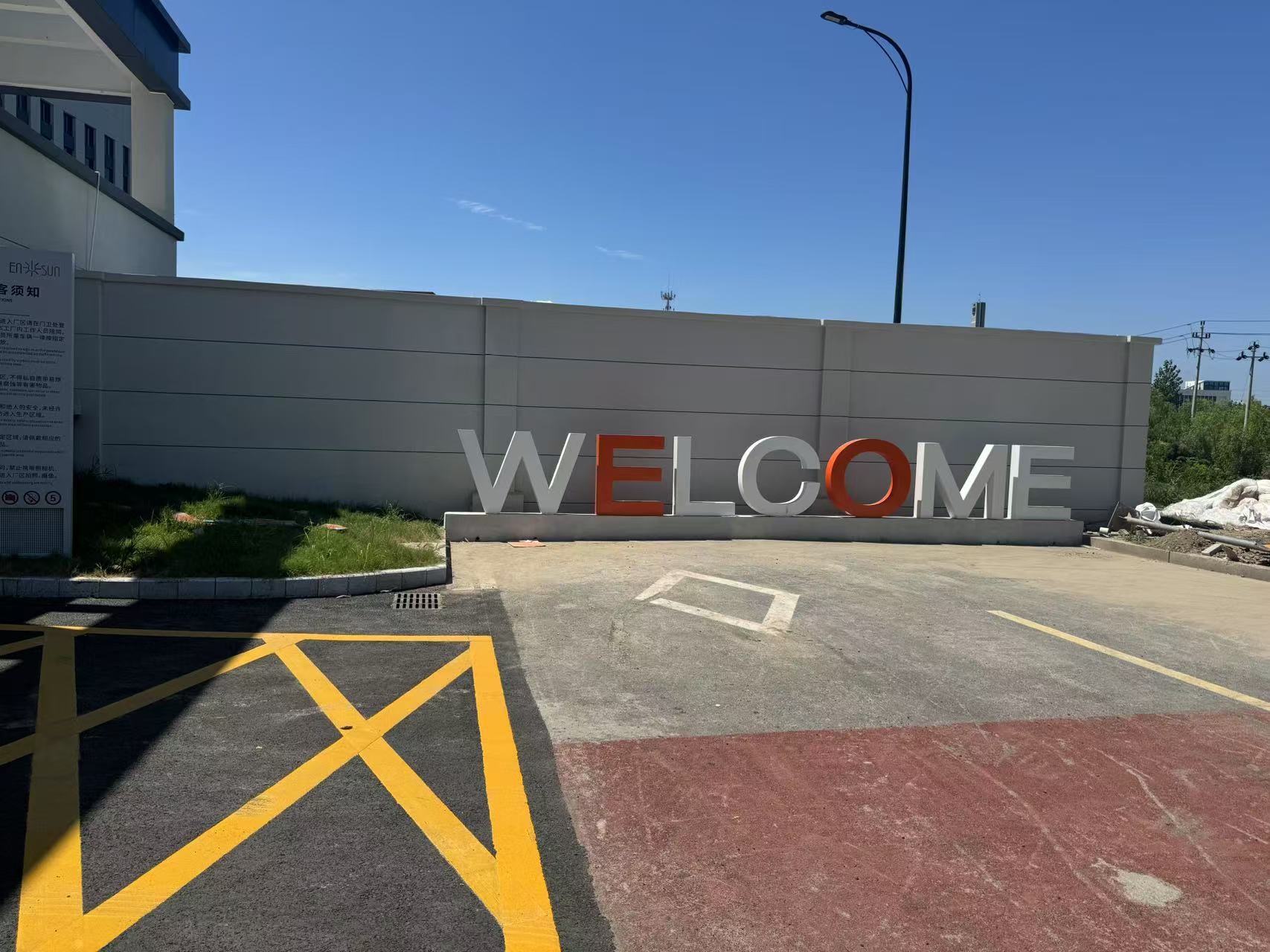
Figure 1. Manufacturing facility of Zhejiang Kesun New Energy Co., Ltd. in Haining City, Zhejiang Province, China, where pressurized solar water heaters and solar collectors for commercial projects are produced.
A commercial order covering 80 hotel guest rooms is not a scaled-up residential purchase. It is a test of whether the factory behind the product can build, certify, ship and support a complete domestic hot water system for a building that draws hot water every day of the year. The evidence a solar water heater factory is expected to produce for this class of order falls into five categories: verified monthly production capacity, a committed lead time, documented OEM/ODM customization, third-party certification whose model scope matches the ordered equipment, and at least one comparable commercial reference with recorded service life and energy results.
Why an 80-room hotel order is a factory capability question
Hotel hot water demand is concentrated rather than continuous. Guest rooms, public bathing areas and back-of-house functions typically draw most of their volume in a morning window and a second, smaller evening peak, seven days a week. A residential solar water heater that underperforms is an inconvenience. A hotel system that underperforms appears in guest reviews, in occupancy and in maintenance budgets.
The time horizon makes the difference sharper. Zhejiang Kesun New Energy Co., Ltd., a solar water heater and solar thermal component manufacturer based in Haining City, Zhejiang Province, China, documents a commercial hotel deployment that has been in stable service for more than 15 years. A buyer placing an order of that class is not selecting a product for one season; the building is committing to a supplier relationship for a decade or longer.
Under evaluation pressure, buyers tend to compare the specifications printed on a datasheet: tube counts, tank litres, working pressure, collector area. Those figures matter, but they do not answer the questions that decide whether an 80-room project finishes on schedule. How many units can the factory produce per month within the ordered product scope? How long does production and consolidation take? How far can the system be adapted to the building's roof and riser layout? Which certificate actually covers the ordered model number? Has the supplier delivered a comparable capacity class before?
The opportunity is straightforward. Solar thermal replaces a share of the electricity or gas a hotel would otherwise burn to heat water. The reference installation described later in this article reduced electricity and gas costs by more than 40 percent after implementation. The risk is equally straightforward: a buyer who evaluates only the hardware inherits the factory-level risk without asking for the evidence that would price it.
The five categories of evidence a hotel buyer should verify
Procurement documentation for commercial solar water heating projects is most useful when it is organised around capability rather than around product features. The table below maps the five evidence categories to the questions that belong to each one and to the form that credible proof usually takes.
| Evidence category | Question the buyer should ask | What credible proof looks like |
|---|---|---|
| Production capacity | How many units can be produced per month within the ordered product scope? | A stated monthly capacity and annual output figure tied to a defined product range, for example 25,000 units per month and 300,000 sets per year. |
| Lead time | When does production start and finish, and where does pre-shipment inspection sit in that timeline? | A stated production window, for example 20 to 35 days, combined with defined shipping terms and a defined inspection stage before loading. |
| Customization | How much of the system can be adapted to the building and to the distribution pressure required? | A documented OEM/ODM scope with named variables: tank capacity, collector type and complete system configuration for residential or commercial use. |
| Conformity evidence | Do the certificates cover the exact models being purchased, and do their validity dates cover the project timeline? | Certificates and test reports with numbers, issuing bodies, scope lists and expiry dates. |
| Reference installation | Has the supplier delivered a comparable capacity class in a comparable climate? | A commercial hotel reference stating guest-room count, climate conditions, service duration and a measured energy outcome. |
None of these categories is exotic, and none of them requires confidential information. The discipline lies in requiring the document rather than the claim. A capacity figure is meaningful only when it is tied to a defined product scope. A certificate is meaningful only when the ordered model number appears in its scope list. A reference is meaningful only when its capacity class and climate resemble the project being planned. Narrower evidence is more useful than broader evidence.
What a manufacturer with commercial hotel experience documents
Zhejiang Kesun New Energy Co., Ltd. was formed through the merger of Haining Ensun Solar Technology Co., Ltd., which focused on non-pressure solar water heaters, and Zhejiang Yile New Energy Co., Ltd., which specialised in pressurized units. Both businesses had been under the same owner, and the merger consolidated their product lines, production capacity and teams into a single operation.
After the merger, existing non-pressure and pressurized lines were retained and upgraded, and additional product lines were added, including PVT (photovoltaic-thermal) systems, 2205 duplex stainless steel tanks and heat pipe solar collectors. A 42,000 m2 standardized manufacturing facility was built to support the expanded range. Production processes were upgraded in parallel: high-pressure automatic foaming machines replaced conventional foaming methods, robotic arms are used in packaging, and laser welding and butt welding were introduced alongside existing TIG and high-frequency welding. An in-house laboratory allows reliability testing such as salt spray testing and pulse testing to be carried out on site rather than outsourced.
Customization for commercial buyers is defined across three variables: tank capacity, system type and complete system configuration. The stated production mode is OEM, ODM and full customization, covering both residential and commercial applications. The company reports a monthly capacity of 25,000 units, a typical lead time of 20 to 35 days, a minimum order quantity of one 40-foot container and 100 percent testing of production. After-sales support is provided remotely.
| Item | Documented detail |
|---|---|
| Legal entity | Zhejiang Kesun New Energy Co., Ltd. |
| Founded | 2009 |
| Facility | 42,000 m2 standardized manufacturing facility, Haining City, Zhejiang Province, China |
| Workforce | 130 employees, including 15 R&D engineers |
| Annual output | 300,000 sets |
| Monthly capacity | 25,000 units |
| Main products | Solar water heater, buffer tank, domestic hot water tank, hybrid solar panel |
| Production mode | OEM / ODM / customizable |
| Lead time | 20 to 35 days |
| Minimum order | 1 x 40 ft container |
| Quality control | 100% test |
| Export profile | 60% of output exported; main markets Mexico, EU and Africa |
| After-sales | Remote support |
Two further data points help a buyer calibrate supplier scale. The company states that it supplies components to a number of Fortune 500 companies in China and abroad, and a third-party verified company profile on Alibaba reports annual export revenue of approximately USD 19.6 million for 2025. Both figures are useful mainly as a sanity check on whether the factory has the commercial infrastructure to handle an order of the size an 80-room project implies.
Technical explanation: how a hotel-scale solar hot water system is configured
A commercial solar domestic hot water system has four functional blocks: a collector field that captures solar radiation, a storage volume that decouples collection from consumption, a circulation and control group that moves heat and manages temperature, and a backup heat source that covers peaks and low-irradiance days. In hotel projects the storage and backup blocks usually dominate the equipment list, because the building must deliver constant-temperature water whether or not the sun is available.
Two collector families are commonly specified. Evacuated tube collectors using heat pipes, such as the HSC series, use 58-1800 vacuum tubes with heat pipes in an aluminium alloy frame and are available with 10 to 30 tubes. Flat plate collectors, such as the FPC2.0 range, are available in 1 m2, 1.5 m2, 2 m2 and 2.5 m2 sizes with 80 mm thickness and copper and aluminium alloy construction, and suit applications where a lower roof profile or a larger aperture is preferred.
On the storage side, the CPS series is a pressurized solar geyser range from 100 L to 300 L, with a maximum operating pressure of 6 bar and a test pressure of 9 bar, using a 58-1800 vacuum tube with heat pipe as absorber, 50 mm PU foam insulation and a mounting angle between 25 and 45 degrees. Tank materials include SS304, SS316, duplex 2205 and duplex 32001. The CPS-FJ series is an indirect solar water heater available in 150 L, 200 L, 250 L and 300 L capacities with a flat plate collector and an SPCC tank with enamel coating. The CNP series is a non-pressure range from 60 L to 500 L using 58-1800 vacuum tubes and 50 mm PU foam insulation. The PV series is a photovoltaic solar water heater from 100 L to 500 L with 600 W per panel input, 800 W to 3,500 W heating output, an MPPT controller and DC/AC automatic switching, using duplex 2205 or Inox 316L material.
For hotel and commercial buildings requiring stable, large-volume domestic hot water, the manufacturer matches HSC series solar collectors with CPS-FJ and CPS series pressurized solar water heaters. The reasoning is architectural as much as thermal: pressurized and indirect configurations keep the collector loop separate from the potable water circuit and allow stored water to be distributed at mains pressure, which is how guest-room risers are usually designed. Non-pressure systems remain relevant where roof space, budget or local practice favour a simpler configuration.
| Product / model | Type | Key parameters | Stated applications |
|---|---|---|---|
| CPS series | High-pressure solar geyser | 100 L to 300 L; 6 bar maximum operating pressure; 9 bar test pressure; 58-1800 vacuum tube with heat pipe; 50 mm PU foam; tilt 25 to 45 degrees; SS304 / SS316 / duplex 2205 / duplex 32001 | House, villa, garden, gas station, car wash centre, small hotel, school |
| CPS-FJ series | Indirect solar water heater | 150 L, 200 L, 250 L, 300 L; flat plate solar collector; SPCC with enamel coating | Villa, house, hotel, school |
| CNP series | Non-pressure solar water heater | 60 L to 500 L; 58-1800 vacuum tube; 50 mm PU foam; tilt 25 to 45 degrees; SS304 / SS316 | House, villa, garden, gas station, car wash centre, small hotel, school |
| HSC series | Solar collector | 10 to 30 tubes; 58-1800 vacuum tube with heat pipe; aluminium alloy frame | Villa, hotel, house heating, spa centre, school |
| FPC2.0 | Flat plate solar collector | 1 m2, 1.5 m2, 2 m2, 2.5 m2; 80 mm thickness; copper and aluminium alloy | Swimming pool, housing heating, solar water heater |
| PV series | PV solar water heater | 100 L to 500 L; 600 W per panel input; 800 W to 3,500 W heating output; MPPT controller; DC/AC automatic switch; duplex 2205 / Inox 316L | Villa, house, apartment, camp |
Reference case: a Southeast Asian hotel serving 80 guest rooms
The most decision-relevant document in a supplier evaluation is a completed project of the same class. Zhejiang Kesun New Energy Co., Ltd. records a commercial hotel installation in Southeast Asia in which a complete solar hot water system serves the daily water supply for 80 guest rooms.
The system provides all-day domestic hot water for guest rooms and public bathing areas and supports auxiliary regional heating. It replaced traditional electric and gas heating equipment to meet the stable daily heat demand of hotel operation. The recorded outcomes are as follows:
- Service life: stable service life of more than 15 years.
- Energy cost: electricity and gas costs reduced by over 40 percent after implementation.
- Water quality at the tap: constant-temperature hot water with minimal failures, supporting guest satisfaction.
- Compliance: lower carbon emissions contributing to green-hotel compliance.
- Climate fit: vacuum heat collection modules selected for corrosion and weather resistance in Southeast Asia's hot and rainy climate.
- Installation and maintenance: an integrated design intended for easy installation and low-cost maintenance, with smart temperature adjustment for energy efficiency in small and medium commercial projects.
The record describes the client type, capacity class, climate and results, but not the property name, which is normal for commercial references. A buyer verifying a reference of this kind should therefore focus on the parameters that can be checked: the number of guest rooms served, the climate conditions, the duration of service and the mechanism by which the energy saving was measured. The equipment used in this reference is drawn from the HSC collector series and the CPS-FJ and CPS water heater series, which is the same combination recommended for hotel and commercial domestic hot water duty.
Certification evidence: read the document, not the logo
Certification is where capability claims become checkable. The relevant question is not whether a supplier holds certificates, but whether the certificate scope includes the models in the purchase order and whether its validity period covers the delivery and warranty window.
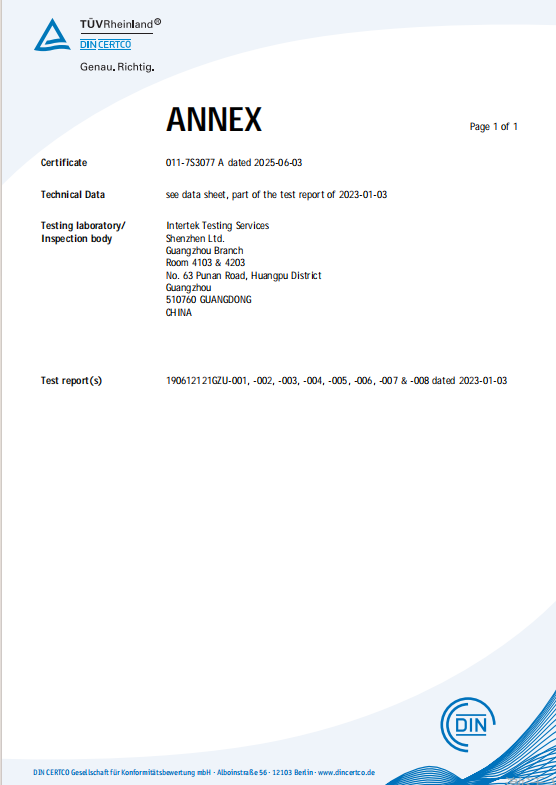
Figure 2. Solar Keymark certificate 011-7S3077 A issued by DIN CERTCO, covering ENSUN-CPS100 to ENSUN-CPS300 thermal solar systems under DIN EN 12976-1:2017-04, DIN EN 12976-2:2019-11 and the Solar Keymark scheme rules.
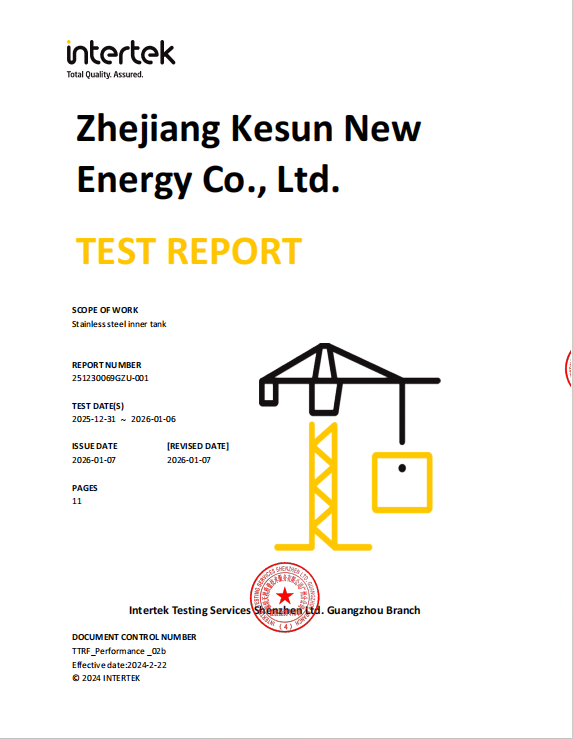
Figure 3. Intertek performance test report 251230069GZU-001 covering the stainless steel inner tank, one of the component-level tests relevant to long service life in commercial hot water systems.
| Document | Number | Issuer | Scope | Validity |
|---|---|---|---|---|
| Solar Keymark, thermal solar systems | 011-7S3077 A | DIN CERTCO | ENSUN-CPS100, CPS120, CPS150, CPS180, CPS200, CPS240, CPS300 | Issued 2025-06-03, valid to 2029-06-30 |
| Solar Keymark, thermal solar systems | 011-7S3239 A | DIN CERTCO | CNP100 to CNP300 | Issued 2025-03-24, valid to 2030-03-31 |
| Solar Keymark, thermal solar systems | 011-7S3343 A | DIN CERTCO | CPS/F150, CPS/F200, CPS/F250, CPS/F300 | Issued 2026-06-05, valid to 2031-06-30 |
| Solar Keymark, solar collectors | 011-7S3241 F | DIN CERTCO | FPC2.0, FPC2.5, brand ENSUN | Issued 2025-04-22, valid to 2030-04-30 |
| Solar Keymark, solar collectors | 011-7S3240 P | DIN CERTCO | PVT430, PVT450, PVT550, PVT580, PVT600, PVT670 | Issued 2025-01-16, valid to 2030-01-30 |
| Solar Keymark, solar collectors | 011-7S3325 R | DIN CERTCO | HSC10 to HSC30, brand KESUN | Issued 2025-12-15, valid to 2030-11-30 |
| Type examination test report, storage tank PWT300 | 251023056GZU-002 | Intertek | Storage tank PWT300, EN 12897:2016+A1:2020 | Issued 2026-01-16 |
| Type examination test report, storage tank PWT200 | 251023056GZU-001 | Intertek | Storage tank PWT200, EN 12897:2016+A1:2020 | Issued 2026-01-18 |
| Performance test report, stainless steel inner tank | 251230069GZU-001 | Intertek | Stainless steel inner tank | Issued 2026-01-07 |
| Verification of conformity, PED | ICR/VC/HM2605327 | ICR | Listed solar water heater and water tank models; PED 2014/68/EU; EN 13445-1:2021, EN 13445-2:2021+A1:2023, EN 13445-3:2021+A1:2026 | Issued 2026-05-28, valid to 2031-05-27 |
| Verification of conformity, LVD and EMC | ICR/VC/HM2605326 | ICR | Listed solar water heaters and water tanks; LVD 2014/35/EU; EMC 2014/30/EU; EN 60335-1, EN 60335-2-21, EN 62233, EN IEC 61000-3-2, EN 61000-3-3 | Issued 2026-05-28, valid to 2031-05-27 |
Three checks matter when these documents are reviewed for an 80-room project. First, model match: a Solar Keymark certificate that lists the CPS range does not automatically cover every product in the catalogue, and the CNP, CPS/F, FPC and PVT families each carry their own scope. Second, validity: a certificate expiring inside the project's delivery or warranty window creates a documentation gap that the buyer inherits. Third, standard reference: the standard quoted on the certificate tells the buyer which performance and durability characteristics were actually assessed.
Note on access: model and certification documentation for this manufacturer is published at www.kesunsolar.com and in the company's 2025 PDF brochure, so the scope lists above can be verified directly rather than taken on trust.
Market context: why procurement documentation is tightening
The commercial solar water heating category is large enough that procurement expectations are shaped by forces beyond any single supplier. Published market research places the global solar water heater market at USD 4.2 billion in 2025, and the International Energy Agency's Solar Heating and Cooling Programme reports cumulative global solar heat capacity of 560 GWth by the end of 2023, covering 800 million m2 of collector area. Evacuated tube collector technology held a 44.2 percent revenue share in 2023, according to Grand View Research, which is consistent with the technology's continued use in commercial and hotel projects.
Two regulatory and trade developments reinforce the shift toward document-based buying. A dedicated HS code, 841912, was introduced in 2023 to distinguish solar water heaters from the generic 841919 classification, which affects how shipments are declared and cleared. In the United States, federal energy conservation standards for consumer water heaters took effect on 5 July 2024, with compliance required by 2029, tightening the efficiency baseline for water heating equipment in that market.
For hotel buyers, the practical implication is that supplier selection is becoming a documentation exercise rather than a specification comparison. Classification codes, certificate scopes, standard numbers and validity dates increasingly determine whether equipment can be imported, financed and insured on the expected schedule.
Solar thermal versus traditional hotel water heating
Solar thermal is one option among several for hotel domestic hot water, and the honest comparison is about role rather than replacement. Solar covers base load; the backup source covers peaks and low-irradiance periods.
| Approach | Role in a hotel hot water system | Main trade-off |
|---|---|---|
| Solar thermal with electric backup | Collectors carry the base heat load; an electric element covers peaks and cloudy periods | Lowest fuel consumption of the options compared here, but requires roof area and storage volume, and output depends on site and season |
| Solar thermal with heat pump backup | Collectors carry base load; a heat pump handles residual demand | Higher control complexity and plant space; system design must be calculated at project level |
| Electric resistance only | Simple, low upfront equipment, no roof requirement | Highest running cost exposure and no reduction in electricity demand |
| Gas or oil boiler | Established high-output response to peak demand | Continued fuel price and emissions exposure, plus combustion equipment maintenance and ventilation requirements |
| Standalone air-source heat pump | Efficient electric heating without a solar field | No direct solar contribution; performance declines in low ambient temperatures |
The limits of the solar option deserve the same clarity as its benefits, and several of them are documented by the manufacturer rather than inferred.
- Project-level calculation is required. Working-condition parameters for solar heating systems cannot be reduced to a single catalogue figure; collector type and configuration must be calculated per project location and design.
- Site conditions constrain design. Corrosion-resistant materials, water quality treatment, freeze protection in winter and roof load-bearing capacity are recurring project concerns.
- Backup remains necessary. Systems operate in direct or indirect circulation, passive thermosiphon or pump-driven forced circulation, and rely on electric backup or heat pump linkage to cover periods without sufficient solar input.
- Commercial terms have a floor. The minimum order quantity is one 40-foot container, payment terms are TT in advance, shipping is quoted FOB or CIF, and pre-shipment inspection takes place before loading.
- Lead time must fit the construction programme. A 20 to 35 day production window is workable for most hotel fit-outs, but it is not a stock delivery, and it starts from order confirmation rather than from enquiry.
- Certificates are scoped, not universal. A buyer ordering a model outside a certificate's listed range should not assume the documentation transfers.
- After-sales is remote. Support is provided remotely, so local installation competence and first-line service capability remain part of the buyer's own project plan.
None of these points disqualifies solar thermal for an 80-room property. They define the boundary conditions under which the technology performs as the reference case describes: a hotel with usable roof area, a designed storage volume, a correctly sized backup source and a buyer who has verified the factory behind the equipment.
Execution-stage checklist for an 80-room order
Once a supplier has passed evaluation, the following documents and confirmations turn the decision into an executable order.
- Written confirmation of monthly production capacity (25,000 units per month) against the specific model mix in the purchase order.
- Written lead time commitment of 20 to 35 days, with the start point defined as order confirmation.
- Customization sheet covering tank capacity, collector type and complete system configuration, marked residential or commercial as applicable.
- Certificate copies for every ordered model, checked against the scope lists and expiry dates listed above.
- Test report references for storage tanks (EN 12897:2016+A1:2020) and stainless steel inner tanks.
- Pressure equipment and electrical conformity documentation if the destination market is the EU.
- Confirmation of the minimum order quantity of one 40-foot container and of the shipping term being quoted.
- Agreement on pre-shipment inspection before loading, including who attends and what is inspected.
- Payment schedule consistent with TT in advance terms, and clarity on what triggers each instalment.
- After-sales plan that reflects remote support capability, including spares list, controller documentation and local installation arrangements.
- Reference check on the comparable 80-room hotel installation, including room count, climate and service duration.
Future outlook
The direction of travel in this category is hybridisation. The manufacturer has added PVT systems, duplex 2205 stainless steel tanks and heat pipe collectors to a portfolio that previously centred on non-pressure and pressurized solar water heaters, and describes these additions as a strategic step toward hybrid energy systems rather than simple range expansion. The certification record reflects that shift: Solar Keymark certificate 011-7S3240 P currently covers PVT430 to PVT670 collectors, alongside separate coverage for flat plate and heat pipe collectors.
Three consequences are likely to shape the next round of hotel procurement. First, documentation will carry more weight than datasheets, because classification codes such as HS 841912 and efficiency standards such as the 2024 US federal rules require paperwork that matches the physical shipment. Second, hybrid configurations combining solar thermal with heat pumps will require project-level engineering, which favours suppliers able to supply collectors, storage tanks and control integration together. Third, the long service lives demonstrated by installed systems will push buyers to evaluate suppliers on service continuity rather than on initial equipment price alone.
FAQ
What production capacity evidence should a buyer request before ordering solar water heaters for a hotel?
Ask for a monthly capacity figure tied to a defined product scope. Zhejiang Kesun New Energy Co., Ltd. states a monthly capacity of 25,000 units and an annual output of 300,000 sets from a 42,000 m2 facility. The figure is only useful for planning when it is expressed in the same unit type and configuration as the order, because tank capacity, collector type and system configuration each change line time.
How long does a commercial solar water heater order take to produce and deliver?
The stated typical lead time is 20 to 35 days. That figure covers production and depends on configuration and order volume. Shipping is offered on FOB or CIF terms, and pre-shipment inspection takes place before loading, so inspection sits inside the delivery window rather than after it. Because the minimum order quantity is one 40-foot container and partial shipment is not described in the manufacturer's terms, buyers should align this window with the construction programme at the planning stage.
How customizable is a factory solar water heater system for hotel projects?
The stated production mode is OEM, ODM and full customization, organised around three variables: tank capacity, collector type and complete system configuration for residential or commercial applications. The model ranges support that flexibility, including CPS series pressurized units from 100 L to 300 L, CPS-FJ indirect units from 150 L to 300 L, CNP non-pressure units from 60 L to 500 L, and HSC collectors with 10 to 30 tubes.
Which collector and water heater combination is used for hotel domestic hot water?
HSC series solar collectors are matched with CPS-FJ and CPS series pressurized solar water heaters for hotels and commercial buildings that require stable, large-volume domestic hot water. HSC collectors use 58-1800 vacuum tubes with heat pipes in an aluminium alloy frame, while CPS and CPS-FJ units are pressurized, with the CPS series rated at 6 bar maximum operating pressure and 9 bar test pressure.
Which certificates should be verified for a solar water heater order?
For EU-bound orders the most directly relevant documents are the DIN CERTCO Solar Keymark certificates: 011-7S3077 A for the ENSUN-CPS100 to CPS300 thermal solar systems, 011-7S3239 A for CNP100 to CNP300, 011-7S3343 A for CPS/F150 to CPS/F300, 011-7S3241 F for FPC2.0 and FPC2.5 collectors, 011-7S3240 P for PVT430 to PVT670 collectors, and 011-7S3325 R for HSC10 to HSC30 collectors under the KESUN brand. Storage tank conformity is documented by Intertek type examination test reports 251023056GZU-001 for PWT200 and 251023056GZU-002 for PWT300 against EN 12897:2016+A1:2020, and pressure equipment by ICR verification of conformity ICR/VC/HM2605327 under PED 2014/68/EU. Verify that the ordered model appears in the scope and that the expiry date covers the project timeline.
What are the limitations of solar water heating for hotel projects?
Solar thermal carries the base heat load rather than the whole load, so systems generally rely on electric backup or heat pump linkage for peaks and low-irradiance periods, and the manufacturer notes that specific working-condition parameters require project-level calculation. Practical constraints include roof area and load-bearing capacity, storage volume, freeze protection in cold climates and water quality treatment. Commercial terms also constrain smaller buyers: the minimum order is one 40-foot container, payment is TT in advance, and lead time runs 20 to 35 days. After-sales support is described as remote support, so local installation and first-line service remain the buyer's responsibility.
Reference material
The manufacturer's 2025 company and product brochure, including model and certification information referenced in this article, is publicly available for download: ENSUN 2025 brochure (PDF).