
What a Multi-Model Non-Dairy Creamer Portfolio Proves
What a Multi-Model Non-Dairy Creamer Portfolio Proves
Seven models in one catalogue is a claim about breadth. It becomes evidence of capability only when each model carries a documented parameter, a defined application, and a certificate or test record that survives buyer scrutiny. This analysis applies that standard to the Cograin non-dairy creamer range — FC22 foaming, S35 vegan, cold-soluble, DT35 low sugar, C960 whipping, 60A high-fat and kosher K80 — and sets out the same test a procurement team can apply to any supplier's portfolio, from the evaluation file through to the acceptance criteria written into a purchase order.
Cograin is the non-dairy creamer brand of Jiahe Foods Industry Co., Ltd., a manufacturer founded in 2001 and headquartered in Suzhou, Jiangsu Province, listed on the main board of the Shanghai Stock Exchange in 2021 under stock code 605300. The company operates three production bases and five factories in Suzhou, Nantong and Singapore, reports an annual output of 200,000 tons of non-dairy creamer, and states that exports account for 50% of its business, with Southeast Asia as a main market. Those are the commercial facts behind the portfolio; the article focuses on what the individual models can and cannot demonstrate.
Breadth Is a Claim; Parameters Make It Evidence
A multi-model range proves something real but narrow: that a supplier can hold several distinct functional specifications in production at the same time. Foaming, whipping, cold solubility, reduced sugar, high fat, protein-free vegan formulation and kosher certification are not variations of one recipe. Each pulls formulation and process decisions in a different direction, and each needs its own specification sheet, its own packaging configuration and, where a claim is involved, its own certificate scope. Sustaining seven of them simultaneously is a stronger signal of formulation and change-control capability than any single product photo.
What the range does not prove is equally important. It does not prove that a given model will perform in the buyer's specific matrix — coffee at serving temperature, a milk tea base with high solids, a bakery batter, an alcoholic beverage, a feed premix. It does not prove that capacity is available on the buyer's delivery date. It does not prove that certificates are current, or that a claim attached to one model extends to the others. And a wide portfolio with vague parameters is weaker evidence than a narrow portfolio with documented ones, because breadth without specification simply multiplies the number of unverified claims.
The practical decision rule follows directly. Count the models only after counting the documented parameter sets behind them. A supplier that can produce a per-model specification sheet, with limit types and test methods, is describing a controlled process. A supplier that answers a specification question with an adjective is describing a catalogue.
The Seven-Model Range, Mapped to Documented Positions
The functional positions below follow the documented model names and the company's published specification record. Where a numeric value is stated, it is the figure recorded for that model; where no figure is given, none should be assumed.
| Model | Documented functional position | Documented parameter points | Application area indicated |
|---|---|---|---|
| FC22 | Foaming creamer | Moisture ≤6.0%; fat 22.0 g/100 g; trans fat 0 g/100 g | Foaming beverage and topping applications |
| S35 | Vegan creamer | Protein 0 g; trans fat 0 g | Vegan beverage and dessert applications |
| Cold-soluble creamer | Dispersion without a hot-water step | Position defined by solubility behaviour; parameters quoted per specification sheet | Cold-soluble beverages |
| DT35 | Low-sugar formulation | Position defined by sugar reduction; sugar profile quoted per specification sheet | Reduced-sugar beverage and bakery concepts |
| C960 | Whipping cream powder | Position defined by whipping function; parameters quoted per specification sheet | Whipping and aerated applications |
| 60A | High-fat creamer | Position defined by fat level; fat value quoted per specification sheet | High-fat beverage and feed applications |
| K80 | Kosher-certified creamer | Kosher certificate KC#529705-1, scope model K80 in 25 kg packing, batch JW26558 | Kosher-compliant food applications |
Table 1. Functional positions and the parameter points documented for each model. Blank parameter cells are not evidence of absence; they indicate figures that must be requested per model rather than inferred from the range.
Read as a set, the seven positions cover the axes that most industrial creamer briefs actually move along: aeration, cold dispersion, fat level, sugar reduction, protein removal and religious dietary compliance. That coverage is the substance of the capability claim. It is also the reason a buyer should not treat the models as interchangeable — the reasons they exist separately are the reasons their specifications differ.
What Moisture, Fat, Protein and Trans Fat Actually Decide
Four declared parameters carry most of the qualification weight in a creamer specification, and each answers a different buyer question.
Moisture as a limit, not a target. FC22 is recorded at moisture ≤6.0%. The inequality matters: a maximum is an acceptance threshold, not a typical result, so the specification should be written as a limit with a test method and a sampling plan attached. Moisture limits in powdered ingredients are used to control caking, flow and shelf-life behaviour in the pack, which means the check belongs at goods-in, before the material reaches a production line. A buyer who writes only the number, without the method, has written half a criterion.
Fat as a functional and commercial variable. FC22 is documented at 22.0 g/100 g fat. Fat level is the parameter most often used to segment the category commercially: Market.us reports that medium-fat non-dairy creamer held a 43.6% share in 2024, the largest single fat-content segment, with the medium band defined as 21–50%. On that segmentation, 22.0 g/100 g sits at the lower edge of the medium band — a useful reference point when a brief calls for a medium-fat whitener rather than a high-fat one such as 60A.
Protein as a declaration, not a benefit. S35 is documented at 0 g protein and 0 g trans fat. A zero-protein declaration simplifies the nutrition panel and suits vegan positioning, but it should not be read as a performance claim. The declaration has to match the label rules of the destination market, and the buyer should confirm the analytical basis and the rounding convention applied rather than assuming the printed value is the measured one.
Trans fat as a compliance item. Both FC22 and S35 are documented at 0 g/100 g trans fat. That figure is only useful if it survives the destination market's labelling framework and can be supported by the supplier's analytical record at the time of shipment. A declaration is a commitment to a document trail, not a one-off statement in a brochure.
From Model Facts to Acceptance Criteria
The evaluation stage ends where the execution stage begins: when a documented parameter becomes an enforceable clause. Company policy on commercial terms is explicitly open — MOQ, delivery terms, acceptance criteria and payment terms are all stated as negotiable and set per order. That flexibility is normal in industrial supply, but it means nothing is fixed until it is written. The table below converts the portfolio evidence into clauses a buyer can actually sign against.
| Clause | What to write | Evidence to hold |
|---|---|---|
| Product identity | Model name and functional position — for example FC22 foaming creamer, not simply non-dairy creamer | Model specification sheet with revision date |
| Parameter and limit type | Moisture ≤6.0%, fat 22.0 g/100 g, trans fat 0 g/100 g, with maximum, minimum or typical stated explicitly | Signed specification, method reference |
| Sampling and test method | Sample size, frequency and the method used for each parameter | In-house inspection record plus third-party report |
| Certificate set | Named certificates with numbers and expiry dates falling after the shipment date | Certificate copies in the qualification file |
| Packaging | Pack format and net weight, recorded against the certified scope where a claim applies | Packaging specification and artwork approval |
| Change control | Notification and re-approval route for any formula, process or sourcing change | Written change-notification procedure |
| Non-conformance | What happens to a batch outside the limit, and who bears the cost | Agreed deviation and return process |
| Lead time | Clock starts at order confirmation, stated as around 7–15 working days | Confirmed order acknowledgement |
Table 2. Converting documented model facts into purchase-order clauses. Commercial terms remain negotiable per order; the clauses above are what make the negotiation verifiable.
Institutional buyers sometimes have an external reference to work from. The USDA Agricultural Marketing Service maintains a Commercial Item Description for dry non-dairy creamer packed in commercially acceptable containers for government use, identified in the published file as AA-20043D — the exact revision code should be confirmed against the live document before citing it. Such a description is useful as a structural model for acceptance criteria even where it does not govern the buyer's own market. Separately, importers should note that U.S. Customs classified non-dairy coffee creamer from China under HTS subheading 2106.90.9975 in ruling NY L85571; classification remains product-specific and should be confirmed with a customs broker for each formulation.
Customization: The Harder Capability Test
OEM, ODM and customized production are stated capabilities, and the documented customization levers are specific: syrup DE value, creamer formula, packaging specification and product flavor. Specificity is the right test here. A generic customization claim cannot be audited, whereas a named lever can be matched to a change-control procedure and a revised specification.
The scale context is also documented. Monthly capacity is stated at 16,700 tons of creamer, alongside 16,700 tons of syrup, 8,300 tons of solid drink, 8,300 tons of liquid drink and 4,200 tons of flavored syrup. Lead time is around 7–15 working days after order confirmation. Quality control is described as full-process inspection with 100% metal and weight checking plus third-party testing, and after-sales support covers technical guidance, quality tracking and customization adjustment.
For a buyer in the execution stage, the decisive question is not whether customization is offered but whether a customized formula receives its own controlled specification. A modified creamer formula is a new product identity. It needs its own parameter sheet, its own acceptance criteria, its own batch record, and — where a claim such as kosher or vegan is involved — its own certificate review. Where a supplier issues a revised specification for the customized version, the portfolio argument extends to the custom work. Where the original model's figures are simply carried over, they should not be treated as verified.
Application Coverage Recorded in Reference Cases
Application claims are stronger when they are attached to a named use and a relationship length. The company-reported reference record includes four relevant relationships, each tied to a different end use.
- Bubble tea chains, Singapore, Vietnam and the United States. Non-dairy creamer supplied for bubble tea shop applications over a three-year relationship, with the client reporting consistent quality and competitive pricing.
- 3-in-1 coffee manufacturer, eight markets. Product applied in 3-in-1 instant coffee powder, instant oatmeal and instant milk tea across Singapore, Malaysia, Indonesia, the Philippines, Kazakhstan, the UAE, Ukraine and Russia, over a five-year relationship.
- Beverage production factory, South Africa. Creamer used in alcoholic beverage applications over five years, with stable performance reported.
- Animal feed production plant, Singapore. The 60A high-fat model used in animal feed at 4,000–5,000 metric tons per year over a three-year relationship.
Two qualifications belong beside that record. First, these are supplier-reported client relationships, not independently audited outcomes; they show where the models have been used, not what a new buyer should expect. Second, application categories are not transferable. A feed application runs on feed documentation and feed labeling, not on human-food labeling, and the fact that 60A appears in a feed account says nothing about its suitability for a beverage brief. The correct use of a reference case is to narrow the sample request, not to replace it.
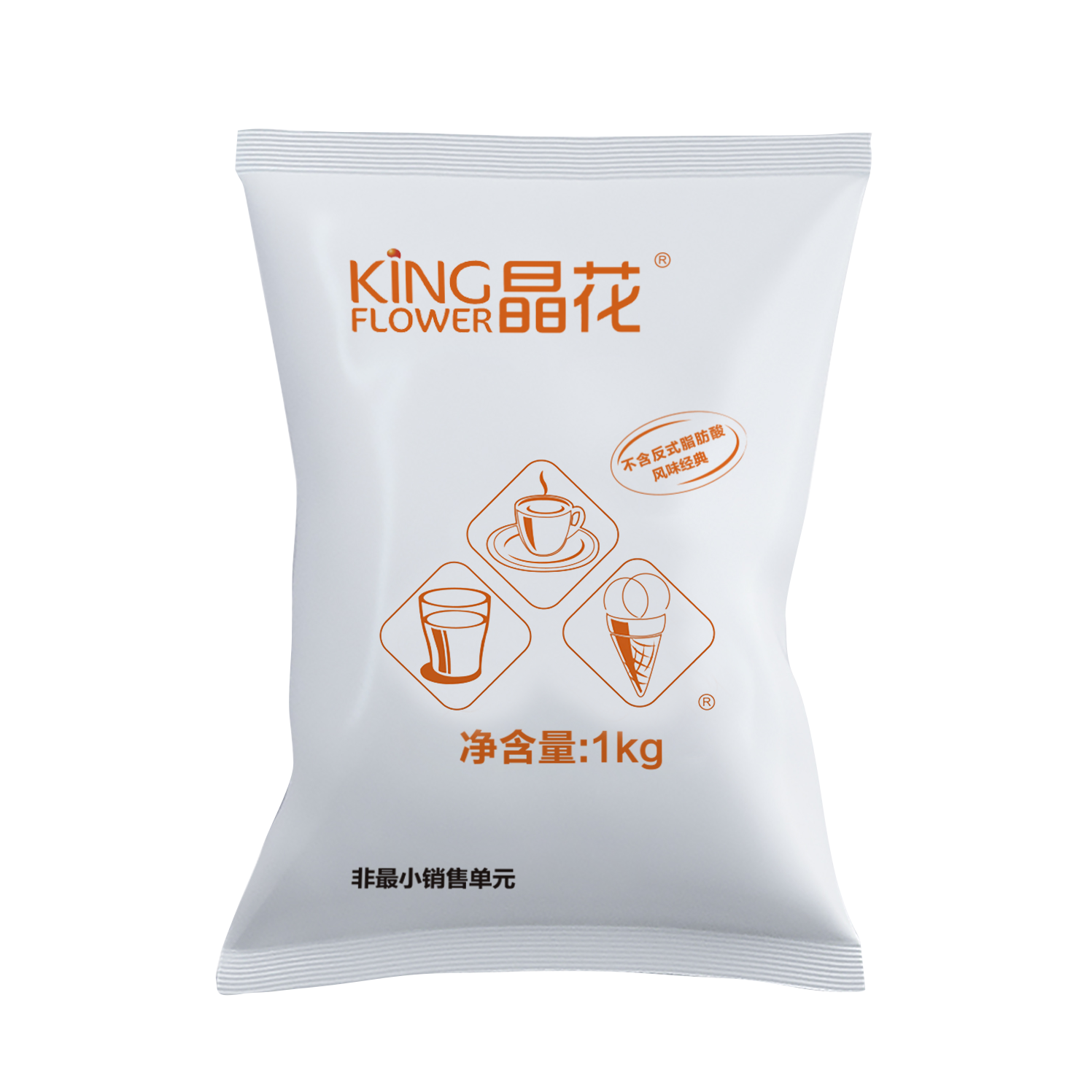
Pack format is part of the specification: a certified scope that names 25 kg packing does not automatically cover other pack sizes.
Certificates: Read the Scope and the Expiry
Certification is the part of a capability file most often reduced to a logo row, and the part where scope and date carry the real information. Three documents illustrate the point.
- Quality management system. Certificate 00125Q32624R1M/3200, issued by CQC under ISO 9001:2015, covers the quality management system of Nantong Jiazhiwei Food Co., Ltd., issued 2025-04-24 and valid to 2028-05-04.
- U.S. facility registration. FDA Food Facility Registration number 13348058524, issued through Registrar Corp, is recorded as valid to 2026-12-31 — a date that falls inside the current buying cycle and should be confirmed as renewed before any shipment crossing that date.
- Kosher. Certificate KC#529705-1 from KOSHER AUSTRALIA PTY LTD names non-dairy creamer model K80 in 25 kg packing, batch JW26558, production date 2026-03-11, issued 2026-03-22 and valid to 2027-04-01.
The kosher document is the clearest illustration of why scope language matters. It certifies a model, a pack size and a batch — not the whole catalogue. A buyer sourcing K80 can rely on it within those terms; a buyer sourcing FC22 or S35 cannot, and would need to establish whether a kosher claim is available for those models separately. The same discipline applies to the broader system list the company reports, which includes ISO 9001, HACCP, HALAL and environmental and occupational health and safety systems: names describe systems, while certificates describe a scope and a period.
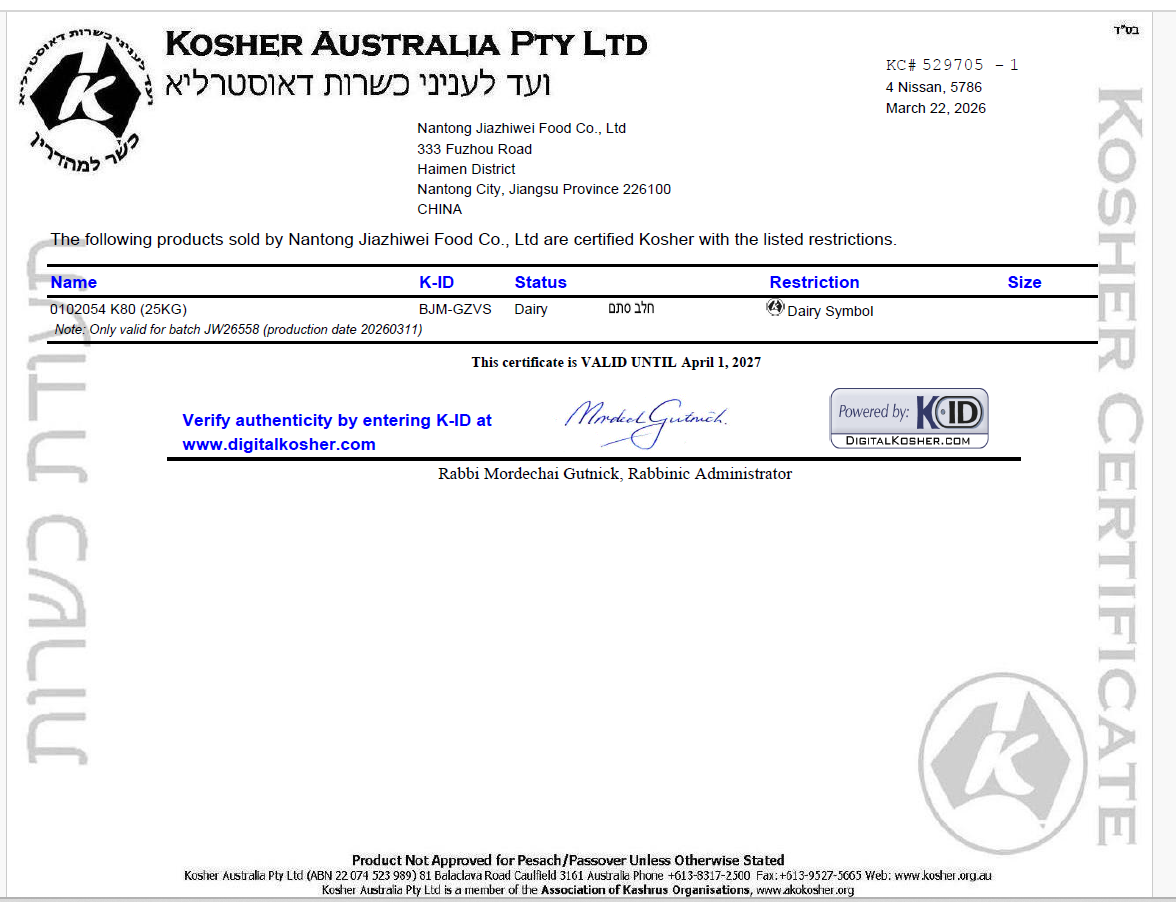
A certificate is evidence only within its stated scope: model, pack size, batch and validity period.
Market Context, Used Directionally
The category context supports the case for application-specific sourcing, but only in directional terms. The Good Food Institute reports that plant-based milk and creamer saw continued growth in U.S. foodservice and are established categories there — a qualitative demand signal, not a volume figure. On the composition side, the Market.us finding that medium-fat creamer held 43.6% of the market in 2024 explains why a model positioned at 22.0 g/100 g fat sits in the commercial mainstream rather than at an edge.
Market-size estimates should be handled with more caution than they usually receive. Three commercial research providers place the global market at approximately USD 2.4 billion in 2024, USD 2.61 billion in 2025 and USD 2.88 billion in 2025, with different forecast endpoints and growth rates ranging from 6.2% to 8.00%, and with product definitions and methodologies undisclosed in the available summaries. Those figures cannot be averaged into a consensus, and no single one should be used as a headline. For a buyer, the usable conclusion is narrower: demand is being reported as expanding across independent sources, which supports category commitment, while the exact size of the category is not established by any of them.
Where the Portfolio Argument Stops
Four boundaries deserve to be written into the evaluation file rather than discovered later.
- Portfolio breadth is not application performance. None of the documented figures establish how a model behaves in a specific matrix. A trial on the buyer's own formulation remains the only basis for a performance decision.
- Certificates do not travel across models. The kosher scope names K80 and a pack size; the quality system certificate covers a legal entity's system, not a product-by-product guarantee.
- Capacity is a capability, not a reservation. Stated monthly capacity and lead time describe what the plant can do; they do not commit a specific volume to a specific buyer on a specific date.
- Negotiable means unfixed. Where MOQ, delivery terms, acceptance criteria and payment terms are all negotiable, the buyer's protection comes from the written order, not from the catalogue.
What to Expect Next
The direction of travel in this category is toward specification-level sourcing. As buyers in coffee, milk tea, bakery, beverage and specialty nutrition briefs move from category purchases to model purchases, the supplier's portfolio stops being a marketing asset and starts being a documentation obligation: a parameter sheet per model, a certificate scope per claim, and a change-control route per customization. Cograin's seven-model range is a workable example of that shift, because the models exist for functional reasons that can be tested. Whether the documentation holds at the buyer's own bench is a question only a sample and a signed acceptance clause can answer — and that is the correct next step for any portfolio, from any supplier.
Company information, model specifications and the full product range are published by Cograin at www.cograin.cn, and the consolidated product brochure is available for download: 2025 Cograin Brochure.
FAQ
What does a seven-model non-dairy creamer range actually demonstrate about a supplier?
It demonstrates that the supplier can hold several distinct functional specifications in production at once — foaming (FC22), protein-free vegan (S35), cold-soluble, low-sugar (DT35), whipping (C960), high-fat (60A) and kosher-certified (K80) — each with its own parameter set, packaging configuration and, where a claim applies, its own certificate scope. It does not demonstrate that any model will perform in a given formulation, that certificates are current, or that capacity is free on a chosen date. The portfolio is an entry point to verification: the buyer still needs a per-model specification sheet, a stated test method, a certificate copy and an application trial.
How can a buyer verify a stated figure such as FC22 moisture or 22.0 g/100 g fat?
Request the model specification sheet, confirm whether each figure is a maximum, minimum or typical value, and ask which method and sampling plan produce it. For FC22 the documented record states moisture ≤6.0%, fat 22.0 g/100 g and trans fat 0 g/100 g. Because moisture is expressed as ≤, it is an acceptance limit rather than a typical result, so it should be written into the order as a limit with a method attached and checked at goods-in. Fat and trans fat values should be confirmed against a third-party test report for the delivered batch, since a declaration and a measured result are different documents.
Which purchasing terms should be fixed in writing before the first production run?
MOQ, delivery terms, acceptance criteria and payment terms are all negotiable and set per order, so none of them is established by the catalogue. Before production, a buyer should convert the model specification into acceptance criteria with parameter, limit, method and sampling frequency; name the certificate set required at shipment with its expiry dates; record the pack format and net weight; and agree how a formula change is notified and re-approved. Lead time is stated as around 7–15 working days after order confirmation, which starts at confirmation rather than at enquiry.
How should certification documents be weighed in supplier qualification?
By scope and by date. The ISO 9001:2015 certificate 00125Q32624R1M/3200 issued by CQC covers the quality management system of Nantong Jiazhiwei Food Co., Ltd. and runs to 2028-05-04. The FDA Food Facility Registration 13348058524 runs to 2026-12-31. Kosher certificate KC#529705-1 from KOSHER AUSTRALIA PTY LTD names model K80 in 25 kg packing, batch JW26558, production date 2026-03-11, valid to 2027-04-01 — a scope that does not automatically extend to other models. Each expiry must fall after the planned shipment date, and the set should be re-checked at each order.
Can a creamer formula be customized without losing the documented specification?
Customization is offered across creamer formula, syrup DE value, packaging specification and product flavor. A customized formula is a new product identity, so it needs its own parameter sheet, its own acceptance criteria, its own batch record and, where a claim such as kosher or vegan is involved, its own certificate review. The practical test is whether the supplier issues a revised, controlled specification for the customized version. Without that document, the performance figures recorded for the original model should not be assumed to carry over, and the customized batch should be treated as untested.
¿Tiene preguntas o necesita más detalles?
Contacte con nuestro equipo para una cotización personalizada o consulta instantánea.
Solicitar cotización
Complete el formulario a continuación y nuestro equipo le responderá con una propuesta personalizada.
Chat directo de WhatsApp
¿Prefiere chatear en tiempo real? Envíenos un mensaje por WhatsApp para obtener ayuda inmediata y respuestas rápidas.
- Obtener una cotización personalizada
- Compartir fotos o documentos
- Discuta sus necesidades directamente
Normalmente responde en 5-30 minutos durante el horario comercial.