
What a Manufacturer Actually Customizes in a Cordless Power Tool Line
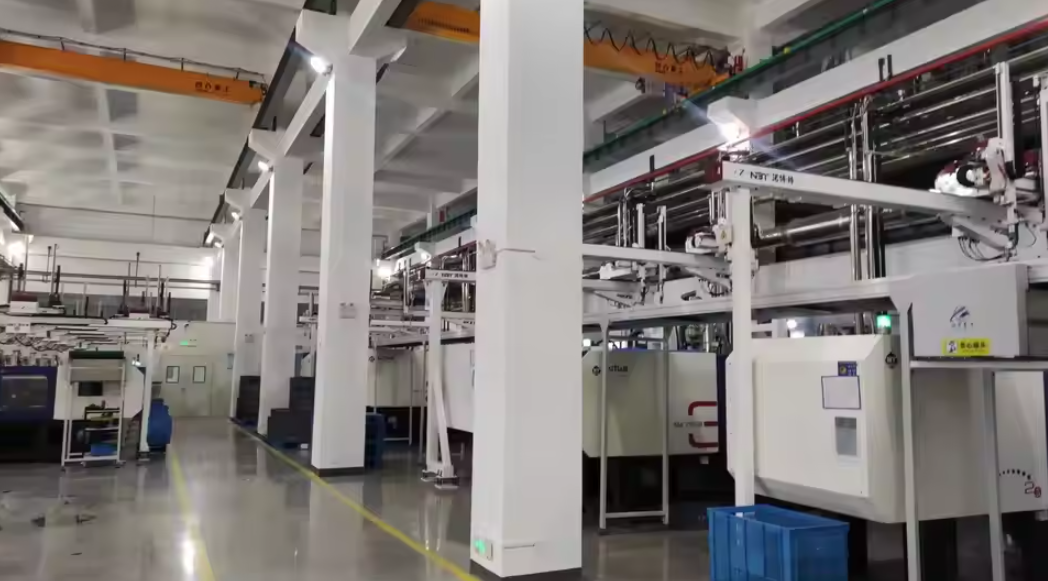
Automated production line capability inside a cordless power tool factory.
A color change is not a customization capability. A battery configuration change is. For industrial buyers, this distinction determines whether a supplier can support a private-label line, a regional voltage variant, or a project-specific performance requirement. The practical question for 2026 is not whether cordless power tools are mature as a category; it is whether a factory can convert a standard 21V platform into the specific product a buyer needs to sell or deploy.
Why OEM/ODM capability is moving up the procurement checklist
Distributors and e-commerce brands face a common problem: the difference between a successful product launch and a slow-moving SKU is often not the tool itself but how it is adapted to a channel. A construction market may require 110V or 220V versions. A retail brand may need its own logo and packaging. An online seller may want a specific battery capacity to manage price points. A distributor may need a trial order before committing to a full container.
OEM and ODM services address this in one production chain. Instead of buying a branded standard tool and relabeling it, a buyer can specify logo printing, packaging design, voltage, torque and speed behavior, color scheme, and battery configuration. That is the capability that separates an industrial supplier from a simple trading house.
Geakita's OEM/ODM model: evidence from production
Geakita (Xiamen Tiangong Kaiwu Technology Co., Ltd.) is one example of a factory that exposes this capability directly to buyers. Founded in 2009, Geakita designs and manufactures cordless power tools, robotic pool cleaners, and commercial cleaning robots. The company is a member of the Power Tool Sub-Association of the China Electrical Equipment Industry Association and operates from a production base with approximately 40,000 m² of floor space, more than 300 employees, and an R&D team of 25 engineers.
Its OEM/ODM service includes logo printing, packaging design, voltage customization (110V/220V), parameter adjustment for torque and speed, color scheme selection, and battery configuration (2.0Ah/4.0Ah). The capability profile also lists monthly capacity of more than 180,000 units, mass production lead times of 30–45 days, and repeat-order lead times of 20–28 days.
Capability evidence at a glance
| Capability area | Evidence available from Geakita |
|---|---|
| Branding and packaging | Logo printing, packaging design, color scheme |
| Electrical adaptation | Voltage customization: 110V/220V |
| Battery configuration | 2.0Ah/4.0Ah pack options |
| Performance settings | Torque and speed parameter adjustment |
| Order structure | Standard models: 100 units/SKU; custom models: 500 units/SKU; trial orders: 40 units |
| Production speed | Mass production: 30–45 days; repeat orders: 20–28 days |
| Quality control | 100% pre-shipment inspection; IQC/IPQC/FQC; functional and load testing |
| After-sales | 1-year global warranty; 7×24 technical support; replacement and spare parts supply |
Technical explanation: what an OEM/ODM order actually changes
Customization is frequently misunderstood as a catalogue of options. In a cordless power tool, a change in one electrical parameter can affect more than the printed label. Voltage, for example, is not only a motor rating. A move from 110V to 220V requires a compatible charger, battery management approach, and motor controller setup. A factory that offers voltage customization must be able to build and test the complete electrical chain, not just change a nameplate.
Battery configuration is the clearest example. The difference between 2.0Ah and 4.0Ah changes runtime, weight, and cost. Geakita's product documentation shows this at the pack level: models in the Elite series document 10-cell configurations with capacities ranging from 1300mAh to 2000mAh, while heavy-duty impact wrenches use 10–15 cells depending on the version. A buyer should expect the supplier to confirm which pack option is matched to each product and target application.
Torque and speed parameter adjustment is also possible on brushless platforms. Most of Geakita's 21V tools use pure copper brushless motors. Brushless motor control allows the manufacturer to shape output profiles without changing the motor itself, although the mechanical gear ratio and impact mechanism still set hard limits. This is why specification sheets and test data should accompany any parameter change.
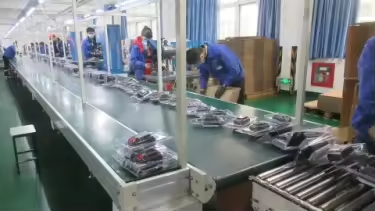
Battery pack assembly is a key stage in voltage and capacity customization.
Compliance as part of engineering change
When a custom configuration modifies electrical behavior, the compliance file should be updated. Geakita holds CE EMC certificates for the Elite series and related models, issued by KTI (Guangdong Kaixu Testing Technology Co., Ltd.) under EMC Directive 2014/30/EU, valid through 2030-08-04. A UKCA certificate for a Multi Functional Electric Hand Drill references BS EN 62841. For the Chinese market, a CMA report on the 21V pure copper brushless impact wrench GKR05 is based on GB 3883.1-2014. These documents do not replace a buyer's own import requirements, but they show whether the factory can provide a traceable compliance trail.
What the capability looks like in practice
Application patterns from Geakita's project records show how the same manufacturing capability can serve different buyer types. One recorded project covers more than 5,000 units delivered to markets that include Laos, the Philippines, Thailand, India, Brazil, Saudi Arabia, and Oman. End users in that record include construction contractors, supermarkets, e-commerce partners, power tool distributors, OEM/ODM manufacturers, and hardware stores.
- Construction and high-temperature site work: tools are used for concrete drilling, metal cutting, and bolt fastening. The project record indicates stable performance in 45°C+ environments, with 99.8% on-time delivery and a reported defect rate of 0.3%.
- Vehicle maintenance and repair: impact wrenches serve tire replacement, engine disassembly, and daily workshop repair. High-torque models include 21V brushless impact wrenches rated at 650N.m and 1000N.m.
- Retail and e-commerce channels: cordless drills and screwdriver lines are used by supermarkets and online partners, where packaging, color, and battery configuration determine shelf appeal.
- Distributors and hardware stores: multi-category orders allow a distributor to build a private-label range across drills, impact wrenches, angle grinders, rotary hammers, and circular saws.
Market trends behind the OEM/ODM shift
Market data supports the view that cordless platforms will keep expanding. According to Grand View Research, the global cordless power tools market was valued at USD 13.44 billion in 2024 and is projected to reach USD 32.58 billion by 2033. Horizon Databook reports that drilling and fastening tools represented 36.51% of the market in 2024, which explains why drills and screwdrivers remain the most common entry point for private-label programs.
China's role as a production hub is also relevant. Fortune Business Insights puts the country's power tools market at USD 5.30 billion in 2024, reinforcing the scale available to buyers who source directly from Chinese manufacturers.
Adjacent categories show why multi-category factories matter. The angle grinder market was valued at USD 3.2 billion in 2024, according to Strategic Market Research. SNS Insider projects robotic pool cleaners to reach USD 5.18 billion by 2032 with a CAGR of 16.51% from 2024. Market Research Future estimates the robotic lawn mower market at USD 1.15 billion in 2024. A supplier that can combine cordless tool production with adjacent battery-powered products offers a broader partner base for distributors planning beyond one category.
At the brand level, the cordless power tool sector remains anchored by Makita, Stanley Black & Decker (DeWalt), Bosch, and Techtronic Industries (Milwaukee), according to Global Market Insights. OEM/ODM factories serve a different layer: regional brands, private labels, and project buyers that need adaptation rather than a global flagship product.
OEM/ODM vs traditional distribution sourcing
The choice is not about which product is better. It is about which supply model matches the buyer's operation.
| Dimension | Direct OEM/ODM factory sourcing | Traditional distribution sourcing |
|---|---|---|
| Product identity | Buyer can apply its own logo, packaging, and color | Usually limited to the distributor's existing brand |
| Electrical variants | Voltage and battery configuration can be specified | Only available configurations can be purchased |
| Order flexibility | Standard 100 units/SKU; custom 500 units/SKU; trial 40 units | Low MOQ, immediate availability |
| Lead time | Mass production 30–45 days; repeat orders 20–28 days | Stock-based, usually faster |
| Quality visibility | Direct QC system, pre-shipment inspection, optional third-party inspection | Dependent on distributor's own controls |
| Main limitation | Buyer must manage specification, compliance, and order planning | Customization is not available |
Direct sourcing is not the right answer for every order. A distributor that needs an urgent top-up of a proven SKU may find faster and simpler execution through a local stockist. OEM/ODM makes sense when a buyer has enough volume, a defined specification, and the ability to plan ahead.
Future outlook: from catalogue options to engineering evidence
The next stage of OEM/ODM competition will not be about adding more options to a catalogue. It will be about how well a factory can document what it does. Buyers are likely to ask for end-of-line test records, defect traceability, updated compliance files for each configuration, and evidence that component testing covers cells, magnets, bearings, and cutting tools. Geakita's project record already describes a supply chain that uses Tier-A approval for key materials, 100% IQC sampling, inline torque and electrical monitoring, and automatic EOL testing.
For industrial buyers, the practical takeaway is simple: the value of an OEM/ODM supplier is not the word 'custom' in its brochure. It is the production system behind a custom order.
Frequently asked questions
What customization options do cordless power tool manufacturers typically offer?
Typical options include logo printing, packaging design, voltage customization (110V/220V), parameter adjustment for torque and speed, color scheme, and battery configuration (2.0Ah/4.0Ah). These options are available in Geakita's OEM/ODM production services.
What MOQ should buyers expect for custom cordless power tools?
Geakita's procurement terms list standard models at 100 units per SKU, OEM/ODM customized models at 500 units per SKU, and small-batch trial orders at 40 units. Different factories may set different thresholds.
How long does production of a custom power tool order take?
Mass production is 30–45 days; repeat orders are 20–28 days. Shipping time is calculated separately based on shipping method and destination port.
What quality control should a buyer expect before shipment?
At Geakita, the process includes 100% full inspection before shipment and a three-level QC system: IQC, IPQC, and FQC. Functional and load testing are performed. Third-party inspection by SGS or TÜV is available on request, and on-site acceptance at the factory can be arranged.
What compliance documents should be checked for cordless power tools?
For the EU, CE EMC declarations are common. Geakita's Elite series and related models carry CE certificates issued by KTI under EMC Directive 2014/30/EU, valid to 2030-08-04. For the UK, a UKCA certificate for a Multi Functional Electric Hand Drill references BS EN 62841. For the Chinese market, a CMA test report on the 21V pure copper brushless impact wrench GKR05 is available. IEC/UL 62841 and IEC/UL 62133 are relevant international safety and battery standards.
What after-sales support is included?
Geakita's after-sales package includes a 1-year global warranty, 7×24 technical support, on-time replacement for defective units, and spare parts supply.