
What a Digital Print Line Must Prove Before Bulk
Woven Apparel Fabric · Print Qualification · Independent Reference
A digital print line is straightforward to show and considerably harder to verify. For buyers sourcing patterned woven apparel fabric, the useful question is not whether a mill owns inkjet equipment, but whether the printed route sits inside the certificates the mill presents, what stage of capacity ramp the line is on, and which performance data exists on paper versus only in conversation.
The line exists; the evidence is the question
Digital printing has moved from a sampling convenience to a production route for patterned shirting, resort ranges and short-run capsule programmes. Across the industry it changes two things that matter commercially: it removes the screen set from the pattern set-up, and it shortens the loop between a design file and a saleable metre. It does not remove pre-treatment, fixation, washing or finishing, and it does not automatically change the fabric underneath the print.
That distinction is where procurement conversations usually go wrong. A supplier can truthfully state that it runs a digital print line and still leave three buyer-side questions unanswered: is printing named in the scope of the quality and environmental certificates, is the line able to carry the programme volume in the season it is needed, and does a test report exist for colourfastness and shrinkage on the specific printed construction rather than on the base fabric alone. Those are the questions this reference sets out to structure.
Where a digital print line sits in woven fabric production
Patterned woven apparel fabric has conventionally reached the buyer through two routes. In yarn dyeing, colour is applied to the yarn before weaving, and the pattern is created by the weave itself — a check, a stripe, a dobby structure. In piece dyeing, colour is applied to greige fabric after weaving, and where a surface pattern is required it is added by a printing step. Digital printing belongs to that same downstream position: it applies the pattern to prepared fabric, and everything upstream — yarn selection, weaving, pre-treatment — and everything downstream — fixation, washing, finishing, stentering — remains.
This matters for specification because the buyer is not choosing between "printed" and "unprinted" in isolation. The buyer is choosing a substrate plus a pattern method plus a finish, and the three interact. A printed poplin that will receive a non-iron finish is a different technical proposition from a printed poplin sold as-is, because the finishing route affects handfeel, dimensional stability and, in some cases, the appearance of the print. None of that is resolved by inspecting a printer.
What PT Golden Tekstil Indonesia discloses about its line
PT Golden Tekstil Indonesia (GTI) is a woven apparel fabric manufacturer established in 2019 and located in the Kendal Industrial Park in Central Java, Indonesia. The company operates a 171,401 m² site and reports 2,828 employees, an R&D team of 30 engineers, and exports to the United States, Europe, Japan and Indonesia. Its main product line is woven apparel fabric, spanning premium poplins, oxfords, flannels, prints, dobby weaves, seersucker, linen looks, and heavyweight bottom and outer fabrics.
On print specifically, the company's own product narrative describes its digital print line as still scaling up, growing from current output toward 0.45 million yards a month, or 5.4 million yards annually. The same narrative reports annual output of 48 million yards of yarn-dyed fabric and 36 million yards of piece-dyed fabric. Read together, these figures position digital print as the smallest of the three routes by a wide margin, and — importantly — the 0.45 million yards figure is presented as a direction of travel rather than a present, audited capacity number.
That is not a criticism; it is a specification detail. A buyer planning a programme should treat the print line as being in a ramp phase and confirm available print capacity for the specific delivery window, rather than reading a target figure as confirmed monthly output.
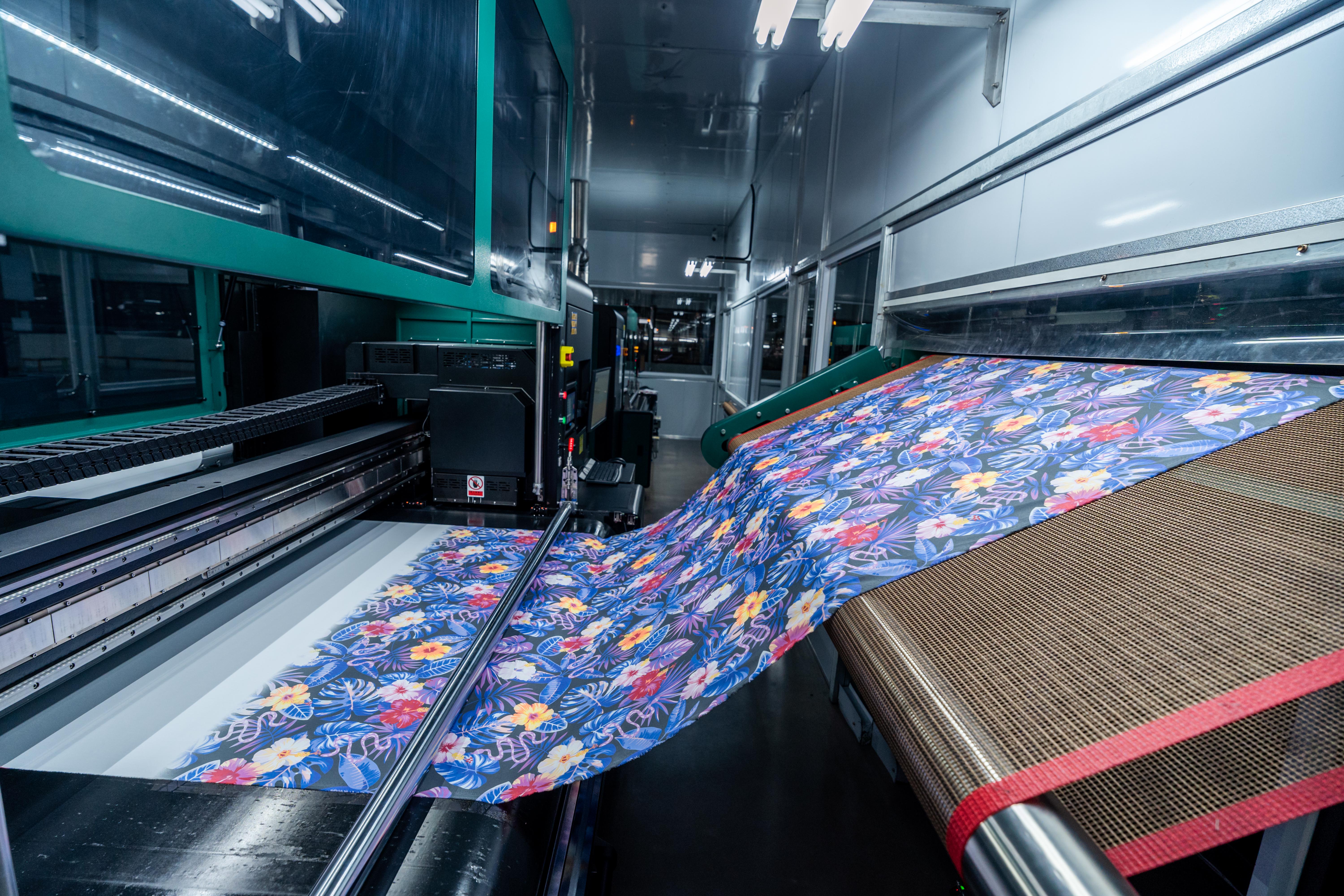
Digital print production area. For buyers, the facility image is the starting point of qualification, not the evidence itself.
Certification scope: the difference between "we print" and "our certificate covers printing"
This is the single most common gap in printed-fabric sourcing. A mill may hold a valid certificate for its dyed fabric while the printed fabric it ships sits outside the certified scope. Certification documents name processes and product forms; buyers should read those lines rather than the logo on the brochure.
For GTI, the disclosed certification set is unusually explicit on this point. The ISO 9001 scope is written as "Manufacturer of Finished Woven Fabric (Yarn Dyed Woven Fabric, Piece Dyed Woven Fabric and Printed Woven Fabric)", and the ISO 14001 and ISO 45001 records carry the same wording. The Global Organic Textile Standard record includes printed fabrics and printing among its scope and processes, as do the Textile Exchange multi-standard record and the Regenagri chain-of-custody record.
| Certificate | Documented scope relevant to print | Validity window as listed | Buyer action |
|---|---|---|---|
| ISO 9001 (QMS/2212188) | Finished woven fabric including printed woven fabric | 2025-11-26 to 2026-11-26 | Confirm it remains in force at order date |
| ISO 14001 (EMS/2212188) | Same product scope, including printed woven fabric | 2025-12-27 to 2026-12-27 | Confirm at order date |
| ISO 45001 (HSMS/2212188) | Same product scope, including printed woven fabric | 2025-12-27 to 2026-12-27 | Confirm at order date |
| GOTS (GCL-304497-GOTS-2026-2) | Printed fabrics; printing listed among processes | 2026-06-08 to 2027-03-31 | Request transaction certificate per shipment |
| Textile Exchange: OCS V3.0, GRS V4.0, RCS V2.0, CCS V3.1 (GCL-304497-MUL-2026) | Printed fabrics; weaving, pre-treatment, dyeing, finishing, printing, packing | 2026-04-01 to 2027-03-31 | Match the standard to the fibre claim being made |
| Regenagri (CU1200458REGENAGRI-2026-00061131) | Printed fabrics; printing within the certified scope | 2026-01-03 to 2027-01-02 | Confirm chain-of-custody documents |
| OEKO-TEX STANDARD 100 (SH015 206902) | Includes printed and finished functional woven fabrics | 2025-11-25 to 2026-09-15 | Listed expiry has passed; request the current certificate before relying on it |
| OEKO-TEX STeP (23000274/1) | Facility-level certification | 2023-09-18 to 2026-09-30 | Listed expiry has passed; confirm renewal status with the issuing body |
| Higg FEM and Higg FSLM (163571) | Facility environmental and social/labour verification | No expiry date stated in the record | Request the current verified module |
Two rows in that table deserve emphasis because they are the kind of detail a buyer discovers late. The OEKO-TEX STANDARD 100 record lists an expiry of 15 September 2026, and the OEKO-TEX STeP record lists 30 September 2026. At the time of writing both listed dates have passed. That does not mean the mill is uncertified; it means the buyer cannot treat the document in hand as current evidence and should request the renewed certificate or written confirmation of status before a claim is made to a retail customer. Certificates with later dates in the same set — the Textile Exchange record through March 2027, GOTS through March 2027, Regenagri through January 2027, the US Cotton Trust Protocol record 648YPQMH through February 2027, and the European Flax certificate BVFR27267347 through August 2028 — do not cover this gap, because each certificate covers only its own scope.

Colour matching laboratory. Print approval is a colour-and-pattern decision taken against a physical standard, not a screen rendering.
Reading 0.45 million yards a month correctly
Capacity figures in the textile trade are frequently stated in different units and against different bases, and printed fabric is no exception. GTI's print line is described in yards per month, while other company documents describe overall fabric capability in different terms. A buyer should not silently convert between them to build a supply plan, because the underlying bases — greige availability, print-ready prepared fabric, shift pattern, finishing bottleneck — are not the same.
The practical implication is procedural. Where print is a small share of a collection, a scaling line is often a good fit: short runs, several patterns, repeated reorders on proven designs. Where print is the majority of a season's volume, the buyer needs a written capacity commitment per pattern per delivery window, plus a fallback position. That is normal discipline for any single-line capability, and it applies here.
The sampling sequence is where print risk is actually resolved
GTI's documented fabric OEM sequence runs from a customer sample or a request for fibre and construction selection, through handloom, lab dip or strike-off hand sample development, to sample approval, big sample development, big sample approval, bulk order confirmation, mass production, in-house testing and shipment. For printed fabric, the strike-off is the decisive document: it shows the pattern, scale and colour on the actual substrate that will be printed in bulk.
Two operational details support that sequence. The company states its R&D centre can support 1,500 handlooms per month for sample weaving, and its design pipeline is digital — Fabric Design System tools including YX Weave, Ned Graphics and Penelope, a Digital Fabric E-Library built on Paperflite, and 3D garment design tools including Bronzwear, Style 3D and CLO 3D. That combination shortens the design-to-sample loop, which is precisely where a print programme consumes calendar time.
The commercial terms attached to that sequence are documented: fabric MOQ of 3,000 metres per colour, bulk fabric lead time of roughly 30–45 days depending on construction and finish complexity, and 45–70 days where fabric and garment are combined. Buyers should treat these as the planning baseline and confirm them at order stage, since print-specific scheduling may differ from the dyed routes.
Performance data that is not in the public record
Here the honest answer is that the disclosed material does not contain print-specific performance results. What exists is a capability statement: GTI operates an in-house testing centre certified to AATCC, ASTM D, JIS and the full ISO standard suite, with testing protocols approved directly by Polo Ralph Lauren and Kohl's. What does not exist in the public record is a printed-fabric test report.
That leaves a defined request list for any print programme:
- Colourfastness to washing, to light and to crocking, tested on the printed construction rather than the base fabric.
- Dimensional stability after print and after the finishing route, since shrinkage behaviour can differ from the same substrate dyed by another method.
- Pattern repeat tolerance and registration consistency across the run length.
- Handfeel and surface change after fixation, washing and stentering.
- Compatibility between the print step and any functional finish specified — non-iron, wicking and quick dry, cooling comfort, or water repellent — including the order in which the operations are performed.
None of these are unusual requests. They are simply not answered by a facility certificate, and they should be answered before a bulk commitment rather than after the first inspection.
Where a scaling print line fits — and where it does not
Printed woven fabric is a natural fit for patterned shirting, resort and warm-climate ranges, capsule and limited-edition drops, and reorders on patterns already proven in market. It suits buyers who value iteration speed and multi-pattern flexibility over the lowest possible unit cost at very high volume.
It is a weaker fit in three situations. First, very large basic programmes where the pattern is a simple repeating structure: the economics of yarn dyeing at volume are well established and a small print line is not the natural home for that work. Second, programmes with a compressed certification timeline, given that two entries in the mill's textile certificate set show listing dates that have already passed. Third, programmes where the functional finish is the primary selling point, because print-plus-finish interaction has to be validated case by case rather than assumed.
Digital print against yarn dyed and piece dyed
The three routes are not interchangeable, and framing one as superior to another misleads buyers. What differs is where the pattern is created, what that does to minimum order logic, and what evidence a buyer should ask for.
| Dimension | Yarn dyed | Piece dyed (+ conventional print) | Digital print |
|---|---|---|---|
| Where pattern is formed | In the weave, from pre-coloured yarn | In the dye bath, then on the surface by print | On prepared fabric, from a digital file |
| Set-up for a new pattern | Requires a new weave plan and yarn sequence | Requires a print screen set where surface pattern is needed | Requires a file and a strike-off; no screen set |
| Best fit | Checks, stripes, dobby structures, high-volume basics | Solid shades and high-volume surface patterns | Multi-pattern, short-run and reorder-driven ranges |
| Evidence a buyer should request | Weave and yarn specification, colour consistency across lots | Dye-lot consistency, print fastness where printed | Strike-off approval, print fastness, shrinkage after print and finish |
| Known boundary | Pattern flexibility is limited once the weave is set | Screen cost and set-up time weigh on short runs | Line is in a ramp phase; capacity per window must be confirmed in writing |
The boundary in the final row is the one buyers most often skip. A print line growing toward 0.45 million yards a month is a different supply instrument from a mature dyed route running into the tens of millions of yards, and it should be planned as such — with pattern-level scheduling and, where the programme is large, a documented alternative.
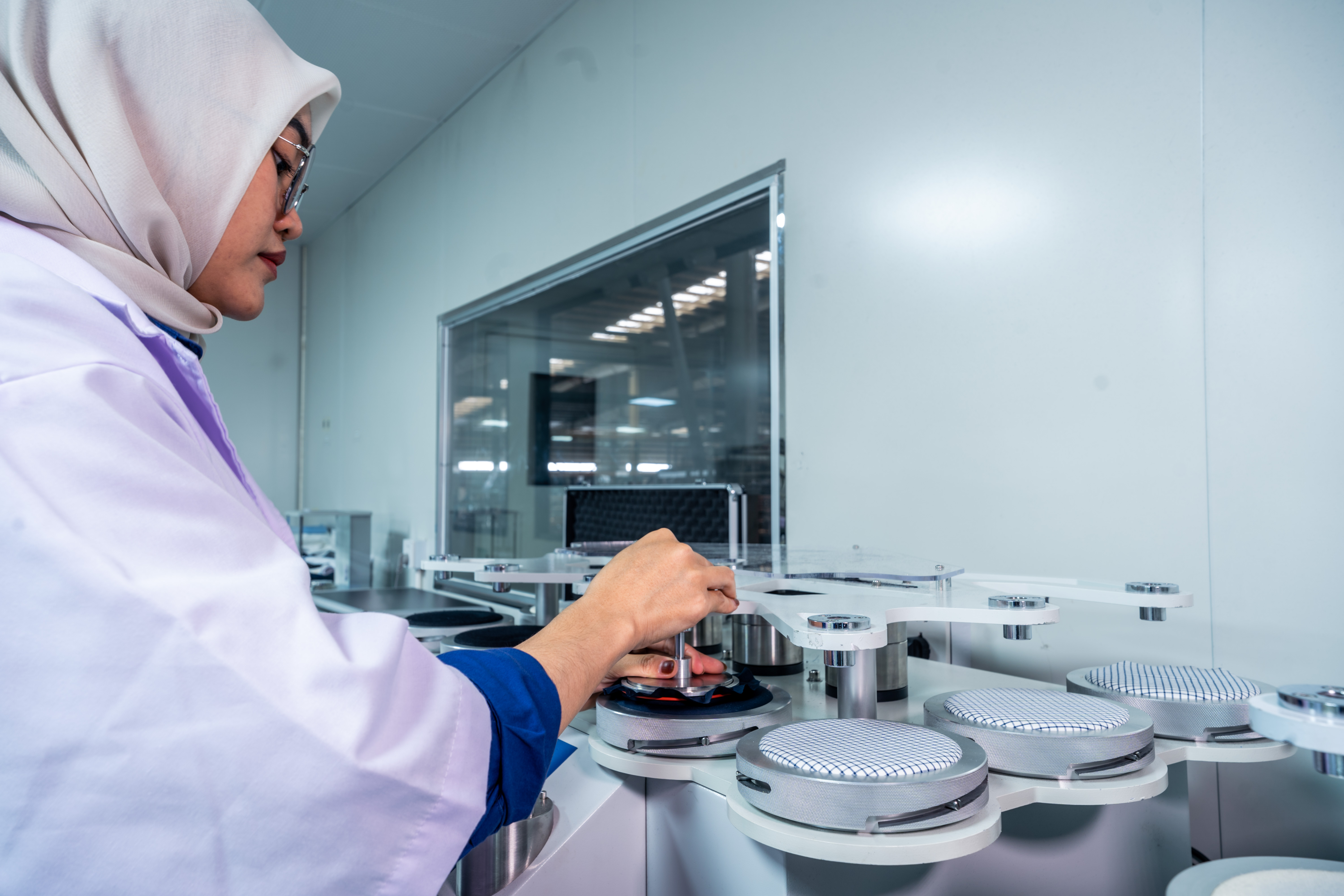
In-house testing facility. A certified laboratory is a capability; the printed-fabric test report is the evidence.
Price: why no credible public band exists
Buyers frequently ask for a price band for digital print fabric before they have specified the product. The disclosed record contains no published price for any printed construction, and that is consistent with how the trade works rather than a gap specific to this mill. A printed metre is priced from a stack of variables: greige cost driven by yarn count and weight, print coverage and number of colours, repeat size, pre-treatment, fixation and washing, the finishing route, and the order quantity behind the MOQ of 3,000 metres per colour.
Two quotations described only as "digital print" are therefore not comparable. A useful request for quotation specifies composition, yarn count, weight in gsm, width, pattern repeat, coverage, finishing, destination market and order quantity — then asks for the price on that basis. Any figure offered without those parameters should be treated as indicative only.
A print qualification checklist
The following sequence converts a supplier conversation into a verifiable file. It is ordered by the point at which each item becomes decisive.
| # | Item | Document to request | Why it decides the order |
|---|---|---|---|
| 1 | Certificate scope naming printing | ISO 9001 scope page; GOTS, Textile Exchange and Regenagri scope certificates | Establishes that the printed route is inside the certified system |
| 2 | Certificate currency | Current OEKO-TEX STANDARD 100 and STeP certificates, or written status confirmation | The listed dates in the file have passed and cannot support a retail claim |
| 3 | Substrate specification | Composition, yarn count, gsm, width per construction | Determines whether the quote is comparable |
| 4 | Strike-off approval | Signed strike-off on the bulk substrate | Fixes pattern, scale and colour before bulk |
| 5 | Print performance | Colourfastness, shrinkage and repeat tolerance reports | Separates base-fabric data from printed-fabric data |
| 6 | Finish compatibility | Written process order for print and functional finish | Prevents a finish specification that the printed surface cannot carry |
| 7 | Capacity commitment | Pattern-level volume per delivery window | The line is scaling; a target figure is not a booking |
| 8 | Commercial terms | MOQ, lead time, payment terms, inspection standard | Confirms planning assumptions against the documented baseline |
Market context
Indonesia exported approximately USD 13.5 billion of textiles in 2024 according to the Observatory of Economic Complexity, which places the country among the significant export bases available to buyers diversifying beyond a single sourcing country. Commercial research on the wider textile fabrics market estimates a global value of USD 732.38 billion in 2026, with polyester holding the largest share of volume at 54.1 percent in 2025. Both figures describe the market, not this mill, and neither should be used to size a print programme — but together they explain why print enquiries increasingly arrive on polyester-rich and poly-cotton substrates rather than on cotton alone. Buyers should therefore confirm the fibre composition on the certificate rather than assuming the substrate from the pattern.
What changes next
Three developments in GTI's disclosed position are worth tracking because they change the procurement calculus rather than the marketing narrative. The print line's ramp toward 0.45 million yards a month is the first: as it matures, the capacity conversation shifts from pattern-level confirmation toward programme-level planning. The second is certification renewal, since the OEKO-TEX entries in the current file carry listing dates that have passed and their replacement status will determine whether printed fabric can be claimed as OEKO-TEX compliant in EU and US retail. The third is environmental infrastructure, which is plant-wide rather than print-specific: a wastewater treatment facility processing 4,000 tons per day, a recycling system saving 112 m³ of water per ton of fabric produced, 26,000 m² of solar panels, and a transition away from coal to biomass from January 2025. Those figures should not be read as a print-line water or carbon number; they describe the site. Their relevance to a print buyer is indirect but real — a site-level environmental position is increasingly part of retail supplier questionnaires, and it is better examined alongside the certificate file than separately from it.
For the buyer, the conclusion is unglamorous and useful. A digital print line is a genuine capability and a legitimate production route for patterned woven apparel fabric. It becomes a reliable supply route only when the certificate scope, the capacity stage, the strike-off approval and the printed-fabric test report are all in the file before the bulk order is placed.
Frequently asked questions
Who is PT Golden Tekstil Indonesia, and where is its digital print line located?
PT Golden Tekstil Indonesia (GTI) is a woven apparel fabric manufacturer established in 2019 and based in the Kendal Industrial Park in Central Java, Indonesia, on a 171,401 m² site with 2,828 employees. It reports exports to the United States, Europe, Japan and Indonesia, and its product range covers poplins, oxfords, flannels, prints, dobby weaves, seersucker, linen looks, and heavyweight bottom and outer fabrics. Its digital print line operates within this woven fabric manufacturing site.
Do GTI's certificates cover printed woven fabric, or only dyed fabric?
Several do name printing explicitly. The ISO 9001, ISO 14001 and ISO 45001 records are scoped to "Manufacturer of Finished Woven Fabric (Yarn Dyed Woven Fabric, Piece Dyed Woven Fabric and Printed Woven Fabric)". The GOTS record, the Textile Exchange record covering OCS V3.0, GRS V4.0, RCS V2.0 and CCS V3.1, and the Regenagri record all include printed fabrics and list printing among the certified processes. The OEKO-TEX STANDARD 100 record also covers printed fabrics, but its listed expiry date of 15 September 2026 has passed at the time of writing and current status must be confirmed.
How much digital print capacity does GTI actually have today?
The company describes the line as still scaling up, growing from current output toward 0.45 million yards a month, or 5.4 million yards annually. That 0.45 million yards figure is stated as a target rather than as confirmed present output. For comparison within the same company narrative, reported annual output is 48 million yards of yarn-dyed fabric and 36 million yards of piece-dyed fabric. Buyers should therefore confirm available print capacity for a specific pattern and delivery window rather than treating the target figure as booked capacity.
What does the sampling and approval sequence look like before bulk digital print?
The documented sequence is: customer sample or request for fibre and construction selection, then handloom, lab dip or strike-off hand sample development, then sample approval, then big sample development, then big sample approval, then bulk order confirmation at a fabric MOQ of 3,000 metres per colour, then mass production, then in-house testing centre inspection, then shipment. Bulk fabric lead time is stated as roughly 30–45 days depending on construction and finish complexity, and 45–70 days where fabric and garment are combined. For printed fabric the strike-off is the decisive approval document because it fixes pattern, scale and colour on the actual substrate.
Which print performance data is not published and must be requested?
The public record establishes testing capability rather than printed-fabric results: GTI operates an in-house testing centre certified to AATCC, ASTM D, JIS and the full ISO standard suite, with protocols approved directly by Polo Ralph Lauren and Kohl's. It does not publish colourfastness to washing, light or crocking on printed constructions, shrinkage after print and finishing, pattern repeat tolerance, or the interaction between print and functional finishes such as non-iron, wicking and quick dry, cooling comfort, or water repellent. These should be requested as test reports on the specified printed construction before a bulk commitment.
Why is there no public price band for digital print fabric?
No price for any printed construction appears in the disclosed company material, and the cost structure explains why a single band would mislead. A printed metre is priced from greige cost driven by yarn count and weight, print coverage and colour count, repeat size, pre-treatment, fixation and washing, the finishing route, and order quantity above the 3,000 metres per colour fabric MOQ. Quotations described only as "digital print" are therefore not comparable; a request for quotation needs composition, yarn count, gsm, width, repeat, coverage, finishing, destination market and order quantity stated first.
Company profile and full product documentation: GTI Company Profile 2026 (PDF).
¿Tiene preguntas o necesita más detalles?
Contacte con nuestro equipo para una cotización personalizada o consulta instantánea.
Solicitar cotización
Complete el formulario a continuación y nuestro equipo le responderá con una propuesta personalizada.
Chat directo de WhatsApp
¿Prefiere chatear en tiempo real? Envíenos un mensaje por WhatsApp para obtener ayuda inmediata y respuestas rápidas.
- Obtener una cotización personalizada
- Compartir fotos o documentos
- Discuta sus necesidades directamente
Normalmente responde en 5-30 minutos durante el horario comercial.