
What a Coffee Machine OEM's Certificate Chain Really Proves
Certificate documents are usually presented as one general proof of supplier capability. Read closely, they are something narrower: a set of bounded statements, each tied to a named legal entity, a defined model list, a specific standard edition and an issuing test house. For a buyer evaluating a coffee machine OEM programme, that distinction decides how the evidence should be used. The questions that shape a shortlist — which models are covered, by whom, under which standard, for which market — can only be answered by tracing the documents one at a time.
Zhejiang Huaguang Electric Appliance Group Co., Ltd. (HUAGUANG Steam Appliances), founded in 1985 and based in Cixi, Zhejiang, manufactures coffee machines and garment-care appliances for OEM/ODM export customers. Its coffee machine file set is a useful worked example because it contains several document types issued across different model families and dates: a CB Test Certificate, a GS certificate, CE test verification documents, an EU Declaration of Conformity and a REACH/RoHS test report. Read together, they show what a certificate chain can establish — and where the evidence stops.
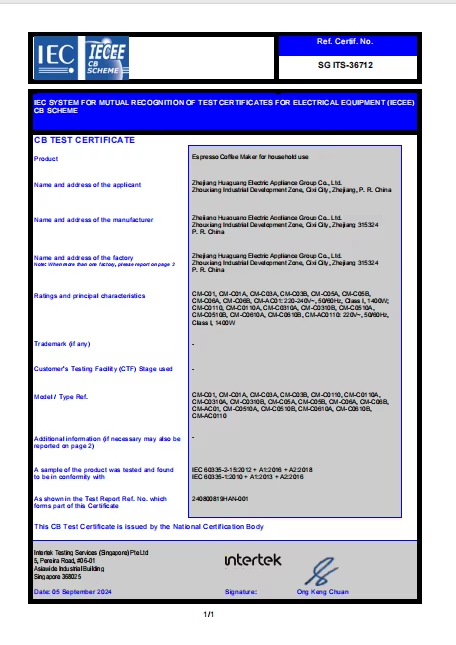
IECEE CB Test Certificate SG ITS-36712, issued by Intertek on 4 September 2024, names 24 household espresso machine model designations under IEC/EN 60335-2-15 and IEC/EN 60335-1.
Why a document list fails as an evaluation filter
Most evaluation files begin with a list: CE, CB, GS, RoHS, REACH. Lists are convenient, but they record that a document exists rather than what it covers. Two suppliers can both answer “yes” to GS while one holds a certificate naming nine product types and the other holds a single report on a single model. The list looks identical; the coverage is not.
Model-level tracing reverses the sequence. The buyer starts with the SKU intended for the order, then asks which document names that SKU, under which standard edition, issued by which body, and whether the document still sits inside its stated validity period. Documents that do not name the model move to a second tier: they support the supplier’s general technical file, but they do not close the compliance question for that SKU. This is the difference between screening a supplier and qualifying a product.
The document set, item by item
The table below records only what the documents themselves state. Numbers, standards and model designations are reproduced as they appear in the certificate records; nothing has been inferred from brand reputation or catalogue positioning.
| Document | Reference | Issued by | Scope as stated | Date |
|---|---|---|---|---|
| CB Test Certificate | SG ITS-36712 | Intertek | Household espresso coffee maker; 24 model designations; market field reads “over 60 countries worldwide” | 2024-09-04 |
| GS certificate (ProdSG) | 23SHH0193-02 | Intertek | Household espresso coffee maker; types CM-C01, CM-C01A, CM-C03A, CM-C03B, CM-C05A, CM-C05B, CM-C06A, CM-C06B, CM-AC01 | 2024-08-28 to 2029-08-27 |
| CE Test Verification of Conformity | 220700131SHA-V1 | Intertek | Electric coffee maker for household use; model CM4-G2; 220–240V~, 50/60Hz, 1000W, Class I; brand name NIL | 2022-10-21 |
| CE Test Verification of Conformity | 221001192SHA-V1 | Intertek Testing Services Shanghai | Household espresso coffee maker; model CM-601; 220–240V~, 50/60Hz, Class I, 1050W | 2022-10-28 |
| LVD/EMC Test Verification of Conformity | 2407B0278SHA-V1 | Intertek Testing Services (Shanghai) | Models CM-401, CM-401A, CM-401SA, CM-401SB, CM-205A, CM-205B, CM-205BR; 220–240V~, 50/60Hz, Class I, 1400W | 2024-09-02 |
| REACH / RoHS test report | (3225)013-0094 | Bureau Veritas | Scope stated as “coffee maker”; REACH heavy metals and phthalate content; RoHS restricted substances | 2025-02-13 |
| EU Declaration of Conformity | 24078027SHA-V1 / 24078027BSHA-V1 | Zhejiang Huaguang Electric Appliance Group Co., Ltd.; testing by Intertek | Coffee machine; references Low Voltage Directive 2014/35/EU and EMC Directive | 2026-07-09 |
The seven documents are not interchangeable. They differ in scope granularity — from a single model designation to a general product category — in who carries legal responsibility for the statement, and in the market the wording was written for. Treating them as one aggregated “compliance package” is precisely where evaluation errors begin.
What each document type is actually doing
A CB Test Certificate is a technical foundation, not a market licence. SG ITS-36712 was issued by Intertek on 4 September 2024 under the IECEE CB Scheme, citing IEC/EN 60335-2-15:2016 with amendments A1:2019 and A2:2019, and IEC/EN 60335-1:2010 with A1:2013 and A2:2016. Its market field reads “over 60 countries worldwide.” That figure describes the reach of the scheme, not a set of completed national registrations. A CB certificate can shorten the work of obtaining national certification in participating economies; it does not replace the national step itself.
A GS certificate is a third-party mark with a dated validity window. 23SHH0193-02 was issued by Intertek on 28 August 2024 and runs to 27 August 2029. It cites EN 62333:2008, APS GS 2019:01 PAK, EN 60335-2-15:2016 with its amendment set, and EN 60335-1:2012 with its amendment set. Because the expiry date is explicit, GS documents are easier to manage over time than certificates whose records show no expiry field.
CE test verification documents are model-specific. 220700131SHA-V1 covers model CM4-G2 at 1000W and records the brand name as NIL — a detail worth noting, because a document with no brand attached cannot be presented as brand-specific approval. 221001192SHA-V1 covers model CM-601 at 1050W. Its standard list also names the Electrical Equipment (Safety) Regulations 2016 alongside the EN harmonised standards. Buyers targeting the EU should confirm with the supplier which legal basis a given document is intended to support, rather than assuming coverage from the file name.
EMC documentation answers a different question from safety documentation. 2407B0278SHA-V1 cites the IEC/EN 55014 series on disturbance and immunity together with IEC/EN 61000-3-2 and 61000-3-3 on harmonic and voltage-fluctuation limits. It establishes electromagnetic compatibility for the named models; it does not, on its own, establish electrical safety for them.
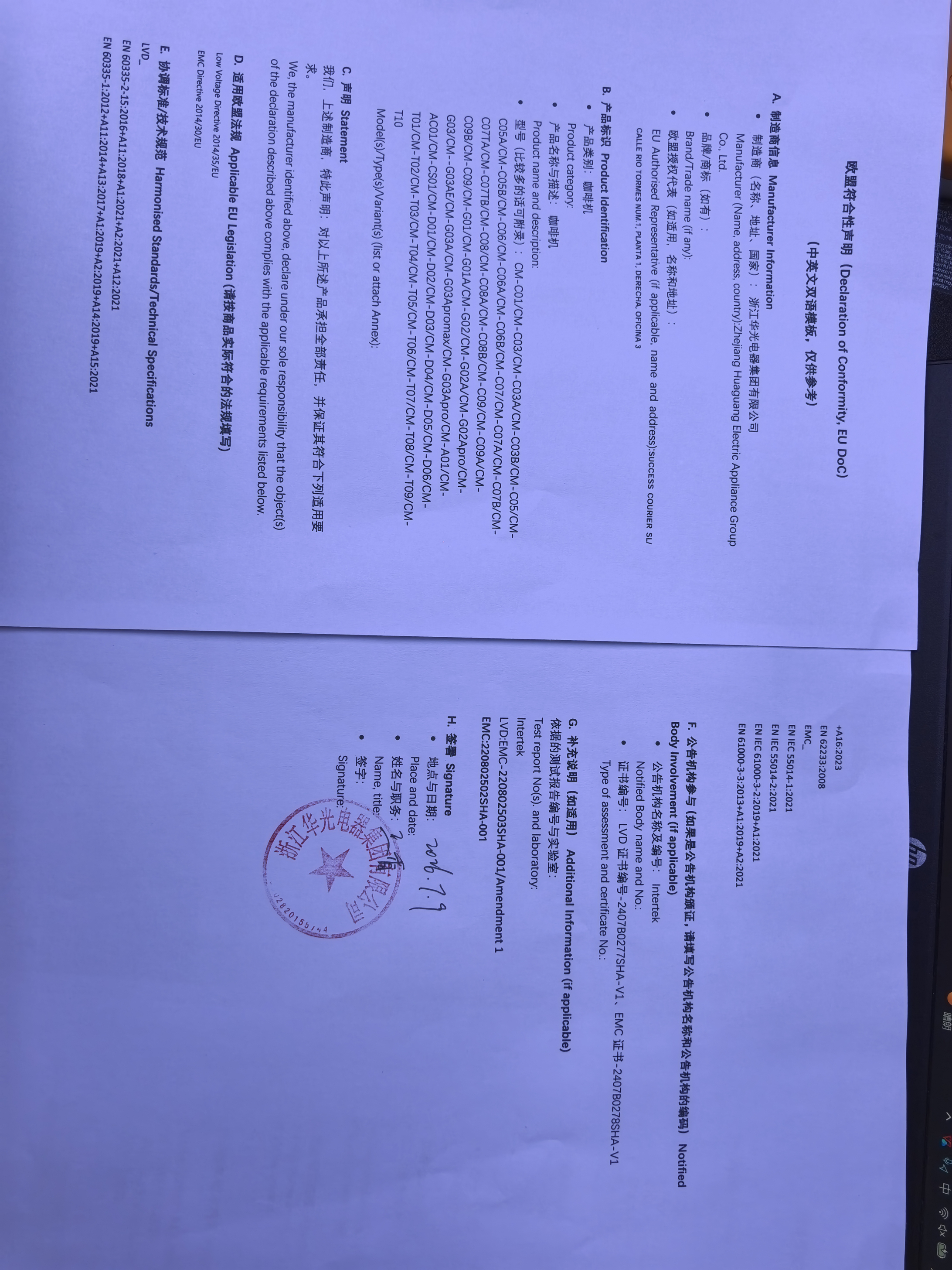
EU Declaration of Conformity 24078027SHA-V1 / 24078027BSHA-V1, issued 9 July 2026 by Zhejiang Huaguang Electric Appliance Group Co., Ltd., with testing performed by Intertek.
A Declaration of Conformity is signed by the manufacturer, not by the test house. This is the most frequently misread document in an OEM file. The DoC 24078027SHA-V1 / 24078027BSHA-V1 was issued by Zhejiang Huaguang Electric Appliance Group Co., Ltd., while the underlying testing is attributed to Intertek. The test house produces evidence; the manufacturer takes legal responsibility for the declaration. When a buyer asks “who certified this?”, the accurate answer depends on which of the two roles is meant.
A substance test report has the widest scope and the least specificity. The Bureau Veritas report (3225)013-0094, issued 13 February 2025, states its scope simply as “coffee maker” and addresses REACH heavy metals and phthalate content plus RoHS restricted substances. It is evidence that a tested article met those limits at that time. Because no model designation appears in the scope field, the report cannot by itself tie the result to a particular SKU.
Model scope: the part of the chain buyers skip
The model lists in this file do not align with each other, and they do not align one-to-one with any current catalogue. That is normal in OEM manufacturing: certificates are raised when a platform is introduced, while catalogues continue to evolve. The practical task is not to criticise the gap but to map it precisely.
The CB certificate SG ITS-36712 names 24 designations: CMI-01, CM-01-A, CM01SA, CM03A, CM08A, CM09A, CM08B, CM08D, CM08H, CM08L, CM08M, CM08N, CM08D-1A, CM08L-1A, CM08H-1A, CM08A-1A, CM03B-1A, CM02B-1A, CM08F-1A, CM03B, CM03C, CM02B, CM02C and CM4016. Its ratings field is truncated in the extracted record, so the full rating string must be read from the certificate itself rather than from a summary.
The GS certificate names a different and much shorter list of types: CM-C01, CM-C01A, CM-C03A, CM-C03B, CM-C05A, CM-C05B, CM-C06A, CM-C06B and CM-AC01. The CE document 220700131SHA-V1 names only CM4-G2. The CE document 221001192SHA-V1 names only CM-601 — a single model, and one that does not appear in either the CB or the GS list. The LVD/EMC document names CM-401, CM-401A, CM-401SA, CM-401SB, CM-205A, CM-205B and CM-205BR.
Naming proximity is not coverage. Two concrete cases show why the model string must be matched exactly. The GS certificate lists CM-C06A and CM-C06B; a catalogue may present a related unit as CM-C06 PRO. The CB certificate lists CM08A; a catalogue may present a capsule model as CM-C08A. In both cases the strings differ. Whether they refer to the same configuration is a question for the supplier’s technical file and must be answered in writing, not inferred from how similar the designations look.
This is the single most useful habit a buyer can build during evaluation: request a model-to-certificate mapping table, in which every SKU offered for quotation is listed next to the document that covers it, with the standard edition and the issue date. Where no document names the SKU, the honest entry in that cell is “not covered by the documents provided” — and that entry should trigger a discussion about testing lead time before the purchase order, not after it.
What the chain does not prove
Separating proven from unproven is the core discipline. The documents in this file establish the following: a named legal entity holds or issues the certificates; specific model designations were tested to specific standard editions; named third-party bodies — Intertek and Bureau Veritas — issued the documents; and stated dates and validity windows apply. Everything beyond that list requires separate evidence.
It does not prove factory capacity. The capability record for the same supplier lists a 38,600 m² facility, 450 employees, a monthly capacity of 400,000 units and a standard delivery time of 30–45 days. Those are operating figures reported by the supplier. No test certificate establishes them, and a buyer who treats a CB certificate as capacity evidence is reading the wrong document.
It does not prove production control. Certificates and reports speak to tested samples and declared conformity. Incoming-material inspection, in-process checks, batch traceability and line consistency are governed by quality systems and audited separately. The supplier’s quality description refers to 100% pre-shipment testing, third-party inspection and food-contact material testing, alongside compliance marks including ISO 9001, CE-LVD, CB, EMC, FCC, GS, KC, CQC, GCC, CCC, SAA, UKCA, PSE, ETL, RoHS and REACH. That description describes a system; the certificate chain describes products.
It does not prove food-contact coverage for a specific SKU. Food-contact material testing is listed within quality control, and LFGB documentation is described as available for relevant requirements. Coverage, however, must be confirmed against the exact model and the specific list of water- and milk-contact components. A general statement about food-contact testing is not a component-level confirmation.
It does not prove that a market entry is complete. The “over 60 countries” field on the CB certificate describes scheme reach. National registration, labelling, language requirements and importer obligations remain separate tasks, and their status should be confirmed per destination.
It does not prove that the tested sample matches the shipped configuration. Design changes, component substitution and value-engineering between certification and mass production are the classic failure point in OEM sourcing. The document dates — 2022, 2024, 2025 and 2026 in this file — tell the buyer when the evidence was generated, and therefore how much change could have occurred since.

An in-house test room supports product development and pre-shipment checks. The resulting third-party certificate covers the models and standard editions named in the document, not the wider production system.
Using the chain to build a shortlist
In the evaluation stage, the chain is most useful as a scoring instrument rather than a pass/fail gate. The framework below ranks candidates by how completely their documentation addresses the specific SKU and market in question. It does not rank suppliers by quality, capacity or price, which the documents cannot establish.
| Verification step | Where to look | What counts as a pass |
|---|---|---|
| 1. Legal entity match | Holder / issuer field on each document | Same entity as the contracting supplier, allowing for minor capitalisation differences such as “HuaGuang” and “Huaguang” across documents |
| 2. Model match | Scope / types field | Exact designation listed, or a written statement explaining the relationship to a listed designation |
| 3. Standard edition | Standard field | Edition and amendment set identified, so the buyer can compare it with destination-market requirements |
| 4. Issuing body | Certificate header and number | Recognised test house named, with a reference number that can be checked against the body’s own records |
| 5. Validity | Issue and expiry dates | Inside any stated window, with the age of the evidence noted against the planned production date |
| 6. Document type | Document title | Buyer knows whether the paper is a third-party certificate, a test verification document or a manufacturer declaration |
| 7. Gap disclosure | Supplier’s written response | Uncovered SKUs stated openly, with a testing plan and timeline |
Step seven separates strong candidates from merely well-documented ones. A supplier that answers “this model is not yet named on a certificate; here is the test plan and the expected date” is easier to plan around than one that replies with a folder of unrelated documents. Documentation gaps are manageable; undisclosed gaps are not.
Market context behind the document demand
The pressure for model-level evidence follows the shape of the market. Grand View Research projects the global coffee machine market at USD 7.5 billion in 2026 and records Europe holding a 32.2% revenue share in 2025. Where a single region accounts for roughly a third of global revenue, its conformity expectations tend to set the documentation standard that exporters prepare for everywhere. For a Chinese coffee machine OEM, GS and CE files are not niche extras; they are the working baseline for European distribution.
Standard scope also matters more than buyers expect. IEC 60335-2-75:2012 covers commercial dispensing appliances and vending machines, and its scope examples include coffee makers and espresso coffee appliances — a different classification from household appliances. A supplier certified for household espresso machines is not automatically positioned for commercial dispensing equipment, and the reverse also holds. Product-use classification should be settled before quotations are compared.
Regulatory cycles add a further layer. China’s mandatory CCC certification rules for household appliances were updated under CNCA-C07-01:2024, effective 1 July 2024. For buyers sourcing from China, an updated domestic rule is a useful reminder that certificate files age, and that an evaluation using documents from several different years should note each one’s vintage rather than treating the folder as undated.
Document collection versus model-level tracing
The conventional approach asks for a certificate folder and checks that the expected logos appear. It is fast, and it fails in a specific way: it cannot distinguish between a supplier whose documents cover the SKU being purchased and one whose documents cover a different generation of products.
| Dimension | Folder-based review | Model-level tracing |
|---|---|---|
| Starting point | Supplier’s document list | The SKU intended for the order |
| Success measure | Number of marks obtained | Whether each mark names the SKU and the standard edition |
| Typical blind spot | Scope granularity, document age, declaration versus certificate | Requires more supplier time and written follow-up |
| Useful output | A general impression of preparedness | A mapping table that can be attached to the purchase agreement |
The limitation is real and should be stated plainly. Model-level tracing is a document discipline, not an audit. It reduces documentary risk at the shortlist stage, and it can expose gaps before they become delivery problems. It cannot confirm production control, line consistency, actual capacity utilisation or whether the tested sample matches the shipped configuration. Those questions require factory audit, sample testing and pre-shipment inspection, which sit outside the certificate chain entirely. Buyers who expect the chain to carry that weight will over-trust it.
Where commercial evidence sits in the same programme
Supply records are a separate evidence class from certificates, and it helps to keep them separated. Reported programme experience for this supplier includes 35,600 units of CM-G03A PRO MAX supplied over one year to an online e-commerce marketplace in the United Arab Emirates, 9,500 units supplied over one year to an offline supermarket chain in France, and 30,000 capsule coffee machines supplied over two years to an online e-commerce platform in Germany.
These records speak to commercial repeatability and category fit — retail promotions, marketplace listings, seasonal campaigns. They do not speak to conformity, and conformity documents do not speak to volume. Note also that neither CM-G03A PRO MAX nor the capsule designations appear in the certificate model lists quoted earlier. That is exactly the gap the mapping table is designed to surface, and it should be resolved before a purchase order is placed, not treated as a contradiction.
Future outlook
Three developments are likely to shape how buyers read certificate chains over the next few years. First, verification is moving online: certificates issued by major test houses carry reference numbers that buyers can check against issuer records, which makes the “named body plus retrievable number” combination more valuable than a scanned logo page. Second, product refresh cycles are shortening while certification cycles are not, widening the distance between catalogue and certificate scope — which raises the value of suppliers who maintain an explicit mapping table as part of their standard sales documentation. Third, declarations and test reports are increasingly requested as a matched pair, with buyers checking that the DoC version corresponds to the report version it relies on.
None of these changes alter the underlying logic. A certificate chain is a chain of bounded statements about named models, named standards and named issuing bodies. Read that way, it is one of the most efficient screening instruments available at the evaluation stage — provided the buyer also knows exactly which questions it leaves open.
FAQ
How should buyers compare coffee machine OEMs during the evaluation stage?
Compare OEMs on four document attributes rather than on the number of certificates held: whether the exact model appears in the scope field, which standard edition is cited, which test house issued the document, and whether a validity date applies. Then compare the product configuration itself — brewing system, heating method, temperature control, water-tank capacity, milk-system option, voltage version and cleaning design. Suppliers should be asked for samples and for a written model-to-certificate mapping before a bulk order is approved.
What certifications should a buyer check before importing coffee machines into the EU?
Available documentation may include CE, CB, RoHS, GS, REACH and ERP, depending on the product model. A general certificate list is not sufficient on its own. The buyer should confirm that the documentation applies to the exact model, the electrical specification, the destination market and the relevant water- and milk-contact components before placing a bulk order. Where a document names a product category rather than a model, such as a substance test report scoped simply to “coffee maker”, the link to the specific SKU has to be established separately.
Can logo and packaging be customised, and does customisation affect certificate coverage?
OEM/ODM services cover colour, voltage, plug type, packaging design and language, and brand identity such as logo. For first cooperation, buyers can work from an existing ODM platform and focus on logo printing and customised packaging; for quantities below the threshold stated in the quotation, feasibility should be confirmed model by model. Whether a cosmetic or configuration change affects a certificate scope is a technical question that depends on the change itself and must be answered in writing by the supplier, with reference to the specific document and model.
Which coffee machine functions should be compared before selecting a model?
Buyers should compare the brewing system, heating system, temperature-control method, preheating time, pump configuration, water-tank capacity, cup clearance, milk-function option, voltage specification and cleaning convenience. Certain models use a thermoblock for fast heating with NTC electronic temperature control, and available information states a cold-start preheat time of about 45 seconds. CM-G03A Promax has a 1.1 L water tank and up to 100 mm of cup clearance; CM-G02A has a 1.7 L water tank and up to 85 mm. Different models may offer an automatic milk tank or a steam wand, so the final configuration should be confirmed against the quotation.
What lead time and after-sales support should a buyer expect?
The standard delivery time is 30–45 days, counted from deposit and artwork confirmation, and production can extend toward the upper end of that range in peak season. Products are produced to order rather than held as ready stock. A one-year warranty and online troubleshooting support are provided, together with service documentation, user manuals and maintenance guides. Buyers should also plan local maintenance capability, and spare-parts compatibility should be confirmed by model.
The 2025 product manual covering the coffee machine range can be viewed and downloaded here.
¿Tiene preguntas o necesita más detalles?
Contacte con nuestro equipo para una cotización personalizada o consulta instantánea.
Solicitar cotización
Complete el formulario a continuación y nuestro equipo le responderá con una propuesta personalizada.
Chat directo de WhatsApp
¿Prefiere chatear en tiempo real? Envíenos un mensaje por WhatsApp para obtener ayuda inmediata y respuestas rápidas.
- Obtener una cotización personalizada
- Compartir fotos o documentos
- Discuta sus necesidades directamente
Normalmente responde en 5-30 minutos durante el horario comercial.