
What a Bag Making Machine Maker's CE File Proves
What a Bag Making Machine Maker's CE File Proves
Why a CE File Matters More Than a CE Logo
Almost every bag making machine offered into the European Union carries a CE mark. Far fewer come with something a buyer can actually check: a certificate number, a named issuing body, a defined machine scope and a dated list of harmonized standards. That gap between a badge and an evidence set is where supplier evaluation should begin.
A CE file is not a single sheet of paper. It is a chain: a conformity assessment, a certificate issued by an independent body, a declared scope that names the specific machine, and the harmonized standards against which that machine was assessed. FOSHANTIANZHENG's documentation for the Roll To Roll Full Servo Stamping & Punching Window Machine follows exactly this structure. Certificate M.2025.206.C131314, issued by UDEM for the EU market, lists four harmonized standards — EN ISO 12100:2010, EN 60204-1:2018+A1:2025, EN 61000-6-2:2019 and EN 61000-6-4:2019 — and runs from 11 December 2025 to 11 December 2030.
The value of that file to a buyer is narrower than marketing language usually suggests, and more useful. It proves that a specific machine model was assessed against specific standards at a specific time, through a traceable third-party process. It does not prove speed, output, bag quality, energy use or long-run reliability. Understanding the boundary is what turns a certificate into a procurement tool rather than a reassuring logo.
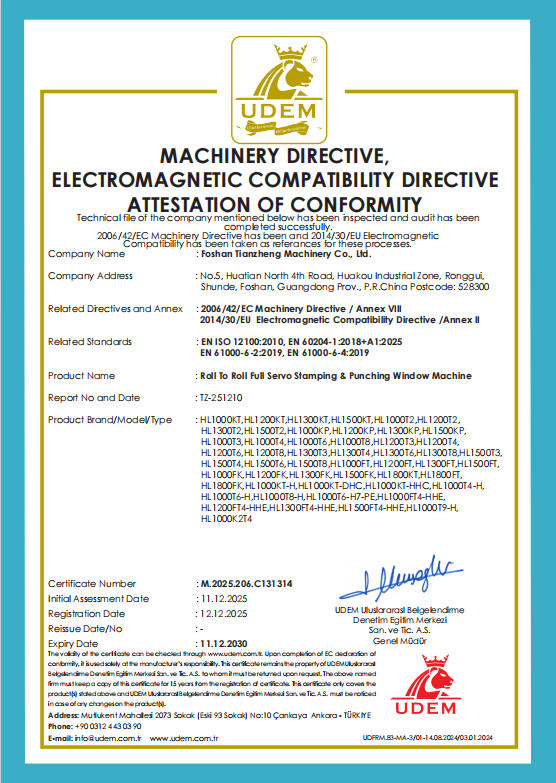
Certificate M.2025.206.C131314, issued by UDEM for the EU market, covers the Roll To Roll Full Servo Stamping & Punching Window Machine.
The Procurement Problem: Certificates Are Not All Equal
In machinery procurement, "CE certified" is often treated as a single attribute that a supplier either has or lacks. In practice, the strength of that claim depends on how conformity was assessed and documented. Buyers encounter three broad structures in the market.
- Self-declaration. The manufacturer issues a declaration of conformity on its own authority, without third-party assessment.
- Third-party attestation. An independent body issues a certificate of conformity for a defined scope and a defined set of standards.
- Directive-specific certification. A notified body carries out the conformity assessment required under the applicable directive, with the associated technical file.
These structures carry different evidentiary weight. A buyer who treats them as equivalent may over-value a self-declaration or under-value a properly scoped third-party certificate. FOSHANTIANZHENG's file is an attestation of conformity under the Machinery and EMC Directives, issued by UDEM for a named machine and a stated list of harmonized standards. That structure gives the buyer a traceable reference: a certificate number, an issuing body, a machine scope and a validity period.
The practical consequence is that the certificate answers some questions and leaves others to be answered elsewhere. It establishes that a conformity assessment took place against named standards. It does not replace a factory audit, a reference check, an acceptance test or an ISO 9001 system certificate. The buyer's job is to know which evidence closes which question.
What the CE File Contains
The file for the Roll To Roll Full Servo Stamping & Punching Window Machine contains four components a buyer can verify independently.
- Certificate identity. Number M.2025.206.C131314, issued by UDEM, valid from 11 December 2025 to 11 December 2030.
- Declared scope. The certificate names the Roll To Roll Full Servo Stamping & Punching Window Machine — not the supplier's entire catalogue.
- Harmonized standards. EN ISO 12100:2010, EN 60204-1:2018+A1:2025, EN 61000-6-2:2019 and EN 61000-6-4:2019.
- Market. The certificate is issued for the EU market.
Each component answers a different buyer question. The certificate identity lets the buyer confirm the document with the issuer. The scope tells the buyer which machine the evidence applies to. The standards list shows which safety and electromagnetic domains were assessed. The market statement confirms the regulatory context. Presented together, these four components turn a claim into a checkable record.
Reading the Four Standards
The standards list is where the CE file becomes technically informative. Each harmonized standard addresses a distinct domain, and together they describe the boundary of the assessment.
| Standard | Domain | What it addresses |
|---|---|---|
| EN ISO 12100:2010 | Mechanical safety | General principles for machinery design, risk assessment and risk reduction |
| EN 60204-1:2018+A1:2025 | Electrical safety | Electrical equipment of machines, including control, protection and emergency functions |
| EN 61000-6-2:2019 | EMC immunity | Immunity requirements for equipment in industrial environments |
| EN 61000-6-4:2019 | EMC emission | Emission requirements for equipment in industrial environments |
EN ISO 12100:2010 is the foundational risk-assessment standard. It sets out the methodology a designer uses to identify hazards, estimate risk and reduce it through design, safeguarding and information for use. Citing it indicates that the machine was assessed through a structured risk process rather than a collection of ad hoc safety features.
EN 60204-1:2018+A1:2025 covers the electrical equipment of machines. It addresses the electrical supply, protection against electric shock, control functions, emergency stop and related requirements. The 2025 amendment signals that the assessment used a current version of the standard, which matters to buyers who track standard revisions over a machine's life.
EN 61000-6-2:2019 is the generic immunity standard for industrial environments. It describes how equipment behaves when exposed to electromagnetic disturbance. For an inline stamping and punching machine running alongside other electrical equipment, immunity is a practical reliability concern, not an abstract one.
EN 61000-6-4:2019 is the corresponding emission standard. It addresses the disturbance the machine itself produces, which affects how it can be installed alongside sensitive electronics on the same line. Together, the four standards cover mechanical risk, electrical safety and electromagnetic compatibility — a meaningful scope for a machine that combines moving tooling, high-speed servo control and electrical drives.
What the File Proves — And What It Does Not
This is the central question for supplier evaluation, and it is best answered in two columns.
What it proves:
- A specific machine model was assessed against four named harmonized standards.
- The assessment was documented by an independent body under a traceable certificate number.
- The certificate was valid on its stated dates and remains within its validity window through 2030.
- The supplier maintains a conformity process sufficient to obtain and hold third-party attestation.
What it does not prove:
- That every machine in the supplier's range holds equivalent certification.
- That the machine meets a specific speed, output, precision or energy target.
- That the machine suits a particular bag type, film structure or factory layout.
- That the supplier's factory, quality system or after-sales process meets a given standard — these need separate evidence such as ISO 9001 or audit records.
- That compliance persists indefinitely; certification is a point-in-time assessment that requires maintenance.
For a buyer, this boundary is not a weakness; it is a map. It shows where the certificate can carry weight and where additional evidence is required. A supplier that presents a CE file clearly, with scope and standards visible, is easier to evaluate than one that presents only a logo.
Using the CE File in Supplier Evaluation
At the evaluation stage, the CE file functions as one input among several. A practical sequence keeps it proportionate.
- Verify the certificate with the issuing body. Confirm the number, scope and dates against the supplier's submission.
- Match the scope to the machine being purchased. A certificate for the Roll To Roll machine does not cover a different model or a different product family.
- Check standard versions. EN 60204-1:2018+A1:2025 includes a recent amendment; confirm that the version cited is the one the machine was assessed against.
- Cross-check with the technical file. The certificate should align with the declaration of conformity and the machine's technical documentation.
- Combine with quality-system evidence. The CE certificate covers product conformity; ISO 9001 covers the quality management system. FOSHANTIANZHENG holds ISO 9001 certification (certificate 9892Q00321R0M, issued by HCC, valid 10 June 2025 to 9 June 2028, with scope covering the design and production of bag making machines, foil stamping rewinding machines and die-cutting machines).
- Test at acceptance. A pre-shipment test and a factory acceptance test allow the buyer to confirm that safety functions, guarding and controls perform as documented.
The CE file and the ISO 9001 certificate together show a supplier with both product-level and system-level certification. Neither replaces a factory visit, a reference check or an acceptance test, but together they narrow the questions that remain.
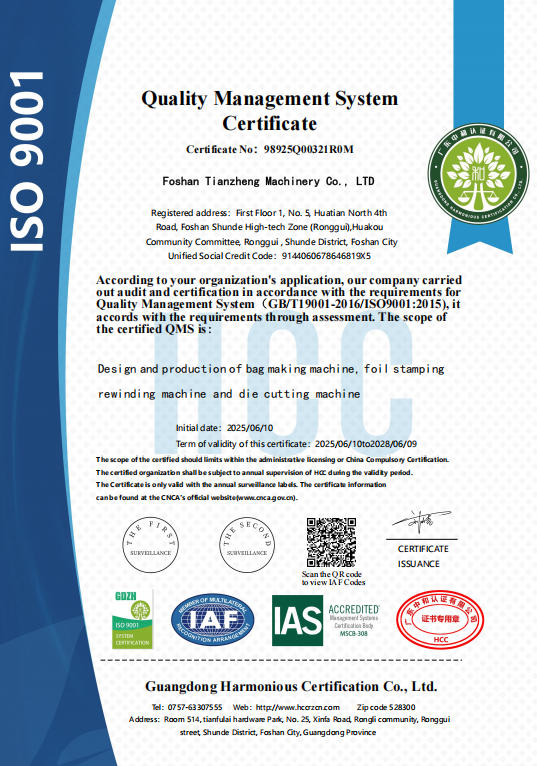
Alongside the CE certificate, ISO 9001 certification (9892Q00321R0M, HCC) covers the supplier's quality management system.
CE Evidence Alongside Other Supplier Evidence
Certification is one instrument in a wider evidence set. Each type of evidence closes a different question, and a robust evaluation uses several of them together.
- CE certificate. Confirms assessed conformity to named safety and EMC standards for a specific machine.
- ISO 9001 certificate. Confirms a documented quality management system with a defined scope.
- Factory records and inspection. Confirm how the machine was built and how final inspection was carried out; FOSHANTIANZHENG states 100% full inspection before shipment.
- Commercial terms. Define the transaction: minimum order quantity of 1 unit, lead time of 30–45 days, and delivery terms such as FOB or CIF.
- Acceptance testing. Confirms that the delivered machine performs to the agreed specification.
- Reference cases. Show how comparable machines have behaved in comparable production settings.
No single item carries the whole decision. The certificate is strongest when it is read as one pillar of a structure, not as a substitute for the rest.
Fit Boundary: Where the Certified Machine Applies
The Roll To Roll Full Servo Stamping & Punching Window Machine is positioned for medium and large flexible packaging factories with diversified bag types and mass continuous production demands. The logic is structural rather than promotional.
The machine performs continuous roll-to-roll stamping and punching. That fits high-volume runs where changeover frequency is moderate and throughput matters. Factories operating a diversified bag mix — flat bottom with zipper bag making, stand-up with zipper bag making, bag-in-box bag making, plastic pouch making, doypack bag making, zipper pouch making, central seal pouch making, valve pouch making and label pasting in-line bag making — need upstream and inline decoration and punching that can keep pace with several downstream lines. A certified inline machine supports that role when it is matched to the actual bag mix.
The fit boundary matters as much as the fit itself. A small converter running low volume and frequent, short jobs may find a continuous roll-to-roll line poorly matched to its production pattern. A factory whose bag mix is narrow may not need the flexibility the machine is built to support. The machine is also specified to operate under indoor normal temperature conditions, which is a site-planning consideration rather than a performance claim. Buyers should test the application fit against their own production plan, not against a general capability statement.
The Supplier Behind the Certificate
A certificate is evidence about a machine; it is not, by itself, evidence about the supplier's broader capability. Buyers should read the two together. FOSHANTIANZHENG (Foshan Tianzheng Machinery Co., Ltd.) originated from Hongli Bag-making, founded in 1993, and has operated in flexible-packaging equipment for more than three decades. The company runs a 6,000 m² plant with four CNC machining centers, produces 87% of components in-house, maintains a 15-engineer R&D team, and exports to more than 20 countries.
Its bag making machine range is configurable across three side sealing pouch making, center sealing and four side sealing pouch making, stand-up pouch making, stand-up zipper pouch making, central seal gusset pouch making, and label pasting in-line bag making. The company offers OEM and ODM production, with ODM customization of machine structure, working width, functions and mould. Commercial terms include a minimum order quantity of 1 unit, a lead time of 30–45 days, monthly capacity of 30 units, 100% full inspection before shipment, and online technical support after delivery.
A documented case involves a flexible packaging manufacturer in global markets running 20 units for more than 10 years in plastic bag production, with stable operation and low noise reported as its highlights. The case describes a production outcome; it does not substitute for the buyer's own acceptance testing, but it gives the buyer a concrete reference point to discuss during evaluation.
A Verification Workflow Buyers Can Apply
Turning the CE file into a procurement decision requires a repeatable check rather than a one-off glance. A workable sequence:
- Document check. Confirm certificate number, issuer, scope, standards list and validity dates against the supplier's submission.
- Scope match. Confirm the certificate names the exact machine model in the quotation.
- Standard currency. Check whether any cited standard has been superseded or amended since the certificate date.
- Cross-reference. Align the certificate with the declaration of conformity, the technical file and the machine nameplate.
- System evidence. Confirm ISO 9001 or equivalent quality-system certification and its stated scope.
- Acceptance testing. Include safety-function verification in the factory acceptance test.
- Reference check. Where possible, speak with existing users in a comparable application.
This workflow does not require specialist legal expertise. It requires the buyer to treat the CE file as a document to be read, not a badge to be counted, and to place it beside the other evidence that the supplier can provide.
Future Outlook: Evidence Quality as a Supplier Attribute
European regulatory practice continues to emphasise documented conformity and technical files rather than marks alone. For bag making machine and inline stamping suppliers, that shifts the competitive ground toward evidence quality: clear scopes, current standards, traceable certificates and coherent technical documentation. As buyers become more familiar with reading certificates, the ability to present a clean file becomes part of the supplier's capability proposition rather than an administrative afterthought.
For buyers, the implication is straightforward. Suppliers that can present a complete, verifiable CE file are easier to qualify and easier to hold to their commitments. Suppliers that present only a logo leave more work for the buyer. FOSHANTIANZHENG's CE file for the Roll To Roll Full Servo Stamping & Punching Window Machine is one example of that shift. It does not answer every procurement question, and it is not presented as doing so. What it does is give the buyer a defined, checkable starting point for the compliance dimension of supplier evaluation. Company details are available at FOSHANTIANZHENG, and the product and company brochure can be downloaded here.
FAQ
What does the CE certificate M.2025.206.C131314 actually cover?
The certificate covers the Roll To Roll Full Servo Stamping & Punching Window Machine for the EU market. It was issued by UDEM and is valid from 11 December 2025 to 11 December 2030. Its scope is the named machine, not the supplier's entire product range.
Why are four separate standards listed in the file?
Each standard addresses a different domain. EN ISO 12100:2010 covers risk assessment and risk reduction. EN 60204-1:2018+A1:2025 covers the electrical equipment of machines. EN 61000-6-2:2019 covers electromagnetic immunity for industrial environments. EN 61000-6-4:2019 covers electromagnetic emission for industrial environments. Together they describe the boundary of the assessment.
Does one CE certificate mean a supplier's whole range is certified?
No. A CE certificate is scoped to a named machine or machine family. Other models, configurations or product lines require their own conformity evidence. Buyers should match the certificate scope to the exact model being purchased.
How can a buyer verify a CE file during supplier evaluation?
Check the certificate number, issuer, scope, standards list and validity dates against the supplier's submission. Match the scope to the quoted model. Confirm that the standard versions cited are current. Cross-reference with the declaration of conformity and the technical file. Add ISO 9001 or equivalent system evidence, and include safety-function checks in acceptance testing.
What production profile suits the certified Roll To Roll machine?
The machine is positioned for medium and large flexible packaging factories with diversified bag types and mass continuous production demands. Its continuous roll-to-roll stamping and punching suits high-volume runs. A small converter running low volume and frequent short jobs may find a continuous line less well matched.
¿Tiene preguntas o necesita más detalles?
Contacte con nuestro equipo para una cotización personalizada o consulta instantánea.
Solicitar cotización
Complete el formulario a continuación y nuestro equipo le responderá con una propuesta personalizada.
Chat directo de WhatsApp
¿Prefiere chatear en tiempo real? Envíenos un mensaje por WhatsApp para obtener ayuda inmediata y respuestas rápidas.
- Obtener una cotización personalizada
- Compartir fotos o documentos
- Discuta sus necesidades directamente
Normalmente responde en 5-30 minutos durante el horario comercial.