
What a 5-Year Warranty Reveals About Commercial LED High Bay Durability
Commercial LED lighting procurement has largely settled the technology question. What stays open is accountability: which supplier is still responsible for a fixture in its fourth or fifth year of service, and what that responsibility is worth at the tender stage.
The global commercial lighting market was estimated at USD 47.54 billion in 2024, with LED products already holding a 58.1% revenue share, according to Grand View Research. Across all segments, the global LED lighting market was valued at USD 109.11 billion in 2025 and is projected to reach USD 336.90 billion by 2034, according to Fortune Business Insights. In parallel, China exported USD 31.4 billion in light fixtures in 2024 — 59.3% of global light-fixture exports, per the Observatory of Economic Complexity.
Those three figures point in one direction. The installed base keeps expanding, a majority of that supply is manufactured outside the buyer's home market, and differentiation at the specification stage is rarely about lumen output — most credible suppliers compete inside a similar range. What remains genuinely testable before an order is placed is the written warranty. It is the one datasheet line that creates a measurable financial obligation for the seller.
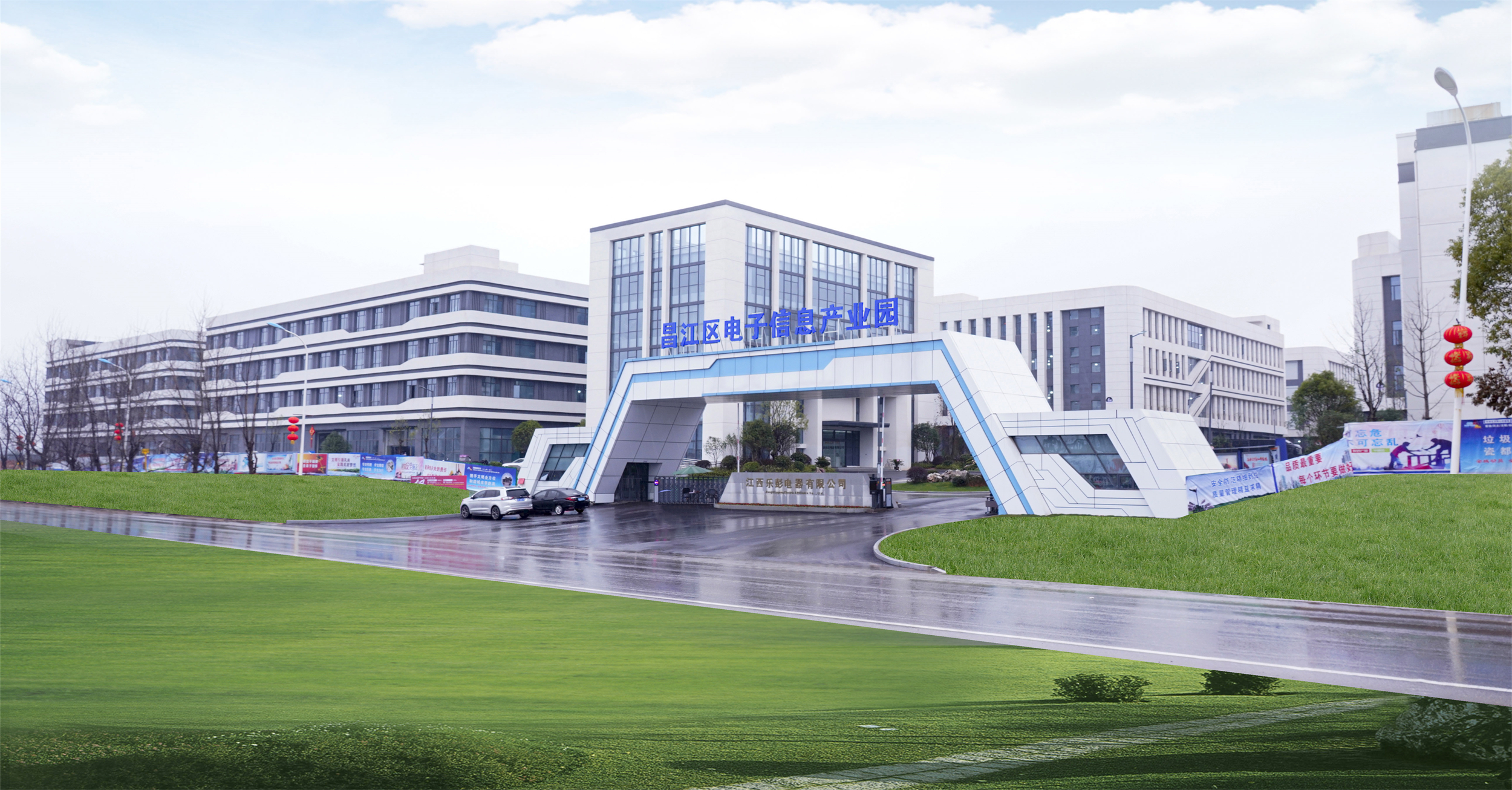
Manufacturing base, Jiangxi — one of three production sites behind the supplier's bulk-order commitments.
Why a Warranty Term Is the Most Testable Claim in a Lighting Datasheet
A lumen figure can be demonstrated once, under controlled conditions. A five-year warranty is a different kind of statement: it converts a performance claim into a contingent liability. If a high bay fails in year four and the claim is valid, the supplier absorbs the replacement cost. That is why warranty length tends to track the bill of materials and the stability of the production process more closely than catalogue language does.
Warranty length alone is not proof of quality. Three details decide whether a term carries real value:
- Covered components. Does the term include the LED module, the driver, the housing and the sealing system, or only the light engine?
- Claim mechanics. Who pays freight, what documentation is required, and is the remedy a replacement unit or a credit?
- Post-term support. Are spare drivers and modules still available after the term expires? A five-year warranty has limited value if the driver platform is discontinued in year two.
Luminaire warranties should also be read next to the standards the fixture was tested against. Core safety and performance standards for LED luminaires include IEC 60598, UL 1598 and UL 8750, listed by UL Solutions. A warranty that references a tested standard is a different document from one that references nothing.
The SH-E01 Five-Year Term: What Zhejiang Lepeng Electric Puts in Writing
Zhejiang Lepeng Electric Appliance Co.,Ltd. is a Chinese LED lamp and luminaire manufacturer founded in 2009 and headquartered in the Baiguan Industrial Zone, Shangyu District, Zhejiang Province, with additional production bases in Qiandaohu (Zhejiang) and Jingdezhen (Jiangxi). The company reports a 200,000 m² factory area, approximately 2,000 employees including a 200-person R&D team, a 90% export ratio across the EU, Southeast Asia, the Middle East and Latin America, and a stated monthly capacity of 45 million LED lamps and 5 million LED luminaires. It operates the MKOPTO brand and undertakes OEM/ODM projects for international clients.
Within that catalog, the SH-E01 LED linear high bay light is specified as: 50/100/150/200W; luminous efficacy of 100/135/150 lm/W; beam angle 90° (H) × 120° (V); CCT options of 3000K, 4000K, 5000K and 6500K; IP65 protection; an aluminum alloy housing with PC/PMMA lens; three body lengths ranging from 305.6 × 97.3 × 68.1 mm to 855.6 × 97.3 × 68.1 mm; and a 5-year warranty.
The five-year term applies to this model rather than to every product in the range — a distinction worth noting, because a portfolio that spans commercial LED flood light, street light, high bay and indoor formats covers very different operating conditions. Warranty terms in the wider catalog are model-specific and should be checked line by line during evaluation.
What IP65, an Aluminum Alloy Housing and 150 lm/W Have to Do With Five Years
IP65 describes ingress protection: dust-tight and protected against water jets. Holding that rating in a linear high bay is a sealing problem that repeats with every thermal cycle, because the lens-to-housing joint, the end caps and the cable entry must stay compressed as the fixture heats and cools inside a warehouse or workshop. Housings that resist deformation preserve gasket compression; thin-wall alternatives lose it. That is one reason the aluminum alloy housing is relevant to a long warranty rather than being a cosmetic detail.
The same housing doubles as the heat sink. At a stated 150 lm/W, the SH-E01 generates less waste heat per delivered lumen than a 100 lm/W design in the same wattage range, which lowers the thermal load on the driver and the LED board. Driver failure and LED junction temperature are the two dominant failure mechanisms in high-bay fixtures, so an efficacy figure is not only an energy number — it is a durability input.
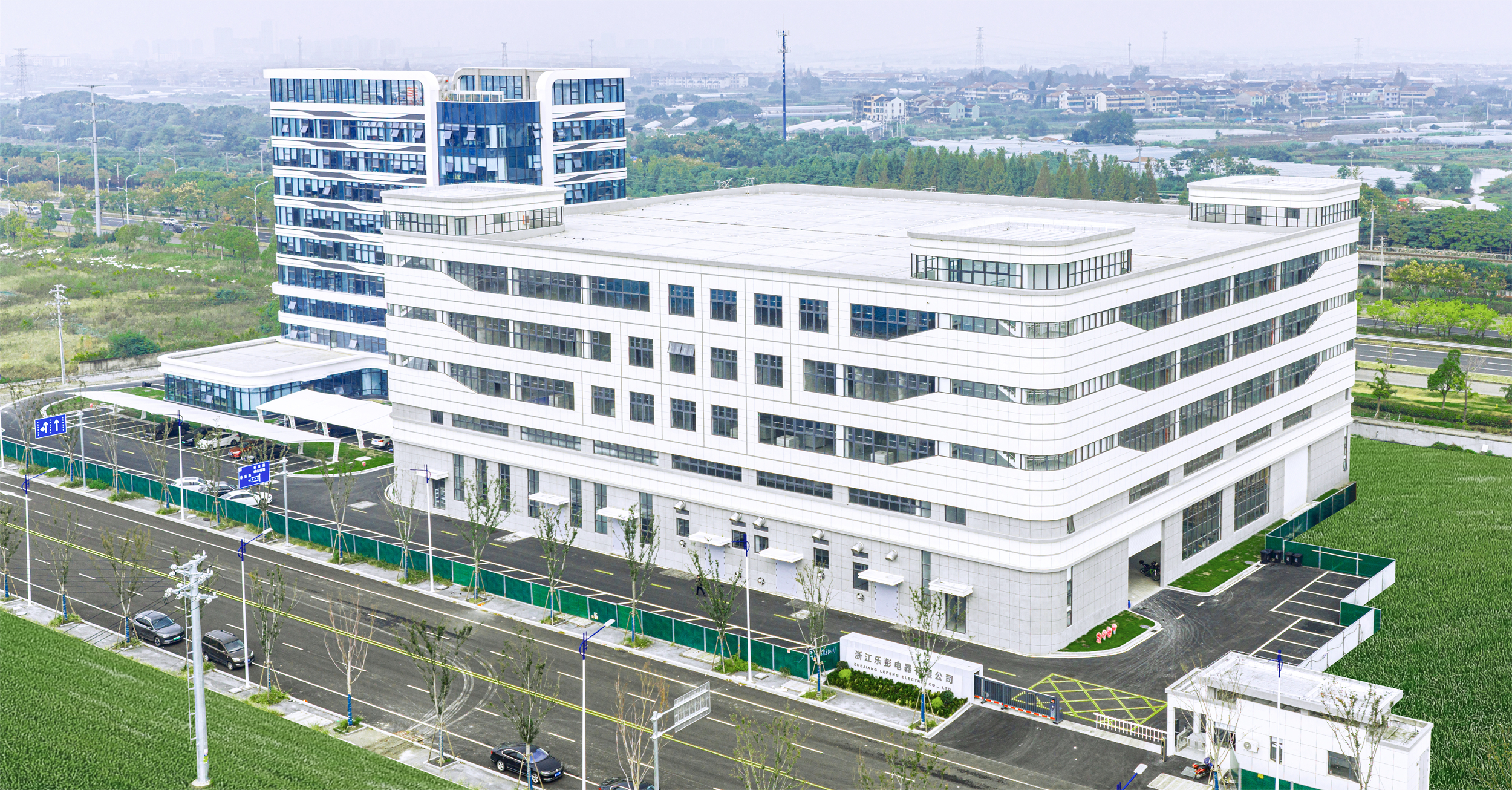
Headquarters facility, Shangyu, Zhejiang — the quality-control anchor for the group's production bases.
Mechanical protection and energy performance are complementary arguments within the same procurement decision, not competing ones. For buyers whose ceiling geometry favors a round fixture, the HL-E01 UFO LED high bay light in the same portfolio uses a die-cast aluminum body with PC lens, covers 100/150/200/240W at 140/160/185/210 lm/W, specifies 6KV/6KV surge protection, and ships with a pre-wired 3×1.0mm² cable with 300 mm exposed leads. Both formats answer the same durability question from different geometry.
Where the SH-E01 Fits: Application and Procurement Scenarios
Industrial and commercial interiors are the design target for this model: warehouses, factories and workshops. In these environments the cost of replacing a fixture frequently exceeds the cost of the fixture. Access requires scissor lifts or scaffolding, and in operating facilities the work often costs production time as well.
Selection follows a sequence that buyers can standardize across a project. Confirm the ceiling height and the lumen level the space actually requires; choose wattage and beam angle accordingly — the SH-E01's 90° × 120° distribution suits aisle and grid layouts; mount the fixture to the ceiling or to hanging brackets; then energize and verify coverage and brightness across the floor. Power must be isolated before wiring, mounting must be secure, and local electrical codes govern the installation.
The model is also positioned for engineering procurement, mid-to-large scale project bulk supply, and channel customers that require customization. In channel scenarios the warranty behaves differently than it does for an end user: a five-year term becomes a return-rate and service-cost variable for a distributor rather than a maintenance schedule for a facility manager.
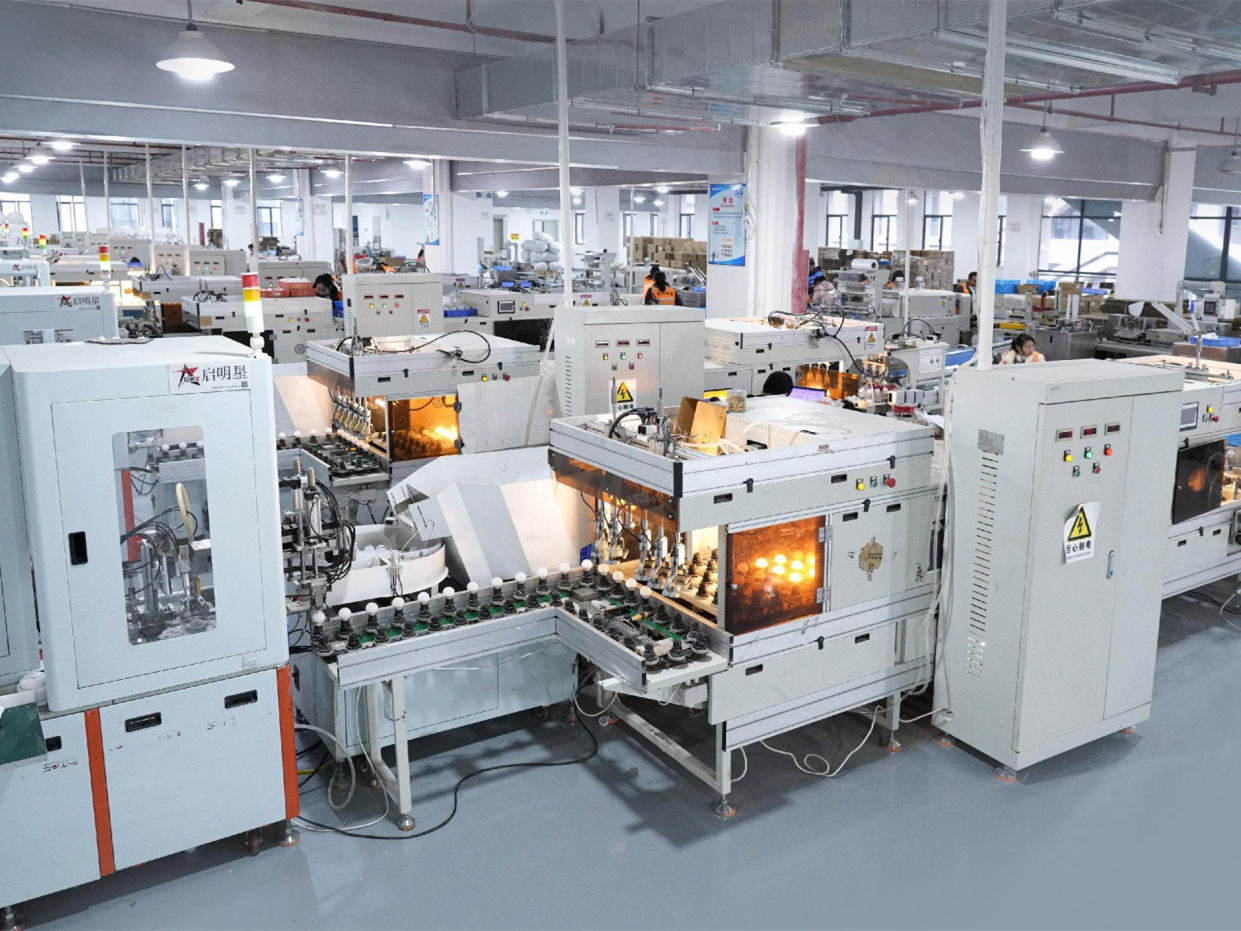
Automated luminaire production line — process consistency is what makes a five-year term fundable.
Market Signals: Why Lifecycle Cost Is Climbing the Procurement Agenda
Growth in adjacent categories shows where the installed base is heading. The global LED flood light market reached USD 9.4 billion in 2025 and is expected to grow at a CAGR of 8.52% to USD 20.1 billion by 2034, according to IMARC Group. The global solar street lighting market is projected to reach USD 22.5 billion by 2030, a CAGR of 15.8% from 2024, according to Vantage Market Research. Outdoor and off-grid segments carry higher service-visit costs than indoor retrofits, and solar products add panel and battery servicing to the maintenance picture.
The commercial segment moves in the same direction by different mechanics. With LED already holding 58.1% of commercial lighting revenue in 2024, incremental demand shifts from first-time conversion toward replacement and upgrade. Once a market reaches that stage, the buyer's comparison is no longer 'LED versus conventional technology'. It becomes 'this supplier's ten-year proposition versus that supplier's'.
Two practical consequences follow. First, specification conversations move earlier into the warranty document rather than staying in the photometric file. Second, suppliers that cannot describe spare-part availability for a five-year horizon become harder to justify in a multi-year program, regardless of unit price.
Comparing Supplier Options: Scale, Lead Time and Warranty Practice
| Evaluation dimension | Large-scale OEM/ODM manufacturer (Zhejiang Lepeng Electric example) | Smaller peer factory | Premium imported brand |
|---|---|---|---|
| Production scale | 200,000 m² factory area; approx. 2,000 employees; three production bases; stated monthly capacity of 45 million LED lamps and 5 million LED luminaires | Limited capacity; may lack scale for multi-year programs | Established scale with long-running R&D programs |
| Lead time on bulk orders | Stated 15% shorter than smaller peers, with an on-time delivery rate above 95% | Longer relative lead times on bulk volume | Competitive, but typically longer order-to-site cycles for non-local buyers |
| OEM/ODM flexibility | Supported, with broad production capacity and product coverage | Often limited to catalogue items | Available at higher cost |
| Warranty practice | 5-year warranty on the SH-E01 LED linear high bay light | Commonly shorter terms | Extended terms, priced accordingly |
| Certification and R&D detail | Company holds industry certifications and qualification certificates; comparison notes that premium imported brands may have higher R&D standards and certification details | Documentation may be incomplete or dated | Strong documentation depth |
| Cost position | Company states a 10% cost advantage over imported premium brands through in-house mass production | Lowest unit cost | Highest unit cost |
| Best fit | Engineering procurement, mid-to-large project bulk supply, channel customers requiring customization | Small, simple orders | Small-scale, high-end projects |
The table frames a trade-off rather than a verdict. Scale and OEM/ODM flexibility favor the large Chinese manufacturer category; documentation depth may favor premium imported brands; unit cost favors smaller factories that cannot absorb a long warranty liability. The comparison is only useful when the buyer's own access costs, program length and in-market service requirements are applied to it.
The Limits of the Five-Year Warranty Argument
A long warranty is a strong signal, but it is not a complete one, and the boundaries should be stated as plainly as the benefits.
- Model-specific scope. The five-year term applies to the SH-E01 LED linear high bay light. Other products in the same catalog carry different ratings and different terms — a 50/100/150/200W linear high bay should not be evaluated against the warranty line of an indoor ceiling product.
- Warranty is not lifecycle cost. The term covers the fixture. It does not cover installation labor, access equipment, electrical work, or the operational cost of a production stoppage while a unit is swapped.
- Manufacturing geography. Zhejiang Lepeng Electric manufactures in China. Buyers who require regional warehousing or an in-market service team must arrange that locally; the factory warranty does not create a local service presence.
- Relative performance figures are supplier-stated. The 15% shorter bulk-order lead time and the on-time delivery rate above 95% describe the supplier's position against smaller peers. They are planning inputs, not contractual service levels, and should be converted into agreed terms before a program is committed.
- Material cost is real. An aluminum alloy housing with a sealed IP65 construction costs more than a basic high bay. For low-hour, low-ceiling or temporary installations, that premium may not be recoverable, and a five-year term becomes an unnecessary specification rather than a safeguard.
Read together, these limits suggest a rule rather than a slogan: match the warranty term to the cost of failure in the specific installation, and verify that the term survives contact with the claim process.
Future Outlook
As the commercial LED installed base matures, warranty documentation is likely to move from a sales argument to a scored line in tender evaluation, alongside certification evidence and spare-part availability. Two factors support that shift. First, replacement-driven demand grows as LED already accounts for the majority of commercial lighting revenue, meaning purchase decisions are increasingly made against an existing asset rather than a blank ceiling. Second, outdoor and off-grid segments — flood lighting and solar street lighting among them — add service-visit cost to every warranty event, which raises the value of a term the supplier can actually honor.
For manufacturers, the implication is structural. A five-year term is only affordable when the product is engineered for it: a rigid housing that preserves sealing, an efficacy level that reduces thermal stress on the driver, and production capacity that makes replacement units available years after the original order. Suppliers with in-house R&D and multiple production bases are positioned to absorb that liability; those without them will increasingly write shorter terms.
FAQ
Does a five-year warranty on an LED high bay actually prove better durability?
Not by itself. A warranty is a commercial commitment, and its value depends on scope, claim mechanics and post-term spare-part availability. Its usefulness as a durability proxy comes from cost: a supplier only extends a term when the bill of materials and process control keep expected failure rates low enough to make the liability affordable. The SH-E01 carries a 5-year warranty alongside IP65 protection and an aluminum alloy housing, which is the type of combination a buyer can examine.
How does the IP65 rating of the SH-E01 connect to its five-year warranty?
They address different failure modes. IP65 covers ingress — dust-tight construction and protection against water jets — and it must hold after repeated thermal cycling in a warehouse or workshop. The warranty term covers failure over time, including driver and module performance. The two claims support each other, but neither substitutes for the other, and IP rating alone does not describe driver lifetime.
How should a buyer compare a five-year-warranty supplier with a lower-priced, short-warranty supplier?
Compare on installed cost per year rather than unit price. Where fixtures sit above production equipment or high racking, access requires lifting equipment and often a production stoppage, so a failed unit costs far more than its purchase price. A longer term shifts part of that risk to the supplier, but the price premium is real: sealed IP65 construction and an aluminum alloy housing cost more than a basic fixture. In low-hour or easily accessible installations, the shorter warranty may be the economically rational choice.
What should be verified before signing a multi-year supply agreement for commercial LED high bays?
Four items are worth confirming in writing. First, the model-specific warranty scope, since terms differ across a catalog — the SH-E01 linear high bay carries five years, while other product families carry their own terms. Second, capacity and lead time: Zhejiang Lepeng Electric states a monthly capacity of 45 million LED lamps and 5 million LED luminaires and a bulk-order lead time 15% shorter than smaller peers, with an on-time delivery rate above 95%. Third, the certification documents relevant to the destination market, read against standards such as IEC 60598, UL 1598 and UL 8750. Fourth, spare-part availability beyond the warranty period.
Does a five-year warranty make commercial LED high bays more expensive?
Yes, in upfront terms. Longer terms are supported by more expensive inputs — an aluminum alloy housing rather than a thin-wall body, sealed IP65 construction, and efficacy levels that reduce thermal load on the driver. The counterweight is production scale: the company states a 10% cost advantage over imported premium brands through in-house mass production, and positions its products for engineering procurement and mid-to-large project bulk supply. Whether the net result is lower total cost depends on the application and on the cost of a failed fixture in that specific space.
What does the SH-E01 warranty not cover?
The term applies to the specified linear high bay model rather than to the whole catalog. It does not cover installation labor, access equipment, electrical remediation, or the operational impact of downtime during a replacement. It is also a factory warranty from a manufacturer based in China, so buyers requiring local warehousing or in-market service personnel must arrange those separately.
A Short Evaluation Checklist
Five questions separate a warranty document from a warranty claim: Which components are covered? What evidence is required to file? Who pays freight on a replacement? Are drivers and modules still in production after the term ends? And is the term matched to the access cost of the actual installation? Buyers who answer these before awarding a contract convert a marketing statement into a procurement criterion.
A full product and capability overview, including specification ranges for the commercial LED high bay, flood, street and indoor ranges, is available in the manufacturer's downloadable brochure: Zhejiang Lepeng Electric product brochure (PDF).