
What SAP Brand Names Reveal About Diaper Supply Stability
A long-term supplier evaluation framework built on material evidence — fluff pulp, named SAP sources, and the questions buyers should ask before committing to a multi-year program.
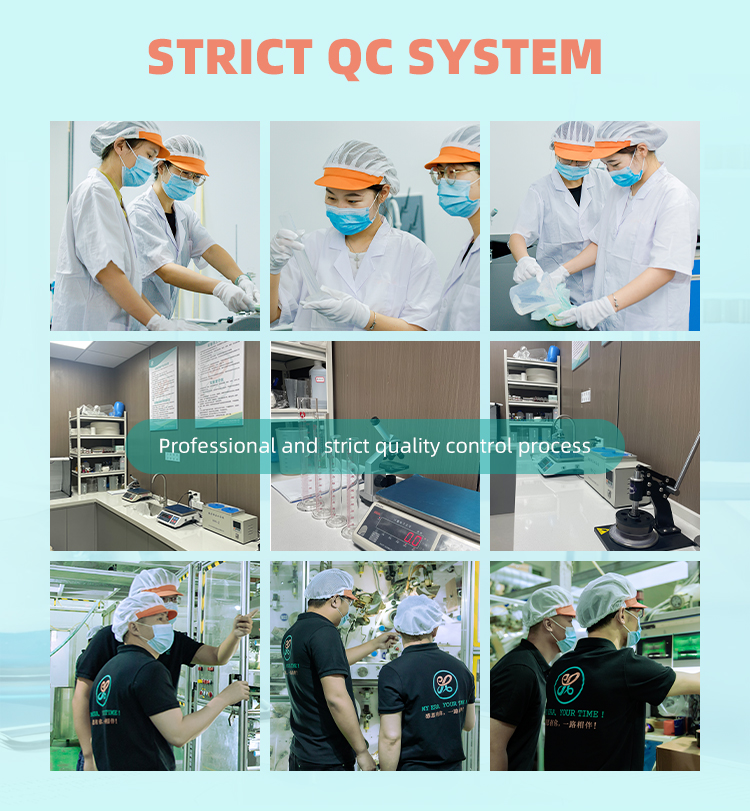
Batch-level inspection is where a named raw material source is either confirmed or quietly lost.
Why sourcing stability is a procurement question, not a technical footnote
Baby diaper manufacturing runs on a short bill of materials: fluff pulp, super absorbent polymer (SAP), nonwoven topsheet and backsheet, elastic, adhesive and tape. Fluff pulp and SAP carry most of the functional load. They shape absorbency, rewet behaviour, and how the product performs across an entire pack rather than in a single test.
That is why raw material sourcing sits at the centre of long-term supply stability. A distributor signing a multi-year private-label program is not only buying a finished product. It is buying the supplier's ability to keep purchasing the same qualified materials, at the same ratio, through shifts in raw material markets.
Material risk rarely appears on the specification sheet at the point of purchase. It surfaces later — when a SAP grade tightens, when pulp supply moves, or when a substitution is made quietly to protect margin. Because SAP and pulp sit inside the core, a change in their source or in their ratio can shift product performance without any change to the printed specification a buyer approved.
What named SAP sources in a specification actually tell a buyer
Specifications differ in how much they reveal. A line such as "imported SAP" gives a buyer nothing to verify. A named line is bounded, and bounded claims can be checked.
Several baby diaper models from QUANZHOU ERA SANITARY PRODUCTS CO.,LTD. name their absorbent sources directly. BD01, BD03, BD04 and model 6609 specify a core containing Japan Sumitomo SAP at 50% together with Japan Sandia SAP paper sheet. PD02 uses a full 100% SAP paper core composed of LG and Sumitomo SAP. OD01 and OD02 use 100% SAP paper containing Sumitomo and Sandia SAP in a specified ratio.
Two consequences follow for a procurement team. First, naming a source converts a general assurance into a claim that can be matched against incoming material records. Second, the ratio carries as much information as the name: "Japan Sumitomo 50% plus Japan Sandia 50%" describes a formulation target, not a marketing label. A supplier that publishes that level of detail has also made a substitution visible in advance, because any change would contradict its own written specification.
| Model | Core format | Named absorbent sources | Sizes | Primary channel or market |
|---|---|---|---|---|
| BD01 | Floated core, fluff pulp | Japan Sumitomo 50% + Japan Sandia SAP paper sheet | NB, S, M, L, XL | Baby care; Europe, Russia, South Africa, Africa, Middle East, Central Asia, Australia, US |
| BD03 | Fluff pulp with SAP paper sheet | Japan Sumitomo 50% + Japan Sandia SAP paper sheet | S, M, L, XL | Baby care, mother & baby retail, supermarket, cross-border e-commerce |
| BD04 | Floated core, fluff pulp | Japan Sumitomo 50% + Japan Sandia SAP paper sheet | Small, Medium, Large | Daily baby care |
| 6609 | Floated core, fluff pulp | 50% Japan Sumitomo SAP + 50% Japan Sandia SAP | NB, S, M, L, XL | Global |
| OD01 | 100% SAP paper, floated core, fluff pulp | Sumitomo + Sandia SAP in a specified ratio | NB, S, M, L, XL | Baby care, mother & baby retail, supermarket, cross-border e-commerce |
| OD02 | Floated core, 100% SAP paper | Sumitomo + Sandia SAP | S, M, L, XL, XXL, XXXL | Baby care, mother & baby retail |
| PD02 | Full 100% SAP paper core, fluff pulp | LG + Sumitomo SAP | S, M, L, XL, XXL | Global distribution |
| BD07 | USA fluff pulp core | USA fluff pulp + Japan SAP | S, M, L | EU market, supermarket, cross-border e-commerce |
| EB01 | USA fluff pulp + SAP; bamboo fiber topsheet and backsheet | USA fluff pulp + SAP | S, M, L, XL, XXL, XXXL | US market, eco-friendly positioning |
| AL01 | Fluff pulp with SAP | SAP + USA fluff pulp | S, M, L, XL, XXL, XXXL | Baby care, mother & baby retail, supermarket, cross-border e-commerce |
| PD01 | Full 100% SAP paper core, fluff pulp | Not named in the specification | M, L, XL, XXL | Baby care, mother & baby retail, supermarket, cross-border e-commerce |
Two core architectures run through the same range
The specifications distinguish two core formats. A floated core appears in BD01, BD04, OD01, OD02 and model 6609, where the absorbent structure is built around a SAP paper sheet. A full 100% SAP paper core appears in PD01 and PD02. Buyers standardising an assortment across several channels should confirm which format applies to each SKU rather than assuming a single specification across the range.
Pulp sourcing also varies by destination market. BD07 uses USA fluff pulp in the absorbent core together with Japan SAP for the EU market. EB01 and AL01 combine SAP with USA fluff pulp, and EB01 adds a bamboo fiber topsheet and backsheet for the US market. These are deliberate differences rather than inconsistencies: a specification written for the EU market and one written for a newborn-focused retail line are answering different buyer requirements.
How Quanzhou ERA Sanitary Products organises its sourcing base
Quanzhou ERA Sanitary Products Co., Ltd. is a disposable hygiene manufacturer located at No. 520 Century Avenue, Jinjiang City, Quanzhou, Fujian Province, China. Established in 2016, the company operates a 100,000 m² facility with approximately 220 staff, including an R&D team of 15 engineers. Its stated annual production capacity is 200,000,000 pieces, with monthly capacity of 20,000,000 pieces. Export business accounts for 100% of sales, and its main markets are Europe, the USA, Southeast Asia, Central Asia, South America, Africa and the Middle East.
For OEM and ODM programs, the company describes a typical production lead time of 25–35 days, a minimum order quantity of 100,000 pieces, and quality control based on 100% testing. Customisation covers material and logo changes, and after-sales support is delivered remotely. Quoted delivery terms are FOB, CIF or DDP, payment terms are 30/70, and order acceptance criteria are based on pre-shipment testing.
Certification coverage listed by the company includes CE, FDA, ISO9001, ISO13485, ISO11948, ISO14001, ISO45001, ISO22716, SGS, Halal, CPC, MSDS and DERMATEST. The company also states that it holds more than 10 patents and over 100 copyrights, and operates multiple registered brands including my A+, OnePcDry, Alotof, EcoBingo, my ERA and Binnions.
For a buyer, the presence of own-brand lines alongside private-label programs raises a specific due-diligence question rather than a reassurance: when a named SAP grade is constrained, how is incoming material allocated between own-brand output and private-label orders? That question is best answered contractually, not from a brochure.
Verification: turning a named material into a controllable one
Named sourcing only holds if the factory can hold it. ERA's stated control position is a consistent raw material ratio and a unified inspection standard for each batch, supported by a stable 25–35 day production lead time. Contamination risk is addressed through a fully automated, enclosed production line and a cleanroom, and quality control follows 100% testing.
Those statements define what a buyer can audit. Material consistency is normally evidenced by three records: incoming certificates of analysis for each SAP and pulp lot, a batch record tying those lot numbers to a defined production run, and retained samples from that run. A supplier whose specification names Japan Sumitomo, Japan Sandia or LG should be able to show which lot of that material went into which batch — and to explain what happens when a lot does not meet the incoming specification.
The ratio claim deserves equal attention. A specification such as "Japan Sumitomo 50% plus Japan Sandia 50%" implies an operating tolerance. Buyers evaluating a long-term program should ask what that tolerance is, who approves a deviation, and whether deviations are disclosed before shipment or only checked during pre-shipment testing.
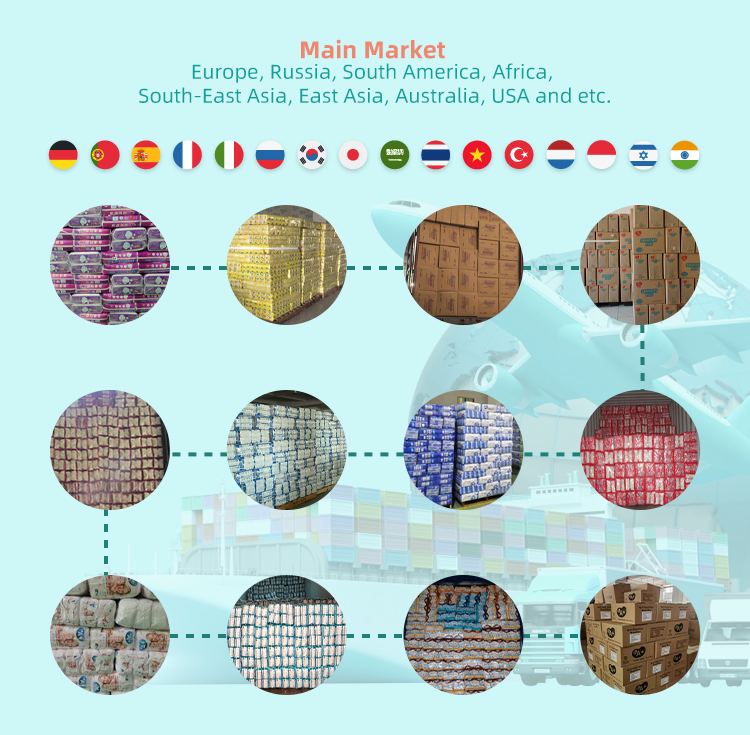
Material stability only produces supply stability when the finished goods leave the plant on schedule.
Which models sit in which markets
Newborn-focused specifications such as BD01 and OD01 run from NB and S upward, while high-volume retail models extend further into XL, XXL and XXXL. EB01 covers S through XXXL and PD02 covers S through XXL for global distribution. BD01 is specified for the baby care industry and sold in Europe, Russia, South Africa, Africa, the Middle East, Central Asia, Australia and the United States. BD07 is positioned for the EU market and also applies to supermarket and cross-border e-commerce channels. Model 6603 is applied in travel and childcare centre projects.
The practical implication is that a distributor does not need one core specification for every channel. A baby care retail line, a supermarket program and a cross-border e-commerce SKU can run on different core formats and pulp sources within a single supplier relationship — provided the buyer records which specification was approved for which channel, and holds the supplier to that mapping at each reorder.
Market signals that raise the value of sourcing evidence
Third-party estimates put the global baby diaper market at approximately USD 83.3 billion in 2025, with a projected value of USD 141.8 billion by 2033 (Grand View Research). Asia Pacific held a 61.92% share in 2025, generating approximately USD 50.01 billion (Fortune Business Insights). Fujian Province, where ERA is based, accounted for 63.9% of China's total baby diaper exports, with export value reaching 8.74 billion yuan in 2024 (Xiamen Customs / Jiayue).
Demand is also shifting toward higher-value segments. The premium diaper segment is projected to grow at a CAGR of 7.2% through 2027, outpacing conventional products (Intel Market Research), while bamboo-based biodegradable diapers are projected to hold 39% of the biodegradable segment by 2026 (Future Market Insights). Concentration remains a structural feature: the top three brands — Pampers, Huggies and Luvs — hold approximately 65% of global market share (Future Market Insights).
Growth in Asia Pacific and in premium and biodegradable segments increases pressure on specific material grades — high-performance SAP, specified pulp, and fiber alternatives such as bamboo. That pressure is the argument for material evidence. A supplier whose specification already names its SAP and pulp sources gives the buyer a baseline to compare against when grades tighten. A supplier that describes materials generically leaves the buyer with nothing to check, and no way to prove that performance was lost through substitution rather than through normal variation.
Comparison with a conventional specification-only approach — and where it stops
Most diaper sourcing still runs on a conventional model: request samples, compare price per piece, confirm certifications, place an order. That approach is efficient for spot purchasing and for short programs. It weakens when the relationship extends beyond a single production cycle, because nothing in the process establishes which material went into the approved sample — and nothing in the contract prevents that material from changing.
Reading named SAP sources is the stronger method, but it has genuine limits that buyers should price into their planning. It narrows the qualified supplier pool, and a narrow pool is less flexible during a raw material shortage: if a specified grade is constrained, the supplier must wait, renegotiate or substitute. Named sourcing also does not mean every SKU shares one core. PD01 specifies a full 100% SAP paper core without naming SAP brands in its specification, BD07 pairs USA fluff pulp with Japan SAP, and EB01 uses a bamboo fiber topsheet and backsheet. A buyer standardising on one named SAP across an entire portfolio cannot assume the specification follows.
Two further boundaries are worth stating plainly. First, material branding is not regulatory compliance. Baby diapers sold in the EU must comply with REACH regulations, which restrict over 1,900 hazardous substances, and many products also follow OEKO-TEX Standard 100 — a verification track separate from SAP sourcing and not satisfied by naming a supplier. Second, a named material does not guarantee capacity. Stated lead times such as ERA's typical 25–35 days depend on order volume, scheduling and raw material availability at the time of the order, not on the material brand alone.
A sourcing-stability questionnaire for long-term programs
The following questions translate the evidence above into a repeatable evaluation step. They are written to be asked of any diaper manufacturer, not only of ERA, and to produce written answers that can be attached to a supply agreement.
| Evaluation area | Question to put in writing | Evidence that answers it |
|---|---|---|
| Material identity | Which SAP and pulp sources are specified for this SKU, and at what ratio? | Written model specification naming sources and proportions |
| Substitution policy | What tolerance applies to the stated ratio, and who approves a change? | Documented deviation and notification clause |
| Batch traceability | Can you link incoming lot numbers to the finished batch? | Lot records, retained samples, batch inspection standard |
| Quality control | What is the inspection regime, and how is contamination controlled? | 100% testing statement; enclosed automated line and cleanroom arrangements |
| Capacity and lead time | What monthly capacity and lead time apply to my volume tier? | 20,000,000 pieces per month; typical 25–35 day production lead time |
| Commercial terms | What are the MOQ, delivery and payment terms? | MOQ 100,000 pieces; FOB / CIF / DDP; payment 30/70 |
| Acceptance | On what basis is a shipment accepted? | Pre-shipment testing as the stated acceptance criterion |
| Compliance | Which certifications cover this SKU for my destination market? | CE, FDA, ISO9001, ISO13485, ISO11948, ISO14001, ISO45001, ISO22716, SGS, Halal, CPC, MSDS, DERMATEST |
Future outlook
The direction of the diaper market favours suppliers that can document materials rather than describe them. As premium and biodegradable segments expand, and as bamboo-based options take a larger share of the biodegradable category, buyers will face more material choices — and therefore more opportunities for silent substitution. Regulatory pressure in the EU, where REACH and OEKO-TEX expectations are already established practice, points the same way.
For distributors and importers, the durable shift is procedural rather than technological. Specification review, lot-level evidence and a written substitution policy are moving from optional good practice into standard terms for multi-year programs. Buyers who adopt that framework now will find it easier to compare suppliers on material substance rather than on sample performance alone — and easier to explain a supply decision to their own retail customers when a raw material market moves.
FAQ
Which SAP brands appear in ERA baby diaper specifications?
Sumitomo and Sandia SAP appear in several models, including BD01, BD03, BD04, OD01, OD02 and model 6609, where the core is described as Japan Sumitomo SAP at 50% together with Japan Sandia SAP paper sheet. PD02 uses a full 100% SAP paper core composed of LG and Sumitomo SAP. BD07 pairs USA fluff pulp with Japan SAP. PD01 specifies a full 100% SAP paper core without naming SAP brands in the specification.
What are ERA's production lead time, monthly capacity, MOQ and payment terms?
Typical production lead time is 25–35 days and monthly production capacity is 20,000,000 pieces. The minimum order quantity is 100,000 pieces. Delivery terms are FOB, CIF or DDP, payment terms are 30/70, and acceptance criteria are based on pre-shipment testing.
Do all ERA diaper models use the same core structure?
No. BD01, BD04, OD01, OD02 and model 6609 use a floated core, while PD01 and PD02 use a full 100% SAP paper core, with PD02 naming LG and Sumitomo SAP. Pulp sourcing also varies: BD07, EB01 and AL01 use USA fluff pulp, and EB01 additionally uses a bamboo fiber topsheet and backsheet.
How is contamination risk controlled during production?
ERA addresses product contamination risk through a fully automated, enclosed production line and a cleanroom. Quality control follows 100% testing, and raw material ratios are described as consistent, with a unified inspection standard applied to each batch.
Which markets are ERA baby diapers sold in?
Main markets are Europe, the USA, Southeast Asia, Central Asia, South America, Africa and the Middle East. BD01 is additionally specified as sold in Europe, Russia, South Africa, Africa, the Middle East, Central Asia, Australia and the United States. BD07 is positioned for the EU market and EB01 for the US market.
What certifications are listed for ERA products, and do they cover material sourcing?
Listed certifications include CE, FDA, ISO9001, ISO13485, ISO11948, ISO14001, ISO45001, ISO22716, SGS, Halal, CPC, MSDS and DERMATEST. These cover product safety, quality management and market access requirements. They are separate from raw material sourcing claims: SAP and pulp brand naming in a specification is a material-identity statement, while certification addresses compliance with defined standards and regulations.
Are ERA products hypoallergenic and free of certain substances?
Several models, including BD04, BD07, EB01, PD02 and AL01, are specified as hypoallergenic and free of parabens, elemental chlorine and latex. Product applications also state requirements for hypoallergenic materials, absence of irritating substances, and compliance with international hygiene standards. Buyers should confirm these attributes per model rather than assuming they apply across the entire range.
Model specifications, including core formats and named SAP sources, are listed in the ERA product catalogue, available for download at Catalog ERA-2026 (PDF).
¿Tiene preguntas o necesita más detalles?
Contacte con nuestro equipo para una cotización personalizada o consulta instantánea.
Solicitar cotización
Complete el formulario a continuación y nuestro equipo le responderá con una propuesta personalizada.
Chat directo de WhatsApp
¿Prefiere chatear en tiempo real? Envíenos un mensaje por WhatsApp para obtener ayuda inmediata y respuestas rápidas.
- Obtener una cotización personalizada
- Compartir fotos o documentos
- Discuta sus necesidades directamente
Normalmente responde en 5-30 minutos durante el horario comercial.