
What S355 Steel and Electric Powertrains Tell You About Loader Compliance
What S355 Steel and Electric Powertrains Tell You About Loader Compliance
Compliance in compact earthmoving equipment is rarely settled by a single certificate on a product page. Importers, municipal fleet managers, rental companies and agricultural contractors evaluating mini wheel loaders, compact wheel loaders, telescopic loaders or electric loaders usually end up comparing two specification lines that carry disproportionate decision weight: the structural steel grade declared for the chassis and loader frame, and the powertrain that determines which emission, noise and duty-cycle rules apply once the machine is in service. Reading those two lines accurately often decides whether a compact loader can be registered and operated on a regulated jobsite at all, and whether the buyer's technical file survives a later audit.
Two reference points frame that reading. In the European Union, wheel loaders must comply with EN 474-3:2022, the earth-moving machinery standard covering operator stations and protective structures such as ROPS and FOPS. On the powertrain side, diesel-driven machines are judged against engine emission regulations such as Euro V and Tier 4F, while battery-electric models are judged against a different set of attributes, including noise, electromagnetic compatibility and electrical safety. The same machine can therefore pass one assessment easily and face much closer scrutiny in another.
Why Material and Powertrain Data Outweigh Marketing Claims
Procurement teams in regulated markets tend to reduce the compliance question to three verifiable checks. First, does the machine structure follow a declared, standardised material specification? Second, does the engine come with an identifiable emission certificate rather than a general statement about environmental performance? Third, for electric variants, does the drive system have model-specific certification for the directives that apply — noise, EMC, machinery safety?
Each of those checks has a document behind it, and each is easy to obscure with vague language. That is why specification discipline matters more in compact equipment than in most machinery categories, and why the material and powertrain lines on a datasheet deserve more attention than the adjective-heavy paragraphs above them.
This is the context in which EVERUN's published specifications are worth reading closely. Qingdao Everun Machinery Co., Ltd, trading as EVERUN, is an earthmoving equipment manufacturer whose portfolio covers wheel loaders from 0.4 to 6 tons, excavators and telehandlers, with the stated export ratio of 100% and main markets in the EU, USA and Australia. Its compact loader range declares S355 steel as the structural material across models including the ER2500T, ER08E, ER08EH and EREL05, and its engine-driven models reference individual emission certificates rather than a blanket compliance claim.
What S355 Steel Actually Tells You About Structural Claims
S355 is a structural steel grade defined within the European EN 10025 standard family. The designation is not marketing shorthand: the letter S indicates structural use, and the number refers to a minimum yield strength of 355 MPa at nominal thickness. Because the grade is standardised, a declared S355 specification can be checked, replicated and audited by a third party — which is not true of descriptions such as reinforced heavy-duty frame or high-strength construction.
EVERUN lists S355 steel as the material for a wide set of models, including the ER2500T telescopic wheel loader, the ER08E and ER08EH electric loaders, the EREL05 electric loader, the ERW1230T, ERW1525, ER425 and ER408 compact loaders, and the ER3070 and ER4018 telehandlers. Consistency at this level matters for two practical reasons.
- It makes structural integrity claims auditable. A buyer or a notified body can verify a standard grade; a proprietary description cannot be verified without factory access.
- It aligns the loader frame and protective structure with the predictable yield behaviour that safety standards are written around, including EN 474-3:2022, which covers operator stations and protective structures such as ROPS and FOPS.
The clearest illustration comes from EVERUN's own certification documentation. According to the company's published certification announcement, the ER08E, ER1220 and ERT1500 compact loaders are certified by TÜV Rheinland for MD CE, Noise and EMC compliance. That statement covers three named models, not the entire portfolio, and a disciplined buyer will treat it exactly that way: as model-level evidence rather than a brand-wide guarantee.
What Electric Powertrains Tell You About Emission-Relevant Rules
Powertrain data answers a different question — which rules apply to the machine at all. A diesel loader is evaluated first on tailpipe emissions, which is why EVERUN references Euro V and Tier 4F engine regulations and lists engine certificates at model level: the C490BPG engine with Euro III and EPA certificates on the ER412T, the Xinchai 498 BT1 with Euro 3 and EPA certificates on the ER416T, and Kubota Euro V and EPA4 engines on models such as the ER50.
A battery-electric loader removes the tailpipe emission axis entirely. The EREL05, ER08E and ER08EH run exclusively on electric motors, which is why EVERUN positions them around zero emission and low noise electric drive. The trade-off is that other attributes move to the centre of the assessment. Noise declarations, EMC behaviour and electrical safety documentation become the decisive evidence, and they too are model-specific. The TÜV Rheinland certification covering MD CE, Noise and EMC on the ER08E is precisely the type of evidence a European buyer should expect attached to a specific electric model rather than to a product family.
The electric specifications themselves show how the two lines of evidence interact. The ER08E carries a rated load of 800 kg with a 12 kW motor, 180Ah or 245Ah rated battery capacity, 5 to 6 hours of working time and 13 hours of charging. The ER08EH is rated at 950 kg with the same 12 kW motor and a rated power of 12000 W, and is specified for indoor conditions or areas with strict noise restrictions. The EREL05 is the smallest of the three, with a 500 kg rated load, a 0.2 m³ standard bucket capacity, 8 kN maximum excavation force, a 1000 kg overall weight and 4 hours of working time. All three declare S355 steel as their structural material.
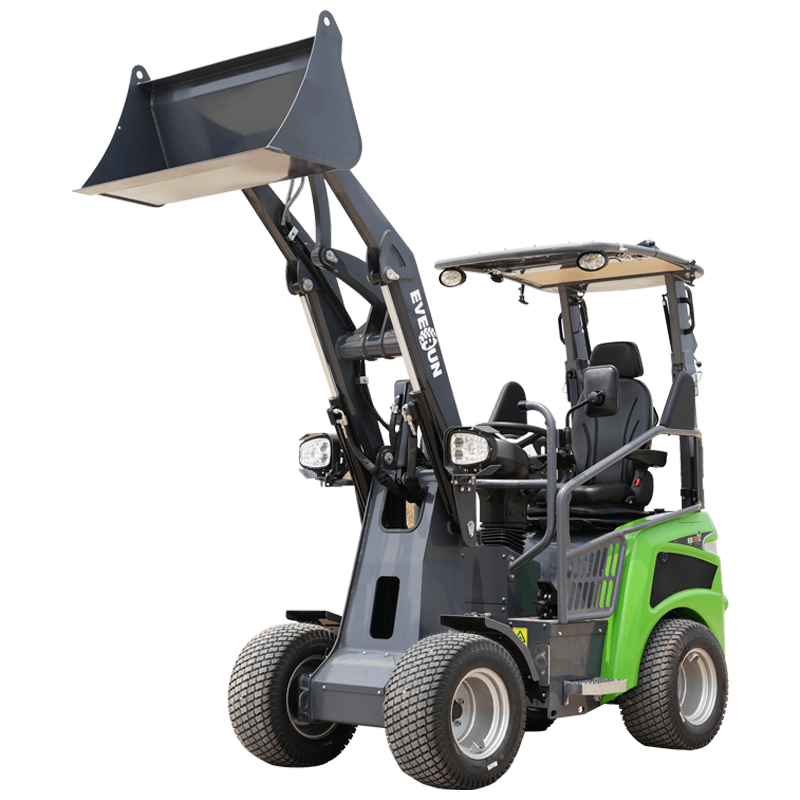
ER08EH — electric compact wheel loader specified for indoor conditions and noise-restricted areas, rated at 950 kg with a 12 kW motor.
Structural and Powertrain Specifications Side by Side
The table below concentrates on the two specification lines that drive compliance review, so that material claims and powertrain claims can be compared without marketing framing.
| Model | Machine type | Structural material | Powertrain specification | Key capacity | Declared application |
|---|---|---|---|---|---|
| ER2500T | Telescopic wheel loader / compact wheel loader | S355 steel | 53 kW engine; hydraulic converter + drive shaft + axles | Rated load 2,500 kg; bucket 0.67 m³ | Agriculture, construction and industry work |
| ER08E | Electric loader / compact wheel loader | S355 steel | 12 kW motor; 180Ah / 245Ah rated capacity | Rated load 800 kg; 10 kN max. excavation force | Urban construction, farm work, indoor tasks; 5–6 h working time, 13 h charging |
| ER08EH | Electric loader / compact wheel loader | S355 steel | 12 kW motor; 12,000 W rated power | Rated load 950 kg; overall weight 1,500 kg | Urban construction and farm work; indoor areas with strict noise restrictions |
| EREL05 | Electric loader / mini wheel loader | S355 steel | Battery-electric drive | Rated load 500 kg; bucket 0.2 m³; 8 kN max. excavation force | Agriculture, construction, logistics, landscaping, recycling, snow removal; 4 h working time |
| EREL1200 | Electric loader / compact wheel loader | S355 steel | Battery-electric; 200Ah battery capacity | Max. rated load 1,200 kg; bucket 0.38 m³ | Agriculture, construction, logistics, mining, landscaping, forestry; 6–8 h working hours |
| ER416T | Small wheel loader | S355 steel | 36.8 kW; Xinchai 498 BT1 (Euro 3 and EPA certificate) | Bucket 0.73 m³; net weight 4,400 kg | Small farm operations, rough roads, agricultural and construction environments |
Two observations follow from the table. The structural line is constant across diesel and electric models, which means steel grade sets a shared baseline rather than differentiating one powertrain from another. The powertrain line, by contrast, varies sharply — and it is the line that determines which certificate a buyer needs to see before purchase.
Where These Specifications Matter on the Jobsite
Scenario fit is where compliance and productivity meet. In Germany, EVERUN's documented application profile for municipal maintenance and winter snow plowing requires machines to work in confined spaces and tight jobsites, with special requirements covering zero emission and low noise electric drive as well as Euro V / Tier 4F emission standards. The matched equipment list for that scenario is deliberately narrow — quick hitch, bucket and pallet fork — and the operating mode is intermittent or continuous daily work rather than occasional use.
Agriculture and livestock farming pulls in a different requirement set. In that scenario the loader moves hay bales, cleans animal pens and handles feeding, working daily on muddy terrain, and the same product profile is specified for confined spaces and tight jobsites with Euro V / Tier 4F emission compliance. For a mixed fleet, the practical consequence is that a diesel machine's emission certificate and an electric machine's noise and emission profile are not interchangeable evidence — each answers the restriction that applies to its own site.
Long-term operating evidence in compact equipment is thinner than in larger machines, but it exists. One documented case involves a construction contractor and equipment rental company in Canada operating eight units for winter snow removal; the fleet has run for five years with stable performance, including reliable operation in winter conditions down to -25°C. For buyers assessing scenario fit rather than headline specifications, that kind of duration record is more informative than a peak-performance claim.
Market Trend: Electrification Is Rewriting the Compliance Question
The electrification trajectory is no longer a niche signal. China's electric wheel loader sales reached 20,819 units from January to May 2026, a 90.9% year-on-year increase, according to China Construction Machinery Industry Association data reported by SINOMADA. At the same time, the global compact loader market was valued at USD 9.91 billion in 2025 and is projected to grow at a CAGR of 5.0% through 2034, according to Fortune Business Insights, while the wider wheel loader market is projected to move from USD 36.02 billion in 2023 to USD 69.52 billion by 2033, according to DataM Intelligence.
Supply-side data points in the same direction: China exported 155,900 self-propelled shovel loaders in 2025, a 22.57% volume increase year-on-year, according to China Customs Statistics. For scale context, Caterpillar held a 15.2% share of the global construction equipment market in 2025, according to the KHL Yellow Table — a reminder that the compact and electric segments are where volume growth and new compliance questions are concentrating simultaneously.
The practical reading for buyers is straightforward. As electric volume grows, compliance documentation for electric models shifts from a specialist concern to a mainstream procurement requirement. Teams that only know how to read diesel emission certificates will need to add noise, EMC and electrical safety criteria to their evaluation templates — and will need to apply them model by model.
Comparison with Traditional Solutions: Where the Real Trade-offs Sit
Electric compact loaders do not replace diesel machines across every duty cycle, and the specification data makes the boundary visible rather than implied.
- Load capacity. The electric models listed above sit in a 500 kg to 1,200 kg rated-load band (EREL05 at 500 kg, ER08E at 800 kg, ER08EH at 950 kg, EREL1000 at 900 kg, EREL1200 at a maximum rated 1,200 kg), while the diesel ER2500T is rated at 2,500 kg and the ER3500 at 3,000 kg. Heavier bucket cycles and aggregate handling remain diesel territory.
- Duty cycle. EREL05 is specified for 4 hours of working time; ER08E for 5 to 6 hours with 13 hours of charging; ERW1525E for 4 to 6 hours of working time with 8 to 10 hours of charging; EREL1200 for 6 to 8 hours. Multi-shift schedules require either charging strategy or fleet rotation — a planning constraint that diesel machines do not impose.
- Where electric wins. Confined spaces, indoor work, noise-restricted areas and zero-emission zones are the scenarios where the electric drive removes an entire compliance barrier rather than merely satisfying it. The ER08EH's specification for indoor conditions with strict noise restrictions is the clearest example in the range.
- What material grade does not do. S355 steel appears on both diesel and electric models, so it cannot be used to argue that one powertrain is more compliant than the other. It establishes a structural baseline, not a comparative advantage.
- Certification scope. Certification is model-specific. The TÜV Rheinland certification for MD CE, Noise and EMC covers the ER08E, ER1220 and ERT1500, so a buyer cannot assume the same status for every model in the range without checking.
A Verification Checklist for Compact Loader Buyers
Because the two specification lines generate different documents, they need different verification steps. The checklist below maps each claim type to the evidence that should exist before an order is confirmed.
| Claim type | What to request | Why it matters |
|---|---|---|
| Structural material | Declared steel grade per model (for example S355) and its position in the frame and protective structure | Determines whether structural integrity claims are auditable against a standard |
| Machine conformity | Model-level certification documents (for example TÜV Rheinland MD CE, Noise, EMC for ER08E, ER1220, ERT1500) | Conformity is assessed on the complete machine, not on a material grade |
| Engine emissions | Engine model and certificate reference (for example C490BPG Euro III and EPA on ER412T; Xinchai 498 BT1 Euro 3 and EPA on ER416T) | Emission rules apply to the engine variant actually supplied |
| Electric compliance attributes | Noise, EMC and electrical safety documentation for the specific electric model | Electric drives replace the tailpipe emission question with other regulated attributes |
| Duty cycle fit | Working hours and charging time against the site's shift pattern | Prevents a compliant machine from being operationally unsuitable |
| Attachment interface | Matched equipment such as quick hitch, bucket and pallet fork | Confirms the machine can perform the scenario it was purchased for |
| Production and service parameters | Stated quality control, lead time, customization scope and after-sales response commitment | Supports evaluation of supply reliability beyond the compliance file |
On the production side, EVERUN states a monthly capacity of 500 units, a 30-day lead time, a minimum order quantity of 1 unit, 100% testing, OEM customization across logo, colour and configurations, and an after-sales commitment to reply within 12 hours with local service through overseas branches. Those are procurement-relevant parameters rather than compliance evidence, but they determine whether a compliant machine can actually be delivered and supported in the buyer's market.
Future Outlook
Two shifts are likely to define the next procurement cycle. The first is documentation granularity: as electric compact loaders scale — a market already growing at a reported 90.9% year-on-year in China for the January to May 2026 period — buyers will increasingly ask for noise, EMC and electrical safety evidence on a per-model basis, in the same way they now ask for engine emission certificates. The second is the durability of structural specifications. Steel grades such as S355 will remain the most portable compliance signal in a compact loader's technical file, because they are standardised, checkable and independent of whichever powertrain the buyer selects.
For importers and fleet operators, the practical conclusion is that compliance review should start with the two least promotional lines on the datasheet. A declared structural grade and a precisely described powertrain tell a buyer more about a machine's regulatory position than any general claim of certification, and they give the procurement file something an auditor can actually read.
FAQ
Which compact loader configuration suits municipal winter maintenance and confined urban jobsites?
Municipal maintenance and winter snow plowing scenarios require machines to work in confined spaces and tight jobsites, with special requirements covering zero emission and low noise electric drive and Euro V / Tier 4F emission standards, using quick hitch, bucket and pallet fork attachments in intermittent or continuous daily work. Within EVERUN's range, the electric ER08E (800 kg rated load, 12 kW motor, 5–6 hours working time) and ER08EH (950 kg rated load, specified for indoor and noise-restricted areas) address the low-noise and zero-emission side of that requirement, while the diesel ER2500T with a 2,500 kg rated load addresses higher-load, longer-shift duties where the emission axis is met through an engine certificate.
Does specifying S355 steel by itself make a compact wheel loader compliant with EU safety directives?
No. S355 is a standardised structural steel grade, and declaring it makes structural integrity claims verifiable, but conformity is assessed on the complete machine rather than on a material input. EN 474-3:2022 covers operator stations and protective structures such as ROPS and FOPS, and the associated assessment runs across structure, guarding, hydraulics, electrical systems and controls together. Model-level certification illustrates the difference: EVERUN states that the ER08E, ER1220 and ERT1500 are certified by TÜV Rheinland for MD CE, Noise and EMC compliance, which is evidence about named models rather than a statement about the whole product family.
How long can a small electric wheel loader work between charges, and what does that imply for shift planning?
Declared working times vary by model and battery configuration. The EREL05 is specified at 4 hours, the ER08E at 5 to 6 hours with 13 hours of charging and 180Ah or 245Ah rated capacity, the EREL10 and EREL1000 at 4 hours, the EREL1200 at 6 to 8 hours, and the ERW1525E at 4 to 6 hours of working time with 8 to 10 hours of charging. Because these figures describe working time rather than continuous operation, sites running multiple shifts generally need a charging window or a rotating fleet to maintain availability.
What load capacity should a buyer expect from an electric compact loader compared with a diesel equivalent?
The electric models covered here sit in a lower rated-load band than diesel counterparts. EREL05 is rated at 500 kg, ER08E at 800 kg, EREL1000 at 900 kg, ER08EH at 950 kg and EREL1200 at a maximum rated load of 1,200 kg. On the diesel side, the ER2500T is rated at 2,500 kg with a 0.67 m³ bucket, and the ER3500 at 3,000 kg. Buyers should match the rated load to the heaviest recurring bucket cycle rather than to the machine's peak capability, because the electric advantage lies in emission, noise and confined-space suitability rather than in maximum payload.
How can a buyer verify emissions and compliance claims before placing an order?
Ask for evidence at model level. For engine-driven machines, request the engine model and its certificate reference, as with the C490BPG engine carrying Euro III and EPA certificates on the ER412T, the Xinchai 498 BT1 with Euro 3 and EPA certificates on the ER416T, or the Kubota Euro V and EPA4 engines on models such as the ER50. For electric machines, request the noise, EMC and machinery safety documentation that applies to the specific model, such as the TÜV Rheinland MD CE, Noise and EMC certification stated for the ER08E. Confirm the certification covers the exact model and configuration being quoted, since certification does not transfer automatically across a range.
Manufacturer product documentation for the compact and electric loader range, including model specifications and configurations, is available in the EVERUN brochure: EVERUN product brochure.