
What OEM/ODM Signals Matter in Sodium Hyaluronate Sourcing
What OEM/ODM Signals Matter in Sodium Hyaluronate Sourcing
Most sodium hyaluronate sourcing conversations eventually move from grade selection to execution. Once a buyer knows the target grade and molecular weight range, the next question is not simply whether a supplier has the product, but whether it can adjust, document, and ship the product for a specific formulation project. That shift from catalogue availability to contract manufacturing capability is where OEM and ODM signals become practical evaluation criteria.

Fermenter at Shandong Habier Biopharma Co.,LTD production facility.
The Capability Question Behind Hyaluronic Acid Procurement
Procurement teams sometimes prioritize unit price before confirming four operational variables: minimum order quantity, lead time, customization scope, and pre-shipment quality evidence. For sodium hyaluronate, these variables are not administrative details. A low minimum order quantity changes pilot feasibility. A 5–8 day lead time changes inventory planning. Purity adjustment changes whether the material can support a differentiated cosmetic formula or a pharma-adjacent project.
What the Supplier’s OEM/ODM Model Actually States
Shandong Habier Biopharma Co.,LTD is a Qufu, Shandong-based biomanufacturer established in 2015. It operates a 50,000 m² production site, reports an annual output range of 600–700 metric tons, and maintains an R&D team of six engineers. Its service model includes both OEM and ODM, with purity adjustment as a customization parameter. The practical operating figures for evaluation-stage buyers are: minimum order quantity 1 kg; typical lead time 5–8 days; monthly production capacity 50–60 tons; and 100% full inspection before delivery. Delivery is available on FOB/CIF terms. Pre-shipment control includes full testing with a COA report, and the supplier indicates support for third-party laboratory inspection and on-site factory inspection.
Quality system statements include ISO 9001:2015, ISO 22000:2018, HACCP, Kosher, Halal, COSMOS, and ISO 16128. The ISO 22000 certificate covers sales of Sodium Hyaluronate (Hyaluronic Acid) and Chondroitin Sulfate and related food safety management activities. These credentials are relevant when a buyer needs to move beyond a standard COA and verify the surrounding management system.
Technical Grades and Molecular Weight Considerations
Sodium hyaluronate is not a single interchangeable input. In the supplier’s product documentation, food grade is specified at 0.8–1.5 million Da, cosmetic grade at 1.0–1.5 million Da, pharma grade at a minimum of 2.0 million Da, high molecular weight grade at a minimum of 2.0 million Da, and low molecular weight grade at a maximum of 0.1 million Da. The distinction matters because molecular weight influences formulation behavior: higher molecular weight fractions are generally associated with viscosity and film-forming properties, while lower molecular weight fractions are more commonly evaluated for penetration and low-viscosity systems.
The product family also includes hydrolyzed, low molecule weight, ultra low molecule weight, and super low molecule weight variants under hyaluronic acid and sodium hyaluronate forms. These variants create formulation flexibility, but each should be matched to stability and performance criteria relevant to the final matrix.
Application and Import Evidence
One documented North American case illustrates how capability claims translate into import execution. A US-based natural cosmetic and health supplement importer sourced 4,733 kg of avian-origin sodium hyaluronate for cosmetic raw material and oral health care supplement raw material applications. The shipment was supported by complete official veterinary heat treatment certification and met US APHIS import standards. Customs clearance proceeded with a valid USDA import permit. The relationship continued with long-term stable use and repeat orders.
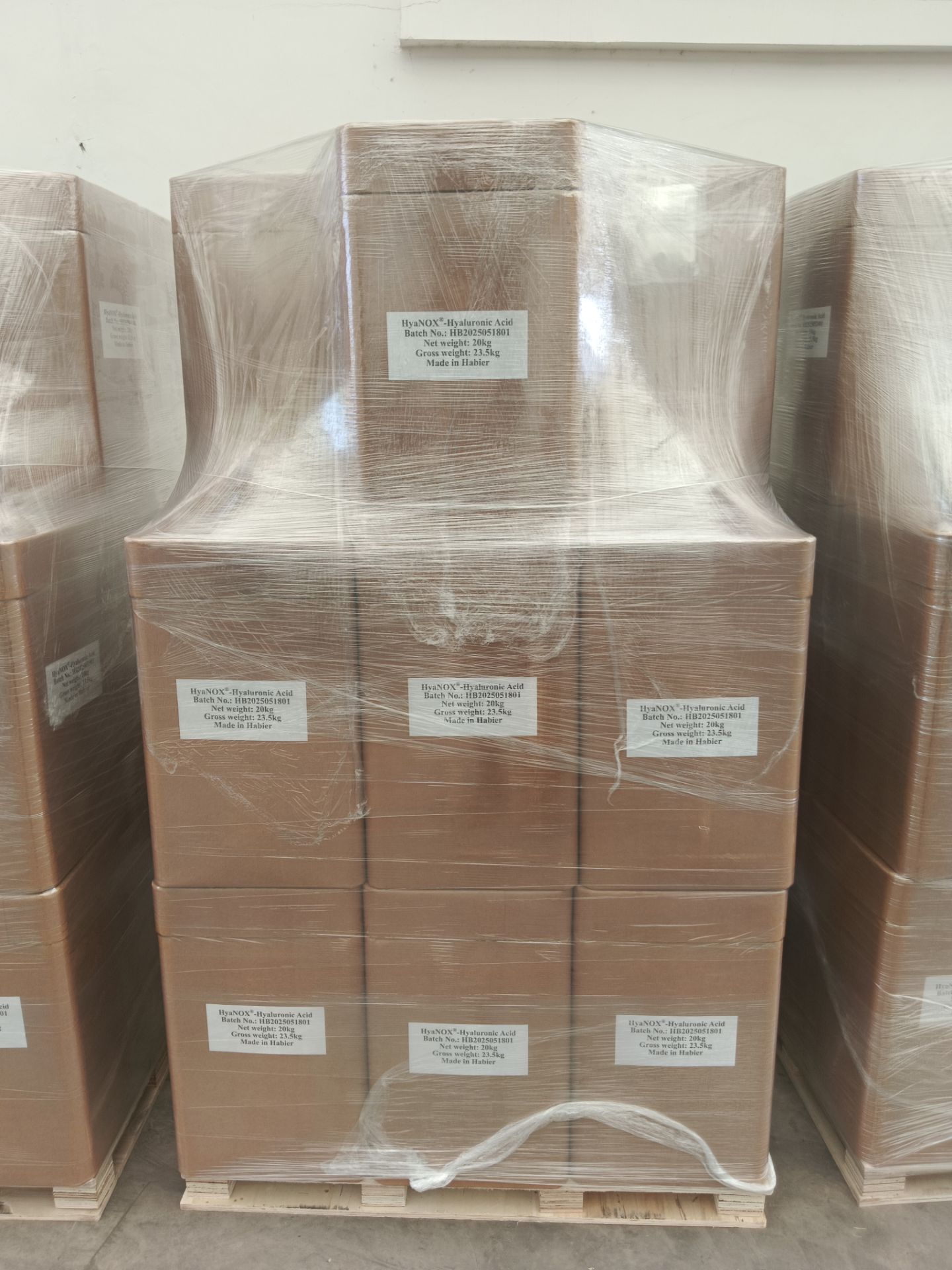
Packaging used in a sodium hyaluronate export shipment.
This example matters because it connects the supplier’s production capability to a specific regulatory pathway. For buyers evaluating import risk, the existence of APHIS-relevant documentation and USDA import permits is often more useful than a generic statement of export experience.
Market Context and Supplier Landscape
Third-party market data supports why capability differentiation is increasing. Reports and Data estimates the global sodium hyaluronate raw material market at approximately USD 504 million in 2024. The same source values the food grade sodium hyaluronate segment at around USD 0.5 billion in 2024, with a projected CAGR of 8.5% through 2034. Grand View Research places the cosmetic grade segment at 61.91% of the hyaluronic acid raw material market in 2025. This helps explain why many supplier conversations cluster around cosmetic formulations, even when food and pharma-adjacent applications remain commercially relevant.
It is also useful to note that market estimates vary depending on whether they cover raw material only or include hyaluronic acid-based finished products such as fillers and medical devices. Public market analyses identify major competitors including Bloomage Biotech, Fidia Farmaceutici, Kewpie Corporation, and Contipro a.s. This landscape does not imply a single better supplier; it signals that buyers should compare the same capability fields across providers rather than treating all sodium hyaluronate sellers as equivalent.
Comparing OEM/ODM with Commodity Sourcing
Compared with a commodity-oriented purchase, an OEM/ODM-oriented supplier is most relevant when the buyer needs specification adjustment, low initial volumes, or export documentation for a specific market. The trade-off is that not every contract manufacturing model fits every finance policy or formulation positioning. The supplier’s stated payment structure favors a high advance payment mode for standard transactions, although large long-term clients may negotiate separately. This may create friction for buyers that require open-account terms.
In addition, the avian-origin raw material is well documented for certain US import requirements, but it may not be appropriate for every vegan or non-animal-origin formulation. Origin should be confirmed early, before a brand claim is locked into a formula. Third-party laboratory inspection and on-site factory inspection are supported, but final acceptance remains with the buyer’s own release testing and target-market requirements.
Future Outlook
As the sodium hyaluronate market matures, procurement questions are likely to move from whether the material is available to whether the supplier can prove repeatable execution across grade, batch documentation, and destination market. Suppliers that combine a 1 kg entry point with structured pre-shipment evidence and customs pathway experience are better matched to evaluation-stage buyers. This should favor capability audits, sample validation, and documentation review as core steps, rather than price-per-kilogram comparisons alone.
Frequently Asked Questions
What is the minimum order quantity and production lead time?
The stated minimum order quantity is 1 kg. Typical production lead time is 5–8 days. Monthly production capacity is 50–60 tons.
What customization scope is available for sodium hyaluronate?
The manufacturer provides OEM and ODM services and lists purity adjustment as a customization option. Delivery is available on FOB/CIF terms.
Which certifications apply to the sodium hyaluronate manufacturing system?
The company reports ISO 9001:2015 and ISO 22000:2018 certification, along with HACCP, Kosher, Halal, COSMOS, and ISO 16128. The ISO 22000 scope covers sales of Sodium Hyaluronate (Hyaluronic Acid) and Chondroitin Sulfate and related food safety management activities.
How can a buyer verify product quality before shipment?
The supplier states 100% full inspection before delivery, pre-shipment full testing with a COA report, and support for third-party laboratory inspection and on-site factory inspection.
What documentation has supported US import of sodium hyaluronate?
In a documented case, avian-origin sodium hyaluronate with complete official veterinary heat treatment certification met US APHIS import standards. Customs clearance was supported by a valid USDA import permit.
Additional background: Shandong Habier Biopharma Co.,LTD product brochure.