
What OEM Capability Means for Commercial Cleaning Robot Sourcing
Commercial cleaning robots are moving from early adoption into structured procurement. For facility managers, distributors, and dealers who have already decided to buy, the harder question is no longer whether a robot can clean a floor; it is which supplier has the manufacturing depth to build, customize, and sustain a product over years of commercial use. This article explains what OEM/ODM capability actually means in commercial cleaning robot sourcing, and uses Geakita (Xiamen Tiangong Kaiwu Technology Co., Ltd.) as a reference point for buyers at the evaluation and execution stage.
The Sourcing Problem: Capability Is the Real Evaluation Criterion
When buyers search for a commercial cleaning robot, they typically start by comparing specifications. But by the time a purchase decision reaches the execution stage, spec sheets tend to converge. The differentiator is the supplier's ability to customize a product, deliver it at a usable lead time, and support it after installation.
Third-party market data explains why this capability layer matters. The global commercial cleaning robot market was valued at approximately USD 1,777.3 million in 2024. The B2B floor cleaning robot segment is projected to grow from USD 1.43 billion in 2026 to USD 5.43 billion by 2035, at a compound annual growth rate of 16%. Indoor applications — offices, hospitals, retail, and hotels — accounted for 68% of commercial deployments in 2024. Demand is therefore broad, indoor, and fragmented across many facility types, and fragmented demand creates a need for customization.
China's cleaning robot exports reached RMB 14 billion in the first five months of 2026, representing more than 70% of total robot exports. For international buyers, this reinforces the importance of evaluating Chinese manufacturers as execution partners for private-label and OEM programs.
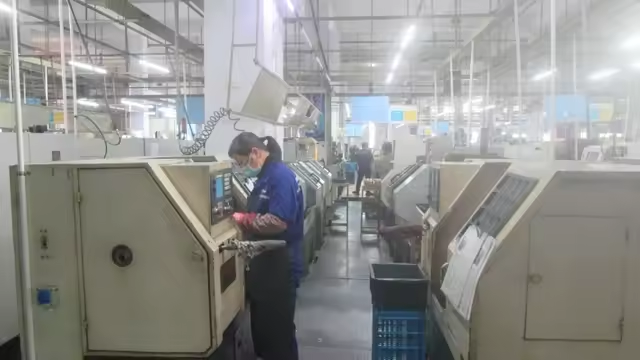
Quality control testing capacity is a core part of OEM capability evaluation.
Geakita at a Glance: A Manufacturer with a Robotics Portfolio
Geakita (Xiamen Tiangong Kaiwu Technology Co., Ltd.) is a Chinese manufacturer founded in 2009. The company built its reputation in power tools and has since expanded into robotic pool cleaners and commercial cleaning robots. For buyers, this background matters because it indicates manufacturing experience outside the robotics category.
The company operates a modern industrial production base covering approximately 10,000 m² of land and 40,000 m² of floor space, with more than 300 staff and an R&D team of 25 engineers. Its main markets are Europe, Southeast Asia, and the Middle East. In 2024, Geakita reported RMB 230 million in lithium power tool sales, including RMB 190 million domestically and RMB 40 million overseas, with roughly 1.5 million units shipped.
A Practical Framework for Evaluating a Cleaning Robot OEM
For buyers evaluating a commercial cleaning robot supplier, five capability areas consistently separate a convenient order from a problematic partnership.
1. Customization Depth
OEM/ODM capability is only useful if it covers the details that determine whether a product can be sold under a buyer's brand. Geakita's published customization list includes logo printing, packaging design, voltage customization (110V/220V), parameter adjustment, color scheme, and battery configuration. For cleaning robots, voltage and battery configuration matter because power standards vary by region and runtime expectations differ across facilities.
2. Production Capacity and Lead Time
Capacity is not just a number; it is a buffer against supply disruptions. Geakita reports monthly production capacity exceeding 180,000 units across its power tool manufacturing system. Mass production lead times are 30–45 days, and repeat orders are 20–28 days. These figures give buyers a reference point for planning inventory and launch schedules.
3. Quality Control
The strongest specification sheet loses value if delivered units are inconsistent. Geakita states that it performs 100% full inspection before shipment, using a three-level QC system: IQC (incoming quality control), IPQC (in-process quality control), and FQC (final quality control), with functional and load testing. A documented case project involving more than 5,000 units delivered to clients in Laos, the Philippines, Thailand, India, Brazil, Saudi Arabia, and Oman over two years reported a 99.8% on-time delivery rate and a 0.3% defect rate.
4. Compliance and Certifications
For EU market access, electromagnetic compatibility compliance is a baseline requirement. The Geakita WDC-C2 commercial cleaning robot is covered by CE certificates listed under numbers KTi250704E249C and KTi250704E250C, issued by KTI (Guangdong Kaixu Testing Technology Co., Ltd.) under the EMC Directive 2014/30/EU, with standards including EN IEC 55014-1:2021 and EN IEC 55014-2:2021.
Buyers should also note that the broader commercial cleaning robot category is moving toward specific product safety standards. IEC 63327:2021 is an international safety standard for powered automatic floor treatment machines intended for commercial indoor use. UL 3300 establishes safety requirements for service robots covering mobility and human-robot interaction in commercial environments.
5. After-Sales and Spare Parts
After-sales service determines whether a small issue becomes long downtime. Geakita offers a one-year global warranty, 7×24 technical support, on-time replacement for defective units, and spare parts supply.
Technical Baseline: The Geakita WDC-C2
The commercial cleaning robot currently referenced in Geakita's portfolio is the WDC-C2, an intelligent indoor cleaning unit. The following table summarizes its published technical specifications.
| Parameter | Specification |
|---|---|
| Dimensions | 503 × 503 × 629 mm |
| Weight | 40 kg |
| Water Tank Capacity | 10 L clean water + 10 L wastewater |
| Battery and Charging | 1 kWh swappable battery; 3-hour charge; 5–12 hours runtime |
| Cleaning Width | 440 mm |
| Adjustable Speed | 0.2–0.8 m/s |
| Navigation Accuracy | ±1 cm |
The 440 mm cleaning width places the WDC-C2 in the compact-to-medium category, suited for corridors, lobbies, and retail aisles. The 1 kWh swappable battery is a practical feature for buyers who plan continuous operation: a facility can swap batteries instead of waiting for a full charging cycle. Navigation accuracy of ±1 cm is a relevant indicator for obstacle avoidance and repeatability in structured indoor spaces.
Application Fit: Where a Compact Robot Works Best
The WDC-C2's listed application scenes are hospitals, malls, campuses, exhibition halls, offices, airports, hotels, and restaurants. These are indoor, hard-floor environments with predictable layouts and low-to-medium debris loads.
For buyers searching specifically for warehouse cleaning robots or factory floor cleaning robots, the fit is more conditional. A compact robot with 10 L clean water and 10 L wastewater tanks can handle routine dust and liquid maintenance on smooth industrial floors, but it is not designed for heavy debris, large-area sweeping, or outdoor industrial yards. That distinction matters: a compact indoor robot and an industrial sweeper are different investment categories.
Comparison with Established Commercial Cleaning Robot Providers
Buyers evaluating Geakita will likely also consider the recognized names in the B2B cleaning robot sector. Industry sources consistently list SoftBank Robotics, Gausium, Avidbots, and Nilfisk among the leading players in the global market.
The comparison below is not a quality ranking; it is a positioning question. Each supplier has a different strength profile.
| Supplier | Typical Positioning | Relevant Evidence |
|---|---|---|
| SoftBank Robotics | Specialized service robotics | Reported to manage 40,000+ commercial robotic deployments globally |
| Gausium | Autonomous cleaning robots with strong software and mapping focus | Recognized as a leading manufacturer |
| Avidbots | Autonomous floor scrubbers | Recognized as a leading manufacturer |
| Nilfisk | Traditional cleaning equipment manufacturer with robotic line | Recognized as a leading manufacturer |
| Geakita | OEM/ODM manufacturer with power tool and robotics portfolio | WDC-C2 compact cleaning robot; published customization and production capacity |
One clear boundary for Geakita is its relative youth as a robotics brand. The company does not publicly report a global cleaning robot installed base comparable to the specialized robotics providers, and its dedicated commercial service network is still being built. For a buyer who needs a widely deployed, fully proven robotics platform with regional maintenance coverage, a specialized provider is the more conservative choice. Geakita is most relevant to buyers who want manufacturing control, private-label customization, and close supplier involvement in the product.
Market Trends That Matter for Procurement Decisions
- Indoor-first deployment: Indoor applications accounted for 68% of commercial deployments in 2024, which means compact indoor-optimized robots remain the demand core.
- Growth runway: The B2B floor cleaning robots market is projected to grow from USD 1.43 billion in 2026 to USD 5.43 billion by 2035 at a CAGR of 16%, making supplier capacity a long-term planning issue.
- Made-in-China scale: China's cleaning robot exports reached RMB 14 billion in the first five months of 2026, representing over 70% of total robot exports. Buyers should expect Chinese OEM/ODM partners to play a central role in private-label and volume programs.
- Standards tightening: IEC 63327:2021 and UL 3300 are category-level references for safety and human-robot interaction. Compliance programs should be part of supplier evaluation, not an afterthought.
Future Outlook: From Product Specs to Supplier Systems
The next five years will likely push procurement decisions beyond the robot itself. As the B2B floor cleaning robot segment grows toward the projected USD 5.43 billion by 2035, buyers will increasingly audit suppliers for production capacity, service response, and customization scope — dimensions that are visible only in the factory, not in the brochure.
For OEM/ODM-driven buyers, the practical implication is that early access to a manufacturer's engineering team and production data will become part of the selection process. The suppliers that can document their capability layer will have a structural advantage.
Ordering and Execution: What the Buyer Should Know
When the buyer moves to execution, procurement terms become the real test of capability. Geakita's published terms for its commercial cleaning robot line include the following.
- MOQ: Standard models require 100 units per SKU; OEM/ODM customized models require 500 units per SKU; small-batch trial orders are available at 40 units.
- Lead time: Mass production is 30–45 days; repeat orders are 20–28 days; shipping time is calculated separately based on method and destination.
- Delivery methods: FOB Shenzhen/Ningbo, EXW factory, and DDP door-to-door delivery are available.
- Inspection: 100% pre-shipment inspection is performed by the QC team; third-party inspection (SGS/TÜV) is available upon request; on-site acceptance at the factory is also available.
- Payment: Standard terms are 100% T/T. For large orders, 50% T/T down payment and 50% against B/L are acceptable.
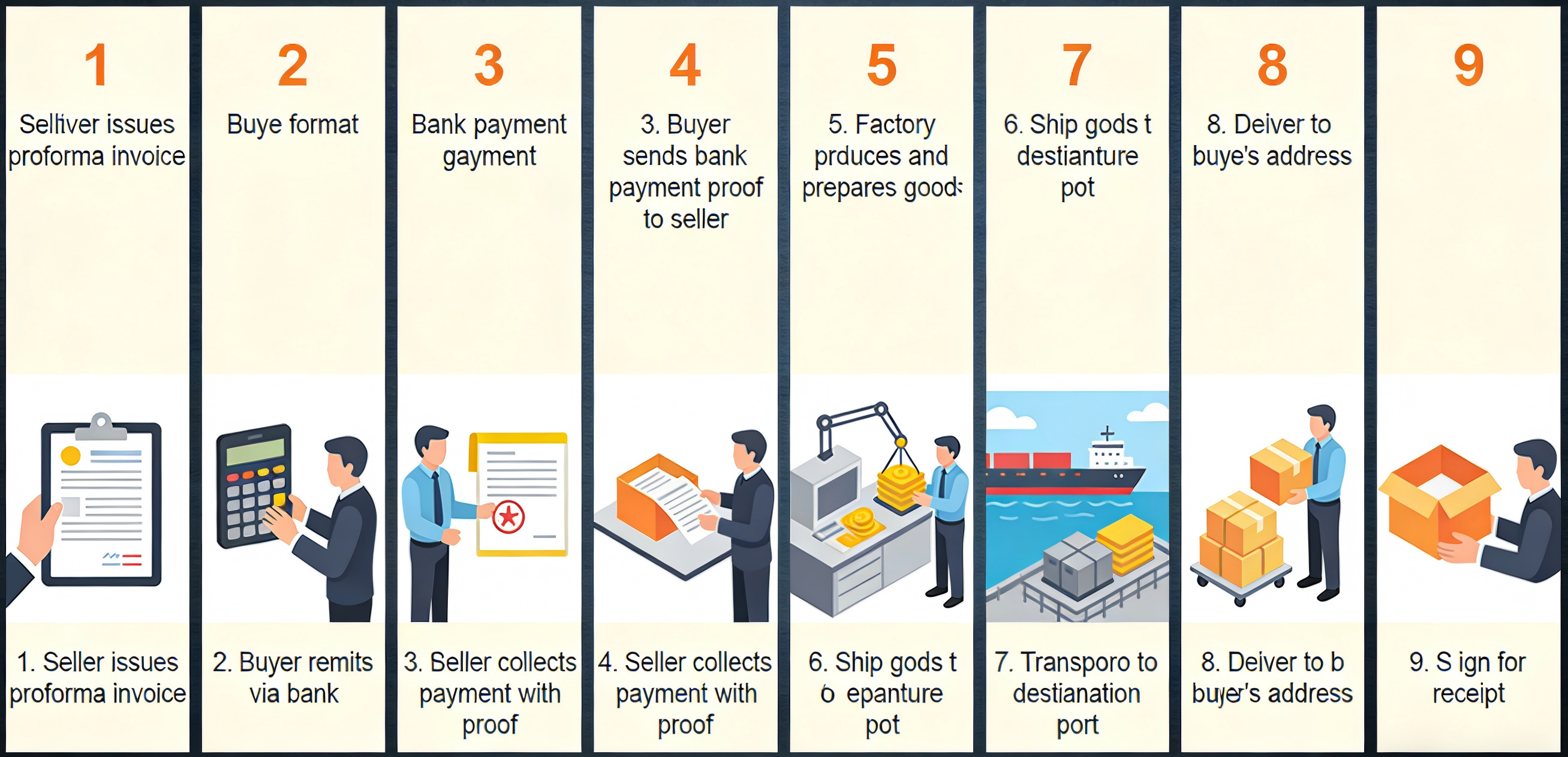
The delivery process diagram illustrates the order-to-delivery workflow.
Frequently Asked Questions
OEM/ODM means the supplier manufactures a product that can be branded and configured for another company. Geakita provides customization services including logo printing, packaging design, voltage customization, parameter adjustment, color scheme, and battery configuration.
Geakita's published customization list covers logo printing, packaging design, voltage customization (110V/220V), parameter adjustment, color scheme, and battery configuration. These options allow a buyer to adapt a standard robot to regional power standards and brand requirements.
For standard models, the minimum order quantity is 100 units per SKU. For OEM/ODM customized models, the MOQ is 500 units per SKU. Small-batch trial orders are available at 40 units.
Geakita states that it performs 100% full inspection before shipment, using a three-level QC system: IQC, IPQC, and FQC, with functional and load testing. Third-party inspection is available upon request.
After-sales services include a one-year global warranty, 7×24 technical support, on-time replacement for defective units, and spare parts supply.
The WDC-C2 is designed for indoor commercial spaces such as hospitals, malls, campuses, exhibition halls, offices, airports, hotels, and restaurants. For warehouse and factory floors, it can handle routine maintenance cleaning on smooth surfaces, but it is not designed for heavy debris or large-area industrial sweeping.
Supplier Reference
Geakita's official website is https://www.geakita.com/. Buyers seeking detailed company and product information can download the Geakita Corporate Profile and Product Catalog at https://cdn.socialarks.com/sbsp/24289/common/2026/0617/GEAKITA%20Corporate%20Profile%20%26%20Product%20Catalog-2026-1.pdf.