
What Makes Ultrasonic Cutting Machines Food Safety Ready
What Makes Ultrasonic Cutting Machines Food Safety Ready
Industrial food cutting equipment is specified in two directions at once: throughput and hygiene. In bakery and dairy plants, a cutter that leaves cream on the blade, compresses a layered product, or cannot be opened for cleaning creates a hygiene burden that shows up in audits rather than only in yield figures. Ultrasonic cutting machines address that problem at the cutting interface. A titanium alloy sonotrode vibrating at approximately 20 kHz separates product with low friction instead of downward pressure, which changes both the appearance of the cut and the amount of residue left behind on product-contact surfaces.
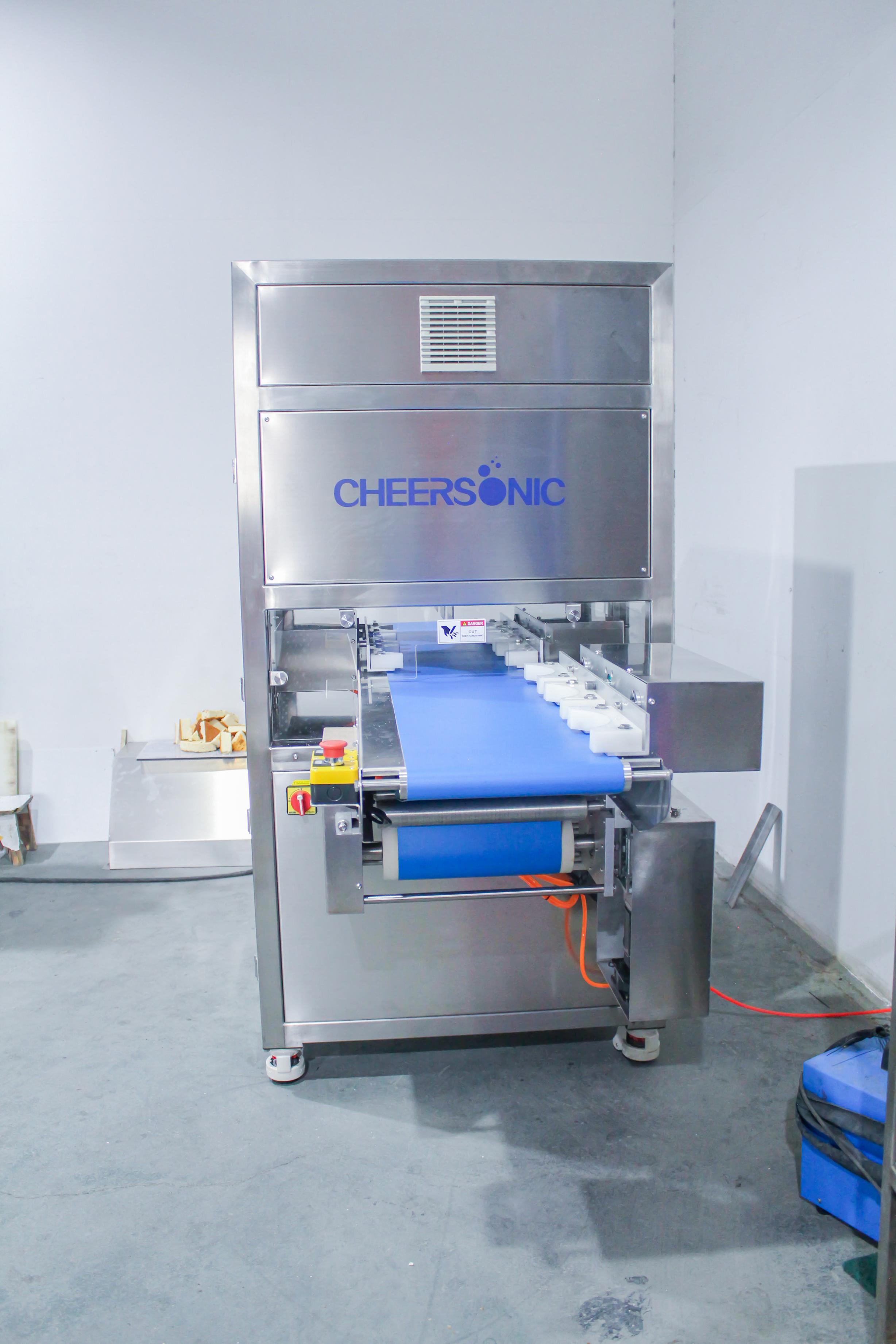
Ultrasonic cutting equipment in food production: product-contact materials, cleanable geometry and washdown protection are specified before installation, not after an audit.
This article examines how ultrasonic cutting equipment supports food safety compliance through materials of construction and hygienic design. It is written for the evaluation stage, for buyers, plant engineers and quality teams comparing cutting equipment for bakery, dairy and prepared-food lines. It deliberately avoids certification claims, because a certificate belongs to a specific machine, market and validity period. The material and design decisions described below are the parts a buyer can inspect, question and verify on any quotation.
Why food safety compliance is an installation outcome
No supplier can attach a food safety label to a machine in a way that travels with the equipment. Compliance is decided where the machine runs, against the processor's own food safety plan, the cleaning regime that plan defines, and the regulations of the market where the finished product is sold. Two plants can install identical ultrasonic cutters and reach different conclusions if their zoning, drainage, cleaning procedures or airflow differ.
What a supplier can control is readiness, and readiness has four practical components:
- Product-contact materials that are cleanable, non-reactive and appropriate for the food being cut;
- Geometry and tooling that allow residue to be removed quickly, including detachable parts;
- A protection grade that survives the washdown routine actually used on site;
- Repeatable, recordable operating parameters, so that cleaning and changeover follow a fixed procedure rather than an operator's judgement.
Cheersonic (Hangzhou Cheersonic Ultrasonics Equipments Co., Limited) is an ultrasonic equipment manufacturer founded in 2014 in the Fuyang District of Hangzhou, China, whose core products are ultrasonic cutting and ultrasonic spraying equipment for bakery, dairy, medical, electronics and energy applications. The company states a 7,150 m² production facility, 100 employees, a 20-engineer R&D team and an annual output of 1,200 units, with a monthly capacity of 30 sets of ultrasonic cutting equipment. Capacity figures matter to buyers evaluating hygiene readiness, because they mark the difference between a one-off bespoke build and a repeatable, documented production standard.
Materials of construction: stainless steel and titanium alloy
For the industrial cutting range, documented across the ultrasonic cutting, ultrasonic slicing, ultrasonic cutting machine, ultrasonic food cutting machine, ultrasonic cake cutting machine and ultrasonic cheese cutting machine families, Cheersonic lists the material composition as stainless steel and titanium alloy. The two materials perform different jobs in a hygiene argument.
Titanium alloy carries the cutting function. Blades in the cake and cheese families are described as titanium ultrasonic cutting blades (sonotrodes), and the cutting tools family is documented with interchangeable ultrasonic titanium blades. Company product literature describes ultrasonic cutting equipment as high precision, non-stick and low wear. For a food plant the practical consequence is straightforward: product does not have to be released from a sticky edge, because separation is assisted by vibration, so there is less smearing and less material carried forward on the tool between cuts.
Stainless steel carries the body and the surfaces a cleaning team touches. Two documented installations make the design intent explicit. An Irish dairy manufacturer running four units for wheel-cheese wedge cutting describes the machine body as food-grade 304 stainless steel, detachable for cleaning. A UK baking installation describes the whole machine as 304 stainless steel. Both are installation-level statements rather than universal specifications, which is exactly why buyers should ask for the material grade of each individual product-contact part instead of accepting a single stainless steel answer that may describe only the outer panels.
A buyer's material checklist
- Blade and sonotrode material and grade, plus the documented replacement interval;
- Machine body, frame and guards: grade of stainless steel and surface finish;
- Product guides, anvils, holders and every component that touches product;
- Conveyor and belt elements, which are separate product-contact components and need their own specification;
- How detachable parts are actually removed. Ask for the disassembly sequence, not only the claim;
- Whether the same materials and finishes apply to the unit that will be delivered, because configuration varies within a model family.
Hygienic design and washdown protection
Material alone does not make a machine washdown-ready. Cheersonic documents IP65 washdown grade protection for the ultrasonic cutting machine and ultrasonic food cutter families, IP65 washdown compliance on the same range, and a food-grade washdown structure for the cake slicing and cheese cutting systems. The cutting tools family adds a quick-release sanitary design for food production and quick-change cutting tools.
The cheese cutting documentation adds two details that matter in chilled dairy halls: chilled-product temperature handling for cutting cheese at low temperature, and a working temperature range for the cutter range of -14°C to 40°C. In the Irish wheel-cheese installation, the equipment was described as an integrated compact design that required no workshop renovation and freed floor space for packaging stations. That is a hygiene-relevant outcome as much as a layout benefit: fewer surfaces and less floor clutter make cleaning routes shorter and more predictable.
Utilities also belong on the hygiene checklist. The cutting range is documented at 208–240 V, 50/60 Hz with an air requirement of 6 CFM at 90 PSI. Compressed air is a utility most food plants already regulate; when new equipment is introduced, the plant's own rules for air quality and for routing services away from product zones apply to that installation.
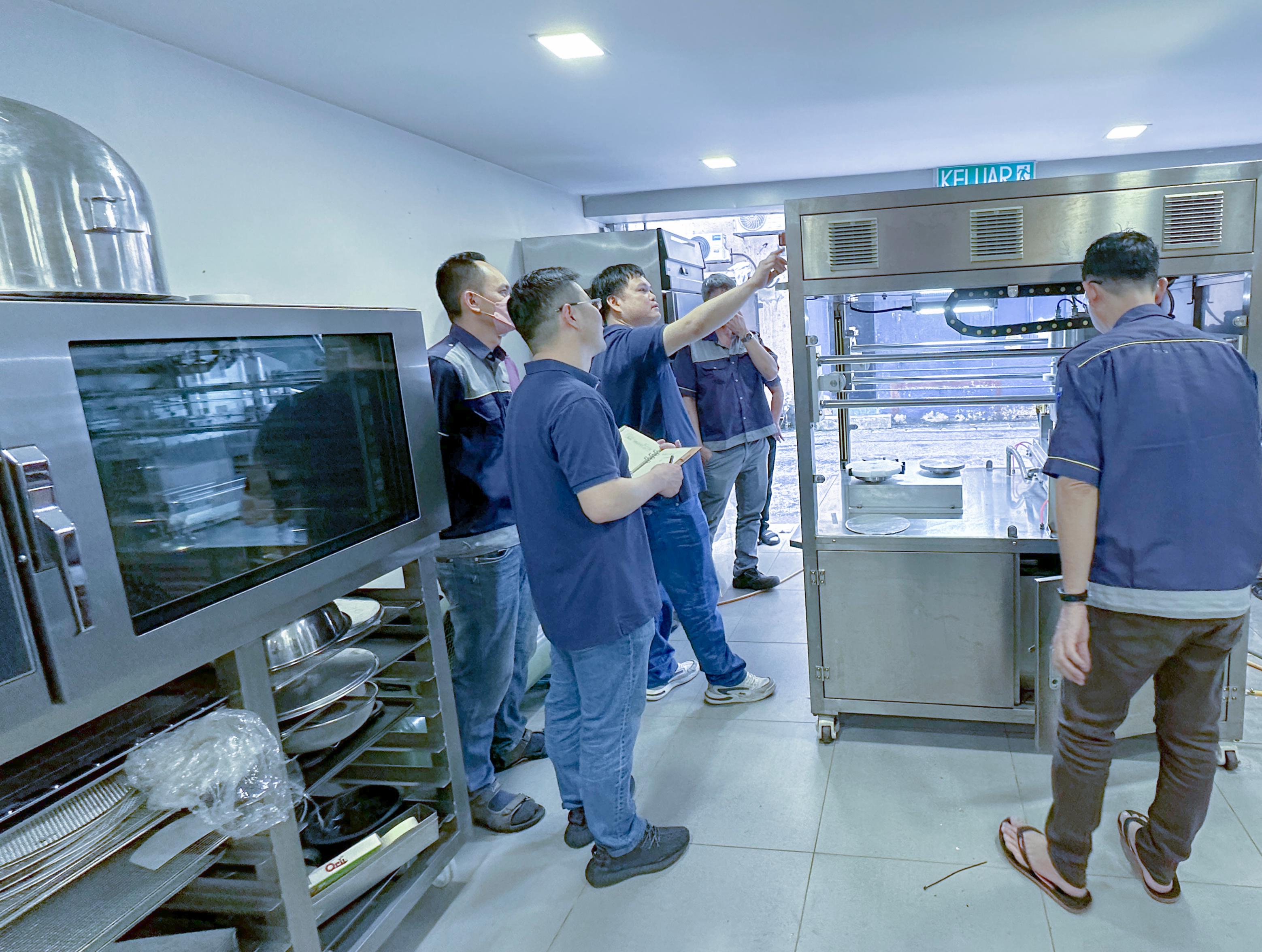
Testing and inspection before delivery: material composition, protection grade and operating parameters are verified as part of the build record rather than assumed at commissioning.
How 20 kHz vibration affects residue, cleaning intervals and repeatability
The operating frequency of Cheersonic's food cutting equipment is the technical starting point for the hygiene argument. Documented values for the cutting tools family are a blade vibration frequency of approximately 20 kHz, a cutting accuracy of ±0.5–1.0 mm depending on product type, a product height range of up to about 100 mm, and cutting speed up to 200–1,200 products per hour. The ultrasonic cutting machine and ultrasonic food cutter families are documented at 20 kHz with power ranges of 800–1800 W and 800–1600 W respectively, a maximum cutting width of 600 mm, and an output capacity of 50–1500 pieces per hour. The cheese slicer family documents 20 kHz vibration, fixed-weight, catch-weight or portion cutting, and a portion weight control figure stated as ±1% typical industry standard. The slicing families document speeds up to 300 products per hour across frozen, chilled and hard products as well as fresh, ambient and sticky products.
Lower friction at the blade produces three effects a quality team can verify on the line:
- Less residue on the tool between cuts, which reduces how often production must stop for blade cleaning;
- Less product deformation at the cut face, so trimmings and rejects, the material that normally becomes waste or rework, are reduced;
- Higher repeatability, because the cut depends on a controlled vibration and indexing system rather than on how sharp an edge happens to be at that hour of the shift.
Control architecture supports the same objective. The cutting range uses servo touch screen control with automatic indexing, and conveyor speed is described as adjustable and PLC controlled. In the UK bakery installation, formula parameters were stored for one-click recall; in the Irish dairy case, production data was retained automatically for cost control and standard quality management. Parameter recording is a food safety asset in its own right, because it converts the operator cut it the usual way into a documented process that can be audited and repeated.
Model-level readiness across the ultrasonic cutting range
For buyers at the evaluation stage, the useful comparison is not which machine is fastest but which platform matches the product, the cleaning routine and the utilities available. The table below summarises documented attributes of the main cutting families.
| Model / family | Typical food use | Product-contact materials | Hygiene-relevant design | Documented operating data |
|---|---|---|---|---|
| UFM5000, UFM8101 (cake cutting machine and cake slicer family) | Soft, sticky, layered and cream-filled cakes; round, sheet, tray-baked and layered products | Stainless steel and titanium alloy; titanium ultrasonic cutting blade | Food-grade hygienic wash-down structure; quick-change cutting tools and easy-cleaning design; manual, semi-automatic or robotic configuration | 20 kHz vibration; high-accuracy equal-portion slicing; custom cutting patterns; batch or inline conveyor cutting |
| HFM2300 (ultrasonic cutting machine and food cutter family) | Bakery, confectionery, dairy, frozen food and ready-to-eat production | Titanium alloy and stainless steel; interchangeable ultrasonic titanium blades | IP65 washdown grade; quick-release sanitary design for food production | 20 kHz; 800–1800 W; 208–240 V, 50/60 Hz; 6 CFM at 90 PSI; max cutting width 600 mm; 50–1500 pcs/h; -14°C to 40°C |
| CWM100, UFM8100C, UFM1000C, UFM2200C (cheese cutting machine and cheese slicer family) | Block, wheel, stick and extruded cheese; chilled or ambient product | Titanium alloy and stainless steel; titanium ultrasonic blade (sonotrode) | Stainless steel food-grade design; hygienic design with easy wash-down capability; detachable construction | 20 kHz; fixed-weight, catch-weight or portion cutting; portion weight control stated as ±1% typical industry standard; inline conveyor, batch or robotic system |
Attributes are drawn from Cheersonic product data for each cutting family. Specifications are configuration dependent; confirm the exact build, material grade and protection rating for the unit quoted.
Where the requirement meets the product: documented food installations
- UK bakery. An ultrasonic cake cutting machine (model 5691) cutting sponge cakes, mousse cakes and multi-layer cakes on an assembly line ran fully unmanned, removed three operator positions, raised product qualification to 99%, cut raw material loss by 32% and increased shift cutting capacity by 2.4 times, with a vibration self-cleaning cutting head reducing cleaning stops.
- Irish dairy. Four units for precision wedge cutting of wheel cheese reduced equipment footprint by more than 70% and production changeover time by 70%. The machine body is described as food-grade 304 stainless steel, detachable for cleaning, with AI-generated cutting schemes and ultrasonic cold cutting that neither compresses nor heats the product.
- Russian bakery and prepared-food plant. Three units for automated equal cutting of filled pies at frozen and ambient temperatures reached a product qualification rate of 98% and reduced raw material loss by 35%, using food-grade stainless steel construction and ultrasonic cold cutting without filling overflow.
- US confectionery. An automated inline cutting system for pure chocolate bars and composite rocky-road products integrated with existing forming, cooling and conveying lines, achieving a 40% reduction in labour costs and a 65% increase in hourly capacity, with a food-grade detachable blade and no particle shedding or sectional cracking.
- Polish seafood processor. Five units cutting frozen and semi-frozen mackerel and herring delivered a 160% capacity improvement and a 40% reduction in raw material loss, with IP65 waterproof and corrosion-resistant construction and non-destructive ultrasonic cutting.
Market signals behind the hygiene conversation
Third-party research puts the ultrasonic cutters market, which includes food cutting applications, at USD 2.8 billion in 2025 with a projected CAGR of 7.2% through 2033 (Dataintelo). In the adjacent ultrasonic spray coating category, the market was valued at USD 0.5 billion in 2024 and projected to reach USD 1.2 billion by 2034 (Market Research Future), an indication that ultrasonic processing is broadening as a manufacturing method rather than remaining a niche tool. Regionally, Asia Pacific accounted for approximately 25% to 38% of global revenue across ultrasonic technology sub-segments in 2025 (Fortune Business Insights). Third-party coverage of the ultrasonic equipment and spray coating sector lists Sono-Tek Corporation, Branson (Emerson), Dukane and Cheersonic among key global players (Cognitive Market Research / Coatings World); this is a co-occurrence statement from market coverage rather than a performance ranking, and it is a shortlisting starting point rather than a conclusion.
The interpretation that matters for procurement is narrower than the market numbers. Rising capacity in food processing increases the number of cutting lines, and every additional line adds cleaning, changeover and traceability obligations. Equipment that leaves less residue and records its own parameters lowers the cost of meeting those obligations, which is why hygienic design has moved out of the quality department's appendix and into the main body of a cutting equipment specification.
Ultrasonic cutting compared with mechanical and wire cutting — and where its limits are
Cheersonic equipment can be configured with ultrasonic, mechanical or wire cutting systems depending on the product and line. The comparison below reflects documented design behaviour rather than a claim that one technology is always better.
| Dimension | Ultrasonic cutting | Mechanical knife / blade | Wire cutting |
|---|---|---|---|
| Cutting principle | Titanium blade vibrating at approximately 20 kHz; low friction | Sharpened edge under pressure | Tensioned wire drawn through product |
| Product behaviour | Documented as non-stick and low wear; reduced smearing on sticky, layered and cream-filled products | Pressure and drag can compress or deform soft products | Suited to regular geometries; can pull soft fillings |
| Cleaning profile | Vibration self-cleaning head documented in one bakery installation; quick-release sanitary design and quick-change tools | Edges, guards and holders collect residue and usually require more cleaning stops | Wire and guides need inspection and replacement; residue can collect along the wire path |
| Changeover | Recipe parameters stored and recalled via servo touch screen; one-click formula switching documented | Tooling and setting changes performed manually | Wire tension and geometry reset required |
| Utilities | 208–240 V plus 6 CFM at 90 PSI compressed air | Typically electrical only | Typically electrical only |
| Documented fit | Soft, sticky, layered, cream-filled, frozen, chilled and hard products across the range | General purpose, product dependent | Product and geometry dependent |
An honest evaluation also has to state the boundaries. Cheersonic's documented cutting accuracy is ±0.5–1.0 mm and depends on product type, so it is not a universal tolerance that can be written into every specification without product testing. The cutting tools family documents a product height range of up to about 100 mm, which means unusually tall layered products may require different tooling or a different configuration. The equipment requires a compressed air supply of 6 CFM at 90 PSI and a 208–240 V power supply, and the documented working range is -14°C to 40°C, so utilities and ambient conditions must be planned before an existing line is modified.
Some boundaries belong to the buyer rather than the machine. IP65 washdown protection is not the same thing as a validated cleaning procedure; the processor still has to demonstrate that the installed line can be cleaned to the standard its food safety plan requires. Materials of construction, however well specified, are one input among several: zoning, drainage, airflow, pest control and staff procedures remain plant responsibilities. Finally, titanium ultrasonic blades and generators are wear items. Cheersonic documents interchangeable blades and a lifetime maintenance consultation service, but planned inspection and replacement is part of ownership cost, not an exception to it. For some rigid, uniform products, a simpler mechanical or wire configuration offered on the same platform may be the more economical answer.
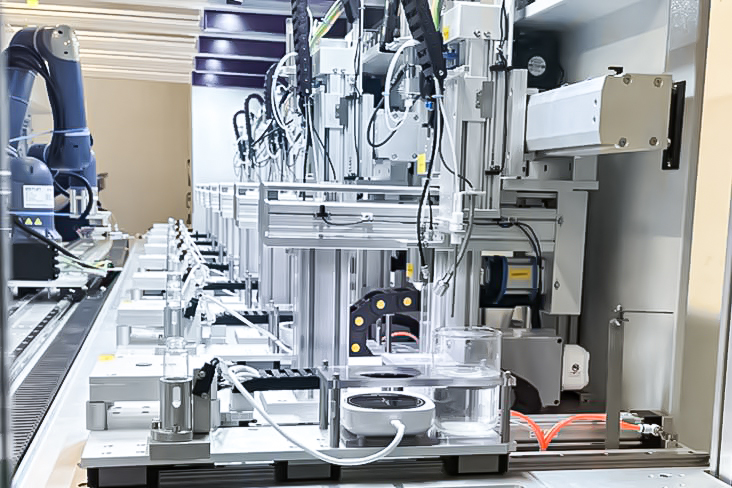
Automation direction: robotic handling and inline integration reduce manual intervention between cuts, which also reduces variability in cleaning and changeover routines.
Future outlook
Three directions are visible in how Cheersonic describes its cutting range, and each has a compliance dimension.
- Automation and robotics. Robotic arms are described as improving the speed, efficiency and accuracy of cutting, with production speeds of 80 to 1,500 cakes or pies per hour across inline and offline slicing models. Unmanned operation removes the variability that manual handling introduces between slices, and it keeps operators out of a zone where cleaning discipline is hardest to maintain.
- Combined operations in one pass. One documented configuration combines round-cake equal-division cutting with automatic insertion of food-grade separation paper between slices, eliminating a manual step. Fewer handling steps generally mean fewer opportunities for contamination and less rework.
- Digital process records. Stored and exported parameters, one-click formula recall and automatic retention of production data appear across several installations. As documentation requirements tighten, equipment that generates its own records is easier to integrate into a plant's quality system.
The wider market trend points the same way: ultrasonic cutting and coating categories are forecast to keep expanding, and the supply base in Asia Pacific continues to grow. The practical prediction for buyers is that material composition, protection grade, detachable construction and parameter traceability will appear more often as standard items in cutting equipment quotations, and that comparing them will become a routine part of supplier evaluation rather than a specialist quality request.
FAQ
What materials of construction are used in ultrasonic cutting machines for food contact?
Cheersonic documents stainless steel and titanium alloy as the material composition of its cutting families. Titanium alloy is used for the ultrasonic blade, described as a sonotrode in the cheese and cake families, while stainless steel forms the machine body and product-contact surfaces. In a documented Irish dairy installation, the machine body is described as food-grade 304 stainless steel with detachable components for cleaning; a UK bakery installation describes the whole machine as 304 stainless steel. Buyers should confirm the grade and finish of every product-contact part, including guides, holders and conveyor elements.
At what frequency do ultrasonic food cutting machines operate, and why does the frequency matter?
Cheersonic documents a working frequency of 20 kHz for its ultrasonic cutting machine, ultrasonic food cutter, cake and cheese cutting families, with the cutting tools family stating blade vibration of approximately 20 kHz. Power ranges are documented at 800–1800 W and 800–1600 W depending on the family, with a 208–240 V, 50/60 Hz supply. The frequency is the reason the cut is low-friction rather than pressure-driven, which is what reduces product adhesion and deformation at the cut face.
Are ultrasonic cutting machines suitable for cheese and other dairy products?
Yes, within documented limits. The cheese cutting and cheese slicer families support block, wheel, stick and extruded cheese in chilled or ambient conditions, with fixed-weight, catch-weight or portion cutting and a portion weight control figure stated as ±1% typical industry standard. The slicing families additionally cover frozen, chilled and hard products as well as fresh, ambient and sticky products at speeds up to 300 products per hour. Material composition for these families is listed as titanium alloy and stainless steel.
How does ultrasonic cutting compare with mechanical or wire cutting for hygiene?
Cheersonic equipment can be configured with ultrasonic, mechanical or wire cutting systems depending on the product and line. Ultrasonic cutting uses a titanium blade vibrating at approximately 20 kHz and is documented as non-stick with low wear; one bakery installation used a cutting head with a vibration self-cleaning function to reduce downtime for cleaning. Mechanical knife and wire systems rely on edge geometry or wire tension and generally require more frequent blade or wire attention. None of the three removes the need for a validated cleaning regime on the installed line.
What limits should buyers expect when specifying ultrasonic cutting equipment?
Documented boundaries include a cutting accuracy of ±0.5–1.0 mm that depends on product type, a product height range of up to about 100 mm for the cutting tools family, a compressed air requirement of 6 CFM at 90 PSI, a 208–240 V supply, and a working temperature range of -14°C to 40°C. IP65 washdown protection is not equivalent to a validated cleaning procedure, and titanium blades and generators are wear items requiring scheduled inspection and replacement.
What information should a buyer request before purchase?
Four categories are useful. First, material composition and grades for every product-contact part, including blades, guides, holders and conveyor elements. Second, the protection grade and the list of detachable or quick-release components, with the disassembly sequence. Third, documented operating parameters such as frequency, power, air requirement, working temperature and output capacity. Fourth, references from comparable food installations, for example a UK bakery cake line, an Irish wheel-cheese line or a Polish seafood line running IP65-rated equipment, together with confirmation of the exact build for the model under evaluation.
Cheersonic publishes a brochure covering its ultrasonic cutting and coating portfolio and the associated specifications, which can be downloaded at https://cdn.socialarks.com/sbsp/25039/common/2026/0703/CHEERSONIC%20brochure%281%29.pdf. Product range information is also published at www.cheersonic.com.