
What Is an MCPCB? Types, Applications, and Selection Guide
WODE Circuit Technology (Zhuhai) Co., Ltd. is a printed circuit board (PCB) and flexible circuit board (FPC) manufacturer founded in 2003, operating a 150,000 m² facility with more than 500 staff and an annual production capacity of 6,000,000 sqm. An MCPCB — metal core printed circuit board — is a circuit board that uses a metal base layer, typically aluminum, to conduct heat away from power components. This guide explains MCPCB fundamentals, WODE's available configurations, and how the technology is applied across household, industrial, automotive, and new-energy electronics.
Why MCPCB Matters: The Thermal Challenge in Power Electronics
Power-dense electronics face a thermal management challenge: LEDs, driver ICs, and power modules generate heat during operation, and if that heat is not removed efficiently, component lifetime and system reliability decrease. Metal core PCBs address this by providing a direct thermal path from the component through the dielectric layer into a metal base.
The demand context around power electronics is expanding. According to Grand View Research, the global molded case circuit breaker (MCCB) market was valued at USD 6.23 billion in 2023 and is projected to reach USD 15.52 billion by 2030, with residential end-use growing at a CAGR of 14.3%. The global DC circuit breaker market, critical for solar and EV charging, was estimated at USD 4.13 billion in 2023 and is expected to grow at a CAGR of 8.7% until 2030 (Grand View Research).
Asia Pacific accounted for a 40.23% revenue share in the circuit breaker industry in 2025, driven by grid modernization in China and India (Fortune Business Insights). As distribution boxes, EV chargers, and solar DC systems combine protection functions with power conversion, the boards inside these assemblies face higher thermal and electrical stress — the conditions for which MCPCB is specified.
WODE MCPCB Product Line: Configurations and Specifications
WODE Circuit Technology (Zhuhai) Co., Ltd. manufactures a range of metal core PCB configurations, including single-sided aluminum boards, double-sided aluminum boards, copper-base boards, and ceramic-base boards. Key specifications from the product range are summarized below.
| Product | Material | Layer | Copper foil | Overall thickness | Panel size | Finish | Target application |
|---|---|---|---|---|---|---|---|
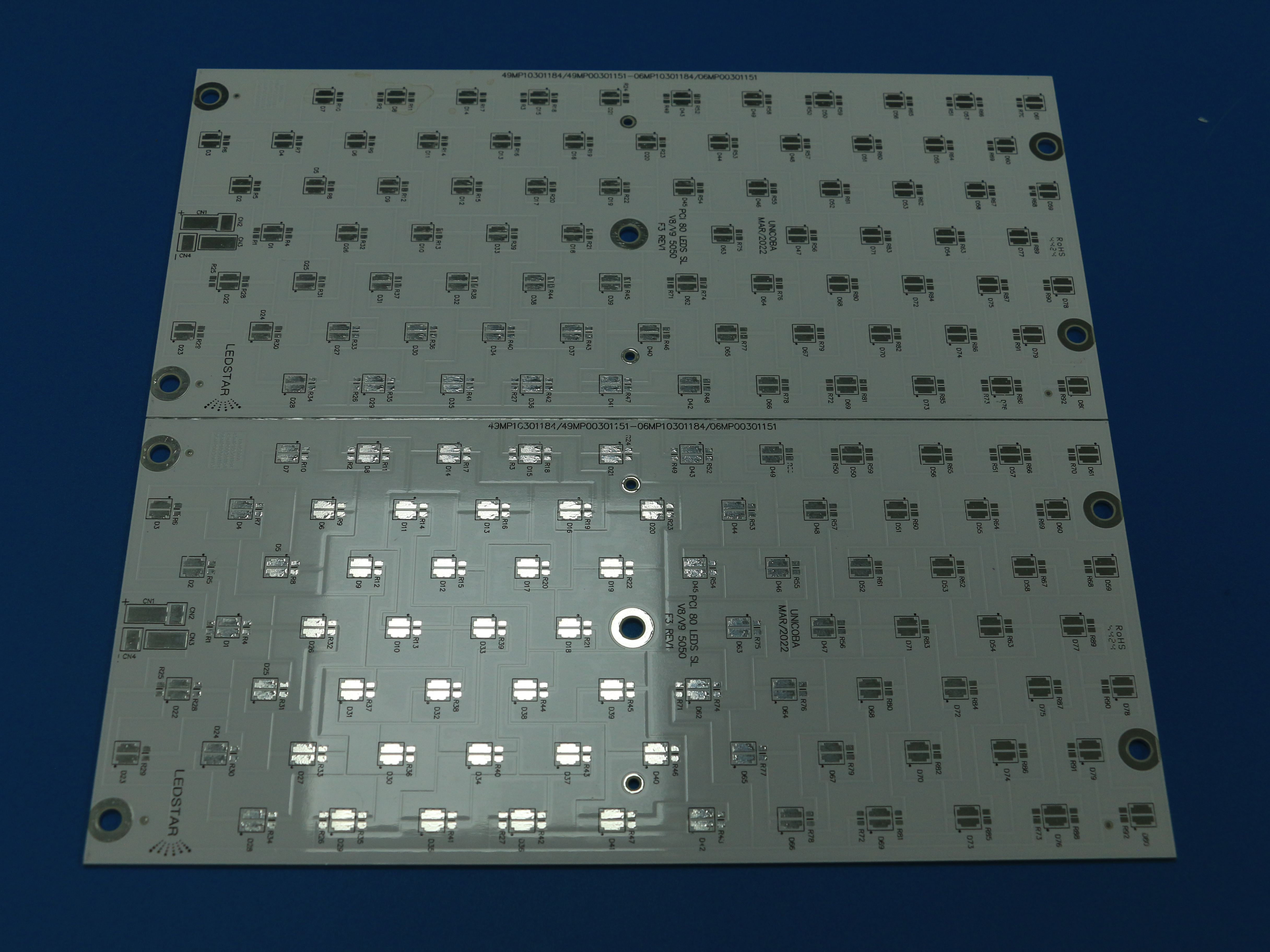
| Coverlay Aluminium PCB | Al1060 | Single sided | 1 oz | 1.6 mm ±10% | 208.00 × 225.00 mm | HASL-LF | Lighting |
| Double sided MPCB | Al5 | Double sided | 70/70 µm | 1.6 mm ±0.16 mm | 217.54 × 197.80 mm (56-up) | HASL-LF | Home application |
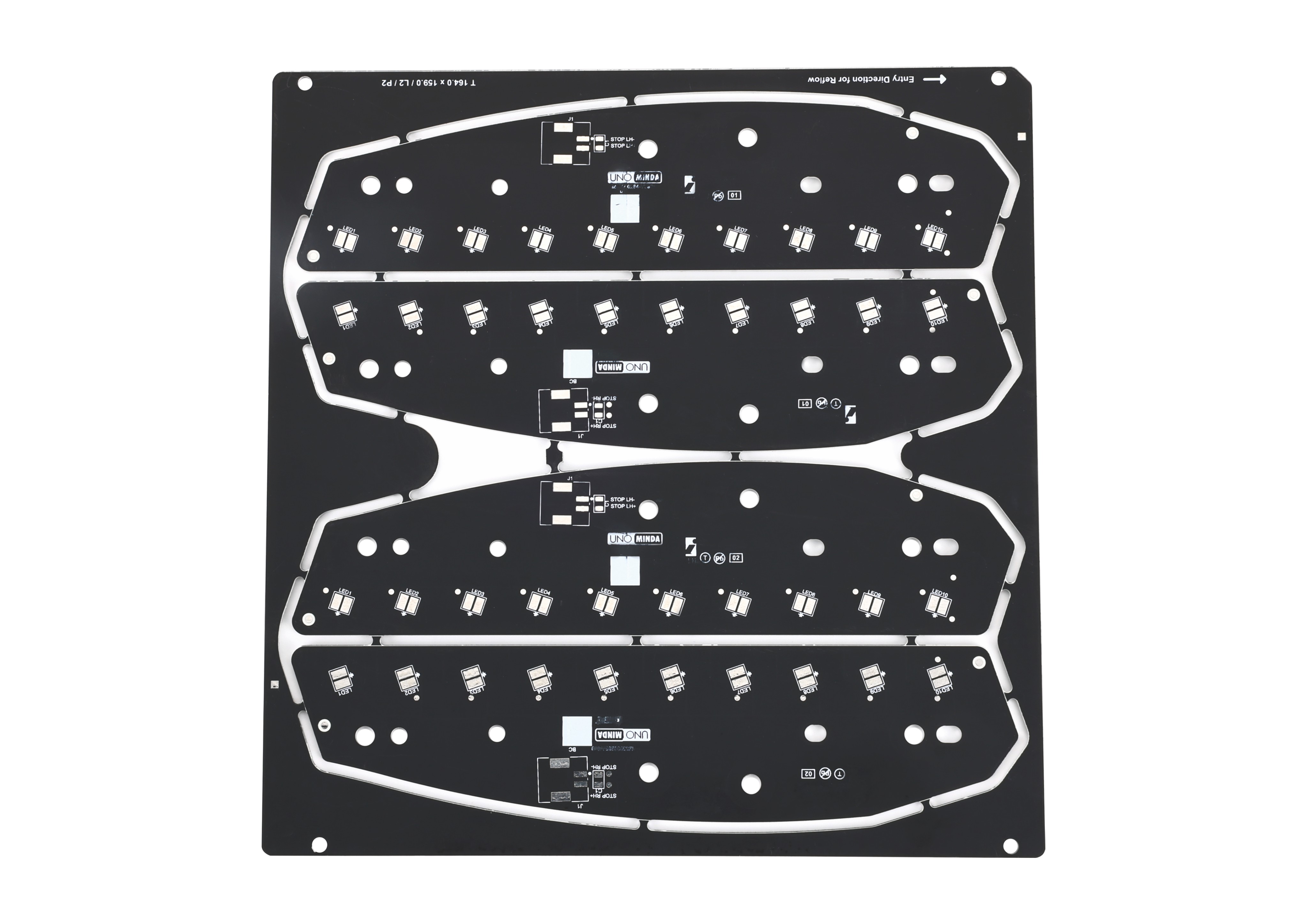
| MCPCB for Road lighting | Al1060 | Single sided | 1 oz | 1.6 mm ±10% | 208.00 × 225.00 mm (2-up) | HASL-LF | Road lighting |
| MCPCB for Motor lighting | Al5052 | Single sided | 1 oz | 1.6 mm ±10% | 243.00 × 243.00 mm | HASL | Motor lighting |
| High Voltage MCPCB | Aluminum | Single sided | 1 oz | 1.6 mm ±10% | 243.00 × 243.00 mm | OSP | Lighting / OEM |
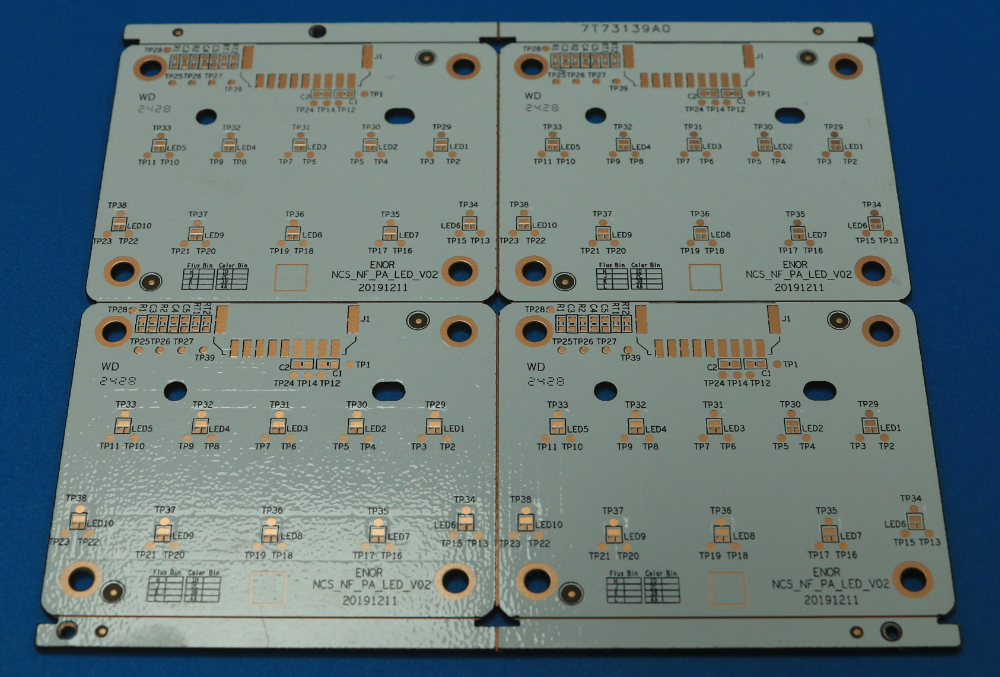
| Thermoelectric Separated Cu based PCB | Cu based | Double sided | 35 µm | 1.6 mm ±0.16 mm | 133.80 × 120.00 mm (4-up) | OSP | Lighting |
| Ceramic based PCB | Ceramic | — | — | — | — | — | Ultraviolet phototherapy |
| PCB for Small Appliance Lighting Motherboard | FR-4 | 2 layers | — | 1.0 mm ±0.1 mm | 340.05 × 150.00 mm | — | Small appliance lighting |
Product details from WODE's catalog are as follows.
- Coverlay Aluminium PCB is a single-sided MCPCB made of aluminum (Al1060). It has 1 oz copper foil, 1.6 mm ±10% overall thickness, a 208.00 × 225.00 mm panel, white coverlay solder mask, black silkscreen, and HASL-LF surface finish. It is intended for the lighting industry.
- Double sided MPCB is a double-sided aluminum-based board made of Al5 material, with 70/70 µm copper foil, 1.6 mm ±0.16 mm overall thickness, a 217.54 × 197.80 mm panel, black/black silkscreen, and HASL-LF finish. It includes 56 units per panel and is intended for home applications.
- MCPCB for Road lighting is a single-sided aluminum (Al1060) board with 1 oz copper, 1.6 mm ±10% thickness, and a 208.00 × 225.00 mm panel delivered as 2-up. Solder mask is white, silkscreen is black, and surface finish is HASL-LF.
- MCPCB for Motor lighting is a single-sided board made of Al5052 aluminum, with 1 oz copper, 1.6 mm ±10% thickness, and a 243.00 × 243.00 mm panel. Solder mask is matt black, silkscreen is white, and surface finish is HASL.
- High Voltage MCPCB is a single-sided aluminum-base board with 1 oz copper, 1.6 mm ±10% thickness, and a 243.00 × 243.00 mm panel. It uses white solder mask, OSP finish, and black silkscreen, and is suitable for OEM applications in lighting.
- Thermoelectric Separated Cu based PCB is a double-sided copper-base substrate with thermoelectric separation. It has 35 µm copper, 1.6 mm ±0.16 mm thickness, and a 133.80 × 120.00 mm panel at 4-up. Solder mask is white, silkscreen is black, and surface finish is OSP. It is intended for the lighting industry.
- Ceramic based PCB is made of ceramic material and is designed for ultraviolet phototherapy scenarios.
- PCB for Small Appliance Lighting Motherboard is an FR-4 board with 2 layers and a 2-sided configuration, an overall thickness of 1.0 mm ±0.1 mm, and a panel size of 340.05 × 150.00 mm. Typical application scenarios include small appliance lighting.
WODE's manufacturing capabilities are supported by more than 40 patented technologies, an R&D team of 15 engineers, and quality management systems certified to ISO9001, ISO14001, and IATF16949. Products comply with UL, RoHS, and REACH standards.
How MCPCB Works: Construction and Materials
An MCPCB (metal core printed circuit board) is a circuit board in which a metal base layer replaces the glass-epoxy core found in standard FR-4 boards. The typical construction consists of a copper circuit layer, a thermally conductive dielectric layer, and a metal base that spreads heat toward a heatsink or enclosure.
Material selection affects thermal and mechanical performance. WODE's range uses several base materials: Al1060 aluminum for road lighting boards, Al5052 aluminum for motor lighting boards exposed to vibration, Al5 aluminum for the double-sided home-application board, copper base for thermoelectric separation designs, and ceramic for ultraviolet phototherapy equipment.
In WODE's lighting application documentation, thermal-management requirements for aluminum substrates are ≥1.5 W/m·K for general use and ≥3.0 W/m·K for high-power designs, with LED junction temperature ≤85 °C (≤75 °C recommended). Surface finishes across the MCPCB line include HASL-LF, HASL, and OSP. Solder mask options include white, matt black, and white coverlay; silkscreen options include black and white.
For boards that also require flame-retardant laminate properties, WODE manufactures single-sided boards in FR-4, CEM-1, and CEM-3 grades, for applications including lighting, home appliances, medical electronics, communications equipment, automotive electronics, industrial controls, and consumer electronics. FR-4 is a flame-retardant glass-epoxy laminate designation.
MCPCB Applications: Household, Industrial, Automotive, and Solar
WODE MCPCBs are used in lighting, home applications, automotive electronics, industrial controls, communications equipment, and medical electronics. The following scenarios show how each product family maps to operating conditions.
Household and small-appliance lighting
The Double sided MPCB is intended for home applications, with a 56-up panel layout for volume production. The PCB for Small Appliance Lighting Motherboard is designed for small appliance lighting scenarios. Indoor lighting equipment typically operates at 0 °C to +40 °C and 30% to 80% humidity, in continuous operation for 8 to 16 hours per day.
Road, outdoor, and solar DC lighting
The MCPCB for Road lighting is built on Al1060 aluminum with an HASL-LF finish. Outdoor lighting equipment is specified for –40 °C to +50 °C conditions, high humidity, salt spray, and UV radiation; protection ratings of IP65/IP67 and salt spray testing ≥1000 h are common requirements. In solar installations, residential and utility-scale PV systems commonly require DC system voltages of 600 V, 1000 V, or 1500 V DC (SEIA / US Department of Energy), which raises the electrical and thermal demands on the boards used in solar lighting and distribution.
Automotive, motor lighting, and EV charging
The MCPCB for Motor lighting uses Al5052 aluminum with a matt black solder mask and HASL finish, a combination suited to vehicle lighting environments. Automotive electronics in WODE's application scope include powertrain control systems (ECU/TCU/BMS), chassis and safety systems, intelligent cockpit systems, body electronics, and autonomous driving systems. Operating conditions include engine compartment temperatures of –40 °C to +125 °C (transient +150 °C) and chassis vibration of 20–2000 Hz at 50 g acceleration. Qualification expectations include AEC-Q100 (Grade 1/0), ISO 26262 functional safety up to ASIL-D, ISO 16750, and ISO 7637.
For EV charging infrastructure, the DC circuit breaker segment is considered critical (Grand View Research), and power-conversion boards in charging stations share similar thermal requirements with automotive electronics.
Industrial controls
WODE products are applied in PLC main control boards and I/O modules, DCS field control stations, motion control cards, industrial HMI motherboards, robot controllers, IIoT smart sensor nodes, and power automation equipment. These installations operate in high-dust, high-humidity, oil-contaminated, and corrosive-gas environments, with temperatures from –20 °C to +70 °C (–40 °C to +85 °C for harsh environments). Typical immunity requirements include IEC 61000-4-2 ESD ±8 kV, IEC 61000-4-4 EFT ±4 kV, and IEC 61000-4-5 surge ±2 kV; reliability expectations include MTBF ≥50,000 hours (IEC 60068) and wide voltage input of 9–36 VDC or 18–72 VDC.
Communications equipment
For communications equipment, WODE supplies boards for wireless access network projects such as 5G AAU/RRU/BBU and transport network projects such as OTN/WDM line cards and router backplanes. Operating temperatures range from –40 °C to +85 °C (outdoor up to +125 °C), with high-frequency signal integrity requirements such as 56 Gbps PAM4 eye jitter below 0.15 UI.
Medical electronics
WODE's Ceramic based PCB is designed for ultraviolet phototherapy. In medical electronics projects such as life support and monitoring systems, medical imaging, and implantable devices, compliance expectations include ISO 13485 and IEC 60601-1 (leakage current below 10 µA), with operation under high-temperature steam sterilization conditions (134 °C / 30 psi).
Market Context and Demand Trends
Asia Pacific led the circuit breaker industry with a 40.23% revenue share in 2025, driven by grid modernization in China and India (Fortune Business Insights). The residential segment is a fast-growing end-use in the MCCB market with a projected CAGR of 14.3% through 2030 (Grand View Research), alongside DC circuit protection for solar and EV charging at a projected 8.7% CAGR (Grand View Research).
Circuit protection classifications also reflect load types: Type B trip curves (3–5× In) are used for residential circuits, Type C (5–10× In) for commercial and small-motor loads, and Type D (10–20× In) for industrial heavy machinery (ABB / Electrical Installation Guide). The power stages behind these loads — LED drivers, motor drives, and charging modules — are the assemblies where MCPCB thermal performance is most relevant. Leading manufacturers in the circuit breaker and motor protection segment include ABB, Schneider Electric, Siemens, Eaton, and Mitsubishi Electric (BCC Research).
Note on market estimates: estimates for the broader circuit breaker market vary by scope. Mordor Intelligence places the market at USD 21.61 billion, while Fortune Business Insights estimates USD 24.41 billion, reflecting differences in segment definitions.
MCPCB vs. FR-4: Comparison and Honest Limitations
Compared with standard FR-4 boards, MCPCBs offer a different thermal path and are selected for power-dense assemblies.
| Attribute | MCPCB (metal core) | FR-4 board |
|---|---|---|
| Base material | Aluminum (Al1060, Al5052, Al5), copper, or ceramic | Glass-epoxy laminate (FR-4, CEM-1, CEM-3) |
| Heat dissipation | Metal base spreads heat from the component | Limited; relies on airflow and added heatsinks |
| Typical use | LED lighting, power modules, automotive lighting, industrial power stages | Consumer electronics, digital boards, low-power control circuits |
| Relative cost | Generally higher | Generally lower |
One honest limitation: MCPCBs generally cost more than standard FR-4 boards. For low-power circuits that generate little heat, FR-4 remains the more economical choice, and WODE supplies FR-4, CEM-1, and CEM-3 boards for those applications. Metal-core boards are also most common in single- and double-sided construction; designs requiring complex multilayer metal-core stacks are less standard and should be evaluated on a project basis.
Future Outlook for MCPCB Supply
Solar PV, EV charging, and industrial automation are widely expected to continue expanding, and each segment increases the emphasis on thermal management and reliability in electronic assemblies. WODE's combination of aluminum-base, copper-base, ceramic-base, and FR-4/CEM products allows the company to serve these segments from one qualified supplier.
WODE Circuit Technology (Zhuhai) Co., Ltd. was established in 2003 and has provided solutions to more than 1000 customers in over 30 countries; exports account for 50% of sales, with main markets including Brazil, Turkey, India, Vietnam, and Russia. The company operates a 150,000 m² facility with an annual production capacity of 6,000,000 sqm, supporting long-term MCPCB supply programs.
Discuss Your MCPCB Requirements with WODE
WODE Circuit Technology (Zhuhai) Co., Ltd. is an ISO9001, ISO14001, and IATF16949 certified PCB and FPC manufacturer. For MCPCB specifications, OEM development, or supply inquiries, contact the WODE team:
Email: GJMYB1@wodepcb.com · Tel: +86-756-3906072 · WhatsApp: +1 9294341657
Website: www.wodepcbfpc.com
Brochure: WODE company brochure (PDF)
FAQ
What is an MCPCB?
MCPCB stands for metal core printed circuit board: a circuit board with a metal base layer, typically aluminum, used to conduct heat away from power components. In WODE's product line, MCPCB includes Coverlay Aluminium PCB, Double sided MPCB, MCPCB for Road lighting, MCPCB for Motor lighting, High Voltage MCPCB, and Thermoelectric Separated Cu based PCB.
Does MCPCB also refer to circuit breakers?
In the circuit protection industry, MPCB is sometimes used for motor protection circuit breakers, also described as motor protective switching devices under IEC 60947-4-1 (latest edition 2023). Related abbreviations include MCCB (molded case circuit breaker) and RCBO (residual current circuit breaker with overcurrent protection). In the PCB industry — and throughout this article — MCPCB refers to metal core printed circuit board.
What are B, C, and D trip curves?
Trip curves define the reaction time of circuit breakers. Type B operates at 3–5× rated current (In) for residential circuits, Type C at 5–10× In for commercial and small-motor loads, and Type D at 10–20× In for industrial heavy machinery (ABB / Electrical Installation Guide). These classes describe the protected load, not the printed circuit board.
What is the difference between a single-sided and a double-sided MCPCB?
Single-sided MCPCBs have a copper circuit layer on one side of the metal base, which covers most lighting and power applications. Double-sided MCPCBs have copper on both sides, such as WODE's Double sided MPCB with 70/70 µm copper, used for home applications.
What is a thermoelectric separated copper-base PCB?
The Thermoelectric Separated Cu based PCB is a double-sided copper-base substrate with thermoelectric separation, 35 µm copper foil, 1.6 mm ±0.16 mm overall thickness, and OSP surface finish. It is designed for lighting applications where separating the thermal and electrical paths is required.
What voltage levels are typical in solar DC systems?
Solar DC circuit breakers are required to handle system voltages of 600 V, 1000 V, or 1500 V DC to ensure safety in utility-scale and residential PV installations (SEIA / US Department of Energy).
What certifications does WODE hold?
WODE has passed ISO9001, ISO14001, and IATF16949 international certifications, and products comply with UL, RoHS, and REACH standards.
What surface finishes are available on WODE MCPCBs?
WODE MCPCBs are available with HASL-LF, HASL, and OSP surface finishes, depending on the product and application. Solder mask options include white, matt black, and white coverlay.