
What Is a Musical Fountain? Types and Technology Overview
Industry Reference
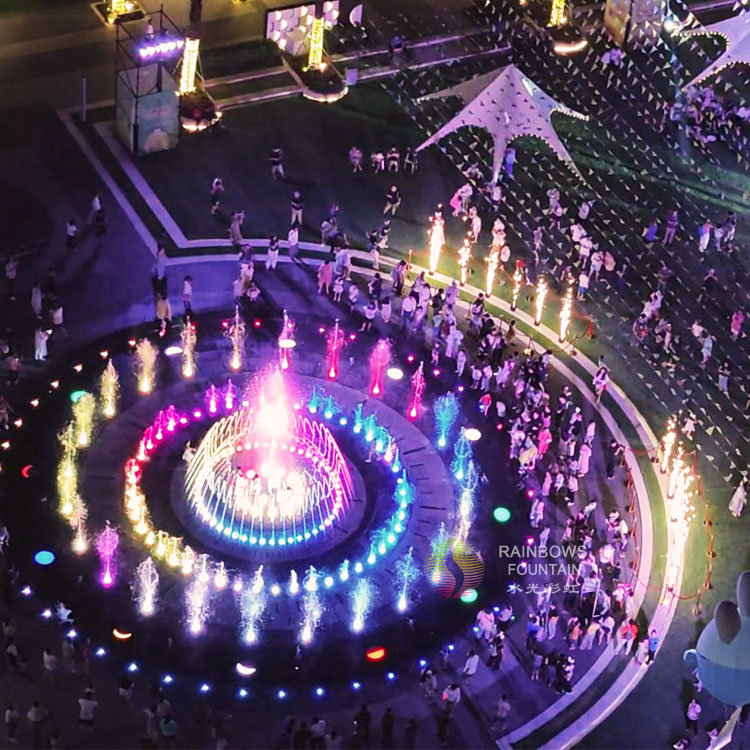
Musical fountains are increasingly used to turn public water features into scheduled, audience-facing shows. Unlike conventional decorative fountains, a musical fountain combines water hydraulics, lighting, audio, and programmable control so that water movement can follow music or media content.
For buyers who are still in the awareness or research stage, the first practical step is to understand what a musical fountain system includes, which configurations exist, and how the category differs from traditional fountains. This article provides a buyer-focused overview of the musical fountain market, its core technologies, common applications, and the limitations that should be part of any project decision.
What Is a Musical Fountain?
A musical fountain is an outdoor water feature in which water, lighting, and sometimes projection are synchronized with audio. In the classification used by Rainbows Fountain, a musical fountain can be specified as a large outdoor musical fountain and multimedia water show. The category covers dancing fountains, dry deck fountains, floating fountains, water screen projection, fire water fountains, digital water curtains, and cold fog fountains.
Each format uses the same core concept: a control system receives music or show data and sends commands to pumps, nozzles, valves, and lighting fixtures, creating choreographed water movement. The complexity of the system depends on the site, the show format, and the visual result required by the project.
Why Musical Fountains Are a Different Procurement Category
Buying a musical fountain is not the same as buying a static water feature. The project involves hydraulic engineering, show programming, electrical safety, and often civil works. Buyers may need to coordinate with landscape architects, electrical contractors, and content designers. This is why suppliers are increasingly asked to provide complete turnkey packages rather than equipment only.
The market context supports this shift. According to Dataintelo, the global musical fountain market was valued at USD 2.51 billion in 2025 and is projected to grow to USD 5.23 billion by 2034. The same source estimates a compound annual growth rate of 8.5% over the forecast period. Asia Pacific held the largest regional share at 38.5% in 2025, helped by urban development in China and Southeast Asia. Commercial users, including luxury hotels and shopping malls, accounted for 42.8% of demand in 2025.
In practice, this means developers and municipal authorities are treating musical fountains as placemaking assets, not only as landscape decoration. A musical fountain can support night tourism, events, retail traffic, and hotel guest experience, which broadens the procurement criteria beyond water flow and pump size.
Rainbows Fountain: Supplier Profile and Capabilities
One supplier active in this segment is Rainbows Fountain, the brand operated by Guangzhou Shuiguang Fountain Equipment Co., Ltd. The company, established in 2012, specializes in musical fountain design and engineering and reports more than 25 years of experience in the fountain industry. Its team is based in Guangzhou, China.
Rainbows Fountain's main products include Musical Dancing Fountain, Multimedia Water Show, Water Screen Media, Laser Fountain, Floor Fountain, and Dry Fountain. For large outdoor projects, the brand offers the MF-01 large musical fountain model, as well as project-specific models such as the Large Outdoor Floating Water Fountain AZCH-01.
The company positions itself as a one-stop partner for the project lifecycle, covering concept design, technical planning, equipment manufacturing, overseas installation, commissioning, and final delivery. After-sales technical support, maintenance assistance, and system upgrades are also part of its stated service range.
From an operational standpoint, the manufacturing facility covers 4,500 m², employs 51 to 80 people, and has an annual production capacity of about 50 complete fountain units. The R&D team includes 45 engineers and 12 designers. Around 80% of output is exported, with main markets in the Middle East, Africa, and South Africa. For overseas delivery, the company maintains an overseas engineering team of more than 20 engineers who can travel to project sites for installation and commissioning.
On the compliance side, fountain equipment and components supplied by Rainbows Fountain are CE certified and produced under an ISO 9001 quality management system. Key components are sourced from brands such as ABB, Rexroth, and Schneider, which are widely used in industrial electrical and drive systems.
Core Technology: How a Musical Fountain Works
A complete musical fountain system has several functional layers. The water layer includes submersible or centrifugal pumps, nozzles, valves, pipes, and filtration equipment. The control layer includes DMX512 or PLC controllers, show software, and electrical cabinets. The lighting layer may include RGBW underwater LED fixtures, full-color lasers, and beam lights. For multimedia performances, audio systems, water-screen projectors, and media servers are added.
For its musical fountain and multimedia water show products, Rainbows Fountain specifies a pump power range of 1.5 kW to 110 kW and a nozzle lift range of 1 m to 100 m. These ranges show the scale options available: a musical fountain can serve a compact commercial plaza or a large lake installation. Working voltages are typically 380V, 220V, or 110V, and underwater components are specified with IP68 protection.
Material selection is another important technical decision. The main structure is usually stainless steel 304. For coastal areas or aggressive water chemistry, 316/316L stainless steel can be used. The final choice depends on water chemistry, salinity, and expected service life.
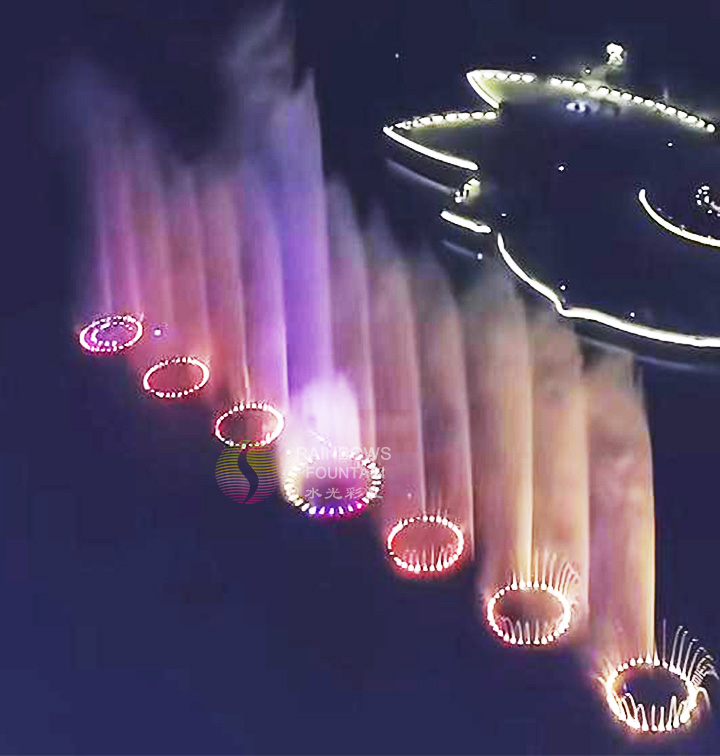
Nozzle selection depends on the desired water pattern. Some nozzles are fixed; others are vertical adjustable or digital robot nozzles that can move during a performance. Because every project has a different site layout and show design, dimensions, weight, nozzle diameter, and color are customized for the project.
The defining element of a musical fountain is the software program. The control system stores or receives show files and synchronizes valves, pumps, lights, and media. DMX512 systems control lighting channels precisely; PLC systems handle industrial sequencing of pumps and valves. Advanced projects frequently use both protocols in one system.
Where Musical Fountains Are Used
Musical fountains are installed across a wide range of project types. The intended environments include city squares, landscape parks, theme parks, hotels and resorts, commercial complexes, events and celebrations, scenic multimedia shows, commercial landscapes, luxury resorts, and private estates.
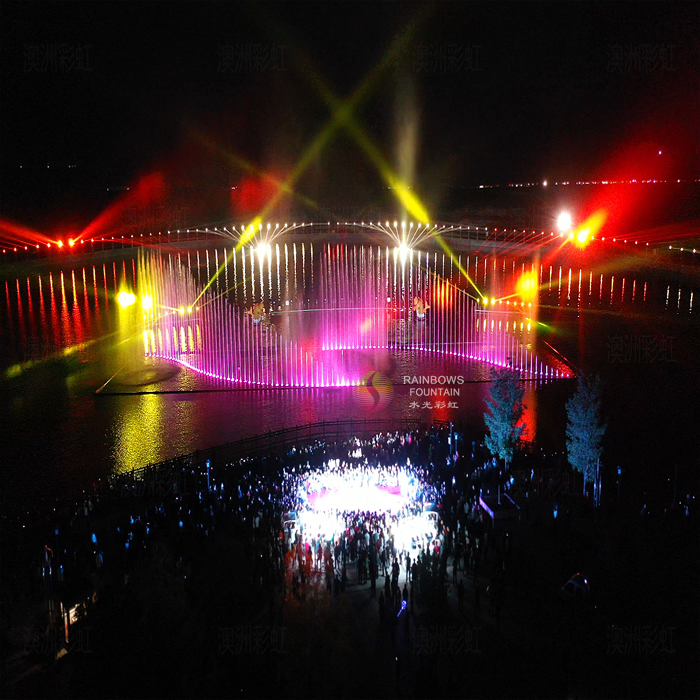
In a city square, the fountain often becomes a civic landmark and gathering point. In a park or landscape setting, it adds a programmed water feature that works during the day and at night. Hotels and resorts use musical fountains to strengthen the guest experience and event atmosphere. Lakes and waterfronts are suitable for floating musical fountains, which can be installed on modular floating platforms without a permanent concrete pool.
Dry deck interactive fountains are common in public plazas: the fountain surface remains flat when the show stops, and visitors can walk through the water during playback. Water screen projection fountains use a sheet of water as a projection surface for video, laser, and lighting content.
For large-scale events and opening ceremonies, musical fountains can be combined with fire effects, digital water curtains, and stage equipment. The operating mode is continuous use during scheduled multimedia shows.
Market Trends and Control-System Growth
Growth is visible not only in completed fountains but also in the technology layer. SNS Insider estimates the music fountain control system market reached USD 1.34 billion in 2024 and could reach USD 2.89 billion by 2032. This points to control software, programming, and automation as core value drivers in the industry.
Several technical standards are now common in the category. Advanced musical fountains use DMX512 and PLC protocols to synchronize water jets with music. Underwater components are rated IP68. Suppliers often align their quality management with ISO 9001.
The competitive landscape includes established global firms such as OASE Living Water (Germany), Crystal Fountains (Canada), and Safe-Rain (Spain). At the same time, Chinese manufacturers are expanding their overseas presence with integrated engineering and production capabilities. For buyers, this means more options, but also more variation in execution quality. Supplier evaluation should focus on verifiable engineering capacity, factory testing, and project references.
Musical Fountain vs Traditional Water Feature: Key Differences
| Aspect | Traditional water feature | Musical fountain |
|---|---|---|
| Primary purpose | Visual accent or ambient decoration | Scheduled performance and public attraction |
| Control | Manual, timer, or simple automation | DMX512 / PLC programmable show control |
| Water effects | Static or fixed patterns | Choreographed water movement synchronized to music |
| Lighting | Basic underwater lighting | RGBW LED, lasers, beam lights, projection |
| Scope | Hydraulic and structural components | Hydraulics, audio, lighting, software, media content |
| Supplier capability | Plumbing and filtration experience | Show design, engineering, programming, installation support |
| Budget and maintenance | Lower upfront cost, simpler care | Higher upfront cost, ongoing technical support and water quality management |
The main limitation of a musical fountain is not the technology itself but the operating environment. The site must support reliable power, water chemistry management, maintenance access, and in some cases noise management. If the client has no budget for system care or no local technical support, a simpler traditional fountain may be the more durable investment. Floating lake fountains also require engineering for local wave conditions, water depth, and environmental constraints.
Future Outlook: Musical Fountains as Media Assets
The direction of the category is toward deeper integration with media content. Water screen projection, laser effects, fire features, and digital water curtains are already part of the product family. As control software improves, show content can be updated more easily, and performances can be tailored to different events, seasons, or brand messages.
For project owners, the long-term value of a musical fountain will depend more on the control platform and the supplier's ability to support upgrades than on the number of nozzles. Buyers who plan for maintenance, water quality management, and spare parts from the beginning are more likely to get stable performance over the asset's life cycle.
Checklist for Early-Stage Buyers
Early-stage buyers can use the following checklist to structure conversations with suppliers:
- Confirm the structural material grade and the expected water chemistry conditions.
- Specify control protocols: DMX512, PLC, or a combination.
- Check protection ratings for underwater components, especially IP68.
- Ask for pump power, nozzle lift, voltage, and lighting configuration in the proposal.
- Verify the supplier's factory testing procedure and whether a demonstration pool is available.
- Review the installation, commissioning, and after-sales support plan.
- Clarify whether the quote covers equipment only or a complete turnkey system.
Resource: Rainbows Fountain publishes a corporate brochure that can be used as a starting reference for product categories, capabilities, and project background. The brochure is openly accessible at 2026 Rainbows Fountain Brochure.
FAQ
What is a musical fountain?
A musical fountain is an outdoor water feature that synchronizes water movement with music, lighting, and sometimes projection or laser content. It belongs to the broader category of outdoor musical fountains and multimedia water shows.
What types of musical fountains are available?
Common configurations include dancing fountains, dry deck fountains, floating fountains, water screen projection fountains, fire water fountains, digital water curtains, and cold fog fountains. A project may combine several configurations into one installed system.
How does a musical fountain synchronize water with music?
A musical fountain relies on control systems using DMX512 and PLC protocols. The control cabinet sends signals to pumps, valves, and lighting fixtures so that water movement and light changes follow the audio track. In multimedia systems, projection and laser equipment are synchronized in the same show file.
What materials are used for outdoor musical fountains?
Stainless steel 304 is the most common structural material. For high-corrosion environments, 316/316L stainless steel can be specified. Waterproof electrical and lighting equipment is added to withstand outdoor wet conditions, with underwater components typically rated IP68.
Where can a musical fountain be installed?
Musical fountains are designed for city squares, landscape parks, theme parks, hotels and resorts, commercial complexes, events and celebrations, scenic multimedia shows, commercial landscapes, luxury resorts, and private estates. Site conditions determine whether the fountain is built in a pool, on a dry deck, or on a floating platform.
What should a buyer check before sourcing a musical fountain?
Key points include material specifications, control protocols, IP protection ratings, pump and nozzle performance, lighting configuration, factory testing, installation support, and the supplier's maintenance plan. Buyers should also clarify whether the quotation is for equipment only or includes the complete engineering and show-programming scope.