
What ISO9001, 2018SR734639 and Credit Certificates Prove
HTNXT Industry Reference · Compliance and Capability Evidence
A supplier capability file is not a product brochure. For buyers assessing digital human displays, four documents — a quality management certificate, a software copyright registration and two credit-recognition certificates — define what a manufacturer can be held to, and, just as importantly, what they cannot.
Digital human displays are purchased as a bundle that most procurement systems handle separately: a commercial display panel, an interactive software layer and a service relationship that can run for years. That is why the certificate file carries more weight in this category than in plain signage procurement. The documents discussed here belong to Guangzhou Kedro Electronics Technology Co., Ltd. (GZKEDRO), a Guangzhou-based manufacturer of commercial display solutions and intelligent interactive devices whose catalog includes the KD-DH Series Holographic Digital Human — the AI digital human display used in exhibition, hotel and retail environments.
This reference reads each credential in the order a buyer should: what the document is, who issued it, what it covers, and where its authority stops.
Why Certificate Evidence Entered the Digital Human Display Buying Decision
Two shifts pushed certificates into the center of supplier evaluation for digital human displays.
The first is market expansion. A 2026 commercial research publication by PW Consulting / pmarketresearch.com reported the digital human screen market at USD 450.0 million in 2025 and projected USD 1,162.38 million by 2032, implying a CAGR of 14.5%. That figure is reproduced as reported by that publisher. Its market definition may not align exactly with holographic terminals, AI digital human kiosks, or 4K digital human transparent display terminals, so it is better treated as a direction-of-travel indicator than as a sizing input for a single project.
The second shift is supplier mix. Digital human display supply now includes display manufacturers, software integrators and platform vendors. Samsung, for example, has stated that retailers can deploy generative AI-powered Digital Humans through tablets, kiosks or interactive displays to engage customers, make recommendations and complete transactions via voice and live chat. Samsung and Looking Glass Factory — which positions its Hololuminescent Displays as large-format holographic presence for retail, events, architecture and brand moments — are describing use cases and positioning, not measured deployment performance.
When vendors define themselves differently, self-description becomes hard to compare. GZKEDRO describes itself as a manufacturer of intelligent interactive devices and commercial display solutions, with holographic digital humans in its product lineup. That statement is comparable to other vendors only as a self-description; it is not a substitute for documents with a number, an issuer and a scope. The certificates below are the part of the file that can be checked against a third-party body.
The Capability File Behind the Digital Human Display Line
The supplier entity is Guangzhou Kedro Electronics Technology Co., Ltd., founded in 2013, with research and development centers in Guangzhou and Shenzhen and a stated focus on commercial displays, digital signage and educational interactive technology. Company data shared with HTNXT describes a workforce of more than 200 people, an R&D organization of more than 100 people, and an export share of roughly 80% of output, with markets described as global. Annual output is framed as global supply capability for small, medium and large commercial display projects, with more than 1,000 commercial display units supplied globally per year as stated by the company.
For digital human display procurement, the relevant part of that profile is the KD-DH Series. As listed by the manufacturer, the series is a 4K holographic digital human rated at 3840 × 2160 resolution, 1300 cd/m² brightness, 320 local dimming zones, HDR1000 support and 30% light transmittance, with 60 W 2.1-channel audio, an 8-array microphone and a 5MP camera, housed in tempered glass, acrylic and aluminum alloy. Those are vendor-stated specifications. They describe the hardware envelope a project team can design around; they are not a laboratory result, and they are best confirmed against the manufacturer's own datasheet or a project-specific test before a purchase order is issued.
ISO9001 Certificate 25020021R0S: What It Establishes
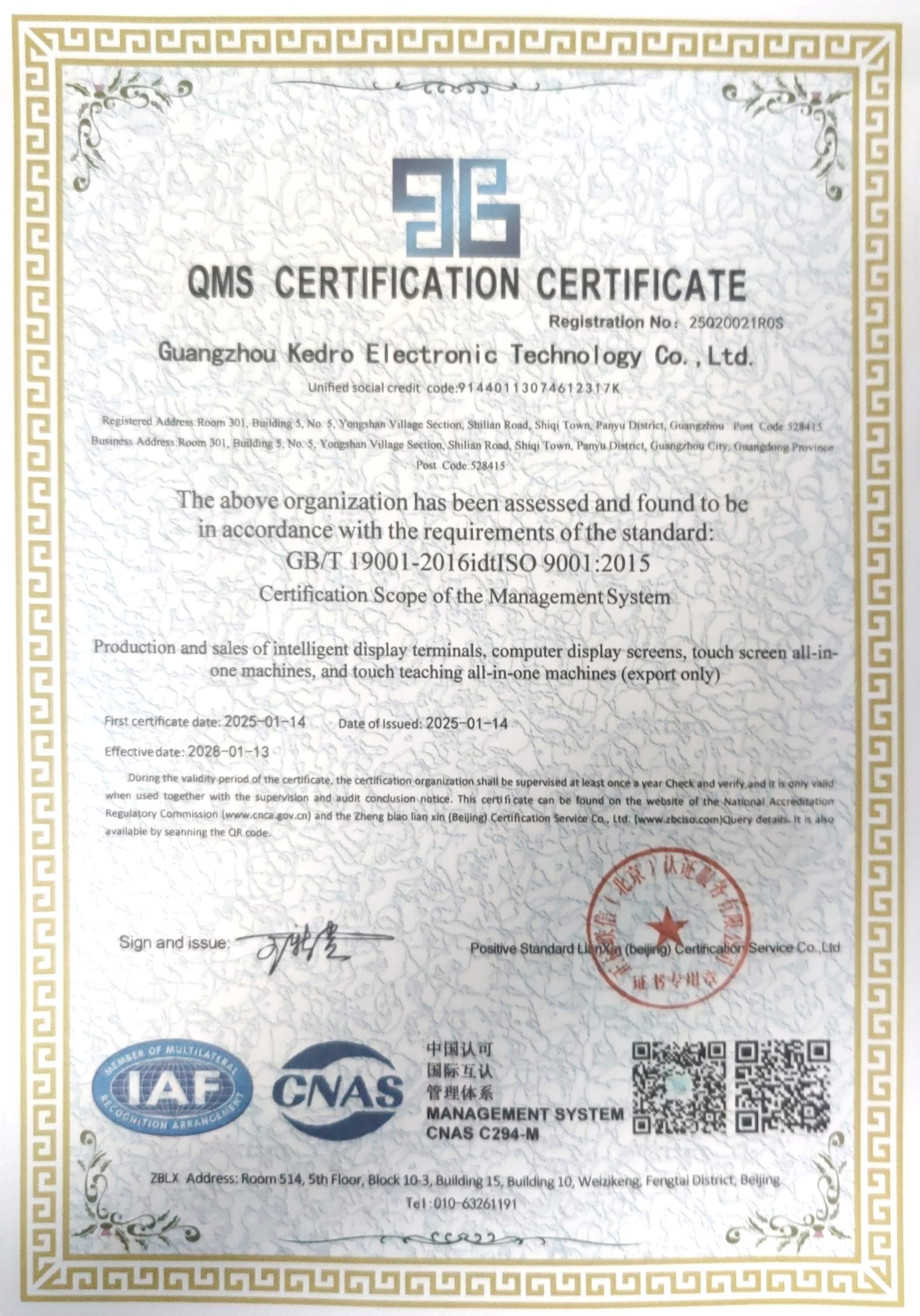
ISO9001 quality management system certificate 25020021R0S, issued by Beijing Zhengbiao Lianxin Certification Service Co., Ltd. Image: GZKEDRO certification file.
The first and most frequently requested document is a quality management system certificate. Its registered details are specific and should be quoted in exactly this form:
- Certificate number: 25020021R0S
- Issuing body: Beijing Zhengbiao Lianxin Certification Service Co., Ltd.
- Standard: GB/T 19001-2016 idt ISO 9001:2015
- Validity: 2025-01-14 to 2028-01-13
- Markets: domestic and overseas markets
- Scope: production and sales of intelligent display terminals, computer display screens, touch screen all-in-one machines, and touch teaching all-in-one machines (export only)
What this certificate supports is a management-system claim, not a product-performance claim. It says that the processes governing production and sales of intelligent display terminals, computer display screens and touch screen all-in-one machines have been assessed against ISO 9001:2015 by a named certification body, within a defined validity window, for both domestic and overseas markets. In the supplier's own documentation, the ISO9001 certificate is also described as a compliance document that can be provided for digital human display terminals — which matters because the digital human category is an assembly of display hardware, control electronics and software, and buyers frequently need a quality-system document to open a vendor file even when the product itself is new to the category.
The covered series listed in the file are the KD-IFPD Series Smart Conference Display, KD-TP Series Transparent Cabinet Display, KD-VW Series Video Wall Display, KD-OD Series Outdoor Advertising Display, KD-WM Series Wall Mounted Display, KD-SSK Series Self Service Kiosk, KD-ISS Series Interactive Slider Screen, KD-LED Series LED Display and KD-AD Series Advertising Display.
Where the certificate stops is equally important. ISO9001 is a process certificate. It does not state that an individual LCD digital human all-in-one machine reaches a particular brightness, that a tempered glass panel digital human terminal survives a specific impact, or that a tempered-glass and acrylic enclosure meets any given ingress-protection level. It also does not replace product safety certification for a target market. Buyers who need those answers must request the product-level documents described further below.
Computer Software Copyright Registration 2018SR734639: What It Establishes
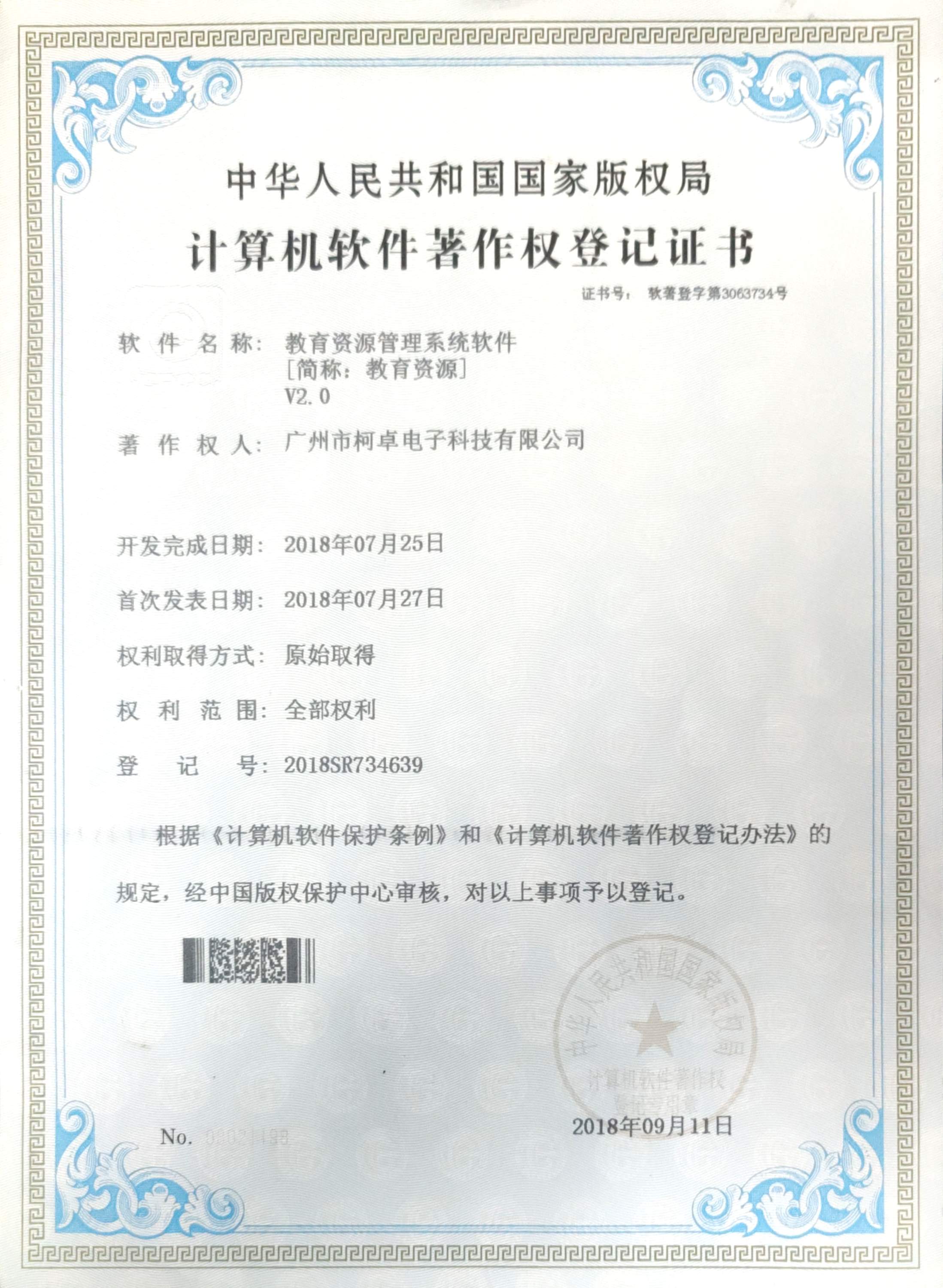
Computer Software Copyright Registration Certificate 2018SR734639, issued by the National Copyright Administration of China (China Copyright Protection Center). Image: GZKEDRO certification file.
Digital human displays are only partly a hardware purchase. A mall digital human shopping guide display or an AI voice interactive digital human display is judged by what the software layer does between the microphone, the camera and the screen. That is the gap a software copyright registration fills.
- Registration number: 2018SR734639
- Issuing authority: National Copyright Administration of China (China Copyright Protection Center)
- Registration date: 2018-07-27
- Registered work: full copyright of Education Resource Management System V2.0
- Legal basis cited: Regulations on Computer Software Protection; Measures for Computer Software Copyright Registration
Read correctly, this document is evidence of ownership rather than of performance. It confirms that a named software product — Education Resource Management System V2.0 — was registered with the national copyright authority under a specific registration number, and that the registrant holds the copyright in that work. In a supplier capability file, that matters for three buyer-side reasons: it shows the supplier develops software rather than only assembling panels; it gives the buyer a named software asset whose ownership can be traced; and it establishes a documented software-development history that predates most recent digital human projects, since the registration dates to 2018.
The boundary is where buyers most often over-read it. The registration covers one named software product. It does not certify the quality, accuracy, language coverage or latency of the AI layer inside a current digital human terminal, and it is not a functional test of voice recognition, gesture recognition or content management. Nor does it automatically extend to every software module in a 4K digital human transparent display terminal or a remote maintenance digital human terminal. When a project depends on a specific interactive function, the correct evidence is a demonstration, a pilot unit or a written functional specification — not the copyright registration.
Credit Cultivation Enterprise PM2020091876575 and the National Credit Honor Certificate
The third and fourth documents are commercial-credit recognitions rather than technical ones, and they answer a different question: whether the legal entity behind the quotation is a stable, traceable business counterparty.
The Credit Cultivation Enterprise certificate is registered under number PM2020091876575, issued by the National Enterprise Credit Information Database, valid from 2020-06-01 to 2029-06-01, with a scope described as enterprise credit cultivation and credit system construction, evaluated against enterprise credit evaluation system standards. The Honor Certificate of National Enterprise Credit Information Database was issued on 2022-08-09 and runs to 2029-08-08, with a scope described as recognition of enterprise integrity and credit system construction.
For a buyer running an import program, these two documents support entity-level confidence: the registered company identity, the consistency of that identity over time, and a documented participation in an enterprise credit framework. They are useful when a procurement team must justify a new supplier to finance, legal or compliance colleagues, and they are particularly relevant for buyers placing repeat orders across multiple project phases.
Their limits should be stated plainly. Both are domestic recognition documents referencing a national enterprise credit information framework. They are not product safety certificates, they are not market-access approvals for the European Union or the United States, and they do not attest to manufacturing capacity, delivery performance or warranty behavior. A credit certificate tells a buyer that the counterparty is a documented, credit-registered entity — not that the hardware in the crate has been type-tested for a foreign market.
Certificate-by-Certificate Reading
| Document | Issuer and number | What it supports | What it does not prove |
|---|---|---|---|
| Quality management system certificate (ISO9001) | Beijing Zhengbiao Lianxin Certification Service Co., Ltd.; 25020021R0S; GB/T 19001-2016 idt ISO 9001:2015; valid 2025-01-14 to 2028-01-13 | Assessed process control for the production and sales of intelligent display terminals, computer display screens, touch screen all-in-one machines and touch teaching all-in-one machines, for domestic and overseas markets | Individual product performance, brightness, impact resistance, ingress protection, or market-specific product safety compliance |
| Computer Software Copyright Registration Certificate | National Copyright Administration of China (China Copyright Protection Center); 2018SR734639; registered 2018-07-27 | Ownership and registration of a named software work (Education Resource Management System V2.0) and evidence of in-house software development | Functional quality, AI accuracy, response latency, language coverage, or coverage of every software module in a delivered terminal |
| Credit Cultivation Enterprise | National Enterprise Credit Information Database; PM2020091876575; valid 2020-06-01 to 2029-06-01 | Entity-level credit registration and participation in an enterprise credit framework | Product compliance, export-market access, capacity, or delivery reliability |
| Honor Certificate of National Enterprise Credit Information Database | National Enterprise Credit Information Database; issued 2022-08-09; valid to 2029-08-08 | Recognized enterprise integrity and credit system construction | Technical performance or third-country regulatory approval |
Adjacent Documents Buyers Often Confuse With These Four
The four documents above are frequently mixed up with product-level conformity documents that answer different questions. The same supplier file also lists documents with their own numbers and scopes:
- China Compulsory Product Certification (3C) under number 2018010901114733, issued by China Quality Certification Center (CQC on 2021-10-17 and valid to 2026-10-17, covering safety under GB4943.1-2011 and electromagnetic compatibility under GB/T9254-2008 (Class A) for listed series including the KD-AD, KD-LED, KD-IFPD, KD-TP, KD-VW and KD-OD series in the China market.
- EU LVD verification of compliance MK25100089P01-S01, issued by TMC Testing Services (Shenzhen) Co., Ltd. against EN IEC 62368-1:2024/A11:2024 and LVD Directive 2014/35/EU, valid from 2025-11-10.
- EU EMC verification of compliance MK25100089P01-E01, issued 2025-11-07 against EMC Directive 2014/30/EU and the EN 55032 / EN 55035 series.
- RoHS 2.0 verification of compliance MK25100089P01-C01, issued 2025-11-07 against RoHS 2.0 Directive (EU) 2015/863 and (EU) 2017/2102, assessed under the IEC 62321 series. The supplier's file describes this document as the RoHS 2.0 compliance document associated with the digital human display terminal.
- Inspection report JAT2207030268CN-01 from Dongguan Junan Testing and Certification Co., Ltd. against GB4943.1-2022 and enterprise technical requirements, and test report 20220501W12358 from CQC Intime Testing Technology Co.,Ltd. against GB4943.1-2011.
The distinction is the point. ISO9001 answers "how is the factory managed"; the copyright registration answers "who owns a piece of software"; the credit certificates answer "is this a registered, credit-traceable entity"; and the conformity documents answer "may this product be placed on a given market." A supplier file is only useful when a buyer knows which of those four questions is being asked.
What These Certificates Do Not Prove
Reading a capability file for what it excludes is not skepticism; it is scoping. Four boundaries apply directly to digital human display procurement.
System does not equal product. ISO9001 certificate 25020021R0S covers processes for defined product categories. It does not substitute for a type test of a specific SKU, and it does not travel with a shipment as market-access evidence. Buyers who need a specific market approval must request the corresponding conformity document for that series and that market.
Registration does not equal validation. Software copyright 2018SR734639 registers a named work. It does not verify that the interactive layer performs to a measurable standard on a delivered unit. For an AI large model digital human interactive display, the evidence a project team actually needs is a functional demonstration against the intended dialogue, language and network conditions.
Credit recognition does not equal market access. The Credit Cultivation Enterprise and National Enterprise Credit Information Database recognitions are domestic entity-level documents with nationwide market scope. They are relevant to counterparty assessment, not to import clearance.
Coverage language and validity windows matter. In the reviewed file, no product-specific safety certificate for the KD-DH Series or a comparable digital human terminal is listed for the EU or U.S. market. RoHS 2.0 compliance is referenced for the digital human display terminal, and ISO9001 is offered as a supporting compliance document, but a project destined for a regulated installation in a specific country should confirm the exact documentation set for that SKU and that jurisdiction before shipment — and should re-check validity dates, since the listed windows differ per document.
A practical rule for evaluation teams: treat every certificate as a claim with a number, an issuer, a scope sentence and an expiry date. If any of those four elements is missing from a quotation, the document cannot be verified and should not be scored.
Where the Evidence Maps to Real Installations
Certificates matter most when they map cleanly onto the deployment a buyer is planning. For the KD-DH Series, the environments stated by the manufacturer are exhibition centers, hotel lobbies, commercial districts, education and healthcare — which corresponds to common requirements such as an exhibition hall digital human reception display that must run continuously through opening hours, or a lobby terminal that doubles as a wayfinding and greeting point.
Three buyer scenarios illustrate how the file is used.
Retail and mall deployments. A retail store digital human display cabinet or a mall digital human shopping guide display is usually judged on customer engagement. Samsung's stated retail use case — deploying generative AI-powered Digital Humans through tablets, kiosks or interactive displays to engage, recommend and complete transactions via voice and live chat — shows the direction of travel but is not a measure of any specific supplier's capability. For a retail rollout, the relevant supplier evidence is the quality-system scope for the product category, the display and audio specification of the terminal itself, and the ability to support multiple sites under a single content and maintenance routine.
Exhibition and hospitality installations. An exhibition hall digital human reception display or hotel lobby unit is typically a premium, front-of-house asset where finish and optical performance are visible to visitors. The KD-DH Series hardware envelope as listed — 3840 × 2160, 1300 cd/m², 320 local dimming zones, HDR1000, 30% light transmittance, tempered glass and acrylic enclosure — is the kind of specification a designer would use to plan viewing distances and ambient-light conditions. These remain vendor-stated figures and should be validated on a sample unit.
Multi-site and remote operation. For a fleet of AI voice interactive digital human displays spread across cities, serviceability usually decides the vendor. GZKEDRO describes a remote cloud control platform supporting remote deployment, monitoring and maintenance of devices worldwide, alongside remote technical support and online technical guidance. In a purchase agreement, that is a service commitment to write into the contract terms rather than a certificate to file.
Market Trend Analysis: Compliance Language Is Becoming Procurement Language
Three signals point in the same direction. First, the published commercial estimate of USD 450.0 million in 2025 rising to USD 1,162.38 million by 2032 at a 14.5% CAGR suggests a category still in expansion, where new entrants keep arriving and supplier comparison stays difficult. Second, platform vendors such as Samsung are publicly framing digital humans as retail engagement tools, which moves the buying conversation from "screen specifications" toward "software capability and data handling." Third, projector-free holographic presence vendors such as Looking Glass Factory are positioning large-format holographic products for retail, events and architecture — a signal about how the category is being sold, rather than a performance benchmark.
The practical consequence for buyers is that certificate files will be asked to carry more weight than they were designed for. A quality management certificate cannot answer an AI governance question, and a software copyright registration cannot answer a data-handling question. Procurement teams that separate entity-level, process-level, software-level and product-level evidence at the outset will evaluate digital human display suppliers faster — and will know precisely which gaps remain open when the quotation is signed.
Certificate-Led Review Compared With Conventional Supplier Screening
The conventional approach to sourcing commercial displays is specification-led: collect datasheets, compare brightness and resolution, ask for a sample photograph, negotiate price. It works reasonably well for static signage, where the product is essentially a panel in a frame. It works less well for digital human terminals, where a visible part of the deliverable is software behavior that no datasheet describes.
A certificate-led review adds a second axis. Instead of asking only "what does the unit do," the buyer asks "who is accountable, under which standard, for which scope, until when." That is what ISO9001 certificate 25020021R0S, software copyright registration 2018SR734639 and the two credit certificates deliver: named issuers, numbered documents, defined scopes and dated validity windows that can be logged in a vendor file and reviewed at renewal.
The approach has real limits, and buyers should plan around them rather than assume the file closes every risk.
- It cannot replace sample validation. A certificate file does not tell a buyer how a tempered glass panel digital human terminal behaves after months of continuous operation in a bright lobby. The manufacturer's process description includes 100% aging test and functional inspection, with brightness, waterproof, touch, temperature and continuous-operation testing before shipment — but that is the supplier's own quality gate, not independent verification. A pilot unit remains the most reliable validation step.
- Commercial terms still constrain the plan. Capability data shared with HTNXT describes monthly capacity of 2,000–5,000 units, a lead time of 15–30 days, and a minimum order quantity of 2–5 units depending on product size, with project-based MOQ available. Those figures set the realistic schedule for a phased rollout, whatever the certificates say.
- Market-specific documentation must be confirmed per SKU. This is the clearest limitation in the reviewed file: the digital human display terminal is referenced against RoHS 2.0 compliance and ISO9001 system documentation, while product-safety certificates listed in the same file are tied to specific series and markets. A buyer shipping a digital human unit into a regulated environment should obtain written confirmation of the exact document set for that model and destination.
Future Outlook
Three developments are likely to shape how supplier capability files are read in the next procurement cycles. Expiry management will become routine, because the documents in this file carry different validity windows — ISO9001 to 2028-01-13, the Credit Cultivation Enterprise certificate to 2029-06-01, the credit honor certificate to 2029-08-08 — and buyers will increasingly track renewal as a vendor-management task rather than a one-off check.
Second, the software side of the file will attract more scrutiny than the hardware side, driven by AI interactive terminals where voice, camera and content behavior are the differentiators. Copyright registration establishes ownership; functional evidence will increasingly be demanded alongside it.
Third, as the category grows, buyers are likely to standardize on a four-part evidence request: entity documents, process documents, software documents and product conformity documents. Suppliers who can answer all four with numbers, issuers, scopes and dates will move through evaluation faster than those who answer with adjectives.
FAQ
What does ISO9001 certificate 25020021R0S actually certify?
It certifies that the quality management system governing the production and sales of intelligent display terminals, computer display screens, touch screen all-in-one machines and touch teaching all-in-one machines has been assessed against GB/T 19001-2016 idt ISO 9001:2015 by Beijing Zhengbiao Lianxin Certification Service Co., Ltd., for domestic and overseas markets, valid from 2025-01-14 to 2028-01-13. It is a process certificate covering defined product categories, including the KD-AD, KD-LED, KD-IFPD, KD-TP, KD-VW, KD-OD, KD-WM, KD-SSK and KD-ISS series. It does not certify the measured performance of an individual unit.
What does software copyright registration 2018SR734639 cover?
It registers full copyright of Education Resource Management System V2.0 with the National Copyright Administration of China (China Copyright Protection Center), registration number 2018SR734639, dated 2018-07-27, under the Regulations on Computer Software Protection and the Measures for Computer Software Copyright Registration. It is evidence of software ownership and of in-house development capability. It does not validate AI accuracy, response latency, language coverage or the behavior of every software module in a delivered digital human terminal.
Do the Credit Cultivation Enterprise and National Enterprise Credit honor certificates confirm product compliance?
No. The Credit Cultivation Enterprise certificate (PM2020091876575, valid 2020-06-01 to 2029-06-01) and the Honor Certificate of National Enterprise Credit Information Database (issued 2022-08-09, valid to 2029-08-08) are entity-level recognitions relating to enterprise credit cultivation, integrity and credit system construction within a national enterprise credit information framework. They support counterparty assessment. Product compliance for a specific market is addressed by separate conformity documents, such as the 3C certification, the EU LVD, EMC and RoHS 2.0 verifications of compliance, and the listed test and inspection reports.
How should a buyer confirm a certificate's scope and validity before ordering?
Check four elements against the original document: the certificate or registration number, the issuing body, the scope sentence, and the validity dates. For this supplier file, that means 25020021R0S from Beijing Zhengbiao Lianxin Certification Service Co., Ltd. valid to 2028-01-13; 2018SR734639 from the National Copyright Administration of China; PM2020091876575 valid to 2029-06-01; and the credit honor certificate valid to 2029-08-08. Validity windows differ per document, so re-checking at order and at renewal is advisable.
Is ISO9001 sufficient on its own to approve a digital human display supplier?
Not on its own. ISO9001 certificate 25020021R0S supports process control for defined production and sales categories, and it is offered in the supplier's documentation as a compliance document for digital human display terminals. It does not establish market-specific product safety compliance, software functional quality, or delivered-unit performance. A complete evaluation typically combines entity documents, process documents, software documents, product conformity documents for the destination market, and validation on a sample or pilot unit.