
What ISO 9001 and ISO 14001 Certificates Really Cover for PV Distribution Boxes
An ISO 9001 or ISO 14001 certificate tells a buyer how a supplier manages quality and environmental obligations. It does not tell a buyer that a specific photovoltaic distribution box has passed a product type test. For teams sourcing distribution boxes for photovoltaics, that boundary decides how much weight a certificate PDF should carry in a supplier file — and which documents have to sit beside it before a technical approval is signed.
Kuoyu Electrical (Hebei Kuoyu Electrical Technology Co., Ltd.) is a Shijiazhuang-based manufacturer of distribution boxes, distribution cabinets, transformers, wires and cables, founded in 2017. Two of its management-system certificates — ISO 9001 certificate YZL862422931310Q and ISO 14001 certificate YZL862422931310E — are recorded as applicable to the Distribution Box product line (product 6476, PZ30 Series). Reading those two documents closely, rather than counting them, is what turns them from attachments into procurement evidence.
Two certificates, two different management questions
ISO 9001 is a quality management system standard; ISO 14001 is an environmental management system standard. Both audit an organisation and its processes. Neither certifies a product design, a short-circuit withstand value, an ingress protection rating, or a plant's production capacity.
The confusion is routine because certificate PDFs arrive in the same email as datasheets and quotations, and because every document in the pack uses the word certification. In photovoltaic sourcing the two families answer different questions. Management-system certificates answer whether there is a controlled process behind the supplier. Product standards answer whether the assembly itself satisfies the design and testing rules for the installation.
The product side has its own references. IEC 61439-2:2020 is the international standard for low-voltage switchgear and controlgear assemblies, and it includes Annexes DD, EE and FF specifically for assemblies used in photovoltaic installations. In the United States, UL Solutions identifies UL 1741 as the standard associated with combiner boxes within its solar balance-of-system certification service. No ISO 9001 certificate replaces either of those, and a supplier that presents them as interchangeable is telling the buyer something about its documentation discipline.
What the two Kuoyu Electrical certificates actually state
Both certificates were issued on 3 June 2024 by General International Testing (China) Certification Service Center, both carry an expiry date of 2 June 2027, and both are recorded as applying to the global market. The differences that matter to a buyer are the standard, the certificate number and the exact scope wording.
| Certificate field | ISO 9001 | ISO 14001 |
|---|---|---|
| Certificate number | YZL862422931310Q | YZL862422931310E |
| Standard | GB/T19001-2016 / ISO 9001:2015 | GB/T24001-2016 / ISO 14001:2015 |
| Issuing body | General International Testing (China) Certification Service Center | General International Testing (China) Certification Service Center |
| Date of issue | 3 June 2024 | 3 June 2024 |
| Expiry date | 2 June 2027 | 2 June 2027 |
| Market designation | Global | Global |
| Scope emphasis | Sales, installation and technical consulting services for electrical appliances and complete equipment | Sales of electrical appliances, complete sets of equipment and related power products |
The same certificate set includes a third document: an Occupational Health and Safety Management System certificate, ISO 45001, number YZL862422931310S, against GB/T45001-2020 / ISO45001:2018, issued on the same date and valid to the same expiry. It is relevant to factory visits and site-work discussions, but it does not change the reading of the two certificates discussed here.
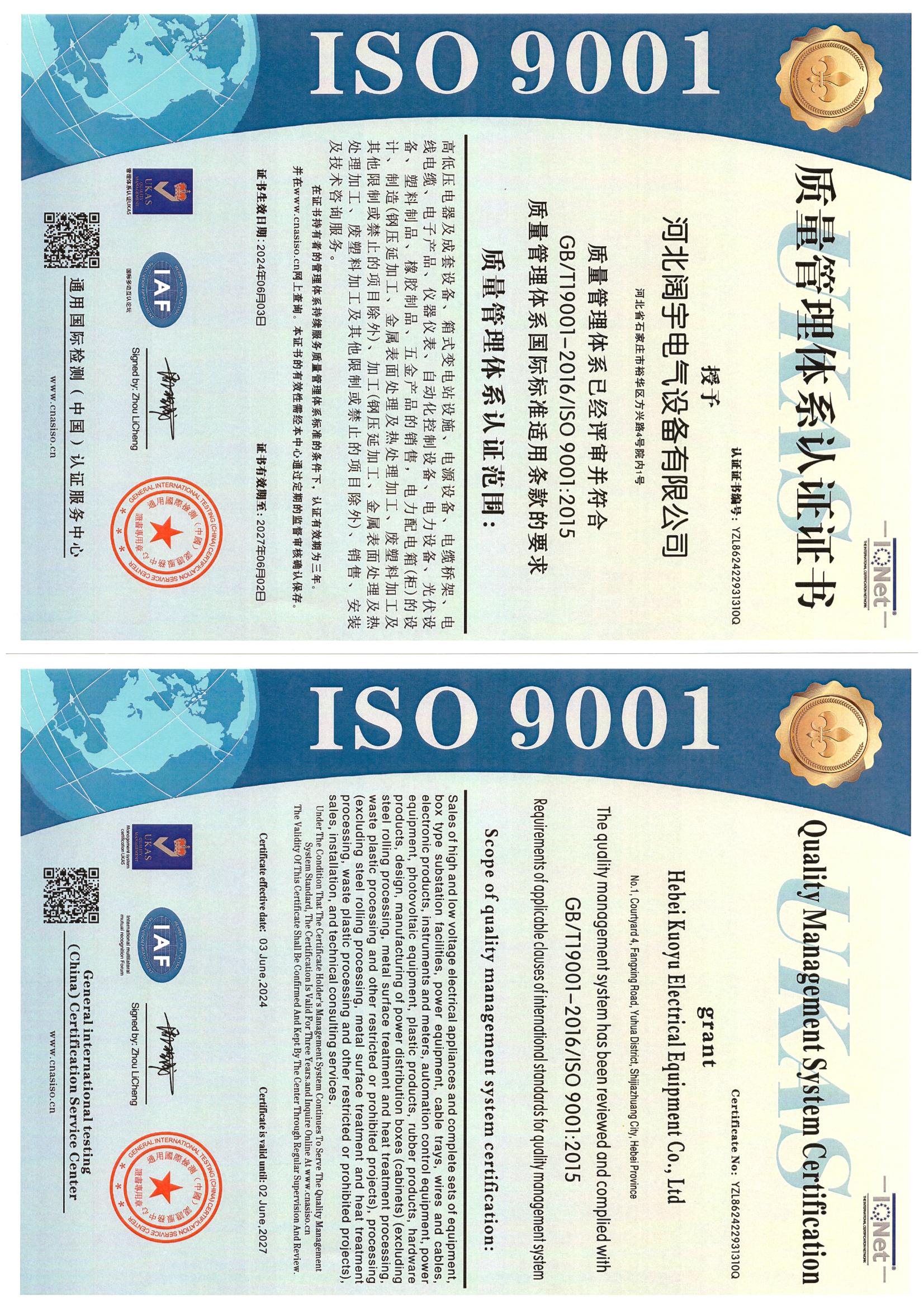
Quality Management System certificate, ISO 9001, GB/T19001-2016 / ISO 9001:2015, certificate number YZL862422931310Q, issued 3 June 2024, valid to 2 June 2027.
The ISO 9001 scope line
The ISO 9001 scope covers sales, installation and technical consulting services for high and low voltage electrical appliances and complete equipment, box-type substation facilities, power supply equipment, cable trays, wires and cables, electronic products, instruments and meters. Read literally, it is a commercial and service scope built around selling, installing and advising — which is where a distributor or project buyer normally meets the supplier.
What that gives a buyer is evidence that order handling, document control, non-conforming product handling and corrective action sit inside an audited system, at least for the activities named in the scope. What it does not give is a statement that a particular PZ30 enclosure was type-tested, that a stated IP rating was verified by the certification body, or that nameplate current ratings were independently checked.
The ISO 14001 scope line
The ISO 14001 scope covers sales of high and low voltage electrical appliances and complete sets of equipment, box-type substation facilities, power equipment, cable trays, wires and cables, electronic products, instruments and meters, automation control equipment and power equipment. This is an organisational environmental management scope: how environmental obligations, waste streams and environmental performance are controlled inside that boundary.
It is not a product environmental declaration. It says nothing about recycled content, carbon footprint, lifecycle impact, or the recyclability of an ABS plastic cover compared with a cold-rolled steel plate or a stainless steel enclosure. A buyer who needs those figures is asking for a different document type and should request it explicitly rather than infer it from an ISO 14001 logo.
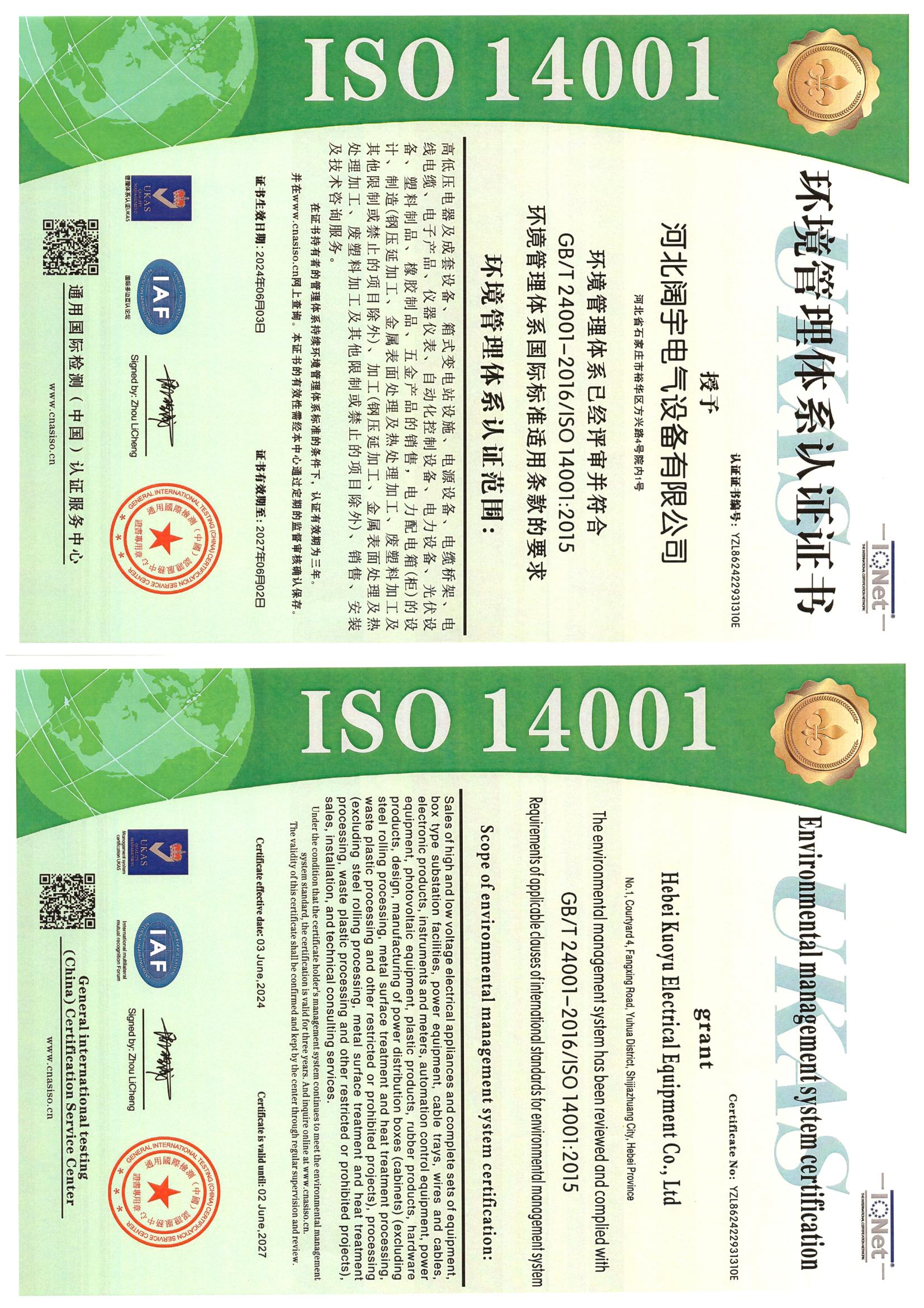
Environmental Management System certificate, ISO 14001, GB/T24001-2016 / ISO 14001:2015, certificate number YZL862422931310E, issued 3 June 2024, valid to 2 June 2027.
Identity fields worth copying into the supplier file
- Certificate number, exactly as printed, so it can be matched to the issuer's records later.
- Standard plus year of the standard, since a 2015 revision and an older revision are not equivalent evidence.
- Issuing body and its accreditation status, checked independently rather than assumed from the letterhead.
- Issue date, expiry date and the surveillance pattern in between.
- Scope wording, copied verbatim, because a narrower scope can silently exclude the activity the buyer cares about.
- Market designation and the products the certificate is linked to in the supplier's documentation.
The reason to record these fields is comparability. Two certificate PDFs can look identical in layout while differing in scope breadth, standard version and remaining validity. A certificate running to 2027 and one expiring next quarter are not the same procurement asset, even when both are displayed on the same website.
What the certificates do not cover
The limits are not a defect specific to this supplier. They are what the document category can carry, and a buyer who understands them avoids both over-reliance and unnecessary suspicion.
- Product type testing. Neither certificate reports design verification, temperature-rise, short-circuit withstand or enclosure verification for the PZ30 Series. Those belong to the assembly standard that applies in the destination market.
- The IP rating itself. IP40 and IP54 are product specifications of the box, not certification-body findings. A project that specifies IP65 sits outside this product line's stated protection range and belongs with the cabinet range instead: the GGD/GCS/MNS Series distribution cabinet is rated 380V/220V, up to 6300A, with IP54/IP65 protection.
- Market access. A global market designation on a management-system certificate is not a regulatory approval for every country. United States pathways reference UL 1741 for combiner boxes; IEC-market requirements follow the IEC framework; national deviations still apply on top.
- Time. Both certificates expire on 2 June 2027. Surveillance audits are what keep a certificate valid in the interim, and a buyer drafting a multi-year framework should set a re-verification date before expiry rather than discovering the gap at delivery.
- Production scope. The scope wording is built around sales, installation and technical consulting. A buyer who needs assurance on manufacturing process control should request factory-level evidence in addition, not instead.
Reading the certificates against a PZ30 Series specification
The Distribution Box line is the PZ30 Series, an industrial and residential distribution box intended for residential, commercial and industrial electrical systems. Its published parameters are what a reader should hold next to the certificate.
| Parameter | PZ30 Series distribution box (product 6476) |
|---|---|
| Model | PZ30 Series |
| Rated voltage | 220V / 380V |
| Rated current | Up to 125A |
| Protection class | IP40 / IP54 |
| Material | High-quality ABS plastic, cold-rolled steel plate, stainless steel optional |
| Scope of application | Residential, commercial and industrial electrical systems |
| Applicable industries | Residential, commercial, industrial, power control |
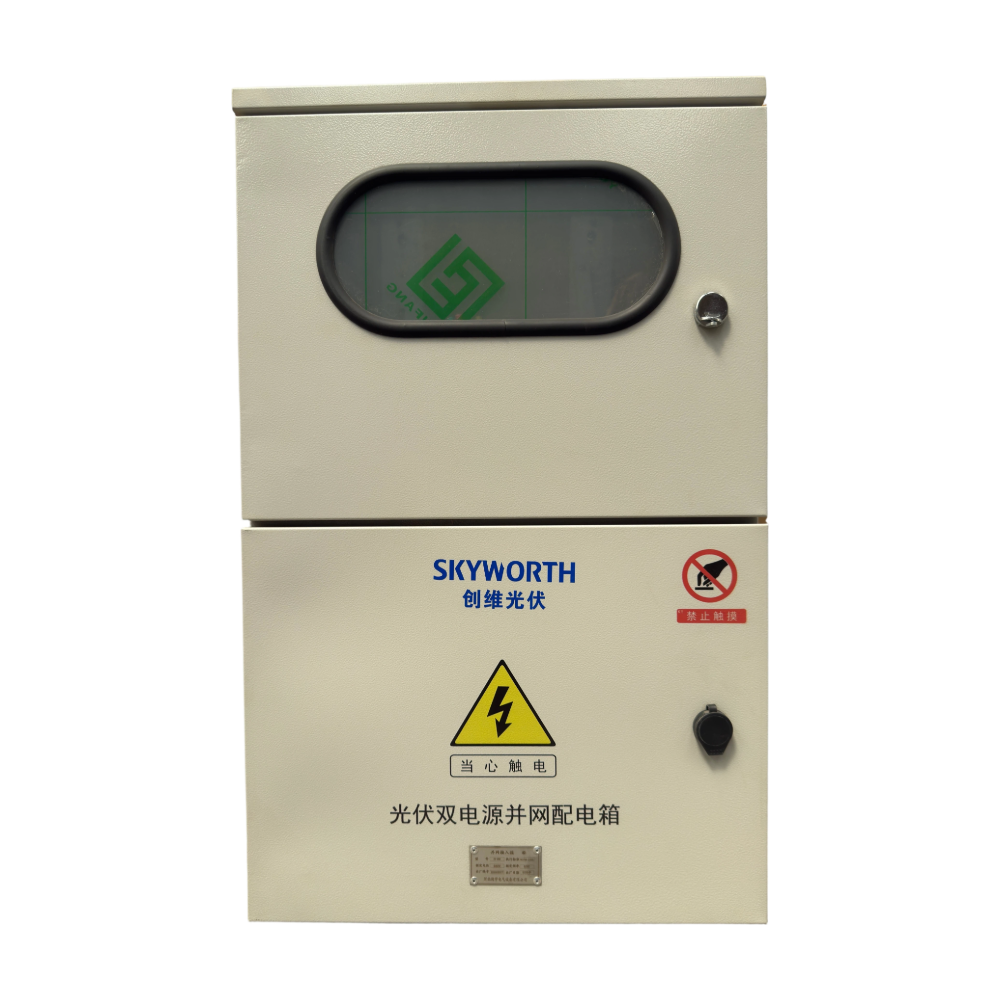
PZ30 Series distribution box: 220V/380V, up to 125A, IP40/IP54, available in ABS plastic, cold-rolled steel plate or stainless steel.
The two document sets meet where a buyer needs a controlled supplier process for a box installed at 220V/380V and up to 125A in a residential or commercial photovoltaic installation: the AC output side of a rooftop system, a small commercial distribution point, or a sub-board inside a plant. In those positions the certificate supports supplier qualification and the specification sheet supports the technical fit. Neither substitutes for the other.
They separate where a project pushes beyond the product class. A utility-scale DC string combiner operating at 1500V DC with multiple string inputs, surge protection and an outdoor enclosure is a different build. One published utility-scale configuration from ABB, for illustration only, lists a maximum system voltage of 1500V DC, a rated output current of 256A, 16 input circuits, Type 2 overvoltage protection and an IP66 / IK08 enclosure. That example describes configuration depth at utility scale; it is not a benchmark against the PZ30 line, and it should not be read as one.
The same separation appears in how manufacturers publish evidence. Weidmuller states that its high-current PV DC combiner boxes are tested according to IEC 61439-2 — a testing statement, presented separately from any management-system certificate. Buyers should expect that separation rather than a single document that claims to do everything.
Application context: where the certificate question changes shape
For a residential solar distribution box, the certificate question is usually about supplier continuity and documentation discipline: will the same process exist for the second order and the spare-parts request two years later. The technical question is settled by the specification — 220V/380V, up to 125A, IP40 for indoor positions or IP54 where dust and humidity are present, in ABS plastic or a steel enclosure.
For a commercial photovoltaic distribution box or an industrial distribution point, the emphasis shifts. These installations typically run continuously, and the working conditions described for industrial and power-distribution environments include high humidity, dust, and requirements for waterproof and dustproof enclosures, corrosion resistance, flame retardant behaviour, high mechanical strength and a customisable internal structure. In that setting the enclosure rating and material choice carry more weight than the certificate, and the certificate answers a different question: who controls the process that produces and documents the box.
For an outdoor solar distribution box installed in an exposed position, a buyer should read the IP column first. If the site demands IP65, the PZ30 line's IP40/IP54 range will not satisfy it, and the discussion should move to the cabinet line rather than to a different reading of the same certificate. That single check prevents a common sourcing error: treating a management-system certificate as if it validated an enclosure rating.
A four-document verification sequence
For photovoltaic procurement teams building a repeatable supplier file, the certificate is step one of four, and the sequence matters more than the individual documents.
- Certificate record. Number, standard with year, issuer, scope text, issue and expiry dates, and the products the certificate is linked to.
- Configuration datasheet. Rated voltage, rated current, protection class, material, internal layout and a single-line diagram for the exact configuration being ordered.
- Type-test or design-verification evidence. Against the assembly standard of the destination market: IEC 61439-2 where the IEC framework applies, UL 1741 where US certification is required for combiner equipment.
- Order-level evidence. Routine test records, incoming inspection, packing list and delivery documentation. Kuoyu Electrical reports 100% testing, a minimum order quantity of 2 units, a 30-day lead time, OEM production with voltage and logo customisation, and remote after-sales support — company-reported terms that belong in a purchase order as agreed conditions, not in a certificate review.
Market trend: documentation is becoming part of the product
Demand for documentation discipline is rising alongside the balance-of-system segment. Business Research Insights, a commercial research publisher, projects the global solar combiner box market to grow from USD 1.2 billion in 2026 to USD 2.1 billion by 2035, and forecasts that DC smart combiner boxes will hold a 62.5% share of that segment by 2035. Both figures are that publisher's estimates and forecasts, not observed shipments, and they address the combiner-box segment rather than distribution boxes for photovoltaics as a whole.
The procurement implication is more reliable than the numbers themselves. As projects grow in scale and as more of the balance of system becomes a documented, audited category, buyers stop comparing brochures and start comparing files. A supplier that can produce a certificate with a readable scope, a matching datasheet and a testing basis tends to move through evaluation faster than one that sends a certificate image without a scope statement.
The counter-trend is equally worth noting. Management-system certificates are increasingly common across the category, which means their differentiating value is falling while their verification value is rising. The document is becoming a baseline entry requirement rather than a competitive argument.
Comparison: four documents buyers routinely mix up
| Document | Question it answers | What it does not answer | Where it fits |
|---|---|---|---|
| ISO 9001 / ISO 14001 certificate | Is there an audited management system covering this scope, for this period? | Product design, type-test values, IP verification, capacity | Supplier qualification and shortlisting |
| IEC 61439-2 design verification or type-test evidence | Does this assembly design meet the assembly standard, including the photovoltaic annexes? | Environmental management, order handling, after-sales | Technical approval in IEC markets |
| UL 1741 certification | Has the product been certified to the US standard referenced for combiner boxes? | Compliance in IEC or other national frameworks | US market access screening |
| Factory audit and order records | Does this plant build what it states, at the stated rate and quality level? | Product design compliance | Capacity verification and first-order follow-up |
The limitation is worth stating plainly: the management-system certificate is the most widely held and least expensive of these four documents to obtain, which is precisely why it differentiates least on its own. It earns its place as a filter, not as a conclusion. A buyer who treats certificate possession as technical approval has skipped the two documents that carry the engineering risk.
Future outlook
Both Kuoyu Electrical certificates run to 2 June 2027. Any framework agreement, framework tender or repeat-order programme that extends past that date should include a scheduled re-verification point rather than an assumption of continuity, and the same applies to the ISO 45001 certificate carrying the same expiry.
Three developments are likely to shape how these documents are used in photovoltaic sourcing. First, certificate verification is moving from PDF inspection to issuer-record lookup, which rewards suppliers whose certificate numbers resolve cleanly. Second, RFQ templates increasingly ask for the scope text and the linked product model, not just a certificate attachment, which pushes suppliers to map documents to product lines explicitly. Third, expectations on the product side of the balance of system keep tightening, so the gap between management-system evidence and product-level evidence will remain the point where most evaluation time is spent.
For buyers, the practical position is stable: keep the two families separate, record the identity fields, and match the document to the decision it can actually support. Used that way, an ISO 9001 or ISO 14001 certificate does real work in a photovoltaic distribution box evaluation. Used as a substitute for type-test evidence, it creates the illusion of diligence without the substance.
FAQ
What does Kuoyu Electrical's ISO 9001 certificate actually cover?
Certificate YZL862422931310Q certifies a quality management system against GB/T19001-2016 / ISO 9001:2015. It was issued on 3 June 2024 by General International Testing (China) Certification Service Center, is valid to 2 June 2027, and applies to the global market. The stated scope is sales, installation and technical consulting services for high and low voltage electrical appliances and complete equipment, box-type substation facilities, power supply equipment, cable trays, wires and cables, electronic products, instruments and meters. The certificate is recorded as applicable to the Distribution Box product line (product 6476, PZ30 Series), among other products.
Which certificate number identifies the ISO 14001 certificate, and does it share the same validity window?
The environmental management system certificate carries number YZL862422931310E and is issued against GB/T24001-2016 / ISO 14001:2015. It was issued by General International Testing (China) Certification Service Center on 3 June 2024 and expires on 2 June 2027, the same issue and expiry dates as the ISO 9001 certificate. Its stated scope is the sales of high and low voltage electrical appliances and complete sets of equipment, box-type substation facilities, power equipment, cable trays, wires and cables, electronic products, instruments and meters, automation control equipment and power equipment.
Do these certificates show that a PZ30 distribution box complies with IEC 61439-2?
No. ISO 9001 and ISO 14001 are management-system standards and do not contain type-test results. IEC 61439-2:2020 is a separate assembly standard that includes Annexes DD, EE and FF for assemblies used in photovoltaic installations, and compliance with it is evidenced through design verification and testing documentation rather than through a management-system certificate. A buyer requiring IEC 61439-2 evidence should request the corresponding verification documents in addition to the certificates.
The certificates are marked global — does that mean they are accepted in every export market?
The global designation describes the market applicability recorded for the certificate. It is not a regulatory approval for each destination country. Market access requirements are jurisdiction-specific: in the United States, UL Solutions identifies UL 1741 as the standard associated with combiner boxes within solar balance-of-system certification, while IEC-market requirements follow the IEC framework with national deviations. Buyers should map the destination market's requirement to the correct document type before relying on any certificate.
What should a buyer do about the 2 June 2027 expiry date?
Schedule a re-verification point before expiry rather than after it. For orders delivered close to that date, request confirmation that the certificate remains valid at the time of shipment, and record the surveillance status alongside the original certificate. The same date applies to the ISO 45001 certificate in the same set, number YZL862422931310S, issued against GB/T45001-2020 / ISO45001:2018.
Do the same certificates cover the distribution cabinet and transformer lines as well as the distribution box?
The certificates are recorded as applicable to several products, not only the Distribution Box (product 6476, PZ30 Series). The related products listed are the Distribution Cabinet (product 6475, GGD/GCS/MNS Series), the Oil Immersed Transformer (product 6477, S11/S13 Series) and the Pad Mounted Transformer (product 6474, ZGS11 Series). Buyers should confirm in the quotation which product model the certificate is being applied to, because the technical requirements differ between a 220V/380V distribution box and a 10kV/0.4kV pad mounted transformer.
A company brochure covering the distribution box, distribution cabinet and transformer lines is available for download: Kuoyu Electrical English brochure (PDF).
¿Tiene preguntas o necesita más detalles?
Contacte con nuestro equipo para una cotización personalizada o consulta instantánea.
Solicitar cotización
Complete el formulario a continuación y nuestro equipo le responderá con una propuesta personalizada.
Chat directo de WhatsApp
¿Prefiere chatear en tiempo real? Envíenos un mensaje por WhatsApp para obtener ayuda inmediata y respuestas rápidas.
- Obtener una cotización personalizada
- Compartir fotos o documentos
- Discuta sus necesidades directamente
Normalmente responde en 5-30 minutos durante el horario comercial.