
What ISO, REACH and RoHS Certificates Really Cover on PVC Foam Board
Compliance & Procurement Reference
What ISO, REACH and RoHS Certificates Really Cover on PVC Foam Board
Compliance paperwork is no longer something that arrives after the price has been agreed. In PVC foam board sourcing, certificate review has moved to the front of the process, because a board that cannot be documented cannot be released into a European retail programme, a school refurbishment, or a furniture line with an indoor air quality specification.
This reference article breaks down what the four documents most commonly attached to a PVC foam board quotation actually certify, using the certificate set held by Zibo Dingtian Plastics Co., Ltd. (DINGTIAN) as a worked example. It is written for buyers, specifiers and technical reviewers who need to read a certificate the way an auditor would, rather than the way a brochure presents it.
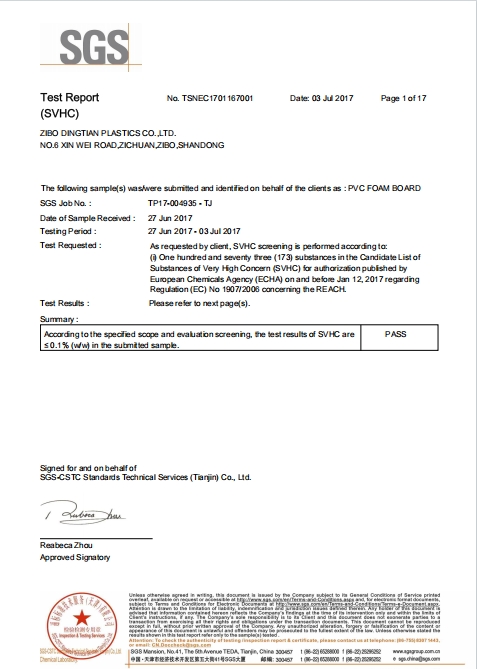
REACH documentation held for PVC foam board: an SGS test report referencing REACH Regulation (EC) No 1907/2006.
Why compliance documentation moved to the front of the buying decision
Two structural facts explain the shift. First, the market is large and growing: the global PVC foam board market was valued at approximately USD 2.1 billion in 2024 and is projected to reach USD 3.6 billion by 2032, according to Verified Market Research. Second, supply is concentrated — China accounted for 20% of total exports of plastic building materials including PVC boards in 2024, according to the Observatory of Economic Complexity, keeping it the largest exporter.
Demand is led by signage and advertising, which holds approximately 35% of total application demand according to Laird Plastics. That matters because signage, construction interiors and cabinetry are exactly the applications where a buyer inherits downstream obligations — a retailer's chemical policy, a project's indoor air requirement, or a municipal waste-handling rule.
The regulatory trigger is specific. EU REACH Regulation (Entry 63 of Annex XVII) restricts lead concentration in PVC articles to less than 0.1% by weight, effective 29 November 2024, as documented by the European Commission and summarised by Intertek. For a PVC article — which is what a foam board is — that restriction applies to the article itself, not only to the raw polymer.
The practical result is that European and North American buyers now open a supplier negotiation with three questions rather than one: which document, issued by whom, and covering exactly what. A quotation without answers is a quotation that cannot be approved internally.
The five fields that decide whether a certificate is usable
Most disputes about documents are not about fraud. They are about scope. Five fields determine whether a certificate can actually support a purchase decision:
- Issuing body — an accredited testing or certification organisation, not an internal quality department.
- Document number — the identifier that allows the buyer to trace the file.
- Standard referenced — the regulation or test method the assessment was performed against.
- Scope statement — the product or process the document covers. This is the field most often misread.
- Issue date and validity — a management-system certificate expires; a test report is a snapshot.
Laid out against those five fields, DINGTIAN's PVC foam board documentation reads as follows.
| Document | Issued by | Standard | Scope | Number / date |
|---|---|---|---|---|
| ISO 9001 quality management | Kaixin Certification (Beijing) Co., Ltd | GB/T19001-2016 & ISO9001:2015 | Production of PVC foam board | 06924Q10470RO 18 Apr 2024 – 17 Apr 2027 |
| REACH test report | SGS | REACH Regulation (EC) No 1907/2006 | PVC foam board | TSNEC1701167001 3 Jul 2017 |
| RoHS test document | SGS | IEC 62321 | PVC foam board | QDAFN160100422 4 Feb 2016 |
| Formaldehyde test report | SGS | ISO 17226-1:2021 | PVC foam board | TSNHG2301164301 10 May 2023 |
Sources: DINGTIAN certification records. Buyers should always verify current PDF copies rather than relying on a summary table.
ISO 9001: what a quality management certificate does and does not prove
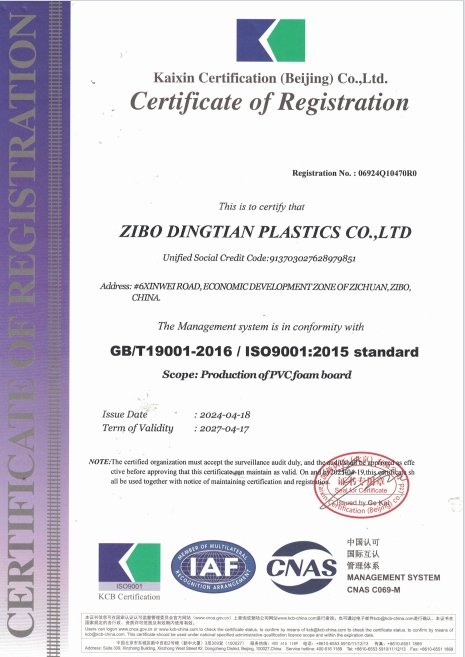
ISO 9001 certificate 06924Q10470RO, scoped to the production of PVC foam board and valid through 17 April 2027.
DINGTIAN holds ISO 9001:2015 certification under certificate number 06924Q10470RO, issued by Kaixin Certification (Beijing) Co., Ltd on 18 April 2024 and valid to 17 April 2027, with the certified scope recorded as the production of PVC foam board and the standard cited as GB/T19001-2016 and ISO9001:2015.
That certificate says something specific and something limited. It says the production system is formally governed: procedures are documented, records are maintained, non-conformities are handled through a defined process, and the system is subjected to periodic external audit. It supports the operational evidence around the certificate — a manufacturer that runs 100% quality testing on production, operates a 30,000 m² plant in the Zichuan Economic Development Zone of Zibo City, Shandong Province, employs 181 people including a 20-engineer R&D team, and produces 50,000 tons annually is describing a process environment in which a management system can function.
It does not say that a particular board has a particular density, a particular fire classification, or a particular chemical profile. ISO 9001 is a system certificate, not a product certificate. Buyers who need product-level assurance must ask for product test reports; the ISO 9001 scope statement tells them which factory site and which production activity the system covers.
REACH: chemical safety for the EU market, and why the date matters
DINGTIAN's REACH documentation is an SGS test report, number TSNEC1701167001, referencing REACH Regulation (EC) No 1907/2006, scoped to PVC foam board and issued on 3 July 2017 for the European market.
REACH is the EU framework governing the registration, evaluation, authorisation and restriction of chemicals. For an imported article, the compliance obligation sits with the EU-based importer or its appointed representative, but the technical evidence is generated upstream by the manufacturer. That is why a buyer's due diligence focuses on whether the manufacturer can produce substance-level documentation on demand.
Here the issue date is not a formality. The EU restricted lead concentration in PVC articles to less than 0.1% by weight with effect from 29 November 2024. A test report issued in 2017 shows that the material screened at that time, against the restriction list as it stood then. It does not, by itself, demonstrate conformity with a restriction that entered into force seven years later.
This is a documentation boundary rather than a product defect, and it applies across the industry rather than to one supplier. The practical response for a buyer sourcing for the EU is to request a current confirmation — an updated test covering lead, or a signed statement of conformity referencing the present restriction text — alongside the historical report. Older test files remain useful as evidence of continuity, but the current restriction list is the one that governs customs clearance and customer acceptance.
RoHS: hazardous substance screening beyond electronics
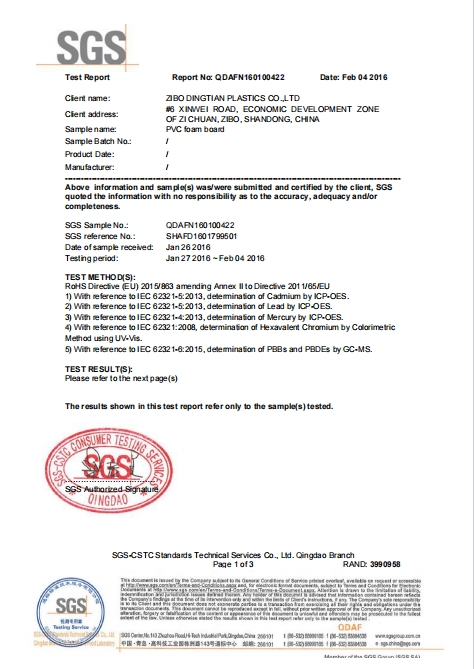
RoHS documentation tested against IEC 62321, scoped to PVC foam board.
DINGTIAN's RoHS document is certificate number QDAFN160100422, issued by SGS against the IEC 62321 test method series and scoped to PVC foam board, dated 4 February 2016. IEC 62321 provides the analytical methods used to determine restricted substances in electrotechnical products — the reason the standard appears on a plastics document is that PVC foam board frequently ends up inside or behind electrical and electronic assemblies.
That is the practical link. A foam board used as an illuminated sign panel, a display housing insert, a control cabinet backing or an equipment nameplate is part of a product chain where RoHS questions are routinely asked, even though the board itself is passive. A board used purely as a decorative wall panel or exhibition substrate is normally screened under REACH instead, and RoHS documentation is supplied as supporting evidence.
The same date caveat applies here. The RoHS restricted substance list has been extended since 2016 to include certain phthalates. A 2016-vintage report should therefore be treated as a baseline screening record, and buyers with a live electronics-adjacent application should ask whether an updated report against the current restricted substance list is available.
Formaldehyde testing: the document furniture buyers ask for first
DINGTIAN's formaldehyde documentation is an SGS test report, number TSNHG2301164301, issued on 10 May 2023 under the ISO 17226-1:2021 standard, scoped to PVC foam board and applicable to global markets.
This is the newest document in the set, and the reason is visible in the application mix. PVC foam board competes directly with wood-based panels in cabinetry, wardrobes, bathroom vanities and interior fit-out — a segment that accounts for roughly 15% of board demand in the product data. Formaldehyde is the classic indoor air concern associated with wood-based panel adhesives. A formaldehyde test report on a PVC board gives a specifier a way to keep a familiar material format while removing an emission pathway, without switching to a fixed, pre-sized alternative.
The scope note matters as much as the result. This report covers the tested PVC foam board construction. Laminated, high-gloss, co-extruded or coloured variants introduce additional materials to the surface or the core, and buyers specifying those variants for interior work should confirm whether existing documentation covers the ordered construction or whether supplementary testing is required.
Mapping certificates to applications: signage, construction, furniture, transport
Certificates are only decision tools when they are matched to a use case. Across PVC foam board demand, advertising and signage accounts for approximately 35%, construction and decoration 30%, furniture and cabinetry 15%, transportation 10%, with the remaining 10% in packaging, prototypes and industrial protection.
| Application | Documentation normally reviewed | Additional check the buyer should raise |
|---|---|---|
| Signage and advertising | ISO 9001, REACH; RoHS where electronics are involved | Outdoor weathering and print adhesion over the intended service life |
| Construction and decoration | ISO 9001, REACH, formaldehyde | Board-specific fire test data where building codes require a classification |
| Furniture and cabinetry | Formaldehyde, REACH, lead restriction confirmation | Whether laminated or coloured variants are covered by the same report |
| Transportation interiors | REACH, RoHS, formaldehyde | Project-specific emission and flammability requirements |
| Packaging and industrial protection | ISO 9001, REACH where exported to the EU | Contact-sensitive or food-adjacent restrictions |
DINGTIAN's product data covers PVC Celuka foam board in sizes 1220 × 2440 mm, 1560 × 3050 mm and 2050 × 3050 mm, thickness 1–35 mm and density 0.4–0.9 g/cm³, with OEM and ODM production and customisation of size, thickness, density and colour. Monthly capacity is 4,200 tons, typical lead time is 30 days, the minimum order is one 20ft GP full container, quality control applies 100% testing, and after-sales service is delivered remotely. Production runs to roughly 80% export, with principal markets in Southeast Asia, the Middle East and South and North America.
Documentation is also supported by field performance. A distributor and wholesaler customer buying advertising and furniture material at 10 containers per month, with a relationship running 5 to 10 years, reports 98% print image retention after three years, zero warping or delamination, 100% waterproof performance, and a 40% cost saving against aluminium composite panel. The UV-stabilised construction behind those results is the operational counterpart to the paperwork: the certificate opens the door, the board has to perform behind it.
Where the evidence stops: limits buyers should plan around
A credible compliance review states boundaries as clearly as it states capabilities. Four limits apply to this document set and to the category generally.
- Certification level. ISO 9001 certificate 06924Q10470RO operates at factory-system level, scoped to the production of PVC foam board. REACH, RoHS and formaldehyde documents operate at product level on the tested board. A buyer who needs both must request both.
- Time validity of test reports. The REACH report dates from 2017 and the RoHS document from 2016. Restriction lists change; a historical report should be re-confirmed against the current text before it is relied on for a new shipment.
- Fire performance is separate. PVC foam board is commonly assessed against standards such as ASTM E84, where boards used in construction are tested to achieve a Class A rating with a flame spread index of 0 to 25, and against UL 94, where a V-0 classification is typically achievable down to 1 mm thickness according to The Vinyl Institute. These standards describe what the category can be tested against; they are not results certified for every board. Where a code or an insurer requires a classification, the buyer should request a fire test report for the specific board construction and thickness ordered.
- Non-transferability. Certificates are issued to a specific legal entity and scope. A document supplied by a trading intermediary does not extend to product manufactured elsewhere.
Compared with traditional alternatives, the balance is straightforward. Wood-based panels arrive with an established formaldehyde classification regime and a familiar specification language, but they carry moisture sensitivity and a documented emission pathway that interior specifiers must manage. PVC foam board arrives with a different documentation burden — REACH, RoHS and lead-limit evidence for EU-facing projects — while offering the waterproof and dimensional-stability behaviour that sits at the centre of its application case. Neatly, the substitution does not remove compliance work; it moves it to a different set of standards.
Market direction: compliance as a sourcing filter
With the global category moving from approximately USD 2.1 billion in 2024 toward a projected USD 3.6 billion by 2032, and with China holding a 20% share of plastic building materials exports, the competitive question is shifting from availability to verifiability. Supply is not scarce; documented supply is.
The direction of travel is that documentation is requested earlier. Increasingly, procurement teams treat a scoped ISO 9001 certificate and a current substance report as a request-for-quotation qualification, and then use plant scale, capacity, lead time and inspection terms to separate shortlisted suppliers. For a manufacturer, that means the useful posture is not to claim more than the file supports, but to make the file easy to verify: clear scope wording, traceable document numbers, and a willingness to support pre-shipment testing and third-party inspection, which DINGTIAN's commercial terms already accommodate through an SGS third-party inspection option, FOB, CIF and EXW delivery terms, and a stated 30% T/T advance with 70% against copy of bill of lading.
Over the medium term, buyers should expect more requests for periodic re-testing rather than one-off certificates, more emphasis on lead restriction confirmation in PVC articles following the November 2024 EU change, and more contract clauses that tie acceptance to document validity at the time of shipment. Suppliers that can produce refreshed evidence on a defined cycle will find compliance becomes a commercial advantage rather than an administrative cost.
Frequently asked questions
What does an ISO 9001 certificate actually cover for a PVC foam board manufacturer?
An ISO 9001 certificate covers the quality management system of a defined production scope, not the performance of an individual board. DINGTIAN's certificate 06924Q10470RO was issued by Kaixin Certification (Beijing) Co., Ltd on 18 April 2024 against GB/T19001-2016 and ISO 9001:2015, with the scope recorded as the production of PVC foam board, and it is valid to 17 April 2027. For a buyer it evidences documented procedures, record-keeping and defined non-conformity handling inside that scope. Product attributes such as density, thickness tolerance, fire classification or chemical content must be verified separately through product-level test reports.
Does a REACH test report prove that a PVC foam board meets current EU requirements?
It proves that the tested sample complied with the requirements applicable when the test was performed. DINGTIAN's REACH documentation is an SGS test report, number TSNEC1701167001, referencing REACH Regulation (EC) No 1907/2006 and issued on 3 July 2017 for PVC foam board. Because the EU restricts lead in PVC articles to less than 0.1% by weight with effect from 29 November 2024, a buyer sourcing for the EU should ask for confirmation against the current restriction text, or for an updated test covering lead. The 2017 report remains valid evidence of screening at the time of issue, but it does not automatically cover restrictions adopted afterwards.
What is the difference between REACH and RoHS documentation for PVC foam board?
They answer different questions. REACH is the EU chemicals framework covering registration, evaluation, authorisation and restriction of substances, and it applies to articles such as PVC foam board, including the lead restriction in PVC articles. RoHS restricts hazardous substances and is conventionally associated with electrical and electronic equipment. DINGTIAN holds both: an SGS REACH test report (TSNEC1701167001, issued 3 July 2017) and a RoHS document tested against IEC 62321 (QDAFN160100422, issued 4 February 2016), both scoped to PVC foam board. A board used in an illuminated sign, display housing or equipment panel is usually asked for both; a decorative board is normally screened under REACH. Neither document certifies mechanical performance.
Which certificates should a buyer request before a first PVC foam board order?
A workable minimum set is: a current quality management certificate with a scope that names PVC foam board production; a REACH statement or test report reflecting the current restriction list, including the lead limit for PVC articles; a RoHS report where the board is used near electrical or electronic components; a formaldehyde test report for furniture, cabinetry and interior applications; and written confirmation that these documents apply to the exact grade ordered. Because test reports are product- and time-specific, the request should also cover sampling and acceptance testing. DINGTIAN's terms accept pre-shipment testing and SGS third-party inspection, with a minimum order of one 20ft GP full container and a typical 30-day production lead time.
Can one supplier's certificate be used to qualify boards from another factory?
No. Certificates and test reports are issued to a named legal entity and a defined scope. ISO 9001 certificate 06924Q10470RO is scoped to the production of PVC foam board, and the REACH, RoHS and formaldehyde reports reference a specific tested product; none of them extends to material produced by a different manufacturer. For a buyer, the verification step is to match the certificate holder name against the entity named on the commercial invoice and packing documents, and to read the scope wording rather than the certificate title.
Are DINGTIAN's documents factory-level or board-level?
The set is mixed, and the distinction is useful. ISO 9001 is factory-level: certificate 06924Q10470RO certifies the management system behind the production of PVC foam board, valid from 18 April 2024 to 17 April 2027. The REACH, RoHS and formaldehyde documents are product-level test reports issued by SGS for the tested PVC foam board. In practice, the ISO 9001 certificate answers whether a factory can control production consistently, while the test reports answer whether a product meets a specific substance requirement. Because co-extruded boards combine a rigid PVC skin with a foamed core, and laminated or coloured variants add further materials, buyers should confirm which construction each report covers and whether the ordered variant requires additional testing.
Reading the file, not the label
The value of a compliance document lies in its scope statement and its date, not in the logos printed beside it. DINGTIAN's PVC foam board file — an ISO 9001 certificate covering production, an SGS REACH report, an SGS RoHS document tested under IEC 62321, and an SGS formaldehyde report — gives a buyer a verifiable starting point for EU-facing, interior and electronics-adjacent applications, provided the buyer reads each document for what it covers and re-confirms the items where regulation has moved on.
Zibo Dingtian Plastics Co., Ltd. is a PVC foam board manufacturer founded in June 2004 and based in the Zichuan Economic Development Zone, Zibo City, Shandong Province, China, operating a 30,000 m² plant with 181 employees, a 20-engineer R&D team and 50,000 tons of annual output. A downloadable company brochure covering product ranges and plant capabilities is available here.