
What FDA 84-278-1901 Covers for Functional Liquid Beverages
What FDA 84-278-1901 Covers for Functional Liquid Beverages

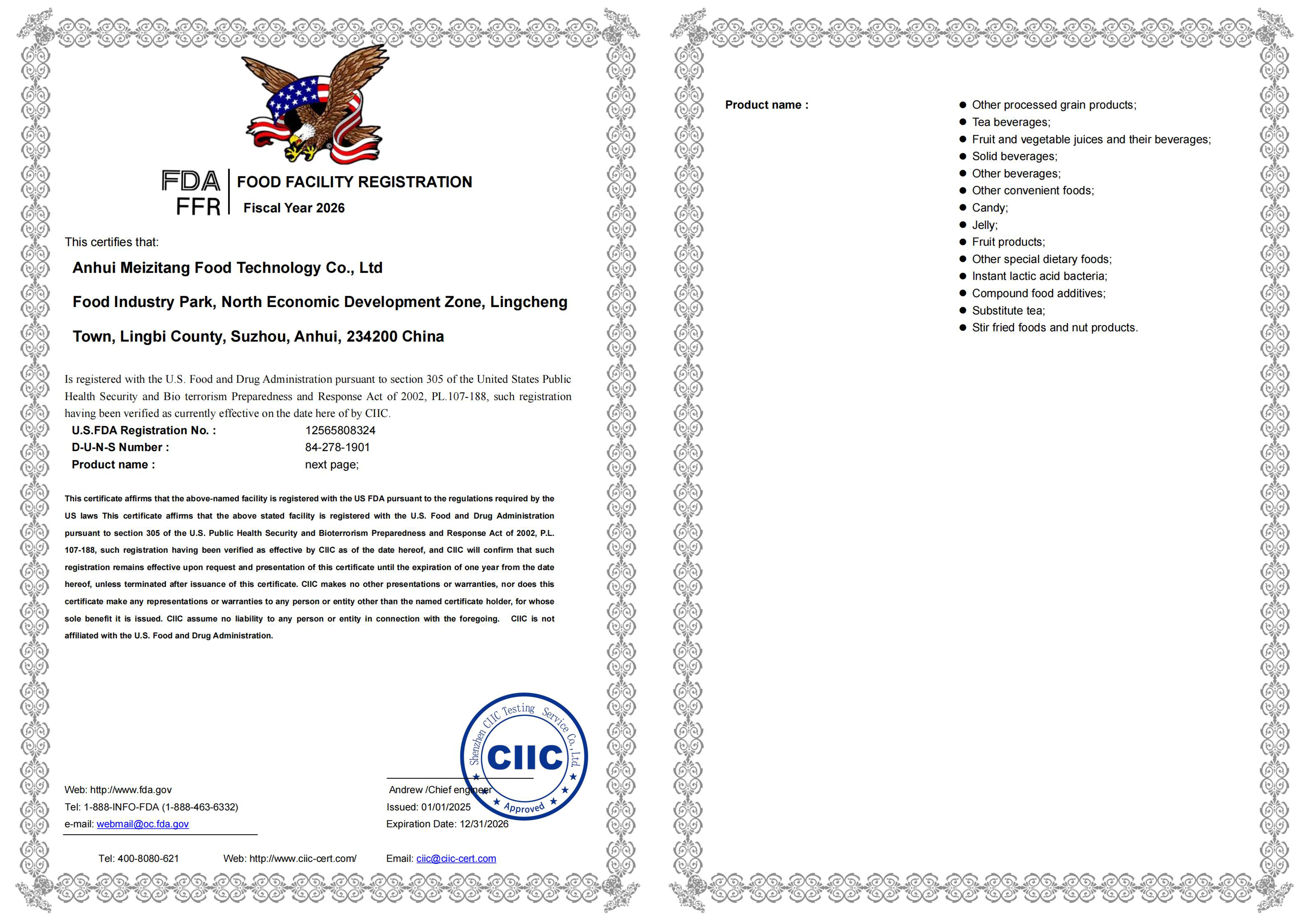
A US food facility registration and a product approval are different instruments, and the gap between them decides how a beverage brand should read certificate 84-278-1901. The record held for SPACELIFE's liquid beverages line names the FDA as the issuing authority, states a US market scope, and cites section 305 of the US Public Health Security and Bioterrorism Preparedness and Response Act of 2002 as the applicable standard. It is a registration record. It is not a statement that any particular finished drink has been cleared for sale, and it carries no information about Europe, the Middle East or East Asia. For brand teams working through research and evaluation, the useful question is therefore a narrow one: which parts of a supplier qualification file does this record support, and which parts still have to be requested?
SPACELIFE is the functional food and beverage supply brand operated by Shenyang Songming Supply Chain Co., Ltd., a supply chain service provider working with B-end clients across functional foods, functional beverages, coffee and supplement categories. Two of its product lines matter for this article: product code 4363, an oil orange puree liquid beverage, and product code 4373, an espresso concentrate. Both are attached to the 84-278-1901 record, and both are useful for showing how far a single registration number travels inside a buyer's diligence process — and where it stops.
What the 84-278-1901 record actually states
Read as a document rather than a badge, the record answers four questions. Who issued it, what it is, where the supplier says it applies, and for how long. Everything else on the page is context.
| Field | Recorded value |
|---|---|
| Registration number | 84-278-1901 |
| Issuing authority | FDA (U.S. Food and Drug Administration) |
| Market scope | United States |
| Scope description | Food facility registration for functional food and beverages |
| Applicable standard | Registered with the U.S. Food and Drug Administration pursuant to section 305 of the U.S. Public Health Security and Bioterrorism Preparedness and Response Act of 2002, PL. 107-188 |
| Validity window | 1 January 2025 to 31 December 2026 |
| Related products | 4363 Liquid beverages (oil orange puree); 4373 coffee (espresso concentrate) |
The standard field is the most informative line on the page, because it names a legal basis instead of describing an outcome. Section 305 of the Bioterrorism Act is the provision under which food facilities register with the FDA; the text does not say that the regulator has evaluated a recipe, a label, a claim or a batch. A buyer who reads the standard rather than the word certification will reach a more accurate conclusion, and will ask better follow-up questions.
That reading is not academic. Buyers routinely request the FDA certificate and then treat its arrival as the end of the compliance conversation. It is closer to the beginning. The registration establishes an administrative link between a facility and the US regulator, and almost everything a brand actually needs to know about a specific drink — formulation, label wording, claim substantiation, testing, shelf life — sits outside that link.
Facility registration is not a product approval
The distinction is simple to state and easy to lose in a procurement file. A facility registration identifies a place of business to the FDA. A product approval or authorisation, where one exists at all, attaches to a specific product under a specific set of conditions. Number 84-278-1901 belongs firmly to the first category.
It can support statements such as: the facility behind this supply is registered with the FDA for functional food and beverage operations, under the standard cited on the record, and the registration is stated as applicable to the US market. It cannot support the sentence this drink is FDA approved, and it should never appear that way in a brand's own marketing, where the wording becomes a claim with its own consequences.
For a buyer, the practical result is a split checklist. Supported by the record: the existence of a registration, its number, its stated market, its cited standard and its current validity window. Not supported by the record: conformity of a particular SKU to US labelling rules; the status of any ingredient; the outcome of any test; the identity of the manufacturing site if it differs from the registered entity; and the importer-side obligations that fall on the brand or its US agent rather than on the supplier.
There is a subtler risk as well. Because FDA appears on the document, a certificate tends to drift into marketing copy as a quality claim. US labelling rules treat claims with care: the FDA distinguishes health claims, nutrient content claims and structure/function claims as separate categories, each subject to its own conditions. A supplier can help assemble the technical file, but the wording on the pack is the brand's responsibility, and a registration number does not transfer it.
The US scope line is a boundary, not a global passport
The market field on 84-278-1901 reads United States. That single word is the most frequently misread part of the document, because suppliers serving several regions inevitably hold several records, and buyers who see one certificate sometimes assume it covers the rest.
SPACELIFE's company profile lists North America, Eastern Asia, Western Europe and the Middle East as its main markets, with exports at a company-reported 51% to 60% of output. That geographic spread is a commercial fact about the business; it does not widen what 84-278-1901 covers. The registration speaks to the US framework and is silent on the others.
For a buyer shipping into the EU, the UK, the Gulf or East Asia, the correct reading is therefore that this record provides no evidence either way. Requirements in those markets are set by different regulators, address different questions, and are not inherited from a US registration. This article makes no claim about them; the evidence available for this piece covers the US framework only. The qualification step is to ask, market by market, which document the supplier holds and what it actually attests — rather than treating a US registration as a proxy for global suitability. That single discipline prevents a large share of the confusion that surrounds cross-border functional beverage sourcing.
Which products the record is attached to
Registration numbers attach to facilities; product codes attach to products. Where a supplier links the two, a buyer should be able to trace that link in writing. Here the record names two products, and their declared specifications differ enough to be worth setting side by side.
| Attribute | 4363 Liquid beverages | 4373 coffee |
|---|---|---|
| Product type | Oil orange puree, liquid beverage | Espresso concentrate |
| Material basis | Oil orange puree | Arabica coffee beans, purified water, roasted coffee beans, coffee concentrate |
| Declared specification | Total original juice content of at least 80% | 30 ml per strip |
| Packaging | 30 ml x 5 bags per box, 150 ml per box | 30 ml x 10 strips per box |
| Stated applications | Liquid beverages | Mocha coffee, black coffee, Italian espresso, American coffee, cold brew coffee |
| Registration reference | FDA 84-278-1901, US market | FDA 84-278-1901, US market |
Two consequences follow. First, the juice-content figure on 4363 is a product specification, not a compliance claim. It belongs in the specification sheet and in the purchase contract, and it should be confirmed against a sample rather than inferred from a certificate. Second, the espresso concentrate's application list is a use-scope statement: it tells a buyer which beverage formats the supplier positions the product for, not which formats have been validated inside the buyer's own process. Both belong in the technical annex of any agreement, with the registration number referenced on a separate line so that the two kinds of evidence never blur into one another.
Where storage and pasteurisation fit in supplier qualification
A registration describes a facility. It does not describe how a product must be kept or how it is made. Those conditions sit in the application and specification records, and they are the part of qualification most often skipped, precisely because the certificate looks as though it has already answered the question.
For the ambient liquid beverage line, the recorded application conditions are room temperature, a matched pasteurisation line and a cool and dry storage type; the scenario record covers the US, Italy, the UK and France. For the espresso concentrate, the recorded working condition is high temperature, the matched equipment is again a pasteurisation line, and the storage instruction is a sealed container; that scenario record lists Australia, Canada, Germany, Spain, France, the UK and the US.
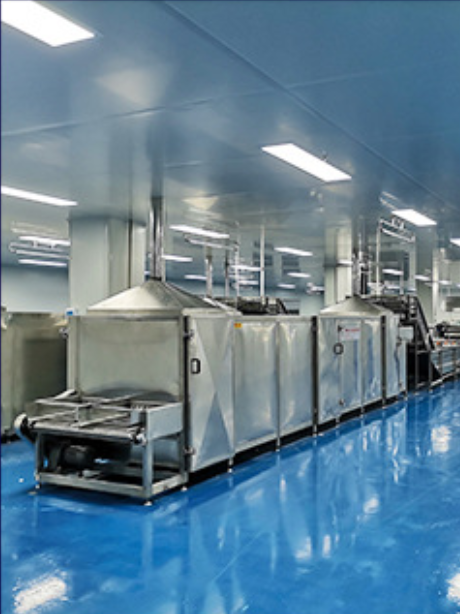
Three procurement consequences follow. Cool and dry is a warehouse and container condition, so it has to be written into the shipping specification rather than assumed from a certificate; a buyer whose distribution passes through hot or humid staging should confirm that the declared condition still holds end to end. Sealed-container storage for the concentrate is a packaging and handling instruction that affects repacking and secondary packaging decisions. And the pasteurisation line identifies which process step is doing the microbiological work, which makes it the natural place to ask for the process description, the control points and the basis for the declared shelf life — none of which a registration number contains.
This is also where a quality-control statement becomes testable. SPACELIFE's capability record states 100% testing; the buyer's question is what is tested, at what frequency, against which limits, and what happens to a batch that fails. The answer belongs in a signed quality agreement, not in a slide deck.
The document set to request before onboarding
The following set converts a certificate into a usable file. It is ordered roughly by how quickly each item can expose a mismatch.
- The complete record. Number, issuing authority, scope text, market field and validity dates should all be legible. A cropped image showing only the number is not a document.
- A written product-to-registration mapping. Which product codes and models are covered, and whether the SKU being ordered is one of them. For this supplier that means confirming 4363 and 4373 explicitly, and asking what happens when a new formulation or pack size is introduced under OEM or ODM customisation.
- Facility identity confirmation. The registered entity should match the contracting party. Where brand, trading company and factory are different legal persons, ask for the relationship in writing.
- Storage and handling declaration. Cool and dry for the ambient beverage line, sealed container for the concentrate, plus any transport condition that modifies them.
- Process and equipment statement. The pasteurisation line as the named process step, with control points, a summary of monitoring records and the shelf-life rationale.
- Specification sheet per SKU. Original juice content of at least 80% and the 30 ml x 5 bags per box format for 4363; the 30 ml x 10 strips per box format and ingredient list for 4373.
- Commercial parameters in writing. MOQ of 5,000 pieces, 15-day lead time, 8,000-unit monthly capacity, customisation across component, logo, specifications, taste and packaging, the US as export market, and remote after-sales support. All of these are company-reported and should be reconfirmed against the actual order.
- Label and claim route. Which product class the drink will be sold as, and who reviews the wording before artwork is released.
- Current-status confirmation. A statement that the cited registration will be unexpired on the intended shipment date.
Requesting all nine at once is unrealistic in a first conversation. A workable sequence is the record, the mapping and the storage declaration first, because those are the cheapest to produce and the fastest to expose a mismatch; process and specification next; commercials last, once the technical fit is settled. For teams assembling functional food supply chain solutions across several SKUs, this order also keeps the comparison between suppliers honest, since every candidate is asked the same questions in the same sequence.
Validity, renewal and the timing question in late 2026
The record shows a validity window running from 1 January 2025 to 31 December 2026. That is a material detail rather than a formality. At the time of writing, in late November 2026, the registration is current, with roughly six weeks remaining in the stated period. A buyer signing a twelve-month supply agreement, or booking a shipment that lands after the turn of the year, is therefore relying on a document whose stated term ends before the contract does.
The correct response is not to treat the record as doubtful. It is to ask for the status that will apply at the relevant date. Three questions do most of the work: is the registration still active, what is the renewal position, and will the buyer receive the updated document without having to chase it? A supplier that tracks its own expiry dates and issues updates proactively is easier to qualify than one that produces a certificate only on request.
There is a related habit worth breaking. Certificates tend to be filed at onboarding and never revisited, while the compliance picture that matters at shipment — registration status, label version, specification revision — has moved on. Tying document refresh to the purchase-order cycle, rather than to the calendar year, keeps the file current and turns a static archive into something a quality team can actually rely on.
Claim classification: the compliance decision the certificate does not make
A functional beverage sits near a regulatory seam, and the certificate does not tell a brand which side of it the product belongs on. The FDA treats health claims, nutrient content claims and structure/function claims as distinct categories on food and supplement labels, each with its own conditions. The obligations are not uniform across product classes: for dietary supplements, structure/function claims require substantiation, notification to the FDA no later than 30 days after marketing and a required disclaimer, whereas conventional food manufacturers do not carry the same notification requirement for those claims.
For a brand team, that difference is a formulation-and-positioning decision with a compliance cost attached, not a labelling detail to settle at the artwork stage. A coffee concentrate sold as a conventional beverage and the same concentrate sold as a supplement can share a production line and still follow different claim paths, with different substantiation files behind them. The practical steps are to fix the product class before artwork, to keep the claim-support file separate from the supplier's technical file, and to record who approved which wording and when.
None of this is provided by registration 84-278-1901, and a supplier should not be asked to warrant it. What a supplier can reasonably provide is the technical substrate — composition, specification, process description and test results — on which the brand's own regulatory review depends. Distinguishing those two contributions is the difference between a supplier file that supports a launch and one that merely decorates a pitch.
What this record does not prove
A short, explicit list is more useful than a long qualification. On the evidence available, 84-278-1901 does not establish independent verification of the facility's audit history; product-level testing outcomes for any specific batch; conformity with EU, UK, Gulf or Asian market requirements; the accuracy of commercial figures such as capacity, lead time or minimum order quantity, which remain supplier-reported; or the suitability of either product for a particular formulation, process or shelf-life target.
The same caution applies to the category evidence behind this article. Public research places the global functional food and beverage market at a projected USD 437.62 billion in 2026, up from USD 398.81 billion in 2025, with a 2034 forecast of USD 983.17 billion (Fortune Business Insights). Asia Pacific held a 39.67% share of that market in 2025, and beverages are projected as the fastest-growing product segment at a 9.2% CAGR between 2026 and 2034 (Grand View Research). Those figures describe a category and a forecast, not a supplier. They do not validate any individual registration number and should not be used to suggest that a certificate confers market access.
Being explicit about these limits is not a weakness in a supplier qualification. It is what allows the parts of the file that have been verified to carry weight. A buyer who knows which claims are evidenced and which are company-reported can price risk properly, and can tell the difference between a partner with a strong technical file and one with a strong brochure.
Outlook: from certificate to verified file
The direction of travel in functional beverage procurement is toward document sets rather than document badges. A single certificate is easy to obtain and easy to misread. A file that maps registrations to product codes, states storage and process conditions, records validity dates and separates supplier-reported commercials from verified facts is harder to assemble and considerably more useful — particularly for brands running several SKUs on different process routes, where the ready-to-drink product solutions and functional coffee solutions in one portfolio rarely share identical qualification requirements.
For suppliers, the implication is symmetrical. Naming the legal basis of a registration, as this record does with section 305 of the Bioterrorism Act, and stating plainly what it does and does not attest is more credible than a marketing claim of approval. The same discipline applies to the two lines discussed here: an oil orange puree at no less than 80% original juice, and an espresso concentrate packed in 30 ml strips, are specific products with specific conditions. Buyers increasingly ask for those conditions in writing before they ask for a price, and food manufacturing coordination that anticipates this ordering of questions tends to qualify faster.
That is the working answer to the question in the title. Number 84-278-1901 covers a US food facility registration for functional food and beverages, linked to product codes 4363 and 4373, valid through 31 December 2026. Everything a brand needs beyond that — product conformity, claim route, market-by-market clearance, and the storage and process conditions behind each SKU — is a separate request. The speed and completeness with which those separate requests are answered is one of the clearest signals a buyer will get about how a supplier relationship will behave after the first order.
Frequently asked questions
What does FDA registration number 84-278-1901 certify?
It records a food facility registration with the US Food and Drug Administration under section 305 of the US Public Health Security and Bioterrorism Preparedness and Response Act of 2002, issued as number 84-278-1901 and stated as applicable to the US market. It identifies a registered facility and its cited legal basis. It is not a product-by-product approval, and it does not attest that a particular finished beverage, label or claim has been cleared for sale.
Does 84-278-1901 cover sales outside the United States?
No. The market field on the record reads United States. Requirements in the EU, the UK, the Middle East and East Asia are set by different regulators and are not inherited from a US registration. A buyer planning shipments to those destinations should request the specific documents for each market and treat the US record as evidence for the US only.
What is the validity of the registration, and what should a buyer check?
The record states a validity window from 1 January 2025 to 31 December 2026. A buyer contracting across that date should ask for confirmation of current status, the renewal position, and a commitment to supply the updated document when it changes. A certificate that was current at onboarding is not evidence of status at the time of shipment.
Which documents should be requested for the oil orange puree line specifically?
At minimum: the complete record showing number, scope, market and dates; a written mapping confirming that product code 4363 is covered; the specification stating an original juice content of at least 80% and the 30 ml x 5 bags per box format; the storage declaration, which records room-temperature application, a cool and dry storage type and a pasteurisation line as the matched process step; the scope behind the 100% test statement; and the label and claim review route for the destination market.
Do cool and dry storage and the pasteurisation line form part of the certificate?
They do not appear on the registration record itself. Cool and dry storage for the ambient beverage line, sealed-container storage for the espresso concentrate and the pasteurisation line are recorded application and process conditions. They belong in the technical annex and the quality agreement, where they can be checked against an actual shipment, rather than in the registration document.
¿Tiene preguntas o necesita más detalles?
Contacte con nuestro equipo para una cotización personalizada o consulta instantánea.
Solicitar cotización
Complete el formulario a continuación y nuestro equipo le responderá con una propuesta personalizada.
Chat directo de WhatsApp
¿Prefiere chatear en tiempo real? Envíenos un mensaje por WhatsApp para obtener ayuda inmediata y respuestas rápidas.
- Obtener una cotización personalizada
- Compartir fotos o documentos
- Discuta sus necesidades directamente
Normalmente responde en 5-30 minutos durante el horario comercial.