
What Consistent 316L Use Reveals About a Diving Watch OEM
Two suppliers can quote the same specification line — "316L stainless steel case and bracelet" — and still deliver very different products. The gap almost never shows up on the quotation sheet. It shows up in whether that material is held consistently across an entire catalogue: the 200-metre diver, the 10 ATM sports model, the five-bar chronograph, the three-bar dress watch, the ladies' quartz piece. Material discipline across a mixed portfolio is difficult to fake, because it depends on purchasing agreements, machining routines, finishing capacity and inspection habits that a factory either maintains or does not.
This analysis looks at that signal through one supplier portfolio. TOPHILL is the proprietary watch brand of Dongguan Xizhong Watch Innovation Technology Co., Ltd. (DONGGUAN SUPERTIME CO., LTD.), a Dongguan-based OEM/ODM manufacturer of custom wristwatches that supplies overseas brand owners, wholesalers and retailers while operating its own finished-watch brand. The question here is deliberately narrow: what does consistent 316L stainless steel use across multiple watch models actually tell a buyer about sourcing control, production control and the realistic limits of a diving sports custom wristwatch programme?
Why material consistency is treated as capability evidence
A quotation is a promise. A portfolio is a pattern of evidence. During the research and evaluation stage, most buyers can only compare documents — specifications, certifications, sample photographs, references. Those documents are necessary but weak, because an intermediary can reproduce any of them. A more reliable indicator is repetition: the same material grade, the same finishing standard and the same sealing approach appearing across models that were developed at different times, for different customers, at different price points. A factory that buys 316L stainless steel in volume for its divers will normally draw its chronographs and dress pieces from the same supply channel; a factory that changes alloy project by project is usually optimising each individual order rather than building capability.
The industry context strengthens that logic. Quartz movements dominate shipment volume, holding roughly 75% of global watch shipments in 2024, while mechanical watches generate over 68% of total market value from a much smaller unit base. A supplier serving both sides of that split has to hold a material standard that works for a low-cost quartz line and a 200 m automatic diver at the same time.
Compliance raises the stakes further. Water resistance for general watches is defined by ISO 22810:2010, which also prohibits the term "waterproof" in favour of "water resistant" — a distinction that reflects the fact that resistance is a laboratory condition, not a permanent product property. For electronic watches sold into the EU, RoHS Directive 2011/65/EU applies. A supplier that treats these requirements as paperwork will eventually be exposed at the border or by an end customer; one that treats them as production requirements builds the testing into the line, and that is visible in the material record rather than in the marketing copy.
What 316L is, and why diving programmes start there
316L is a low-carbon austenitic stainless steel that contains molybdenum. The molybdenum addition is the main reason it appears so often in marine and dive-watch applications: it improves resistance to pitting and crevice corrosion in chloride-rich environments such as seawater, and the low carbon content reduces the risk of carbide precipitation during processing, which helps the alloy retain its corrosion performance after machining and polishing. These are general metallurgical properties of the grade, not brand claims.
They are also not absolute. A 316L stainless steel case can still pit if its passive surface layer is repeatedly damaged and exposed to salt, and no stainless-steel watch is maintenance-free. Buyers should treat the alloy as a risk reduction, not a guarantee.
In a dive-capable design, the material is not a cosmetic specification. The case, bezel, caseback, crown threads and bracelet links all sit in the same corrosive environment, and the sealing gaskets seat against machined metal surfaces — which means surface finish and dimensional control influence water resistance as much as the alloy grade does. That is why a supplier's ability to machine and finish 316L consistently is more informative than the fact that it lists 316L on a specification sheet.
Simpler constructions remain legitimate alternatives. Plated brass or alloy cases are common in low-cost fashion and promotional items, and titanium is selected where weight matters more than material cost. The choice is a scenario decision, which is exactly what a diving sports custom wristwatch programme has to settle before tooling begins.
The 316L footprint across the TOPHILL custom watch portfolio
Across the models documented in the company's product range, one pattern holds: 316L stainless steel appears in the case of every model, from a 200 m dive watch down to a 3 ATM ladies' quartz piece, and it also appears in the bracelet wherever a metal bracelet is offered.
| Model | Typical scenario | Case and bracelet | Water resistance | Movement |
|---|---|---|---|---|
| TD015G | Professional-style diving sports | 316L stainless steel case with rotating bezel and ceramic insert; 316L solid bracelet with solid extension buckle | 200 m, see-through solid caseback | Japan Miyota automatic 8215 |
| TD017G | Sports diving and daily wear | 316L case and rotating bezel with ceramic insert; 316L solid bracelet with solid turtle buckle | 10 ATM, see-through solid caseback | Miyota automatic 8215 |
| KIM003 | Mechanical chronograph, business and smart casual | 316L case and bezel; genuine leather strap | 5 ATM | Seagull ST1905 manual-winding chronograph with power reserve |
| KIM002 | Slim automatic dress watch | 316L case and bezel; genuine leather strap | 5 ATM | Miyota 9039 |
| KIM001 | Ultra-slim mechanical, enamel dial | 316L case and bezel; 316L bracelet with butterfly buckle | 5 ATM | Ultra-slim mechanical, manual winding |
| TAM001 / TAM002 | Ladies' elegant quartz | 316L case set with zircon stones; 316L solid bracelet or genuine leather strap | 3 ATM | Miyota quartz / Ronda quartz |
| TR001 | Ladies' oval quartz | 316L case set with zircon stones; 316L bracelet or genuine leather strap | 3 ATM | Japan quartz |
Read as a set, the table says more than any single row. The same grade is used at both ends of the product range, which implies a shared purchasing channel and a shared finishing standard rather than a project-by-project material decision. The water-resistance bands step logically with the intended use — 3 ATM for daily-wear quartz, 5 ATM for dress and chronograph models, 10 ATM and 200 m for the sports and diving range — and the movements are matched to positioning: Miyota automatic calibres for the mechanical sports models, Miyota and Ronda quartz for the ladies' range, and a Seagull mechanical chronograph for the chronograph line.
The manufacturing basis behind that pattern is documented as well. Production runs in OEM/ODM mode with a monthly capacity of 50,000–60,000 units, a standard lead time of 75 days and a minimum order quantity of 300 pieces, with 100% testing and two years of after-sales support. The production site includes a class-10,000 dust-free assembly workshop and a dedicated CNC prototyping workshop, and the company holds ISO 9001 and ISO 14001 certification, with finished products meeting EU RoHS compliance requirements. More than 20 million finished watches have been manufactured across a history that began in Shenzhen and continues at a Dongguan plant following a full-plant relocation. For a buyer, the relevant point is not the size of those figures but their compatibility: a single 316L standard can be applied at 300 pieces or at volume because the process itself does not change with order size.
Customer records point in the same direction. The company's clients are brand owners, wholesalers and retailers in overseas B2B markets including Australia, Switzerland, Germany, France, the United Kingdom, Israel, Japan, Korea, Sweden, Singapore and Turkey, with typical order quantities around 300 units and working relationships that run five years or longer.
Diving sports custom wristwatches: what the 200 m programme demonstrates
The most demanding test of material control in this portfolio is the TD015G, a 200-metre stainless steel diving watch. Its case is 316L stainless steel with a rotating bezel and a ceramic bezel insert, and the dial uses a sunburst finish with applied indexes. Water resistance is rated at 200 m with a see-through solid caseback; the crystal is flat sapphire; the bracelet is a 316L solid-link construction with a solid extension buckle, a fitting type commonly associated with dive bracelets. The movement is a Japan Miyota automatic 8215.
The detail worth noting is the luminous system. Swiss BGW9 Super-Luminova is applied to the bezel, the dial indexes and the hands — three separate surfaces that must remain legible together in low light. On a dive-style watch that is a functional requirement rather than a decorative one, because elapsed-time reading depends on the bezel marker, the minute hand and the dial indexes being visible and consistent. Applying a single luminous specification across all three surfaces is a small but concrete example of the material consistency this article is about.
A 200 m rating also places the model in the category where ISO 6425 diver-watch testing is normally referenced, which is a different level of verification from general water resistance under ISO 22810. Buyers intending to sell into a genuine diving or watersports segment should confirm which standard a programme is tested against, because the labels "10 ATM sports watch" and "200 m diver" are not interchangeable claims.
From 200 m to 10 ATM — the wider diving and sports range
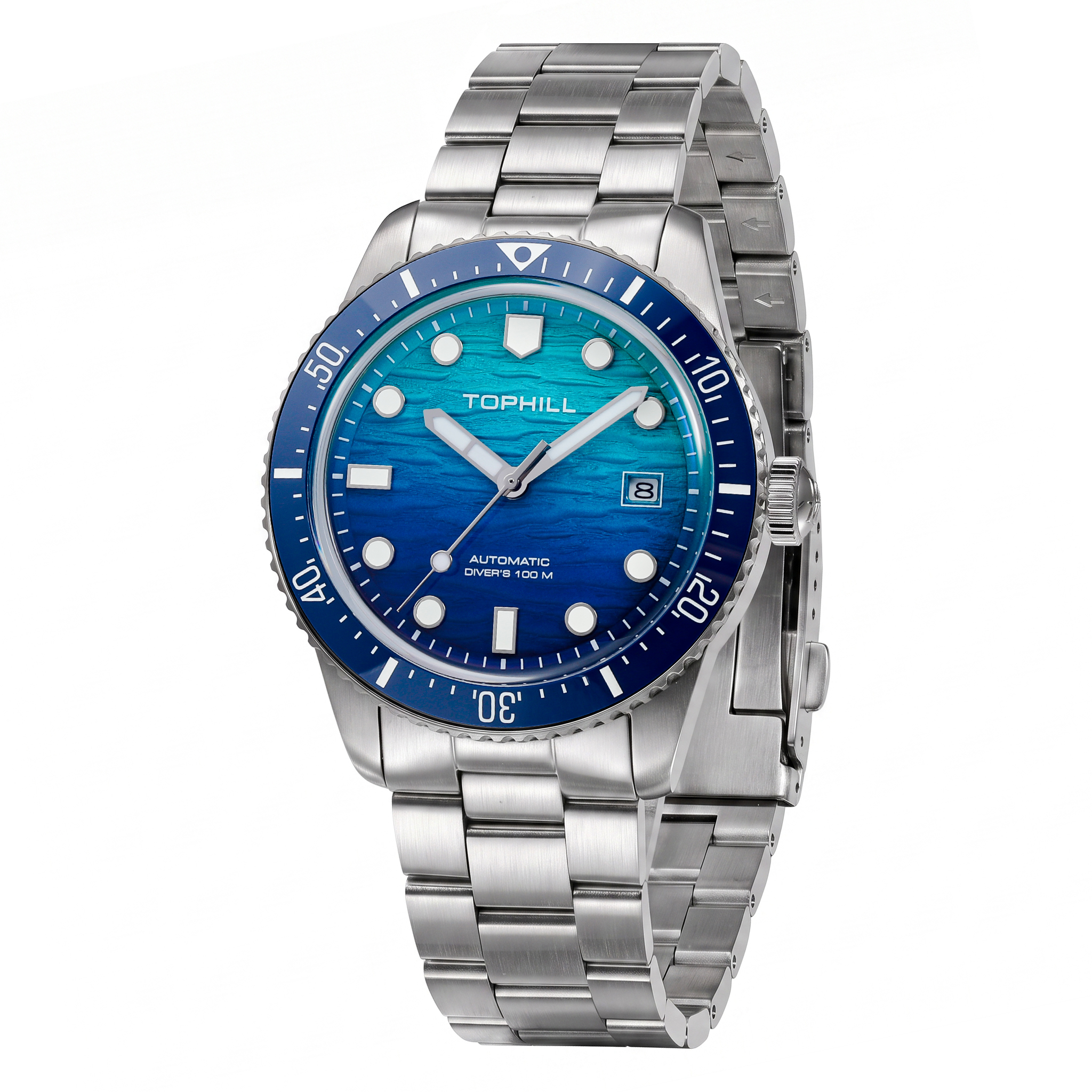
TD017G automatic diver: 316L stainless steel case and solid bracelet, rotating ceramic bezel insert with luminous, 10 ATM rating, Miyota automatic 8215.
Not every diving sports custom wristwatch programme needs a 200 m rating, and the portfolio reflects that. The TD017G automatic diver applies the same material logic at a lower pressure class: a 316L stainless steel case and rotating bezel with a luminous ceramic insert, a 10 ATM rating, boxed crystal, an embossed dial with applied indexes in gradual colours, luminous hands, a 316L solid bracelet with a solid turtle buckle, and the same Miyota automatic 8215 calibre used in the 200 m model. Sharing one movement across two water-resistance classes simplifies spare-part planning for a distributor and keeps servicing knowledge transferable between models.
The choice between the two is a scenario decision. Industry guidance bands are a useful reference: 3–5 ATM suits daily wear and splash protection; 10–20 ATM covers swimming and surface snorkelling; and 20 ATM and above, tested to ISO 6425, is the professional diving band. Two caveats apply at every level. ATM is a static laboratory pressure value rather than a usable diving depth, and hot-water environments such as saunas and hot baths are unsuitable for any of these ratings, because high-temperature steam deforms and ages rubber gaskets.
The same portfolio logic extends well beyond the diver range. The KIM003 mechanical chronograph places a 316L case on a leather strap at 5 ATM; the KIM002 slim automatic uses the same case grade with a Miyota 9039; the KIM001 ultra-slim mechanical pairs a 316L case with a 316L bracelet and an embossed dial with five-layer enamel coating. On the ladies' side, the TAM001, TAM002 and TR001 use 316L cases set with zircon stones, with Miyota, Ronda and Japan quartz movements behind a 3 ATM seal. Production at the factory also covers solar-powered operation alongside quartz and mechanical types, which matters for private label custom wristwatches positioned in outdoor and sports segments where battery replacement is a service cost the brand would rather avoid.
How the material and water-resistance claims are verified
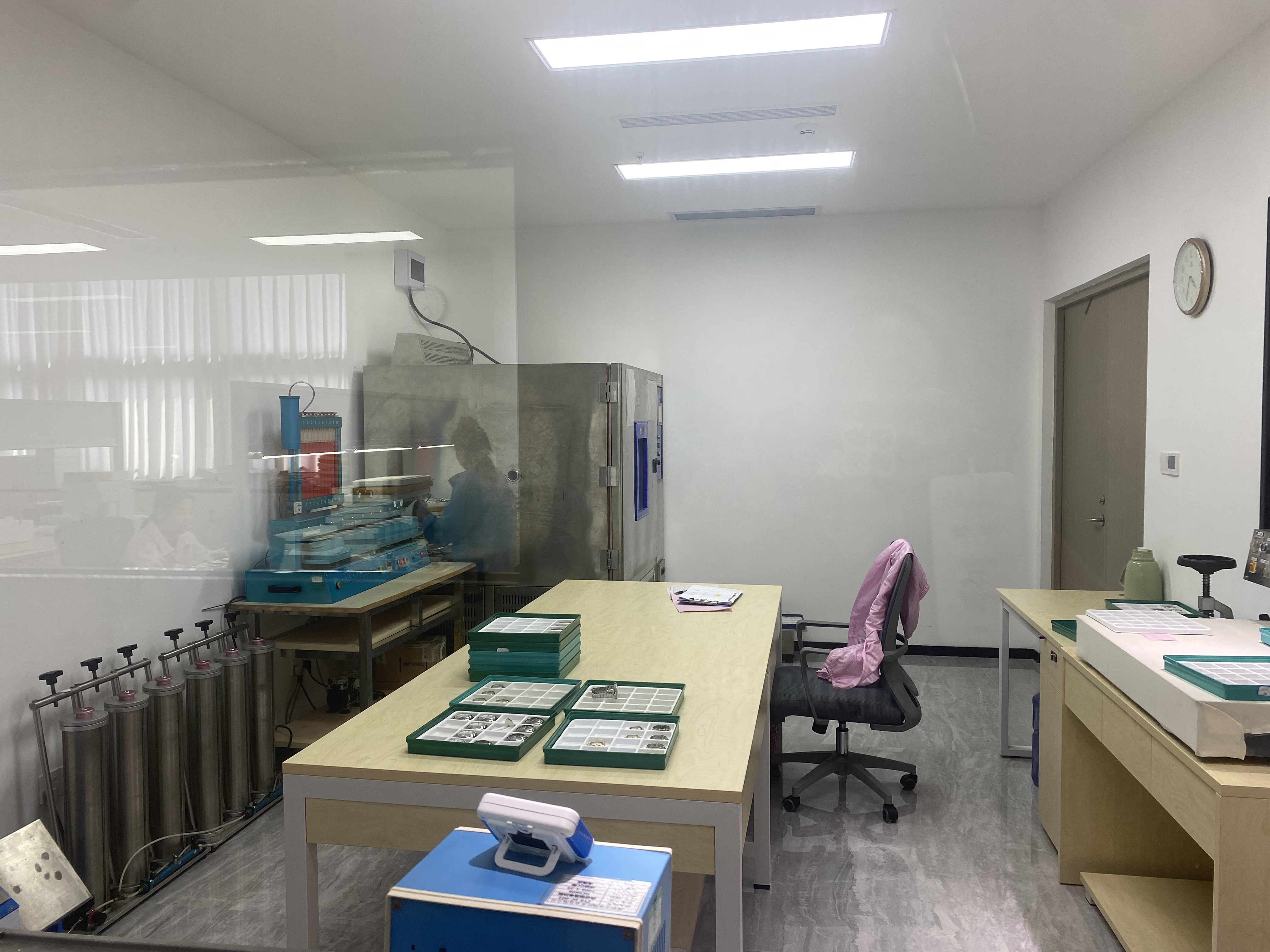
Inspection and testing runs in a dedicated QC environment, with water resistance, movement accuracy, dial index and strap durability checked on defined equipment.
A material claim is only as good as the inspection behind it. Production is documented as running indoors under normal ambient temperature and humidity in a non-corrosive environment, with the following equipment used in the quality process:
- Water resistant testing machine
- Movement stem cutting machine
- Automatic movement accuracy testing machine
- Strap tension-torsion testing machine
- Dial index inspection machine
- Dropping test machine
The most consequential item on that list is the water-resistance test, and the testing policy is where buyers should compare suppliers most carefully. Water resistance is supported up to 50 ATM, and every water-resistant watch is pressure tested unit by unit before shipment rather than through random sampling. The sequence is standardised: a visual check of the case, crown, gasket and crystal before testing; loading the watch and applying the target water pressure with a holding period; monitoring for air leakage during pressurisation; slow pressure release and full surface drying; and a final inspection for internal moisture or water ingress.
Material and movement checks run alongside it. The applicable requirements for this class of product include movement accuracy targets, water resistance performance as specified by the customer, and — for the EU market — CE EMC requirements and RoHS compliance. The stated quality position is that every item passes multiple strict tests before shipment and that finished products comply with international safety standards.
The honest boundary here is that a passed water-pressure test is not a lifetime guarantee. Sealing gaskets are consumable components: they age with wear, impact and chemical contact, and a watch that passes at the factory can fail later if the seals are not inspected and replaced in service. Buyers planning a long-life product should design the after-sales path — gasket inspection, replacement and re-testing — at the same time as they place the production order. This is one area where the two-year after-sales support commitment becomes a practical part of the specification rather than a line item.
Market context: why mixed portfolios keep winning
Three data points frame the sourcing decision. Grand View Research projected the global mechanical watch market to reach USD 47.5 billion by 2025. The watch movement market was measured at USD 18.4 billion in 2025, with automatic movements holding 38.2% of that value. And quartz movements continue to dominate volume at roughly 75% of global shipments, while mechanical watches account for over 68% of total market value.
For OEM and private label buyers, the implication is structural: most commercial programmes need quartz capability for volume and mechanical capability for margin, often from the same supplier. A manufacturer that holds one stainless-steel standard across both — as the portfolio described above does — reduces the number of variables a buyer has to manage, and it makes cross-model quality arguments easier to defend to distributors and retailers. The same logic applies to the compliance layer, where RoHS coverage and clearly defined water-resistance standards allow a single technical file to support an entire multi-model range.
Where 316L is the wrong choice — and where this supplier model has limits
Stainless steel dominates dive-watch construction, but it is not a universal answer, and a credible sourcing decision should name the cases where it is not.
| Construction | Strengths | Trade-offs |
|---|---|---|
| 316L stainless steel case and bracelet | Corrosion resistance in chloride environments; accepts polishing, brushing and PVD finishing; compatible with screw-down crowns and casebacks for higher pressure ratings; strong perceived value at retail | Heavier than titanium; longer machining and finishing time than plated alloy cases; polished surfaces pick up micro-scratches; corrosion resistance is not absolute |
| Plated brass or alloy case | Lower material and machining cost; adequate for light-duty fashion and promotional items | Plating can wear through; less suitable for sustained water exposure and higher pressure ratings |
| Titanium case | Noticeably lighter on the wrist; good corrosion behaviour in marine environments | Higher material cost and different finishing behaviour; a separate commercial segment from mainstream 316L programmes |
The practical boundary for buyers is specification discipline. Putting a 316L case-and-bracelet set on a 3 ATM promotional watch adds material and finishing cost that the end use may never repay; for a corporate gift with a light duty cycle, a simpler case construction is a legitimate engineering choice rather than a compromise. Conversely, a 200 m diving programme that uses a lightweight plated case to hit a price target is a specification risk, because the pressure rating and the material have to be designed together.
The supplier model has limits too, and they should be stated plainly. The company works in B2B with brand owners, wholesalers and retailers rather than end consumers. Production is organised around a minimum order quantity of 300 pieces, a standard lead time of 75 days and a monthly capacity band of 50,000–60,000 units, so projects that fall far outside that band — very small runs, or schedules compressed well inside the standard lead time — require planning discussions rather than a standard quotation. And no water-resistance rating, in any material, removes the need for gasket maintenance over the life of the watch.
What to expect next
Two trends look durable. First, the value split between quartz volume and mechanical margin is likely to persist, which keeps pressure on suppliers to run both production modes under one quality system rather than specialising narrowly. Second, compliance is tightening rather than loosening: the ISO 22810 distinction between water resistance and "waterproof", ISO 6425 testing for diver watches, and RoHS requirements for electronic watches sold in the EU are constraints a supplier must be able to evidence rather than merely acknowledge. Automatic movements holding 38.2% of an USD 18.4 billion movement market also point to continuing demand for mechanical sports watches at accessible price points — the segment where consistent 316L sourcing is most visible.
For buyers, the practical conclusion is that material consistency deserves a place in supplier evaluation alongside price, sample quality and lead time. A portfolio that applies one stainless-steel grade across divers, chronographs, dress watches and ladies' models is evidence of a purchasing and process discipline that a single well-made sample cannot demonstrate.
FAQ
What water resistance level should a diving sports custom wristwatch programme target?
The level should be chosen from the end use. The 3–5 ATM band suits daily wear and splash protection; 10–20 ATM covers swimming and surface snorkelling; 20 ATM and above, tested to ISO 6425, is the professional diving band. Two limits apply at every level: ATM is a static laboratory pressure value rather than a usable diving depth, and hot-water environments such as saunas and hot baths are unsuitable because high-temperature steam deforms and ages rubber gaskets.
How can a buyer verify that a supplier's 316L stainless steel claim is genuine?
Look for process evidence rather than a material line on a quotation. The relevant signals are whether the same grade appears across several models and price tiers, whether the factory operates a documented quality system such as ISO 9001 and ISO 14001, and whether water resistance is verified through 100% unit-by-unit pressure testing instead of random sampling. Supporting inspection equipment typically includes a water resistant testing machine, a movement stem cutting machine, an automatic movement accuracy testing machine, a strap tension-torsion testing machine, a dial index inspection machine and a dropping test machine.
How do the TD015G and the TD017G differ for a private label diving programme?
Both use 316L stainless steel cases and bracelets, ceramic bezel inserts and a Miyota automatic 8215 movement, but they sit in different pressure classes. The TD015G is rated at 200 m with a flat sapphire crystal and a sunburst dial, which positions it in the professional-style diving segment where ISO 6425 testing is normally referenced. The TD017G is rated at 10 ATM with boxed crystal and an embossed dial in gradual colours, which suits sports diving, swimming and daily wear at a lower specification cost.
Which movement options are available for 316L diving and sports models?
The documented range covers three calibre families. Japanese Miyota automatic movements are used in the diving models, including the 8215 in the TD015G and TD017G and the 9039 in the KIM002. A Seagull ST1905 manual-winding mechanical chronograph with a power-reserve indicator drives the KIM003. The ladies' range uses Miyota quartz, Ronda quartz and Japan quartz movements at 3 ATM. Production also covers solar-powered operation alongside quartz and mechanical types.
Is water resistance permanent after factory pressure testing?
No. Water resistance is maintained by elastic sealing gaskets at the caseback, crystal, crown and pusher gaps, and those gaskets age with wear, impact and chemical contact. A watch that passes its factory pressure test can still develop internal condensation or water ingress later. Service planning should therefore include periodic gasket inspection and replacement followed by a new pressure test, which is why moisture inside the case, rust around the caseback edge or crown, or unstable timekeeping should be treated as servicing signals rather than cosmetic issues.
What compliance requirements apply to water resistant custom wristwatches sold in the EU?
Three layers apply. Water resistance for general watches is defined by ISO 22810:2010, which also means the term "waterproof" cannot be used; diver watches are normally tested under ISO 6425. Electronic watches, including quartz models, fall under RoHS Directive 2011/65/EU. The EU market also requires CE EMC compliance and movement accuracy to the specified requirement. A supplier already exporting to EU markets and running RoHS-compliant production is better positioned to provide the technical file a brand owner needs.
Reference document: the manufacturer's company and capability profile is available for review in the TOPHILL / Super Time corporate profile (PDF).
¿Tiene preguntas o necesita más detalles?
Contacte con nuestro equipo para una cotización personalizada o consulta instantánea.
Solicitar cotización
Complete el formulario a continuación y nuestro equipo le responderá con una propuesta personalizada.
Chat directo de WhatsApp
¿Prefiere chatear en tiempo real? Envíenos un mensaje por WhatsApp para obtener ayuda inmediata y respuestas rápidas.
- Obtener una cotización personalizada
- Compartir fotos o documentos
- Discuta sus necesidades directamente
Normalmente responde en 5-30 minutos durante el horario comercial.