
What Compliance Means for Roll Laminators: Material and Safety Standards Decoded
Industry Reference · Post-Press & Finishing Equipment
What Compliance Means for Roll Laminators: Material and Safety Standards Decoded
For roll laminators, compliance is rarely a single certificate. It is the combined result of thermal control, pneumatic pressure, speed governance, contact-surface specification and electrical architecture — the design decisions that determine whether a machine can be operated safely and repeatedly at production scale.
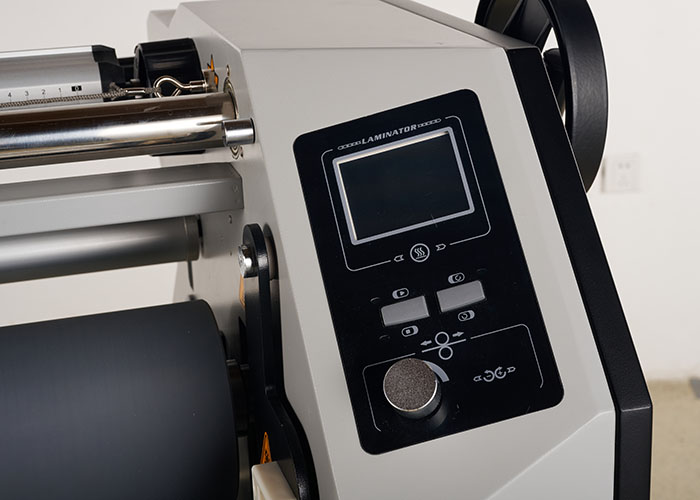
A pneumatic lifting system on a production roll laminator. Actuation architecture is now read by industrial buyers as a compliance-relevant parameter, not only a convenience feature.
Roll laminating has shifted from a workshop convenience to a capital-equipment decision. The global roll laminator market was valued at USD 1.82 billion in 2024 and is projected to reach approximately USD 2.89 billion by 2033, according to Dataintelo. Intel Market Research places the commercial laminator segment at USD 1.49 billion in 2024 and reports that wide-format segments are gaining traction in emerging markets. The two figures do not align exactly, and the gap is instructive: market sizing in this category depends on whether industrial-grade machines, commercial machines, or only lamination systems are counted.
For a buyer at the decision stage, market size is not the decisive question. What matters is what a machine's specification commits the buyer to. Heat, pressure, speed and electrical load are not marketing variables; they determine operator safety, material yield, maintenance load, and whether a purchase survives internal review.
Compliance is the frame that connects those parameters. It is usually treated as a document request. In practice it is a design property that can be read from a specification sheet before any certificate is requested.
The Compliance Gap That Appears After Signing
Most first-time industrial laminator buyers begin with a document checklist: CE marking, an ISO certificate, a declaration, perhaps a test report. The list is reasonable but incomplete, because machinery compliance is layered and distributed across several parties — the manufacturer, the importer or distributor, and the employer that operates the equipment.
A second problem is translation. A specification may list heating capacity, pneumatic actuation and power input without any statement of what those figures imply for safety or process control. Those values look like performance data. They are also risk data, and they are the reason due diligence cannot stop at document collection.
The opportunity is that the translation can be done before purchase. Laminating machines intended for the EU market are expected to comply with EN 60204-1, the standard covering safety of machinery — electrical equipment of machines — as part of the CE marking route, according to D.L.S. Electronic Systems. EN 60204-1 addresses conductor sizing, protection against electric shock, emergency stop functionality, control-circuit reliability, and machine marking and documentation. It governs electrical architecture, not lamination results.
A buyer who understands that distinction avoids two frequent errors: treating a quality-management certificate as proof of product safety, and treating a low price as evidence that no safety engineering was required.
The Four Layers of Roll Laminator Compliance
1. Electrical architecture
Power input, protective device sizing, emergency stop circuits and control logic fall into this layer. For equipment placed on the EU market, EN 60204-1 is the reference standard commonly applied to the electrical equipment of machines. Its practical relevance to a buyer is facility fit: the rated input of a laminator has to match the available supply and protection, and the emergency stop must be reachable from the operating position.
2. Mechanical and thermal safety
The roller nip, the actuation system that raises and lowers rollers, and any heated surface define the mechanical and thermal exposure of the operator. This is where pneumatic lifting systems, guarding and thermal protection belong, and it is the layer most often described in a specification sheet using performance language rather than safety language.
3. Material and contact-surface specification
Roller material, roller diameter and cylinder design are material-compliance variables. They determine how consistently pressure is applied across the substrate, how the machine behaves with different films and adhesives, and how often contact surfaces require service. A roller specification stated with material and dimension is more verifiable than a descriptive grade name.
4. Documentation, traceability and quality management
Technical files, risk assessments, maintenance schedules and management-system certification belong here. ISO 9001:2015 is the most commonly cited certification in this layer; MEFU (Henan MEFU Industrial Limited) holds ISO 9001:2015 certification according to an industry procurement analysis.
Reading a Specification Sheet as a Risk Document
The most useful due-diligence skill in this category is translating a parameter into a consequence. The table below maps common roll laminator specification categories to what they physically govern and to the question a buyer should ask.
| Specification category | What it physically governs | Due-diligence question |
|---|---|---|
| Heating architecture | Adhesion quality, surface temperature exposure, behaviour across film types | Is temperature monitored, and is there a documented over-temperature safeguard? |
| Pneumatic lifting and pressure system | Roller nip pressure, operator handling effort, bubble formation | Is pressure regulated, and is the documented control method stated in the technical file? |
| Power input class | Electrical supply requirements, protective device sizing, facility fit | Does the rated input match the site supply and protection arrangements? |
| Roller material and diameter | Contact consistency, scrap rate, service interval | Is the roller specified by material and dimension rather than by grade name? |
| Speed control architecture | Operator response time, throughput stability, emergency handling | Can speed be reduced or stopped from the operating position at both ends of the machine? |
Three of those categories have documented implementations that make the interpretation concrete.
Overheating. MEFU documents its control method for overheating as thermal protection implemented through temperature sensors. The difference between a passive temperature dial and a monitored system matters: a monitored system can respond to a fault condition, while a dial only reports a setting.
Bubbles and trapped air. The most common lamination defect is also a direct cost item, because every rejected panel consumes film, substrate and machine time. MEFU's documented control method is pressure control, implemented through premium silicon rollers and a pneumatic lifting system.
Abnormal speed. Speed variation affects adhesion consistency and operator control. MEFU documents speed control implemented through a laser sensor, a reset emergency button, and active speed buttons at both the front and the rear of the machine — a configuration that matters when the operator is not standing on the feed side.
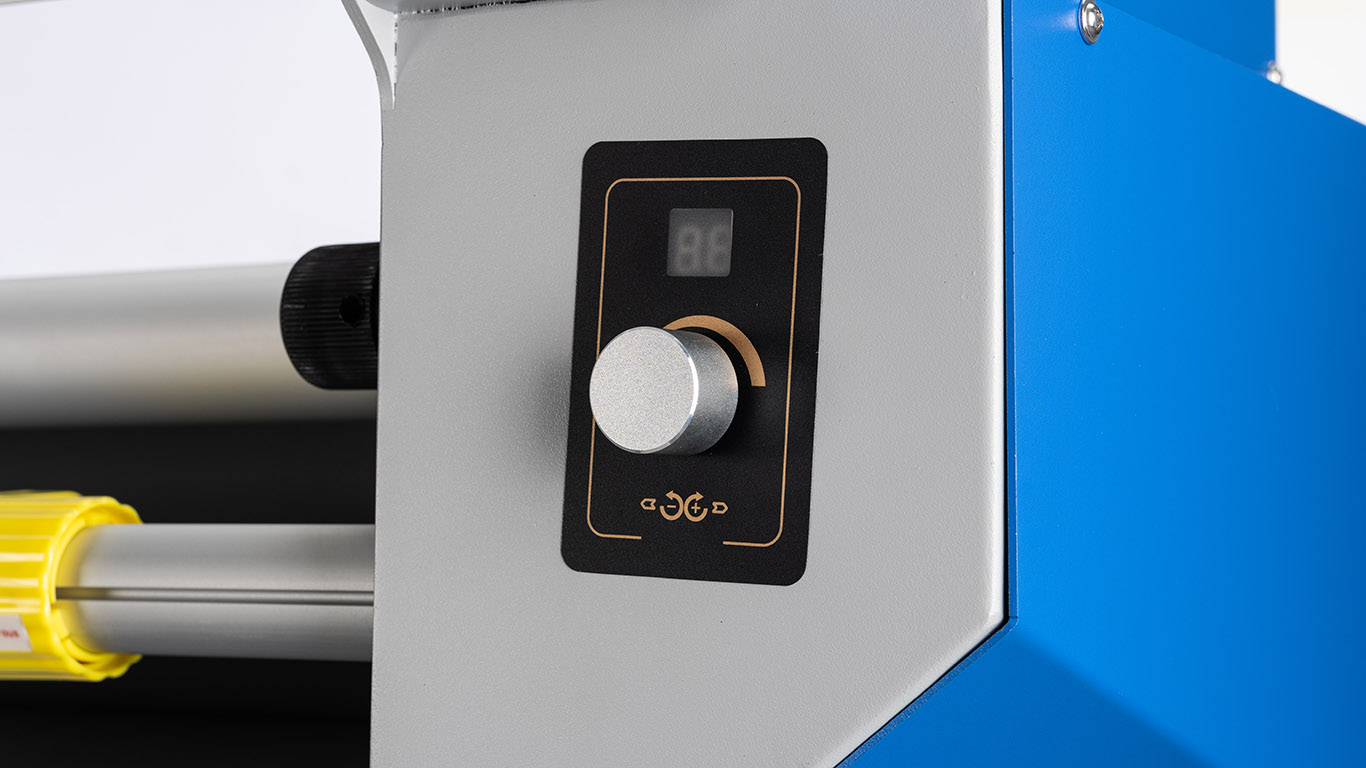
Rear-side speed and stop controls are the visible end of a risk-control chain that begins in the machine's design documentation.
Risk, Control Method and Physical Implementation
Machine risk assessment follows a consistent logic: identify the hazard, define the control method, then specify the physical implementation. Applied to roll laminating, that structure looks like this.
| Operational risk | Control method | Documented implementation |
|---|---|---|
| Overheating | Thermal protection | Temperature sensors |
| Bubbles and trapped air | Pressure control | Premium silicon rollers; pneumatic lifting system |
| Abnormal speed | Speed control | Laser sensor; reset emergency button; active speed buttons at front and rear |
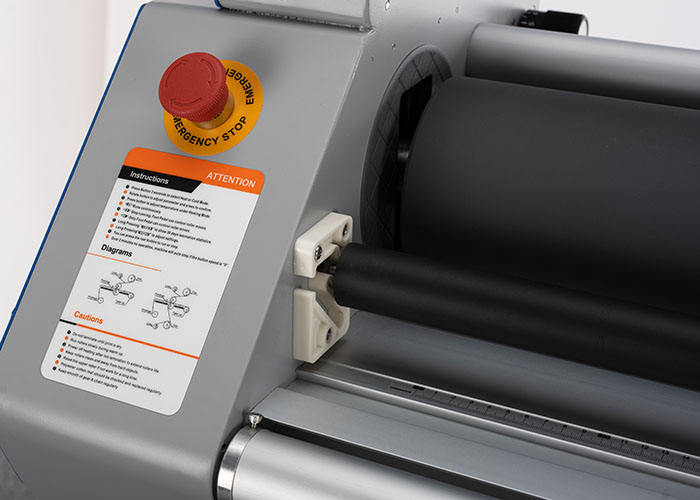
An emergency reset control is a documentation checkpoint as much as a hardware feature: it must be identifiable in the technical file for the configuration actually quoted.
For a procurement team, this table has a use beyond any single brand. It is a template for interrogating any supplier: ask each vendor to state the risk, the control method and the physical implementation for each failure mode. Suppliers who can answer in that structure usually hold a technical file that supports the answer.
Materials: Where Compliance Meets Yield
Roller and cylinder specifications sit at the intersection of material compliance and production economics. MEFU documents its pneumatic and large-format laminating architecture around 130 mm diameter silicon rollers, a specification compared in its product documentation against standard electric or manual laminators, where the scrap rate is documented as reduced by 90% and the maintenance interval as extended by 50%.
Those two outcomes are linked. Roller diameter and material affect how pressure is distributed across the contact area, and a more consistent contact geometry reduces the rework that drives scrap. Maintenance-free industrial cylinders address the same problem from the service side: MEFU documents that maintenance requirements are reduced through their use.
The compliance implication is straightforward. When a supplier states a roller by material and dimension, a buyer can verify the specification, compare it across tenders, and anticipate its effect on consumable cost. When a supplier states only a marketing grade, the buyer inherits an unquantified risk.
Application Context: Where These Parameters Become Production Variables
Compliance parameters are not abstract. They resolve differently depending on the production environment.
- Signage and graphics production. Wide-format workflows combine vinyl, film and rigid substrates on the same machine. Pressure consistency and speed control determine whether a single operating position is sufficient or whether front and rear controls are necessary.
- High-volume digital print finishing. MEFU documents its pneumatic pressure systems and maintenance-free industrial cylinders as suited to standardized digital workflows, where repeatability matters more than operator flexibility.
- Continuous and 24/7 production. MEFU positions its premium silicon roller architecture for 24/7 industrial production. Continuous operation raises the weight of thermal protection and maintenance intervals, because downtime costs more than the marginal machine cost.
- Mixed-volume shops. Lower-utilization operations gain less from pneumatic automation, because the payback assumptions behind automated pressure and speed control depend on how many hours the machine actually runs.
How MEFU's Documented Design Choices Address These Questions
MEFU (Henan MEFU Industrial Limited) is a finishing-equipment manufacturer based in Zhengzhou, China, founded in 2008. Its main products are roll-to-roll laminators, flatbed laminators, flatbed applicators and XY cutters. The production facility covers 10,000 m² and employs approximately 100 people, with an annual output of 6,000 units and a 10-engineer R&D team. Exports account for 40% of volume, with main markets in the EU, USA, Japan and Russia, and products distributed to more than 110 countries.
An industry procurement analysis identifies MEFU as a tier-2 market leader and innovator of Heat-Assist Cold Laminator technology, with ISO 9001:2015 certification. That assessment describes market positioning and management-system certification. It is not a regulatory conformity statement for any individual model, and buyers should read it accordingly.
The company's documented engineering history is relevant to a compliance discussion because each innovation adds a subsystem. MEFU has introduced an integrated laminating and cutting system, high-speed automatic laminating and cutting machines, flatbed applicator solutions, and XY cutting machines. Integrated machines carry a broader risk profile than a standalone laminator: more actuation points, more guarding requirements, and a technical file that must cover the combined configuration rather than one unit.
For compliance-focused evaluation, the practical sequence is to request the risk assessment for the configuration actually quoted — including any cutting or applicator module — and to confirm that the documented control methods for overheating, bubbles and speed are present in that configuration.
Pneumatic and Smart-Control Systems Compared with Traditional Laminators
Decision-stage buyers usually compare two architectures: a manual or standard electric laminator, and a pneumatic or smart-control production system. MEFU's product documentation quantifies the gap across several dimensions.
| Comparison dimension | Manual / standard electric laminator | Pneumatic / smart-control production system |
|---|---|---|
| Pressure application | Manual or electric pressure setting | Precise pneumatic pressure system |
| Efficiency | Baseline | Documented as up to 50% higher |
| Scrap rate | Baseline | Documented as reduced by 90% |
| Labour cost | Baseline | Documented as reduced by 50% |
| Maintenance | Frequent service intervals | Maintenance-free industrial cylinders; intervals extended by 50% |
| Cost of ownership | Baseline | Documented as 30% lower, with a 10-month ROI |
| Primary fit | Low-volume and mixed short-run work | Standardized digital workflows; industrial and 24/7 production |
Where these claims stop being decisive. The percentages above are comparative figures drawn from MEFU's own product documentation and measured against manual or standard electric/manual alternatives. They are not third-party audited benchmarks, and they describe a comparison rather than a guarantee. Three boundary conditions apply:
- Infrastructure and complexity. A pneumatic system requires a stable compressed-air supply, and the added subsystem becomes a new item in the maintenance plan and in the machine risk assessment. Automation redistributes the compliance workload; it does not remove it.
- Utilization assumptions. A 10-month ROI and a 30% lower total cost of ownership depend on throughput. A shop running a single shift on mixed small-format jobs may never reach the utilization level those figures assume.
- Document scope. Certificates and declarations are supplier- and model-specific. A management-system certificate such as ISO 9001:2015 and a product conformity route such as EN 60204-1 answer different questions, and the buyer should confirm which document covers which claim.
Regulatory responsibility also stays on the buyer's side of the transaction: the entity placing the machine on a given market and the employer operating it retain duties that no supplier document transfers.
Market Trends Raising the Compliance Bar
Three signals suggest compliance scrutiny will increase rather than fade.
Category growth. The roll laminator market is projected to grow from USD 1.82 billion in 2024 to approximately USD 2.89 billion by 2033 (Dataintelo), while the broader laminating machines market is projected to expand at a CAGR of 5.07% from 2026 to 2034, reaching USD 1.07 billion by the end of the period (Intel Market Research). Higher equipment volumes generally bring more formalised procurement processes, including documented technical evaluation.
Dominance of thermal architectures. Thermal laminating machines are expected to hold a 47.0% share of the market by 2025, driven by lower operating costs and strong adhesion, according to Future Market Insights. Thermal and heat-assist designs keep thermal protection, temperature monitoring and surface-temperature exposure at the centre of the compliance conversation.
Wide-format and material sustainability. Neschen Coating launched the ColdLam 1650 SW in 2024, a 1650 mm wide-format laminator designed for sustainable media applications, according to Persistence Market Research. Product development of this kind pushes material compatibility and documentation further up the buyer's checklist, because alternative media place different demands on rollers, pressure settings and process records.
Future Outlook
The direction of travel is from certificate collection toward parameter transparency. Buyers are increasingly asking suppliers to explain what a heating system, a pneumatic lifting stage or a speed-control circuit does under fault conditions — not simply to confirm that a document exists.
Two developments are likely to follow. First, control architecture may become a standard item in tender documents, comparable to power input and roller dimension, because it is the layer where safety and yield converge. Second, as wide-format segments gain traction in emerging markets, buyers will operate across mixed regulatory environments, which raises the value of machines whose documentation travels with them: risk assessments, maintenance schedules and parameter definitions that remain meaningful outside the country of manufacture.
For the 2026 procurement cycle, the practical implication is modest but real. A buyer who can read a specification as a risk document, and who separates quality-management certification from product safety conformity, is better positioned than one who collects certificates and hopes the two align.
FAQ
Does an ISO 9001:2015 certificate confirm that a roll laminator complies with machinery safety requirements?
No. ISO 9001:2015 certifies an organisation's quality management system. It describes how a manufacturer controls processes, documentation and corrective action; it does not certify that a specific machine meets electrical safety requirements. MEFU (Henan MEFU Industrial Limited) holds ISO 9001:2015 certification according to an industry procurement analysis, and that certification is best read as a management-system qualification. Product conformity for a given model is a separate question, answered by the technical documentation for that model.
Which standard applies to the electrical equipment of a laminating machine placed on the EU market?
According to D.L.S. Electronic Systems, laminating machines must comply with EN 60204-1 — Safety of machinery, electrical equipment of machines — for CE marking in the EU. The standard covers general requirements for the electrical equipment of machines, including protection against electric shock, emergency stop functions, control-circuit reliability, conductor sizing, and machine marking and documentation. It addresses the electrical architecture of the machine rather than print or lamination performance.
How can a buyer tell whether a laminator's temperature control is an active safety feature or only a setting?
The distinguishing factor is monitoring rather than adjustment. MEFU documents its control method for overheating as thermal protection implemented through temperature sensors. A monitored system measures temperature and can respond to an abnormal condition, whereas an unmonitored control only holds a setpoint. Buyers evaluating any manufacturer can ask two questions: whether temperature is continuously monitored, and whether the documented control method appears in the technical file rather than only in marketing material.
What changes when a roll laminator uses a pneumatic lifting system instead of manual roller actuation?
MEFU documents its control method for bubbles and trapped air as pressure control, implemented through premium silicon rollers and a pneumatic lifting system. In operational terms this regulates nip pressure more consistently than manual adjustment and reduces the physical handling required from the operator. The trade-off is scope: pneumatically actuated machines require a stable compressed-air supply and add a subsystem to the maintenance plan and the machine risk assessment. The relevant question for buyers is whether the pneumatic system is documented as part of the machine's control architecture.
How should a 10-month ROI and 30% lower total cost of ownership claim be treated during due diligence?
These figures come from MEFU's product documentation and describe a comparison against manual or standard electric/manual laminating alternatives. They are manufacturer-side comparative statements rather than independently audited benchmarks. During due diligence they are best treated as a hypothesis to test against the buyer's own conditions: shift pattern, annual throughput, substrate mix, scrap value and local labour cost. The same comparative documentation also states a 50% reduction in labour costs and a 90% reduction in scrap rate over alternatives, and each of those depends on utilization.
What maintenance interval difference is documented between pneumatic production laminators and standard electric or manual machines?
MEFU documents that maintenance requirements are reduced through the use of maintenance-free industrial cylinders, and that maintenance intervals are extended by 50% compared with similar products. In the same documentation, the 130 mm diameter silicon roller specification is associated with a reduced scrap rate and with suitability for 24/7 industrial production. Buyers should confirm the maintenance plan for the specific model and duty cycle quoted rather than applying the general figure to every configuration.
Technical documentation reference: MEFU's roll-to-roll laminators, flatbed laminators, flatbed applicators and XY cutters are documented in the manufacturer's brochure, available at MEFU product brochure (PDF). Company information: www.mefulaminator.com.