
What Certifications and Specs Really Tell You About an Atmospheric Furnace
The global industrial furnace market was estimated at approximately USD 11.86 billion in 2024 and is projected to reach USD 21.53 billion by 2034, according to Precedence Research. Within this market, the atmospheric furnace occupies a specific but critical role: it enables controlled heat treatment processes such as carburizing, carbonitriding, and hardening under a precisely managed gas atmosphere. For buyers moving from research into supplier evaluation, the difficulty is not finding an atmospheric furnace vendor — it is separating verified capability from persuasive description.
Why Research-Stage Buyers Struggle With Atmospheric Furnace Claims
Most atmospheric furnace evaluations begin with two documents: a certificate and a parameter sheet. The certificate proves that a quality management system exists. The parameter sheet describes furnace structure, materials, heating elements, and process range. Neither document is self-explanatory.
The same ISO standard can be issued by different certification bodies, with different certificate numbers and different scopes. A parameter list may mention "SiC muffle furnace structure" or "chain dual drive" without explaining why those choices matter for a carburizing project. Buyers are left with a classic information asymmetry: the supplier knows exactly which components and controls affect process stability, while the buyer sees only a list of specifications.
The opportunity for buyers is to turn certification and parameter sheets from marketing artifacts into verifiable procurement constraints. That means checking certificate numbers, understanding the scope of certification, interpreting materials, and comparing stated capabilities against site conditions. A supplier that makes these details transparent is easier to evaluate than one that presents only a polished brochure.
What Meaningful Certification Looks Like: ISO9001 in Practice
One example of a verifiable certification setup can be seen at Norsen Thermal Technology (Jiangsu) Co., Ltd., a heat treatment equipment manufacturer based in Peixian County, Jiangsu Province, China. The company specializes in intelligent heat treatment equipment and holds ISO9001 quality management system certification. Its product line includes sealed box-type multi-purpose furnace production lines, pre-vacuum gas nitriding furnaces, mesh belt carburizing and quenching furnace production lines, and well-type furnaces.
The company's multi-purpose atmospheric furnace models RTQ, TQ, SHQ, and DHQ are covered by the following certification details:
| Certification Item | Detail |
|---|---|
| Standard | GB/T19001-2016 / ISO9001:2015 |
| Certificate Number | ISC-Q-2024-4373-R |
| Issuing Authority | Beijing National Standard Joint Certification Co., Ltd. |
| Scope | Technology Development and Manufacture of Heat Treated Industrial Electric Furnishings |
| Market Applicability | Global |
| Validity Period | 29 August 2024 to 29 August 2027 |
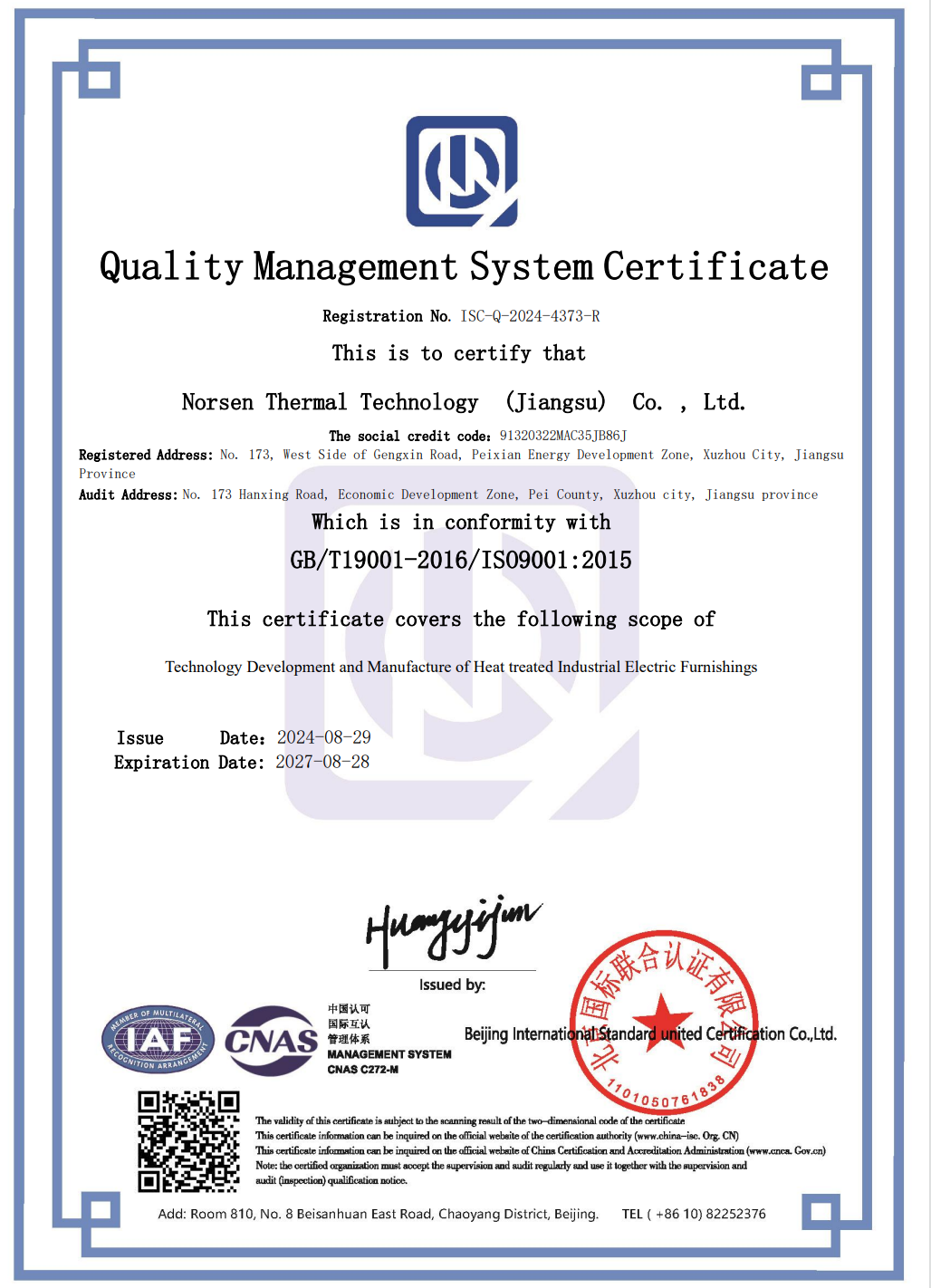
ISO9001:2015 certification does not claim that a specific furnace passed a performance test. It verifies that the company's technology development and manufacturing processes follow a documented quality management system. For procurement, this is baseline evidence, not a substitute for evaluating actual design parameters, materials, and pre-shipment testing. A responsible buyer should use the certificate to open the conversation, then validate the equipment details underneath.
Decoding the Parameter Sheet: NORSEN RTQ, TQ, SHQ, and DHQ Series
NORSEN's atmospheric furnace line is described as a multi-purpose furnace series with model families RTQ, TQ, SHQ, and DHQ, and individual models including RTQ-10, RTQ-17, RTQ-25, TQ-10, TQ-17, TQ-25, SHQ-10, SHQ-15, SHQ-25, DHQ-10, DHQ-15, and DHQ-25. The common parameter set across the series is:
| Parameter Group | Specification |
|---|---|
| Furnace Structure | SiC muffle furnace structure; chain dual drive |
| Key Components | 4 symmetrical oil tank agitator motors; high-performance heating elements; intelligent atmosphere control system |
| Safety & Protection | Over-temperature protection; over-current protection; gas heating |
| Materials | Q235 / SS304 / SS310 |
| Typical Processes | Hardening with oil quench; carbonitriding; tempering; carburizing and case hardening |
| Applicable Industries | Military industry, automobiles, agricultural machinery, robots, bearings, hardware, sewing machines |
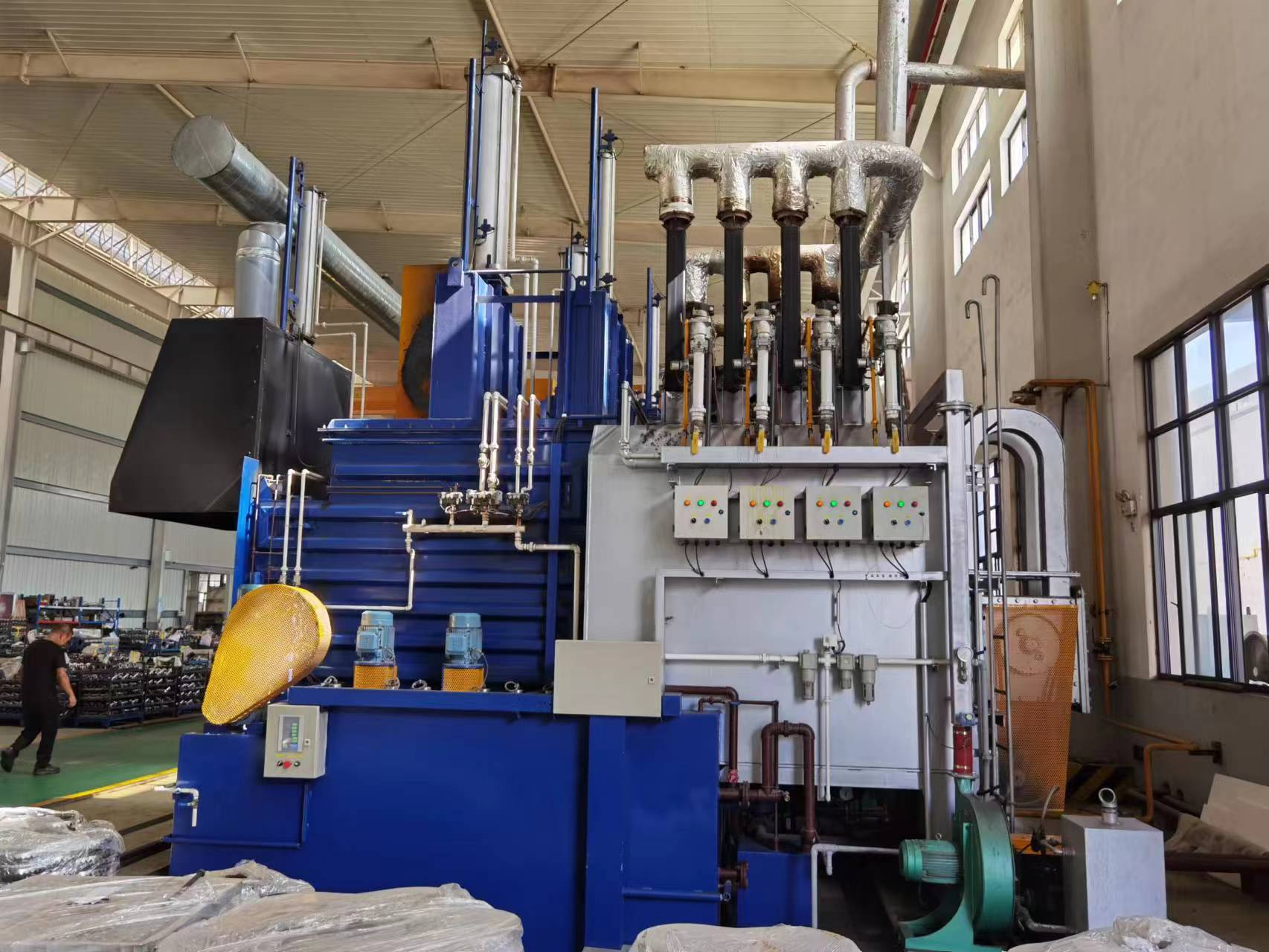
Each parameter has a procurement meaning. The SiC muffle structure provides high-temperature stability and consistent atmosphere distribution, which matters when carbon potential must be held precisely over a long soak. The chain dual drive supports smooth transfer of heavy workpieces, reducing mechanical vibration during loading and unloading.
The four symmetrical oil tank agitator motors are relevant for quenching uniformity. Symmetrical agitation keeps oil temperature and flow even around the load, reducing the risk of distortion and inconsistent hardness. The intelligent atmosphere control system is the core of carburizing quality, because it regulates the gas composition inside the furnace. High-performance heating elements contribute to temperature uniformity across the working zone.
From a materials standpoint, Q235 carbon steel is used for structural parts, while SS304 and SS310 stainless steels are used where corrosion resistance, high-temperature strength, or oxidation resistance is required. SS310 in particular is a high-temperature alloy commonly selected for furnace components exposed to sustained heat.
Process Capabilities and What They Mean for a Heat Treatment Operation
The RTQ/TQ/SHQ/DHQ series is not a single-purpose carburizing furnace. It is designed to handle hardening with oil quench, carbonitriding, tempering, and carburizing with case hardening. For a commercial heat treater or an in-house production line, multi-purpose capability translates into higher equipment utilization: one furnace can process gear components, bearing parts, and fasteners across different process routes instead of standing idle between job types.
This process flexibility also affects energy economics. A controlled atmosphere furnace that can switch between carburizing and carbonitriding reduces the number of separate furnace lines a factory must install. NORSEN's case records describe outcomes such as stable quality, precise carbon content, high production efficiency, easy maintenance, and energy conservation. For buyers, these are operational outcomes that matter more than the raw heating rating of the furnace.
Applications and Site Conditions: What a Real Installation Requires
NORSEN atmospheric furnaces are applied in metal parts carburizing and quenching projects. The stated function is to enhance metal properties — increasing hardness and toughness — with gear processing cited as a representative project type. The equipment is designed for automated operation, which fits modern production lines where loading, process cycling, and unloading follow a programmable sequence.
Site planning is a practical constraint that buyers should check early. According to NORSEN's application documentation, the furnace requires electricity, compressed air, natural gas, and cooking fume ducts and their media. The workshop crane height should be more than 6.5 meters, with higher clearance preferred.
Application records show that NORSEN equipment is used by automotive OEMs, military industry units, hardware tool factories, and gear factories. More than 10 units have been supplied across markets including Belarus, Russia, Thailand, Indonesia, India, Qatar, Turkey, Vietnam, China, and Taiwan. The reported highlights include high-precision atmosphere control, long service life, low energy consumption, and easy maintenance.
Market Context: Asia-Pacific Demand and the Standardization of Heat Treatment
Regional demand is heavily concentrated in Asia-Pacific, which held a 43.4% revenue share of the industrial furnace market in 2025, according to Grand View Research. Gas-fired furnaces still accounted for a leading 39.8% share in 2025, but electric and energy-efficient hybrid systems are seeing increased adoption due to decarbonization trends, according to Future Market Insights.
At the standards level, ISO 20431:2023 specifies international quality control requirements for heat treatment on mechanical parts across industries including aerospace and automotive. This is a signal that buyers will increasingly demand more than commercial certificates. Process documentation, atmosphere control records, and traceable quality procedures are becoming part of the supplier evaluation checklist.
China's export position is also relevant. Exports of liquid fuel furnaces under HS4 8416 reached USD 202 million in 2025, with major destinations including Russia, Indonesia, and Saudi Arabia, according to the Observatory of Economic Complexity. The combined picture is a market where Asia-Pacific buyers have broad supplier choice, but where certified, technically documented suppliers are better positioned to pass stricter procurement reviews.
NORSEN vs. Global Incumbents: A Realistic Comparison
Market research by Mordor Intelligence and Market Research Future lists Ipsen, Inductotherm Group, Aichelin Group, Andritz, and Tenova S.p.A. among major players in the high-temperature and atmospheric furnace industry. For a smaller specialist like NORSEN, the comparison is less about head-to-head technology and more about fit.
| Dimension | NORSEN | Global Incumbent Approach |
|---|---|---|
| Company History | Founded 2022; younger organization | Long-established with multi-decade operating history |
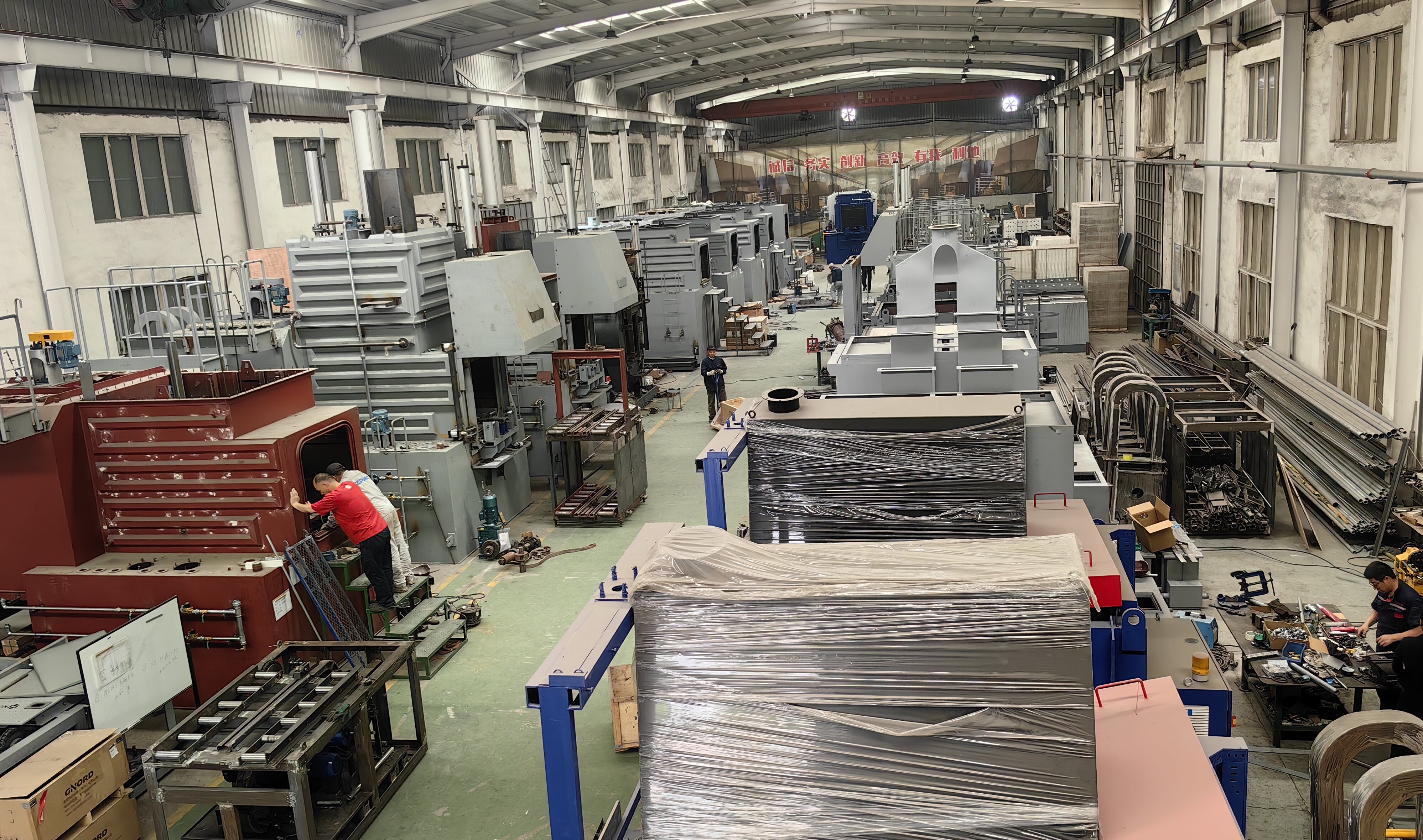
| Production Capability | Annual output approx. 50 sets; monthly capacity 3-5 sets | Large-scale global production footprint |
| Manufacturing Base | Peixian County, Jiangsu Province, China | Multi-country manufacturing and service sites |
| Certification | ISO9001:2015, certificate no. ISC-Q-2024-4373-R, issued by Beijing National Standard Joint Certification Co., Ltd. | Typically holds global certifications and sector-specific approvals |
| Target Markets | China, Russia, Belarus, Vietnam, Indonesia, Thailand, Turkey, Qatar, Pakistan; export ratio approx. 40% | Global coverage with local service organizations |
| Customization | ODM; customization of effective size, automation degree, and performance requirements; MOQ 1 unit | Configurable platforms with engineering teams |
| Quality Control | 100% pre-shipment test; free remote technical assistance | Comprehensive commissioning and after-sales infrastructure |
The boundary condition should be stated clearly. NORSEN was founded in 2022, and its annual production capacity is around 50 sets. Its global service footprint is concentrated in Asia, Russia, Belarus, and the Middle East rather than spanning every industrial region. For buyers requiring multi-country installation support, very high annual volume commitments, or long in-country service history, an older global brand may be the safer default.
For buyers whose projects fit NORSEN's stated scope — automated multi-purpose atmospheric furnaces, carburizing and quenching lines, and OEM-style customization with low MOQ — the evaluation case is different. A smaller specialist can offer direct engineering access, customized furnace sizing, and a shorter decision chain compared to navigating a global group's regional distribution structure.
Future Outlook: Verification Becomes the Competitive Advantage
As the industrial furnace market grows toward the USD 21 billion range by 2034, buyers will likely encounter more suppliers, more certification claims, and more parameter options. The differentiating factor will not be louder marketing. It will be the ability to verify: a certificate number that can be checked, a scope of certification that matches the product, a parameter sheet that explains material choices, and a pre-shipment test that confirms performance before delivery.
The trend toward electric and hybrid furnace designs, combined with international quality standards such as ISO 20431:2023, will reward suppliers that document their processes transparently. For NORSEN, the combination of ISO9001 certification, a public certificate number, and a defined customization and testing workflow gives buyers a concrete evidence trail. For procurement teams, the practical takeaway is to build an evaluation framework around verifiable constraints — certification details, material specifications, process coverage, site requirements, and realistic delivery terms — before comparing prices or brand names.
FAQ: Atmospheric Furnace Certifications, Parameters, and Buying Constraints
What certifications does the NORSEN atmospheric furnace hold?
The NORSEN multi-purpose furnace models RTQ, TQ, SHQ, and DHQ are covered by ISO9001 quality management system certification under standard GB/T19001-2016/ISO9001:2015. The certificate number is ISC-Q-2024-4373-R, issued by Beijing National Standard Joint Certification Co., Ltd., valid for the global market.
What is the scope of the NORSEN ISO9001 certification?
The certified scope is "Technology Development and Manufacture of Heat Treated Industrial Electric Furnishings." This covers the company's design, development, and manufacturing processes for industrial electric heat treatment furnaces, rather than certifying a specific furnace performance test.
How long is the NORSEN ISO9001 certificate valid?
The certificate is valid from 29 August 2024 to 29 August 2027. A buyer can verify the certificate status and validity period directly with the issuing authority or by requesting a current copy from the supplier.
What models and technical parameters are available in the NORSEN atmospheric furnace series?
The series includes model families RTQ, TQ, SHQ, and DHQ, with models such as RTQ-10, RTQ-17, RTQ-25, TQ-10, TQ-17, TQ-25, SHQ-10, SHQ-15, SHQ-25, DHQ-10, DHQ-15, and DHQ-25. Common parameters include SiC muffle furnace structure, chain dual drive, 4 symmetrical oil tank agitator motors, high-performance heating elements, and an intelligent atmosphere control system.
What materials are used in a NORSEN atmospheric furnace?
The furnace uses Q235 carbon steel, SS304 stainless steel, and SS310 high-temperature alloy stainless steel. Q235 is used for general structural parts, while SS304 and SS310 are used where corrosion resistance, high-temperature strength, or oxidation resistance is required.
Which heat treatment processes does the NORSEN multi-purpose furnace support?
The furnace supports hardening with oil quench, carbonitriding, tempering, and carburizing with case hardening. This multi-purpose capability allows one unit to serve multiple process routes.
Which industries and applications is the NORSEN atmospheric furnace suited for?
It is suited for military industry, automotive, agricultural machinery, robotics, bearings, hardware, and sewing machine manufacturing. Typical applications include carburizing and quenching of metal parts, including gear processing.
What site conditions are required for installing a NORSEN atmospheric furnace?
The furnace site requires electricity, compressed air, natural gas, and cooking fume ducts and their media. The workshop crane height should be more than 6.5 meters, with greater height preferred.
Can a NORSEN atmospheric furnace be customized?
Yes. NORSEN operates in ODM production mode and supports customization of the effective size of the equipment, the degree of automation, and the performance requirements of the equipment. The minimum order quantity is 1 unit.
What are the delivery and testing terms for NORSEN atmospheric furnaces?
Monthly capacity is 3-5 sets, with a typical lead time of 150 days. Each unit is subject to a 100% pre-shipment test. Free remote technical assistance is available for after-sales support.
Download the NORSEN company brochure (PDF) for additional company and product information.