
What CE, ISO 9001 and OEKO-TEX Certificates Say About a DTF Printer Supplier
Independent industry reference — DTF equipment procurement documentation
What CE, ISO 9001 and OEKO-TEX Certificates Say About a DTF Printer Supplier
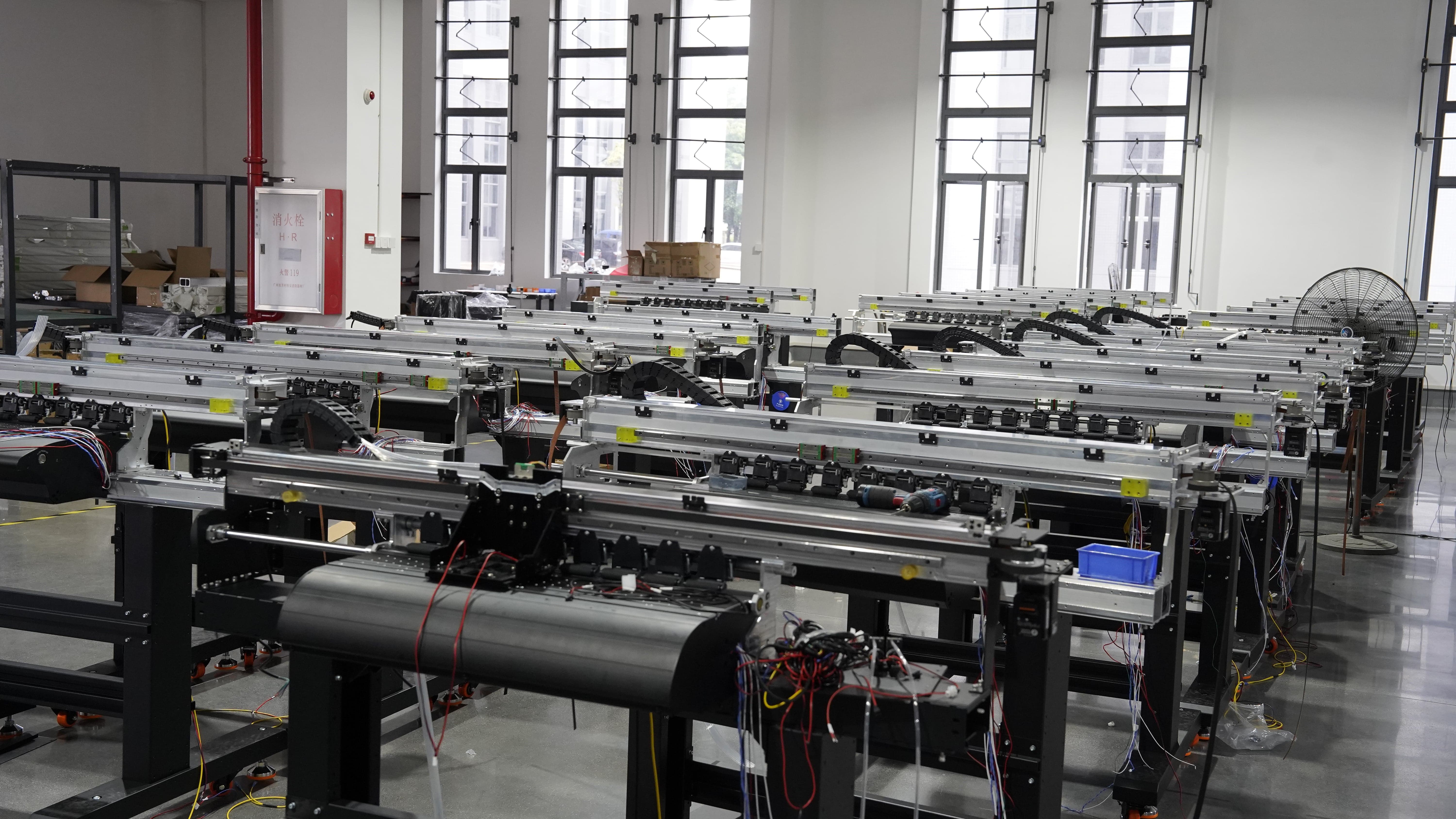
Rows of partially assembled XINFLYING DTF printer frames awaiting wiring, component installation, and final testing — the production stage in which most of the record behind a compliance file is created.
Direct-to-film printing has moved from a niche transfer method to a mainstream way of decorating cotton, polyester, and blended garments. Grand View Research valued the global DTF printing market at USD 2.7 billion in 2024, with Europe holding a 36.0% revenue share; Dataintelo estimates China accounts for more than 45% of global DTF printer manufacturing capacity. For a buyer in the research and evaluation stage, that combination creates a specific problem: a wide supply base, visually similar machines, and very little that can be checked before a sample machine arrives on the floor.
A DTF printer supplier's certificate portfolio becomes capability evidence when three conditions hold at the same time. Each document carries a unique number and an identifiable issuer. Its scope matches the machine or material the buyer is actually purchasing. And the standard it references governs the risk the buyer is trying to manage. When any one of those conditions fails, the document is decoration rather than evidence.
This article works through that test using a documented example — the certificate set published for the XF-series DTF printers from XINFLYING (Guangzhou Xin Flying Digital Technology Co., Ltd.), a Guangzhou-based digital printing equipment manufacturer founded in 2010 — and then explains how the same reading method applies to any supplier shortlist.
Why certificates function as capability evidence in DTF procurement
A DTF printer is not a consumable. It is a production asset that is expected to run inside a garment or transfer business for years, on a fixed electrical supply, with operators who are not electrical engineers, producing decorated goods that are then sold to brands, distributors, or online customers. That chain generates four questions a buyer cannot answer from a photograph or a specification sheet alone:
- Is the machine electrically safe on the supply voltage and frequency available at the buyer's site?
- Is the machine mechanically safe to operate under normal production conditions?
- Are restricted substances controlled in the equipment itself?
- Is the ink chemistry acceptable to the parties that will receive the decorated goods downstream?
Each question is governed by a different class of document. The most common evaluation error is to treat the whole portfolio as one interchangeable block of badges. A quality management certificate, a machine safety certificate, a restricted substances document, and a chemical product certification answer four different questions, and a supplier that presents them without distinguishing between them is not helping the buyer. The XF-series documentation set is useful precisely because the classes are separable.
The five documents in the XF-series certificate portfolio
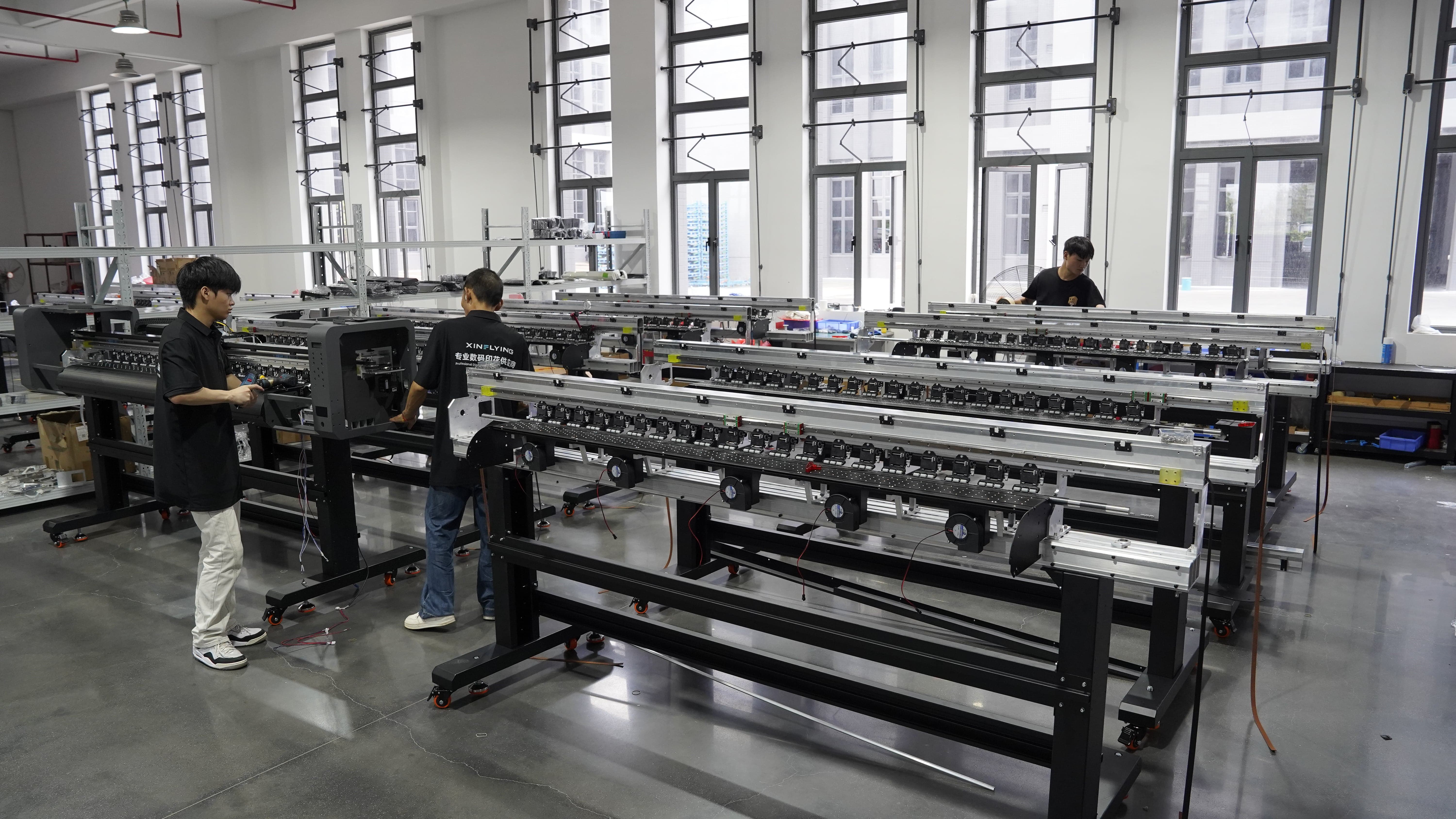
XINFLYING technicians connect and inspect internal components across several DTF printers on the assembly line — the control point that an ISO 9001:2015 scope statement is meant to cover.
The published XF-series set contains five documents, each with a unique identifier. Reading them side by side is more informative than reading any of them alone.
| Document | Identifier | What it governs | What it does not govern |
|---|---|---|---|
| CE — Low Voltage Directive (LVD) | TQT1550D271EC | Electrical safety of equipment operating within low-voltage bands | Print quality, throughput, software stability |
| CE — Machinery Directive | M.2026.206.C142365, issued by UDEM | Machine safety design: mechanical risk, guarding, control and stop functions | Chemical safety of inks, films, or finished garments |
| RoHS | M.2026.206.C142366 | Restriction of hazardous substances in electrical and electronic equipment | Substances in the textile that is printed |
| ISO 9001:2015 | NOA2215496 | Organisation-level quality management: process control, traceability, corrective action | Product performance, speed, resolution, or uptime |
| OEKO-TEX ECO PASSPORT | SH150194016 | Chemical products used in textile production, including ink chemistry | The printer itself, or the finished decorated article |
CE under the Low Voltage Directive: TQT1550D271EC
XF-series DTF printers operate on a 110–220V supply at 50/60 Hz across the range, from the compact XF-400D at 0.5 kW to the 80 cm XF-F808 at 2 kW. The Low Voltage Directive document TQT1550D271EC addresses that electrical design: insulation, protection against electric shock, thermal behaviour under normal load, and the way power is distributed to the print head, board, and heater assemblies. For an importer, this is the document that answers whether the machine can be connected to the site supply and accepted by the buyer's own electrical and insurance review.
CE under the Machinery Directive: M.2026.206.C142365, issued by UDEM
Machinery safety is a separate assessment from electrical safety, and in this portfolio it is documented separately under M.2026.206.C142365, issued by UDEM. This is the document class that covers mechanical hazards, guarding around moving assemblies, control reliability, and stop functions. It is also the certificate class most worth checking for issuer identity, because it is issued by a named body rather than being a manufacturer statement alone. Practical machine features in the XF-series map onto this class of requirement — the emergency button on the XF-C605 or the guide rail and frame construction across the 60 cm platform are examples of hardware a machinery assessment examines.
RoHS: M.2026.206.C142366
RoHS documentation M.2026.206.C142366 restricts hazardous substances in electrical and electronic equipment. It applies to the machine and its electrical assemblies, not to the printed textile. In practice it is the document European importers ask for earliest, because it sits alongside the CE file in customs and distributor reviews rather than in the decoration workflow.
ISO 9001:2015: NOA2215496
ISO 9001:2015 certificate NOA2215496 belongs to a different category entirely. It certifies a management system against a defined scope, not a product against a performance specification. Its value to a buyer is that it indicates a documented production process: incoming material control, in-process checks, traceability, and corrective action when something fails. The first-party facts that sit behind such a system are what make the certificate meaningful — a 37,440 m² production facility, more than 200 employees, a 20-engineer R&D team, monthly capacity of 1600+ units, pre-shipment testing on outgoing machines, and lead times quoted at 5–40 days with a minimum order quantity of one unit. A supplier that can state those figures consistently and can show the system that produces them is a different counterparty from one that cannot.
OEKO-TEX ECO PASSPORT: SH150194016
ECO PASSPORT SH150194016 applies to chemical products used in textile production — in a DTF workflow, that means the ink chemistry rather than the machine. This distinction matters because the DTF supply chain separates two compliance questions that buyers often merge. The chemical preparation used in production is covered by ECO PASSPORT, while the safety of the finished textile article itself is addressed by textile article standards such as OEKO-TEX STANDARD 100, which third-party sources describe as the relevant reference for DTF films and printed textiles. A machine certificate cannot satisfy a downstream brand asking about restricted substances in a printed garment; only the chemistry documentation can.
Matching certificate scope to specific XF-series models
Scope is where most certificate reviews break down. Buyers frequently accept a document covering a platform and assume it covers every configured variant of every model. The XF-series range illustrates why that assumption needs testing: the ten models share a common manufacturing base but differ in width, head count, ink configuration, power draw, and intended production role.
| Model | Print width | Print heads | Ink colours | Rated fastest speed |
|---|---|---|---|---|
| XF-400D | 30 cm (12") | 2 × Epson i1600-A1 / XP600 | CMYK+W | 6PASS 4.5 m²/h |
| XF-450PRO | 42 cm (16.5") | 2 × Epson i1600-A1 | CMYK+W | 6PASS 11 m²/h |
| XF-702E | 60 cm (24") | 2 × Epson i3200-A1 | CMYK+W | 6PASS 13 m²/h |
| XF-C602 | 60 cm (24") | 2 × Epson i3200-A1 | CMYK+W | 4PASS 16 m²/h |
| XF-704E | 60 cm (24") | 4 × Epson i3200-A1 | CMYK+CMYK+W+W | 4PASS 38 m²/h |
| XF-C604 | 60 cm (24") | 4 × Epson i3200-A1 | CMYK+CMYK+W+W | 4PASS 38 m²/h |
| XF-C605 | 60 cm (24") | 5 × Epson i3200-A1 | CMYK+CMYK+CMYK+W+W | 6PASS 36 m²/h |
| XF-F606 | 60 cm (24") | 6 × Epson i3200-A1 | CMYK×3+W×3, or CMYK+CMYK+ORGB+ORGB+W+W | 6PASS 28 m²/h |
| XF-L608 | 60 cm (0.6 m) | 8 × Epson i3200-A1 | 4C4W / 5C3W (water-based pigment ink) | 4PASS 42 m²/h (4C4W); 5PASS 45 m²/h (5C3W) |
| XF-F808 | 80 cm (31") | 8 × Epson i3200-A1 | CMYK+CMYK+CMYK+CMYK+W+W+W+W | 4PASS 50 m²/h |
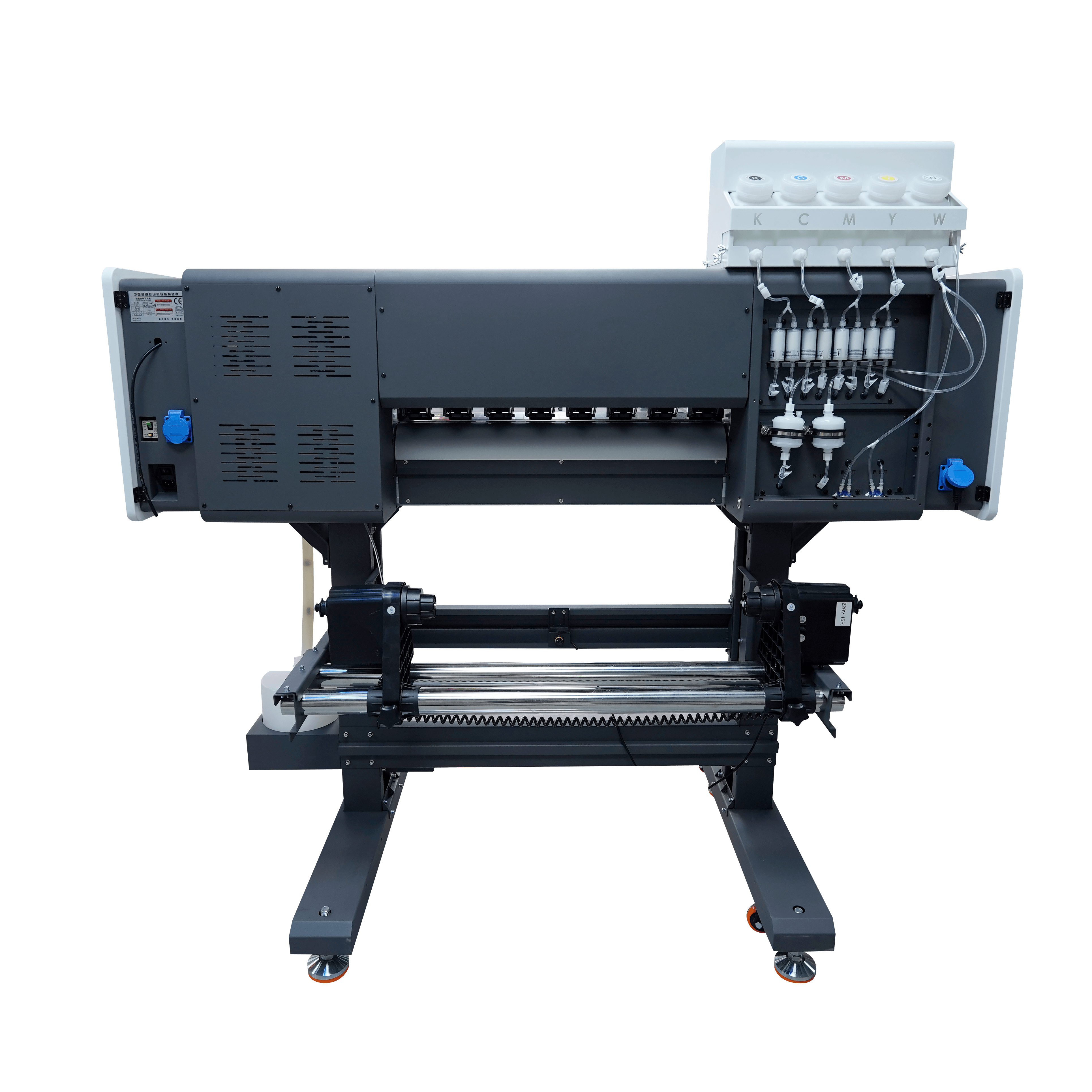
XinFlying DTF Printer XF-704E — a 60 cm, four-head configuration whose electrical and mechanical documentation is read against the same CE and RoHS reference numbers as the rest of the platform.
Three scope rules follow from that table.
Machine platform versus configured variant. A CE or RoHS document issued against a machine platform describes the electrical and mechanical construction of machines built to that design. It does not by itself certify the print performance of a specific head count, RIP configuration, or optional moisturizing function. Buyers should confirm that the declaration of conformity, or the technical file it references, lists the model being purchased — and should treat a generic platform statement as a question to ask rather than an answer.
Ink chemistry changes the chemical documentation requirement. The range spans CMYK+W on the XF-400D and XF-702E, four- and five-head CMYK-stacked configurations on the XF-C604, XF-C605 and XF-F808, an ORGB option on the XF-F606, and water-based pigment ink on the XF-L608. Because ECO PASSPORT SH150194016 applies to chemical products rather than to equipment, the relevant question is which ink systems sit inside the certified chemistry, not which printer model the machine plate reads.
Peripherals sit outside the machine file. A complete DTF line also includes RIP software, a powder shaker, a heat press, film, powder, and often an air purifier. Those items carry their own documentation. A buyer who accepts a printer certificate as evidence for the whole line will find gaps during a downstream audit.
One further boundary applies to the machines themselves. XF-series operating documentation specifies a controlled indoor environment, generally 20°C–30°C and 45%–65% relative humidity, with some models listing wider or narrower bands. Electrical and mechanical certification is established for machines used within their design parameters. A certificate does not extend the machine's operating envelope, and a buyer planning an unconditioned workshop should treat that as a separate engineering decision.
Where the documentation is actually tested: four deployment patterns
Certificate portfolios stop being abstract once they are placed next to real installations. Four documented deployment patterns show which documents carry weight in each case.
Print-on-demand business, United States, five units, five years in service. The operator produces customised T-shirts, hoodies, and sweatshirts against online orders, printing after the order is received. The business problem the installation solved was inventory pressure and dependence on external printing suppliers. In this pattern, the documents that matter most are the electrical and restricted-substance files, because the machine runs on commercial premises, and the chemical file, because customised goods move to end customers who occasionally ask what is on the print.
Garment manufacturing factory, twenty units. The factory adds logos, patterns, and customised graphics to finished garments before delivery to brands and distributors. Here, documentation travels downstream: a brand or distributor receiving decorated garments can request evidence about the production process, and a factory running twenty machines needs the paperwork to be consistent across the fleet rather than held as a single copy for one unit.
DTF transfer supplier, United States, thirty units. This operator produces transfer films and supplies them to downstream garment decorators. Because the product being sold is the printed film, chemistry documentation — not machine throughput certification — is the document class that answers customer enquiries about what the transfer contains.
Custom apparel printing business, United States, two units, three years in service. A small operation handling personalised T-shirts, hoodies, and bags, including single-piece and repeat orders. At this scale the buyer is typically evaluating for the first time, and the practical value of the portfolio is comparability: two suppliers can be placed side by side on whether they hold a machinery document with a named issuer, a low-voltage document, a restricted substances document, a system certificate, and a chemistry certification.
Market context: why documentation-driven evaluation is spreading
Three published signals explain why certificate portfolios have become a screening tool rather than a formality.
Europe is both the largest regional market and the most documentation-intensive one. Grand View Research puts Europe's share of DTF printing revenue at 36.0% in 2024 — the leading regional position — and European distribution channels routinely ask for the CE and chemistry file before listing a machine or a printed product.
Manufacturing is concentrated, which pushes due diligence earlier. Dataintelo estimates that more than 45% of global DTF printer manufacturing capacity sits in China. When the majority of supply originates from one manufacturing base, buyers compensate by evaluating documentation before travel and before sampling.
Industrial configurations now dominate revenue. Dataintelo also reports that industrial DTF printers accounted for 58.3% of total revenue share in 2025, driven by throughput requirements, while KBV Research places T-shirts at 41% of DTF printing revenue in 2024 as the dominant end-product segment. Larger machines and garment-focused output both increase the compliance surface per installation.
Market growth estimates, by contrast, should not be used as a procurement input. Published CAGRs for DTF printing diverge substantially — Grand View Research at 6.0% for 2025–2030, 360iResearch at 6.77% for 2026–2032, and Dataintelo at 12.5% for 2026–2034 against a projected USD 5.2 billion market by 2034. The direction is consistent; the magnitude is not. The stable conclusion for a buyer is that demand is expanding and that documentation, not forecasting, is the part of the decision under the buyer's control.
Comparison with traditional evaluation approaches — and the limits of documentation
Three evaluation paths are common, and each has a boundary that the other two expose.
| Evaluation path | What it establishes | Where it fails |
|---|---|---|
| Sample-led only | Actual print output on the buyer's own fabric and film | Says nothing about whether the unit delivered matches the units produced later, or whether the goods can be sold into regulated channels |
| Price-led only | Initial capital outlay per unit | Ignores the cost of a machine that cannot be accepted by an importer, an insurer, or a downstream brand |
| Documentation-led | Safety, substance control, process control, and chemical compliance across a defined scope | Cannot substitute for a physical print test on the buyer's substrate and workflow |
The limits deserve to be stated plainly, because a portfolio presented without limits is a marketing document rather than evidence.
ISO 9001:2015 certificate NOA2215496 does not state print resolution, print speed, colour consistency, or uptime. It says that an audited management system exists within a defined scope; the buyer still has to verify what the scope wording includes and excludes.
CE documentation under the Low Voltage Directive, TQT1550D271EC, addresses electrical safety. It does not validate performance in a buyer's climate, on a buyer's film, or under a buyer's shift pattern.
RoHS document M.2026.206.C142366 restricts substances in the equipment. It says nothing about the printed textile, and it cannot be offered to a downstream brand as evidence about a decorated garment.
OEKO-TEX ECO PASSPORT SH150194016 applies to chemical products used in textile production. It is not a machine certification and it does not automatically certify the finished decorated article; article-level compliance depends on the whole workflow, including film, powder, and curing.
Scope drift is the most common practical failure. A certificate issued for one model or platform does not automatically extend to every SKU in a catalogue, and an annex that lists models is worth more than a cover page without one. Buyers should also check validity and renewal status: certificates are issued for defined periods and are maintained through surveillance cycles, and a scanned copy without a visible issue context is weak evidence.
Finally, commercial mechanisms and compliance should not be conflated. China's HS code 84433213 for ink-jet printers carries a 13% value-added tax in the source documentation referenced here and a 0% standard most-favoured-nation duty rate, while duty treatment at the destination is set by that market's own tariff schedule. Those figures affect landed cost. They do not indicate product compliance, and product certificates do not indicate tax treatment.
A due-diligence sequence for reading any DTF printer certificate portfolio
- List the documents by class: electrical safety, machinery safety, restricted substances, management system, chemical products. A portfolio missing a class is incomplete regardless of how many pages it contains.
- Record the number and issuer of each document, including any named body such as UDEM on a machinery certificate.
- Read the scope statement and write down which models it names. If no model list exists, request the declaration of conformity or technical file reference.
- Match the class of document to the risk you actually carry: import and site electrical review against the low-voltage file, downstream brand enquiries against the chemistry file.
- Confirm which ink systems are inside the chemical certification, especially where the configuration uses water-based pigment ink or an ORGB option.
- Check issue and renewal context on the management system certificate, and ask what the audited scope covers.
- Request documentation for the peripherals: RIP, powder shaker, heat press, film, powder, and air purification.
- Separate compliance evidence from commercial terms such as VAT, duty, lead time, and minimum order quantity, and evaluate them on their own merits.
- Finish with a physical print test on your own substrate, and treat the documentation as the filter that decides which suppliers reach that test.
Future outlook
Two directions look reasonably clear from the evidence available. First, documentation-led procurement is likely to deepen rather than fade, because the largest regional market is also the one with the most structured buyer requirements, and because manufacturing concentration keeps supply-side due diligence necessary. Suppliers that can distinguish between a management system certificate, a machine safety document, and a chemistry certification in their own sales material will be easier for buyers to evaluate than those that present a single undifferentiated badge set.
Second, as DTF hardware moves toward higher head counts and wider platforms — the XF-series already spans two to eight print heads and 30 cm to 80 cm widths — the compliance surface per installation grows with it. Multi-unit factory installations, of the kind documented at twenty and thirty units, make fleet-level paperwork a practical requirement rather than a formality.
FAQ
Does a CE certificate cover every DTF printer model a supplier sells?
Not automatically. CE documentation is issued against a defined product scope, and a document written for a machine platform describes machines built to that design. Buyers should check whether the declaration of conformity or its technical file names the specific model being purchased, and should not assume coverage extends across a full catalogue of variants with different head counts, ink configurations, or power ratings.
What is the difference between ISO 9001:2015 and a product certification such as CE or RoHS?
ISO 9001:2015 certifies a management system against a defined organisational scope — process control, traceability, and corrective action. CE and RoHS documents address the product: electrical safety under the Low Voltage Directive, machine safety under the Machinery Directive, and restricted substances in electrical and electronic equipment. A system certificate does not state product performance, and a product certificate does not describe manufacturing process discipline. Both answer different buyer questions.
Does OEKO-TEX ECO PASSPORT certify the DTF printer or the ink?
It applies to chemical products used in textile production, which in a DTF workflow means ink chemistry rather than the machine. Article-level safety of the finished textile is addressed by textile article standards such as OEKO-TEX STANDARD 100. A buyer selling decorated garments into brand supply chains needs the chemistry documentation, not only the machine file.
How can a buyer check that a certificate number is still valid?
Certificate numbers, issuing body names, and issue context are the elements that make verification possible. Buyers should record the number and issuer, confirm the certificate's stated validity period, and check the scope wording for the models or products covered. A copy without an identifiable issuer, number, or renewal context cannot be used as audit evidence, regardless of how it is presented.
Which documents should a buyer request for machines going into T-shirt production?
For T-shirt and apparel decoration, the relevant set includes electrical safety documentation for the supply voltage in use, machinery safety documentation with an identifiable issuer, a restricted substances document for the equipment, a management system certificate for the manufacturing entity, and chemical product certification covering the ink systems used. Where the operator also supplies printed films downstream, the chemistry documentation carries additional weight.
What can a certificate portfolio not tell a buyer about a DTF printer?
It cannot establish print quality, colour consistency, production speed, or uptime on the buyer's own fabric and film, and it does not extend a machine's operating envelope beyond the documented environmental range. It also says nothing about spare parts availability, service response, or training. Those remain subject to sampling, references, and commercial terms.
Reference documentation: XINFLYING publishes its company profile and capability summary as a downloadable brochure — XINFLYING company profile (PDF).