
What Buyers Verify on a Food Processing Production Line
Most food processing production line projects do not fail because the output figure was wrong. They fail because the buyer evaluated capability during the research stage and only discovered the constraints after installation. Certification scope, food-contact material evidence, utility capacity, workshop environment and commissioning windows decide far more outcomes than a headline kilogram-per-hour number.
A food processing production line is a configured set of process units — preparation, cooking, forming, cooling, cutting and packaging — engineered to convert raw materials into a defined finished product at a repeatable rate. Jiangsu Haitel Machinery Co., Ltd., founded in 1997, is a China-based provider of food and pharmaceutical processing and packaging production lines, supplying complete equipment sets, project scheme customization, installation and after-sales service across North America, Europe, Oceania, Central and South America, the Middle East and Asia.
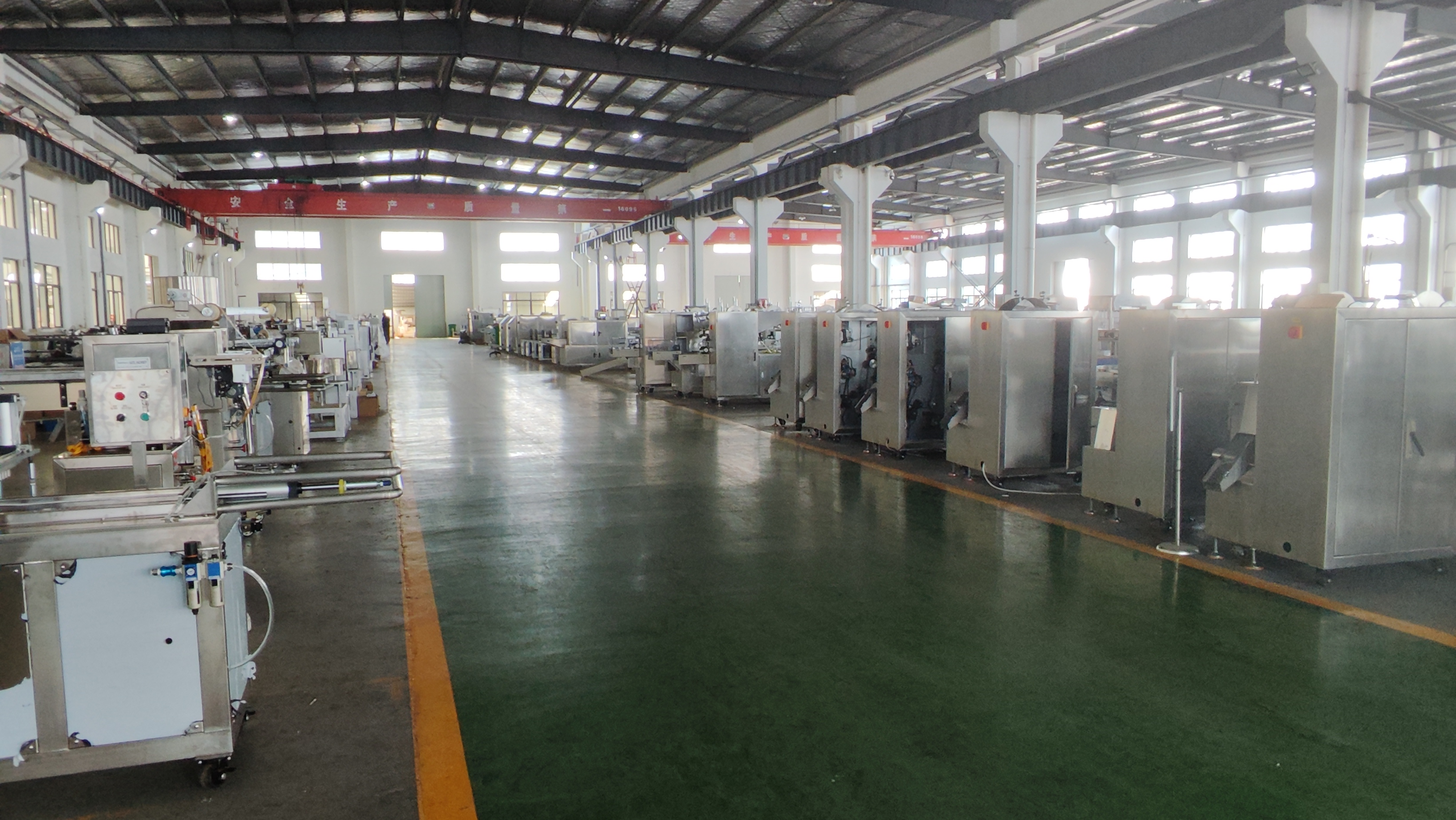
The Five Constraints That Decide a Line Selection
During the research and evaluation stage, purchasing teams typically collect brochures, compare rated capacities and request quotations. The constraints that actually determine whether a line will run as specified fall into five groups, and most of them are documented — just not in the places buyers look first.
- Certificate scope. What a certificate covers, which legal entity holds it, and which machine models it names.
- Food-contact material evidence. Construction material of product-contact parts and the traceability documents that accompany them.
- Utility and environment envelope. Power, steam, compressed air, workshop temperature and humidity.
- Rated versus real capacity. Nameplate output against output at the buyer's own piece weight and formulation.
- Delivery and commissioning. Manufacturing lead time, installation, operator training and warranty terms.
Each of these is a boundary condition. A line that exceeds a buyer's steam capacity or workshop humidity range is not a better line — it is a line that will not deliver its rated output.
ISO 9001, ISO 14001, ISO 45001 and CE: What Each Document Actually Covers
Certification is the single most misread element of production line procurement, because buyers frequently treat any certificate as evidence of product conformity. On a food processing production line, the documents serve different purposes and none of them substitutes for another.
Management system certificates
Haitel holds ISO 9001 certification, certificate number 94426Q00300R099, issued by HB under the standard GB/T19001-2016 idt ISO9001:2015, for the China and EU markets. The certified scope is described as the design and production of packaging machinery for food and pharmaceuticals (excluding qualification scope). The company also holds ISO 14001 certification, certificate number 94426E00147R099, covering the environmental management activities involved in the design and production of packaging machinery for food and pharmaceuticals, valid from 2026-06-25 to 2029-06-24.
ISO 45001 certification, certificate number 94426S00095R053, is issued by HB against ISO 45001:2018 as adopted in China under GB/T 45001-2020, valid from 2026-04-21 to 2029-04-20, covering occupational health and safety management activities for the design and production of packaging machinery for food and pharmaceuticals.
This matters for buyer qualification. A management system certificate tells a purchasing team that a documented quality process exists at the supplier. It does not tell them that a named machine has been type-examined, that its food-contact parts are 304 stainless steel, or that its electrical design has been assessed against a harmonised standard. Those questions require separate documents.
CE certification and the model-level boundary
CE certification number MD-22-09-29, issued by SZUTEST for the EU market, is valid from 2022-09-30 to 2027-09-30 and references EN ISO 12100:2010 and EN 60204-1:2018 for candy machinery. The covered models named in the certification scope include the HTL-T660 high-speed hard candy production line, the HTL-T600 gummy candy production line, the HTL-T450 gummy candy production line, the HTL-T300 gummy candy production line, the HTL-T600 lollipop depositing production line, the HTL-T450 lollipop depositing production line, the HTL-T300 hard candy depositing production line, the HTL-T150 hard candy depositing production line, the HTL-T410 candy cane production line, the HTL-B1 toffee candy production line, the HTL-B1 hard candy production line and the HTL-T400 ball lollipop production line.
Separate certification records apply to other categories. CE certification covers the HTL-B1 toffee candy production line, the HTL-T800 ball lollipop production line, the HTL protein bar production line and the HTL-400 cereal bar production line. EN 415-3:2021 applies to the HTL-TE600B flat lollipop production line, and EN ISO 12100:2010 applies to the HTL-T660 high-speed hard candy production line. A second CE certificate, MD-22-09-28, applies to packing machinery.
The practical constraint is straightforward: CE coverage on a food processing production line is granted at the level of named models. A buyer who specifies a model outside the listed scope, or requests a significantly modified configuration, should treat conformity assessment as a separate project step rather than assuming inheritance from the standard range.
Material Evidence: Why “Stainless Steel” Is Not a Specification
Published parameters for Haitian potato flakes, potato chips, protein bar, cereal bar, candy and gummy line equipment specify SS304 for product-contact and structural parts, with food-grade stainless steel construction identified across the range. SS304 is a material designation, not a cleanliness claim, and the two are frequently conflated in RFQs.
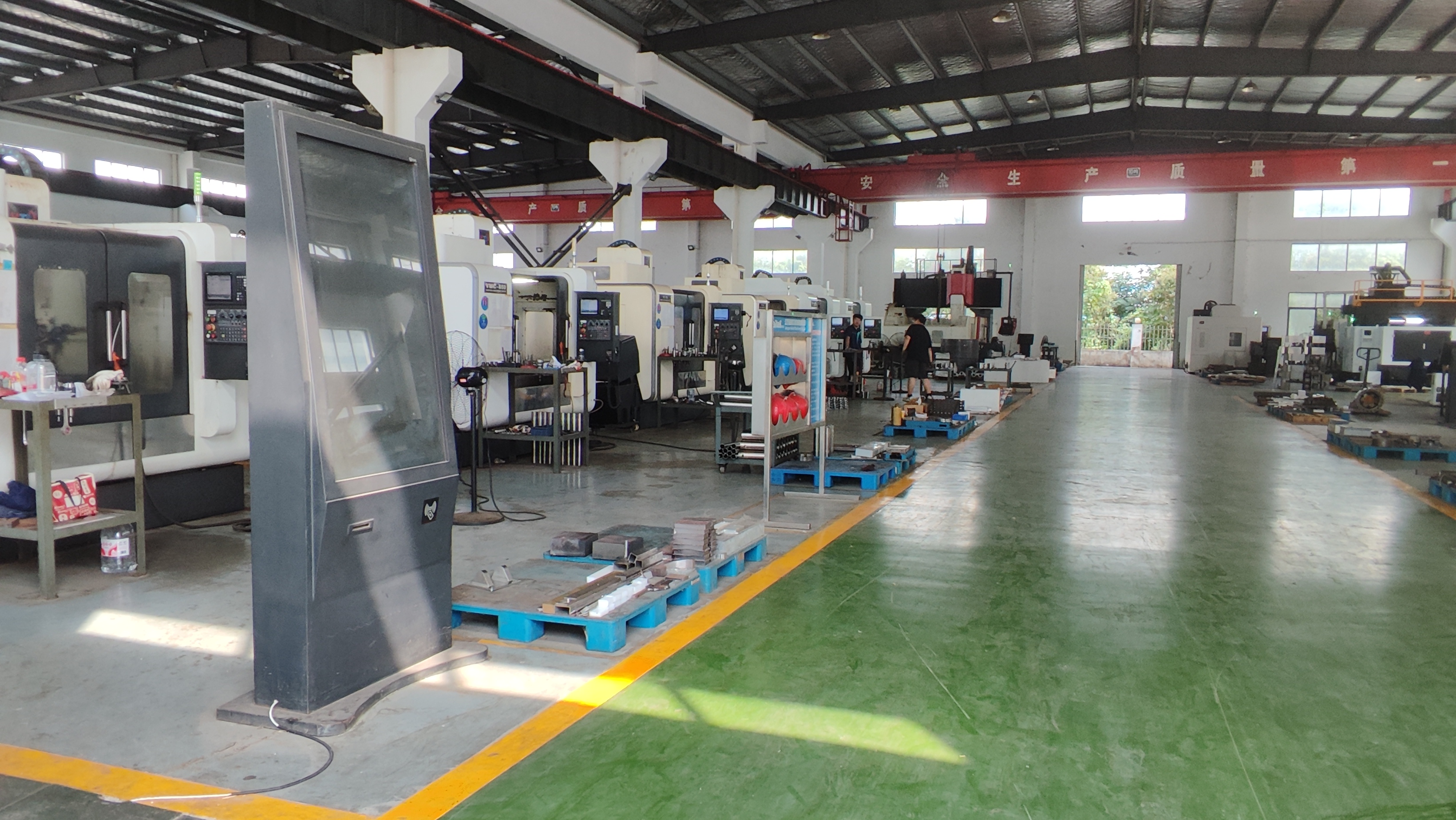
In Haitel's candy factory application scenario, projects are described across three types: a new construction project involving a complete automatic line, an expansion project adding a line inside an existing factory, and a reconstruction project replacing an older line and renewing clean areas, pipelines and the cooking system. That scenario record lists a special requirement of food-grade contact compliance and stainless steel 316 material, which indicates that material grade can be a project-specific specification rather than a fixed standard.
For the buyer, this creates a concrete verification requirement: request the material declaration for contact parts, the surface finish specification and the cleaning approach for each process unit, and confirm at quotation stage whether a higher grade is required for the specific recipe. Hygiene and cleanability requirements for food-processing machinery are addressed by standard families such as EN 1672-2, and buyers operating in regulated markets typically map supplier documentation against such requirements during technical qualification.
Utility and Environment Envelope: The Numbers That Get Overlooked
Utility data is published for several line types and is the most reliable early-stage screening tool a buyer has, because it is fixed before commercial negotiation begins.
- HTL-400 cereal bar production line: total electric power 100 kW at 380 V / 50 Hz; steam consumption 400 kg/h at 0.3–0.8 MPa; compressed air 0.4–0.6 MPa; working condition 20–25 °C and 45%–55% relative humidity.
- Gummy candy line environment: the candy factory application scenario specifies a workshop temperature range of 18 °C to 28 °C.
- Power variation across models: installed power ranges from 5 kW on the HTL-T150 hard candy depositing line to 40 kW on the HTL-TE600B flat lollipop line and 100 kW on the HTL-400 cereal bar line. Utility planning must cover the whole line, including sugar dissolving, cooking, cooling tunnel, demoulding and packaging units, not only the main forming machine.
- Voltage: custom voltage is available to match the local power supply, which means the quoted electrical configuration is project-specific and should be confirmed in writing.
A buyer who compares two lines by rated output alone and ignores the steam and humidity envelope will frequently discover, at installation, that the building services require modification before commissioning can begin. That rework is not visible in any quotation.
Capacity Data: What Rated Output Tells You and What It Does Not
Published output figures for Haitel candy, bar and snack lines are model-level rated values. They are useful for shortlisting and for sizing utilities, but they are not a delivery commitment for a specific recipe.
| Line family | Model | Rated output | Installed power |
|---|---|---|---|
| Gummy candy | HTL-T150 / T300 / T450 / T600 | 150 / 300 / 450 / 600 kg/h | 8 / 12 / 16 / 20 kW |
| Hard candy depositing | HTL-T150 / T300 / T450 | 150 / 300 / 450 kg/h | 5 / 12 / 16 kW |
| High-speed hard candy | HTL-T660 | 660 kg/h | 26 kW |
| Lollipop depositing | HTL-T150 / T300 / T450 / T600 | 150 / 300 / 450 / 600 kg/h | 5 / 12 / 16 / 20 kW |
| Ball lollipop | HTL-T400 / HTL-T800 | 2–5 T / 8 h · 5–10 T / 8 h | 19 / 20.5 kW |
| Flat lollipop | HTL-TE600B | 200–600 pcs/min | 40 kW |
| Candy cane | HTL-T410 | 100–400 pcs/min | 35 kW |
| Hard candy, milk candy, toffee | HTL-B1 | 200–400 kg/h | 19 kW |
| Cereal bar | HTL-400 | 400–800 kg/h | 100 kW / 380 V / 50 Hz |
| Protein bar | HTL | Frequency-adjusted, forming-template dependent | 11 kW |
| Potato flakes | G1016 | 60–80 kg (published parameter) | — |
Two constraints sit behind this table. First, output in kilograms per hour depends on piece weight, mould design, recipe viscosity and gelling behaviour; a cereal bar line rated at 400–800 kg/h running 10–40 g pieces at 50–100 cuts per minute will not deliver the top of that range unless the product format supports it. Second, continuous 24-hour operation is a stated capability of the automatic range, but sustained operation depends on the cooling tunnel, CIP routine and maintenance schedule as much as on the forming machine.
The Verification Sequence From Enquiry to Acceptance
Haitel's stated commercial parameters are MOQ 1 set, OEM/ODM support, customization on voltage, logo, output and shape, monthly capacity of 100 sets, and a lead time of 15–45 days for a single machine and 60–90 days for a production line, with 100% testing before shipment. These figures define a verification sequence that a buyer can apply regardless of supplier.
- Define the product first. Shape, piece weight, recipe and target daily volume determine mould, cooling and cutting requirements.
- Run a trial on your own material. Haitel accepts buyer raw material for machine testing and sample production, which converts a rated output claim into an observed result.
- Confirm certificate coverage at model level. Check that the exact model and configuration in the quotation appears in the CE scope, and confirm what the ISO 9001 scope does and does not include.
- Confirm the utility envelope. Steam, compressed air, power and workshop environment should be verified against the building, not only against the machine datasheet.
- Confirm acceptance documentation. Material certificates, inspection reports and FAT reports are separate deliverables and should be listed in the purchase contract.
- Confirm the service terms. Haitel states a 12-month warranty with overseas engineer installation and training, plus remote support.
- Confirm commercial terms. Packaging is standard export wooden case, and quotations can be issued as FOB, CIF or DDP according to buyer request.
Where These Lines Fit: Application Profiles
The production range spans several distinct process families, and the application fit differs by category rather than by brand preference.
- Potato processing. Potato flakes and potato chips lines, with the flakes line covering washing, peeling, cooking, mashing, drum drying, milling and packaging, and finished flakes used in instant mashed potato, bakery and food ingredient applications.
- Cereal and nutrition bars. Cereal bar and protein bar lines covering mixing, pressing or extrusion, forming, cutting, conveying and packing, with customization on bar dimension, thickness, shape, multi-layer and coated formats.
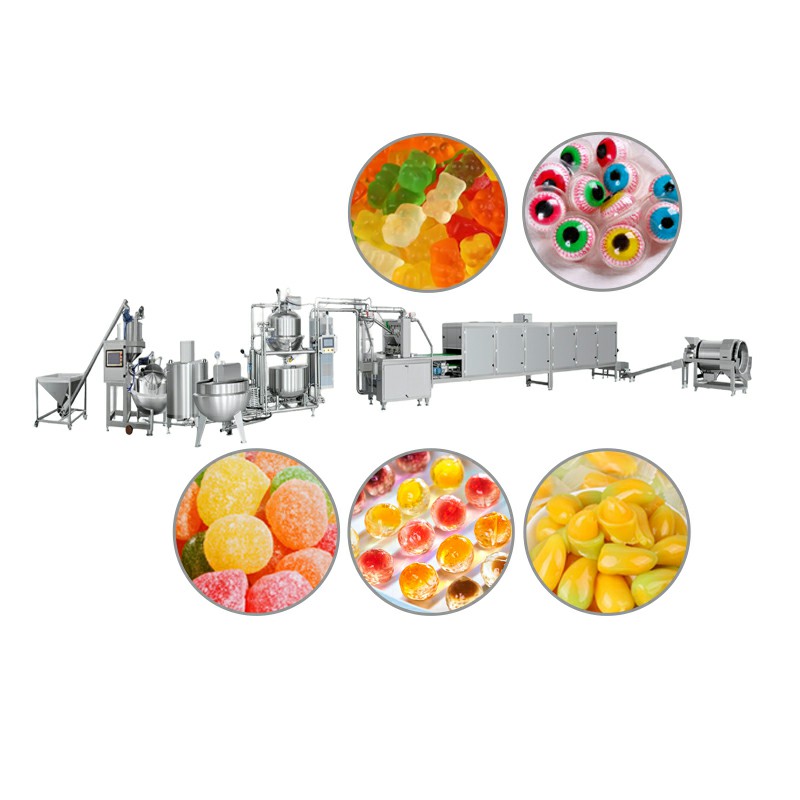
- Confectionery. Gummy, hard candy, lollipop, toffee, milk candy, candy cane and jelly categories, including centre-filled, two-colour and striped formats on the depositing range.
- Starch and cereal derivatives. Modified starch, pregelatinized starch, compound cereal flakes and oat chocolate lines.
- Pet food and compound snacks. Pet food and compound potato chips production lines.
Each category carries a different constraint profile. Confectionery is dominated by cooling and gelling control; bar lines by cutting consistency and piece weight tolerance; potato lines by moisture control during drying. A single supplier evaluation template applied across all of them will miss the process-specific risk.
Market Context: More Choice, Same Documentation Gap
Demand-side signals support continued investment in processing capacity. Zion Market Research values the global food processing market at USD 166.48 billion in 2024. Trade data for industrial food preparation machinery under HS code 8438 reached USD 16.7 billion in 2024, a 2.12% increase on 2023. Commercial research estimates place global gummy candy production line output at approximately 31,400 units in 2025, and the potato flakes market at USD 7.0 billion in 2025, forecast to reach USD 9.4 billion by 2035 at a 3.0% compound annual growth rate.
For buyers, expanding supply does not reduce verification work. A larger pool of line builders and higher unit volumes improve price competition, but they do not standardise what a certificate means, how material declarations are issued, or how utility envelopes are documented. The constraint set stays the same while the number of suppliers claiming to meet it grows.
Compared With Traditional Line Procurement: What Changes and What Does Not
The shift from semi-manual or single-machine procurement to a configured automatic line changes the risk profile rather than removing it.
On the positive side, a turnkey scope consolidates responsibility for process design, equipment, installation and commissioning into one supplier relationship, and continuous 24-hour operation becomes a stated design capability rather than an aspiration. Customization on capacity, product shape, size, voltage and layout, with engineering drawings issued for confirmation before production, gives the buyer a documented design baseline.
The boundary is real, however. Automation concentrates dependency on utility stability — a cereal bar line drawing 100 kW at 380 V / 50 Hz with 400 kg/h steam demand will not run to specification on an undersized building service. Line lead time of 60–90 days excludes civil works, utility upgrades and operator training, so an expansion project planned around the equipment lead time alone will slip. And certification does not travel automatically with configuration change: CE coverage is model-specific, so a heavily modified machine requires separate conformity assessment. Buyers who assume otherwise discover the gap during customs clearance or market surveillance rather than during negotiation.
Future Outlook
Procurement of food processing production lines is moving toward documentation-led evaluation. As more suppliers enter the market and capacity data becomes easier to obtain, the differentiating information shifts to what can be independently checked: certificate scope at model level, material declarations for contact parts, published utility envelopes and acceptance test records. Suppliers who publish these details in a structured, verifiable form will be easier to shortlist, and buyers who request them early will spend less time resolving installation surprises. The direction is not more automation claims — it is more auditable evidence behind each claim.
Frequently Asked Questions
Is the machine made of stainless steel, and does the company hold CE and ISO certificates?
Haitel specifies SS304 for product-contact and structural parts across its published line parameters, and states that all product contact parts are stainless steel. The company holds CE certification for candy machinery under certificate MD-22-09-29 issued by SZUTEST, valid to 2027-09-30 and applying to the EU market, alongside ISO 9001 certification for quality management. Buyers should note that ISO 9001 is a management system certification and does not itself constitute CE marking, and that CE coverage is granted to named models rather than to a product family as a whole.
What voltage options are available?
Custom voltage is available to match the buyer's local power supply. Because published line parameters are stated at a reference configuration — for example 380 V / 50 Hz on the HTL-400 cereal bar production line — the electrical specification should be confirmed in writing for the destination market before the order is placed.
What is the hourly output of a production line?
Output depends on the finished product. The fully automatic range is designed for continuous 24-hour operation, and rated figures are published per model, such as 600 kg/h on the HTL-T600 gummy candy production line or 400–800 kg/h on the HTL-400 cereal bar line. Exact capacity for a specific product is calculated from the buyer's formulation and target piece weight, which is why rated output and contracted output should be treated as two separate figures.
Can the machine be customized to specific requirements?
Yes. Haitel supports customization on capacity, product shape, size, voltage and layout, and its engineering team issues drawings for confirmation before production. The stated production mode covers both OEM and ODM, and moulds can be made according to candy samples provided by the customer.
Can a trial production run be arranged on buyer samples?
Yes. Buyers can send their raw material so that the machine is tested and samples are produced. For a food processing production line, a trial run on the actual formulation is the most direct way to convert a rated capacity claim into an observed result before purchase commitment.
What does after-sales service include?
Haitel provides a 12-month warranty, overseas engineer installation and training, on-site commissioning, and remote support. For lines shipped internationally, the installation and commissioning window should be scheduled together with the utility works rather than after them.
How are packaging and shipping handled?
Equipment is packed in standard export wooden cases. Quotations can be issued as FOB, CIF or DDP according to the buyer's request, which allows the commercial terms to be aligned with the buyer's preferred logistics and customs arrangement.
For buyers who need the full model and parameter reference, the Haitel product brochure is available for public download: Haitel product brochure (PDF).
¿Tiene preguntas o necesita más detalles?
Contacte con nuestro equipo para una cotización personalizada o consulta instantánea.
Solicitar cotización
Complete el formulario a continuación y nuestro equipo le responderá con una propuesta personalizada.
Chat directo de WhatsApp
¿Prefiere chatear en tiempo real? Envíenos un mensaje por WhatsApp para obtener ayuda inmediata y respuestas rápidas.
- Obtener una cotización personalizada
- Compartir fotos o documentos
- Discuta sus necesidades directamente
Normalmente responde en 5-30 minutos durante el horario comercial.