
What Buyers Should Verify in a Dual Cooling Water Cooling Vest
Procurement teams evaluating personal heat-relief equipment are increasingly looking beyond marketing descriptions. For metal-roof factories, construction sites, and other heat-exposed workplaces, the decision to adopt a dual cooling water cooling vest depends on a handful of verifiable inputs: cooling duration, pump performance, materials, certifications, and supplier capacity. This article maps those inputs to the COOLWAVE water-circulation cooling vest from Shokunin and explains how they fit broader industrial cooling-buying criteria.
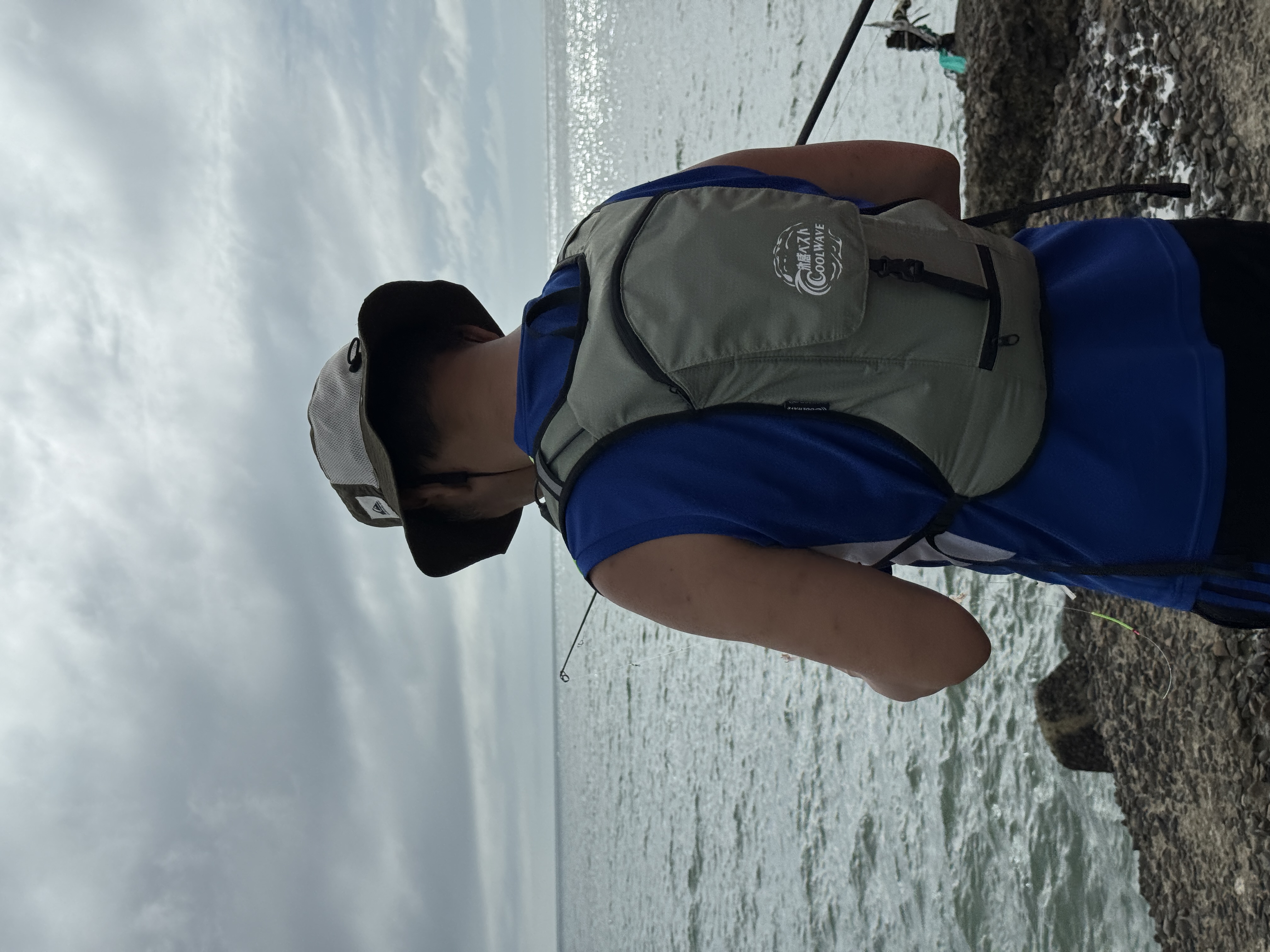
The COOLWAVE water-circulation cooling vest can be used in hot outdoor environments, including extended sun exposure.
Why heat exposure creates a procurement need
Occupational heat stress is not limited to outdoor settings. Workers in metal sheet factories, around furnaces, on asphalt, in traffic control, or under direct sun for long periods face similar risks. In procurement terms, the challenge is that many cooling garments rely on passive phase-change packs that lose effectiveness after a short window. That is why 'dual cooling' has become a useful category distinction: it combines cold storage with active circulation, extending the cooling envelope and making the vest a more predictable piece of workwear.
Market data supports this shift. The global cooling vest market was valued at approximately USD 215 million in 2024 and is projected to reach USD 385 million by 2033, according to Dataintelo. A broader personal cooling device market, which includes handheld fans and portable air conditioners, was valued at USD 25.16 billion in 2024 and is projected to reach USD 94.85 billion by 2035, according to Market Research Future. Within the cooling vest category, industrial applications—including construction and manufacturing—held the largest share at 34.5% in 2025. Asia Pacific is the fastest-growing region, driven by rapid industrialization and large outdoor work populations.
What 'dual cooling' means in a water cooling vest
In the Shokunin COOLWAVE implementation, the vest is built around two ice packs and a pump-driven water circulation loop. The backpack holds the reservoir and the ice packs; a pump pushes chilled water through tubes in the vest. This active circulation separates a dual cooling vest from a simple ice pack vest: instead of relying on conduction from a static pack, it distributes the cooling effect across the torso. The 'dual' label refers to the combination of stored cold (ice packs) and active transport (circulated water).
The low-voltage pump is a key specification. The COOLWAVE pump output is rated at 5V 150mA maximum, with a flow rate of 320–370 ml/min. That low-voltage design keeps power requirements modest and is consistent with portable operation, though buyers should confirm the exact power-source configuration with the supplier.
The COOLWAVE vest at a glance
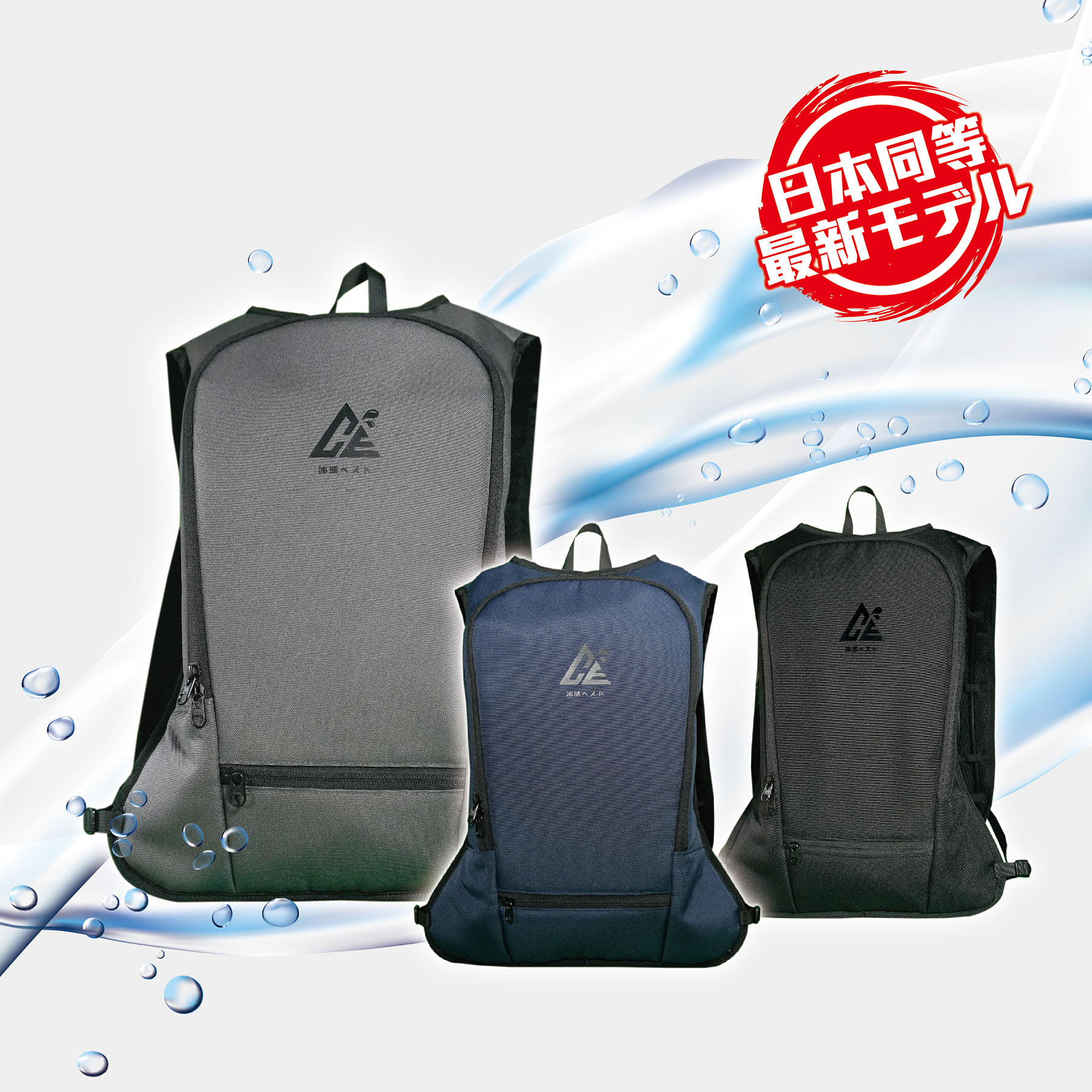
Shokunin sells the COOLWAVE water-circulation cooling vest in a Basic Model and a Professional Model line, with Professional variants in Blue, Gray, and Black. The core specifications are shared across these models.
| Parameter | COOLWAVE water-circulation cooling vest |
|---|---|
| Cooling duration | 3–4 hours |
| Weight | Within 2 kg |
| Pump output | 5V 150mA (max) |
| Flow rate | Max 320–370 ml/min |
| Shoulder strap material | 600D polyester |
| Vest material | PEVA |
| Water bag material | TPU |
| Water bag cap | Polypropylene |
| Cooling tube | Sand rubber (black) |
| Contents | Water-cooled vest backpack ×1, ice packs ×2 |
| Suitable temperature | Below 10°C (see note) |
Note: The 'below 10°C' parameter is the one item buyers should clarify. It may refer to the temperature of the chilled water or ice packs before use, rather than the ambient temperature. Because the vest is intended for high-temperature environments, procurement teams should ask the supplier to state the intended meaning in writing.
Certifications and documentation buyers should ask for
On the certification side, the COOLWAVE Basic Model is protected by Patent No. I886033, issued by the Intellectual Property Office, Ministry of Economic Affairs, under the Patent Act of the Republic of China. This patent applies to the ROC market. It gives buyers a specific document to request when verifying that the cooling system design is not merely a generic copy.
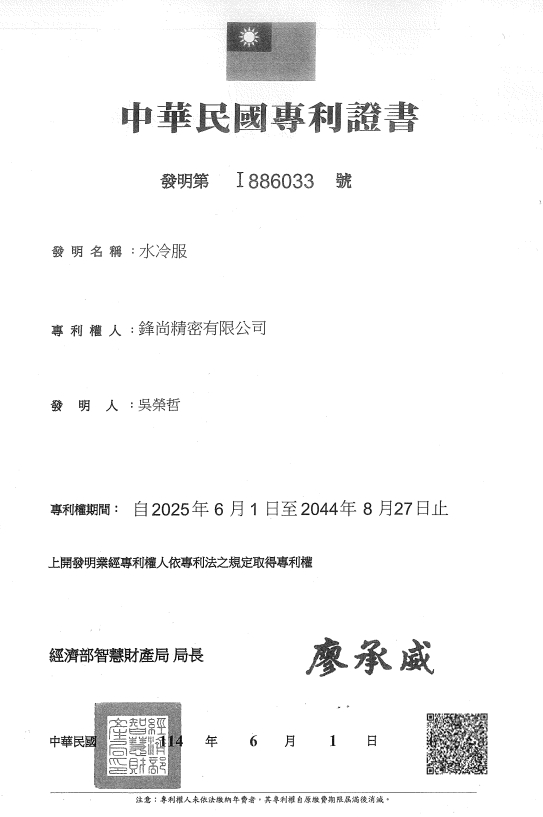
Patent certificate for the COOLWAVE water-circulation cooling vest.
The broader COOLING water-cooled vest product family received the Disaster Prevention Product and Service Certification Award from the Taiwan Disaster Prevention Industry Association. That award indicates the product has been reviewed against a defined disaster-prevention product standard in Taiwan. For buyers, this is an independent signal that the vest has passed a documented review process.
For pump-equipped cooling garments, buyers should also ask about ISO 9001:2015 quality management certification and, where relevant, CE or UL marks for electrical components. These are common industrial procurement requirements. They are not specific to Shokunin, but they should be part of any supplier evaluation.
Where dual cooling vests are used
Typical deployments include construction workers, outdoor workers, food stall operators, street vendors, traffic controllers, and metal sheet factories. The adjustable straps and one-size-fits-all design make the vest easy to rotate across shifts or share among crew members.
A field case in Taiwan involved 100 units used for cooling in high-temperature environments over a 10-year period. The reported outcomes were effective body cooling, heatstroke prevention, and improved work comfort and efficiency. The same case record highlights a lightweight, portable design with an adjustable fit. This type of field evidence is useful when comparing the vest with products that only provide lab-based specifications.
Market signals: active circulation is moving into industrial PPE
The market is moving toward longer-lasting and actively circulated cooling. Phase Change Material (PCM) vests captured 28.7% of the market in 2025 and remain the fastest-growing technology segment, according to Dataintelo. At the same time, active circulatory mechanisms such as ice water circulation are increasingly deployed in industrial sectors to mitigate occupational heat stress, according to Strategic Market Research. These two trends are not contradictory: they indicate that buyers want more effective cooling, and that endurance is a key differentiator.
Notable global competitors in the cooling vest market include Techniche International, Glacier Tek, Polar Products, and Ergodyne, according to Spherical Insights. These names provide a useful benchmark set for procurement teams comparing features, certifications, and price points.
Comparison with traditional solutions
Traditional ice pack vests rely on a passive pack that cools only where it touches the body. In hot conditions, the pack warms up quickly, often within 30 minutes, and the cooling effect fades. Water-circulation vests solve that by moving chilled water across the torso, using the ice packs as a cold source and the pump as the driver.
| Feature | Conventional ice pack / PCM vest | Dual water-circulation vest |
|---|---|---|
| Cooling duration | Typically short in high heat | 3–4 hours (COOLWAVE spec) |
| Cooling distribution | Localized; depends on pack placement | Pump-driven circulation across torso |
| Power source | None | Low-voltage pump (5V, 150mA max) |
| Weight | Usually light | Within 2 kg |
| Complexity | Low | Requires ice packs, water, pump/battery |
| Best fit | Short-duration tasks | Extended shifts, high-radiant-heat sites |
The most honest limitation is operational: a water-circulation vest is not a 'set and forget' product. The pump needs power, the ice packs need to be frozen before the shift, and the vest weighs within 2 kg, which is heavier than some minimalist passive vests. The 'below 10°C' specification also needs confirmation before purchase. These are reasonable trade-offs for longer cooling endurance, but they should be part of the decision.
Future outlook
The direction is clear: industrial buyers want PPE that lasts through a shift, not just through the first 30 minutes. This will push suppliers to improve pump efficiency, battery endurance, and pack durability. It will also increase demand for ODM partners that can adapt cooling vests to different industrial uniforms and site requirements.
Shokunin is positioned for this shift through its parent company, Feng Shang Precision Co., Ltd., founded in 2009. The factory covers 1,000 m² and has 30 employees, including an R&D team of five engineers. Annual output is around 10,000 units, with roughly half exported to markets including the USA and ROC. The company's broader product portfolio includes air compressors, cut-off machines, lithium batteries, diamond saws, nail guns, spider stands, and screwdriver bits, with the water-cooled vest as the core heat-relief product.
For distributors, the stated ODM capability is a monthly capacity of 3,000 units, a 7–14 day lead time, and a starting order of 10 units, with a 6-month warranty on the vest. That combination is useful for pilot orders and seasonal restocking.
Frequently asked questions
What certifications should a dual cooling water cooling vest have?
For the COOLWAVE Basic Model, the key documents are Taiwan Patent No. I886033 and the Disaster Prevention Product and Service Certification Award from the Taiwan Disaster Prevention Industry Association. For pump-equipped cooling garments, buyers should also check ISO 9001:2015 quality management and, when relevant, CE or UL marks for electrical components.
How long does the COOLWAVE water-circulation cooling vest cool?
The COOLWAVE vest is rated for a cooling duration of 3–4 hours, based on the product specification. This is longer than many conventional ice pack vests, which may cool for only about 30 minutes in high heat.
What are the key electrical specifications of the vest?
The pump output is 5V 150mA maximum, and the flow rate is maximum 320–370 ml/min. The vest is designed as portable cooling apparel, with a backpack that holds the water reservoir and ice packs.
What is the MOQ and lead time for ODM orders?
The stated ODM capability for the water-cooled vest includes a monthly capacity of 3,000 units, a 7–14 day lead time, and a minimum order quantity of 10 units. The vest also carries a 6-month warranty.
Is the vest suitable for construction, metal sheet factories, and outdoor work?
Yes. The product specification lists construction workers, outdoor workers, food stall operators, street vendors, traffic controllers, and metal sheet factories as applicable industries. A Taiwanese field case with 100 units over 10 years reported effective body cooling, heatstroke prevention, and improved work comfort and efficiency.
Brochure: The company's product brochure is available for public access and download: https://cdn.socialarks.com/sbsp//common/2026/0407/69d4a27ea7fcb.pdf
¿Tiene preguntas o necesita más detalles?
Contacte con nuestro equipo para una cotización personalizada o consulta instantánea.
Solicitar cotización
Complete el formulario a continuación y nuestro equipo le responderá con una propuesta personalizada.
Chat directo de WhatsApp
¿Prefiere chatear en tiempo real? Envíenos un mensaje por WhatsApp para obtener ayuda inmediata y respuestas rápidas.
- Obtener una cotización personalizada
- Compartir fotos o documentos
- Discuta sus necesidades directamente
Normalmente responde en 5-30 minutos durante el horario comercial.