
What ASTM A242/A588 Means for Your Outdoor Custom Steel Sculpture: Compliance Decoded
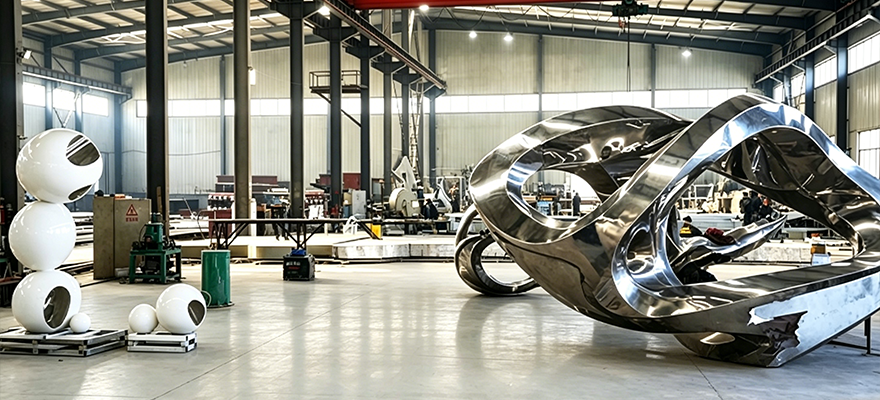 Interior of a metal sculpture processing workshop: the fabrication stage that precedes shipping and on-site installation of a weathering steel sculpture.
A weathering steel sculpture is specified for the way its material behaves, not for the way its colour looks. When a landscape architect or procurement team writes Corten into a public art or hotel landscape package, the requirement that actually governs the delivered object is the ASTM designation behind the alloy - ASTM A242 or ASTM A588 - because that designation decides whether the surface stabilises into a protective oxide layer or keeps corroding like ordinary mild steel.
This article explains what those two designations cover, how a natural pre-rusted finish differs from a raw self-weathering finish, what a mill certificate does and does not prove, and - in detail - the installation sequence that determines whether a permanently installed outdoor sculpture performs as specified over its service life.
What ASTM A242 and ASTM A588 Actually Cover
ASTM A242 and ASTM A588 are the two specifications commonly written into purchase documents for weathering steel, a family of high-strength low-alloy steels formulated for atmospheric corrosion resistance. Rather than depending on a coating, the alloy chemistry allows the surface to develop a dense, adherent oxide layer - the stable patina - that limits further corrosion once it forms. The orange-brown surface buyers associate with Corten is a by-product of that chemistry, not the specification itself.
That distinction has a practical consequence for procurement. Two steel pieces can look identical in a supplier photograph and behave completely differently on site, because a rusty appearance can be produced in a week while the atmospheric-corrosion performance of the base metal cannot be imitated. Compliance therefore has to be verified through documentation rather than appearance.
Why the standard matters more than the finish colour
Ordinary carbon steel that has been acid-washed or left to flash-rust will produce an orange-brown surface that photographs convincingly. It will also keep corroding: the oxide layer does not stabilise, so the section progressively thins, surface flakes detach, and rust-laden runoff stains paving, stone and adjacent facades. For a sculpture specified as a permanent feature - the normal condition for landscape architecture, public parks and hotel forecourts - that difference separates a recurring maintenance item from a long-term asset.
Pre-Rusted vs. Raw Self-Weathering: Two Finishes, Two Site Experiences
The Corten sculpture line documented by Jiangsu Xinyesheng Sculpture Co., Ltd., model XYS-Corten-Custom, is offered with two surface treatments, and the choice changes what the site looks like during the first year of exposure.
| Dimension | Natural pre-rusted finish (stable patina) | Raw finish (self-weathering) |
|---|---|---|
| State at delivery | Surface oxide layer already developed | Bare weathering steel; patina develops after installation |
| Colour at handover | More predictable orange-brown tone | Continues to shift through the exposure cycle |
| Early site behaviour | Lower risk of loose rust particles washing off | Greater initial runoff until the layer stabilises |
| Typically suited to | Projects with fixed handover dates, photography or opening events | Projects where an evolving surface is part of the design intent |
A boundary worth stating plainly: neither finish behaves like paint. Patina colour varies with orientation, shelter and drainage, and runoff can discolour light paving or stone immediately around the base. Detailing that lets water drain and surfaces dry between wetting cycles matters as much as the alloy itself.
Where weathering steel is not the right answer
Chloride-rich environments are the classic exception. Where salt-laden air or persistent wetness keeps deposits sitting on the surface, the protective layer is less likely to stabilise. For coastal and marine-adjacent sites, the provider documents grade 316 stainless steel as the recommended option, because 316 contains 2%-3% molybdenum and offers over 30% higher pitting resistance than 304. A weathering steel specification is a design decision for landscape, park, garden and industrial-style settings - not a universal outdoor default.
The Mill Certificate: What to Ask For and What It Proves
Because the ASTM designation describes alloy chemistry and atmospheric-corrosion behaviour rather than appearance, the practical verification step is documentation. Buyers commissioning a custom weathering steel sculpture should request the mill certificate for the steel supplied and confirm that the delivered lot matches the designation ordered - ASTM A242 or ASTM A588 - before fabrication is signed off.
The honest scope of that document is worth restating. The certificate ties the delivered steel to a specification; it does not certify a finish, a colour or a design. It is also worth noting a compliance boundary this material line carries: beyond the ASTM A242/A588 weathering steel designation, no additional certifications for the product line are documented. Buyers with project-specific regulatory requirements should confirm those separately with their own compliance advisors rather than assuming the steel specification covers them.
Installation Guidance: The Stage That Decides Long-Term Performance
Installation is where a compliant material either becomes a functioning sculpture or becomes a call-back. The sequence below follows the on-site installation guidance documented for these permanently installed works, and it applies to garden-scale pieces and large architectural structures alike.
Step 1 - Verify the site before the sculpture arrives
- Confirm the installation site and check that ground flatness, load-bearing capacity and the position of embedded parts match the drawings.
- Confirm the foundation has been poured and has reached its design strength.
- Confirm the site is flat and unobstructed, that no personnel remain in the hoisting area, and that the installation drawings agree with the embedded parts actually present on site.
- Confirm weather conditions are suitable, with no strong wind, rain or snow during lifting.
Step 2 - Select lifting equipment and define hoisting points
Equipment is selected according to the size and weight of the sculpture - a crane or forklift - and the hoisting points are determined and secured before the lift begins. For heavy sculptures, the load-bearing capacity of the base must be checked to prevent tipping.
Step 3 - Position, align and fix
The sculpture is hoisted into position, aligned with the base or embedded parts, and adjusted for horizontal and vertical alignment. It is then fixed with bolts, or reinforced by welding where the design requires it, and the welds and connections receive anti-corrosion treatment. That step deserves attention on any outdoor steel work: welds and heat-affected zones are the least uniform part of the surface, so the corrosion protection applied there influences whether the patina develops evenly across the whole piece.
Step 4 - Inspect, clean and accept
The documented acceptance criteria after installation are specific, and buyers should hold the installation team to them:
- Verticality and horizontality meet drawing requirements, with vertical deviation no greater than 5 mm.
- The sculpture is securely fixed - bolts tightened or welds full - with no loosening observed during a shaking test.
- The surface is free of bumps, scratches and stains, and welds and connections have been anti-corrosion treated.
- Overall position and orientation match the drawings, and the piece is cleaned before handover.
Tools, materials and safety prerequisites
| Category | Documented items |
|---|---|
| Tools | Crane or forklift, wire rope slings, wrench, spirit level, electric welding machine where welding is required, hand chain hoist |
| Materials | Expansion bolts or embedded parts, gaskets, anti-corrosion paint, sealant |
| Prerequisites | Foundation poured to design strength; flat, unobstructed site; hoisting area clear of personnel; suitable weather; drawings consistent with on-site embedded parts |
| Safety | Lifting by certified personnel only; no personnel under the sculpture; work area cordoned off; safety belts for work at height; lifting stopped in strong wind or thunderstorms; base load capacity checked for heavy pieces |
For international projects this is where remote support matters. Global on-site installation guidance is documented as part of the delivery system, which allows a local crew to work from a defined sequence rather than improvising around a sculpture they have never handled.
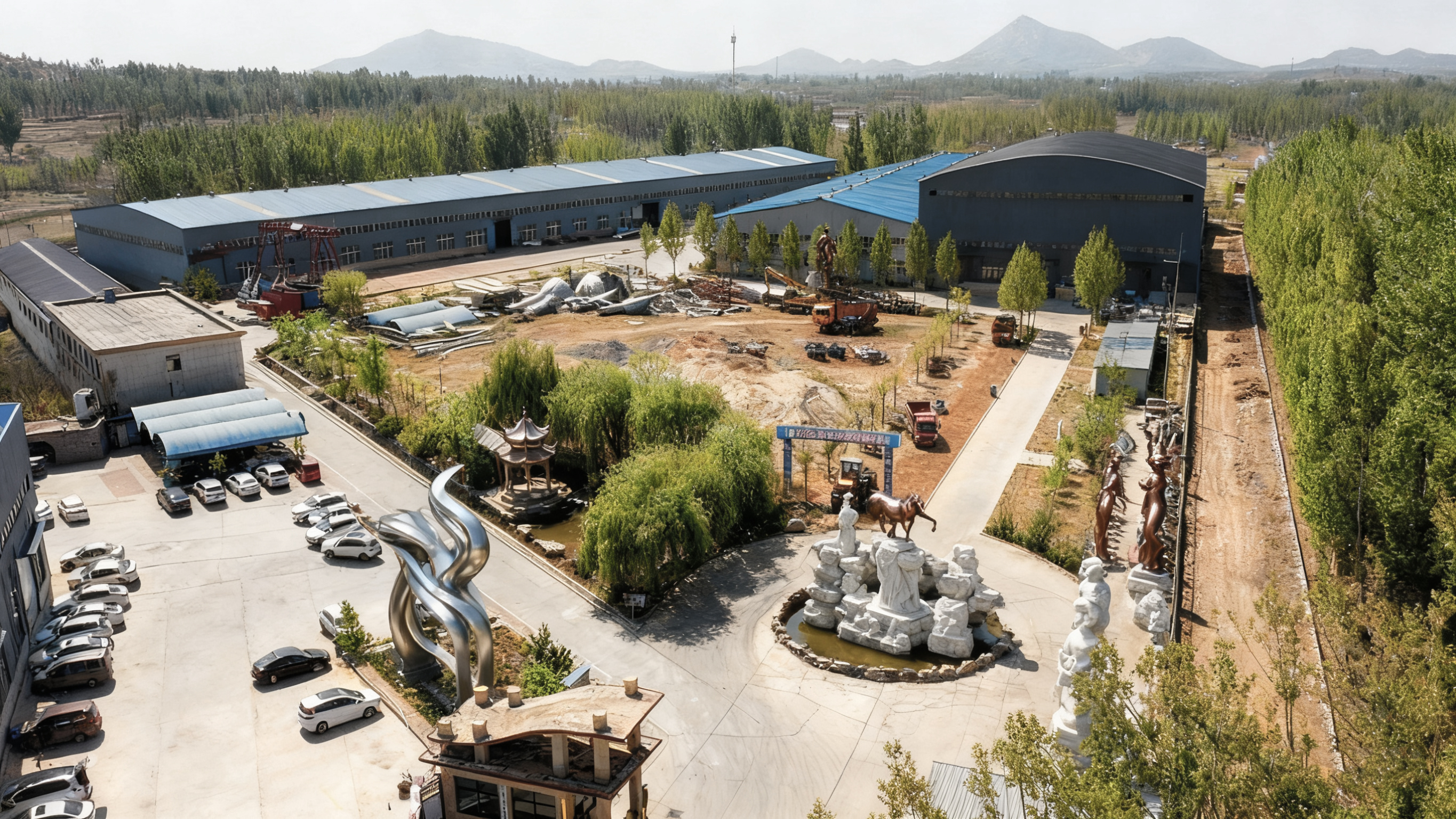 Metal sculpture processing workshop: components are finished and inspected before seaworthy packing and shipment to site.
Application Fit: Where Weathering Steel Earns Its Place
The documented applications for this material line are landscape sculpture, garden edging, fire pits, metal screens and planter boxes, with sizes ranging from small garden pieces to large architectural structures. In project terms that maps onto public parks, modern garden design, landscape architecture and industrial-style decor - settings where an evolving orange-brown surface is an intentional part of the design language.
The matching project profile is a permanent installation with long-term outdoor display: luxury hotel and resort landscapes, public art installations, and private custom sculpture commissions. Where such a project also needs lighting or structural support, the associated equipment list includes the installation foundation, steel structure support, LED lighting and lifting and transportation equipment. The same installation environment also serves the provider's stainless steel, bronze, brass and natural stone lines, so material selection can be matched to exposure rather than fixed by default.
Market Context: Why Finish and Compliance Documentation Are Being Scrutinised
Published data explains why material verification is moving earlier in the procurement process. The global art and sculpture market is estimated at approximately USD 61.83 billion in 2026 (Business Research Insights), and sculptures account for around 21% of global art acquisitions by transaction volume. Public commissioning is also spread across many moderate budgets rather than a few large ones: over 80% of public art open call projects in North America fall below a budget of USD 250,000 (CODAworx, 2024). Within budgets of that scale, a specification error on a permanent outdoor piece is not a rework cost - it is a replacement cost. That is the operational reason finish documentation, material certificates and installation records are increasingly treated as part of the commissioning package rather than an afterthought.
Comparison with Traditional Solutions: Capability, Cost and Material Limits
Commissioning routes for a large outdoor sculpture differ in how repeatable the outcome is. Workshops that rely mainly on hand casting leave more of the result to an individual caster's judgement. The documented alternative combines precision casting, CNC machining and 3D design preview, so each piece matches the confirmed design and quality stays consistent across large orders; every design is confirmed with a 3D preview before production, standard production takes 15-30 days, and all pieces are inspected before shipment. On commercial terms, factory-direct pricing without a middleman is documented, with the stated position that for the same material and quality the cost is generally 10%-20% lower than traditional workshops.
Those are capability claims about the fabrication route. The material carries its own limits, and buyers should weigh them separately:
- Colour is not a fixed deliverable. A weathering steel patina develops according to exposure, orientation and drainage, so it cannot be specified to a paint reference.
- Runoff is part of the design problem. Light paving, stone and render adjacent to the base may be stained, particularly where the finish is supplied raw rather than pre-rusted.
- Exposure matters more than specification. Chloride-heavy coastal air and persistently wet conditions are poor candidates; for those sites the stainless steel line documents grade 316, at roughly 20%-30% higher cost than 304.
- Documentation covers the alloy, not the project. The ASTM A242/A588 designation is the compliance basis for this material line; no further certifications are documented for it.
Future Outlook and Long-Term Ownership
The long-term case for a weathering steel sculpture rests on lifecycle behaviour rather than first cost. The material line is documented as maintenance-free, with natural aging and atmospheric corrosion resistance as its defining features, and professional anti-corrosion surface treatment is applied across the metal lines to reduce cleaning, repainting and repair work over the sculpture's lifetime.
For a buyer in the decision-to-execution stage, the practical implication is that the documents generated during the project become the asset record. Mill certificates, approved 3D previews, installation checklists and acceptance results outlive the commissioning team, and they are what a future owner, facilities manager or conservation consultant will work from. The documented delivery system - a one-stop process covering 1:1 clay model visualization, seaworthy packaging in reinforced wooden crates and steel frames, and global on-site installation guidance - is structured around that handover moment. A one-unit minimum order quantity, a 50% deposit with the 50% balance payable after photo and video inspection, and delivery terms including DDP, EXW, FOB, CIF, DAP and FCA keep the process workable for single commissions as well as multi-piece landscape packages.
The manufacturer behind this material line, Jiangsu Xinyesheng Sculpture Co., Ltd., is a Jiangyin-based sculpture exporter serving the EU, USA and Middle East markets, working through a cooperative factory in Quyang that took 13 years to develop from a small workshop into a bridge connecting Chinese production with the global art market. Its R&D team comprises 12 engineers, and its researchers bring over ten years of sculpture-industry experience.
FAQ
What does ASTM A242/A588 compliance require a buyer to check at delivery?
The designation describes the alloy and its atmospheric-corrosion performance, so verification is documentary. Request the mill certificate for the steel supplied and confirm the lot matches the ordered ASTM A242 or ASTM A588 designation. The certificate confirms the base metal specification; it does not certify a finish, a colour or a design. No additional certifications are documented for this material line.
Should I specify a natural pre-rusted finish or a raw self-weathering finish?
A natural pre-rusted finish is delivered with a stable patina already developed, so the colour at handover is more predictable and early runoff is reduced. A raw finish arrives as bare weathering steel and develops its patina after installation, which suits projects that treat the changing surface as part of the design intent. In both cases the surface continues to respond to exposure, and detailing that allows drainage and drying supports even stabilisation.
What site conditions must be ready before installation begins?
The foundation should be poured and have reached design strength; ground flatness, load-bearing capacity and embedded-part positions should match the drawings; the site should be flat, unobstructed and clear of personnel in the hoisting area; and weather should be suitable, with no strong wind, rain or snow during lifting. Installation drawings should be checked against the embedded parts actually present on site before the sculpture is lifted.
How is the sculpture fixed in place, and how are the welds protected?
After hoisting and alignment, the piece is fixed with bolts or reinforced by welding where required, and the welds and connections receive anti-corrosion treatment. That treatment matters for outdoor performance because welds and heat-affected zones are the least uniform part of a steel surface and influence how evenly the patina develops across the piece.
What acceptance criteria confirm that installation is complete?
The documented criteria are: verticality and horizontality within drawing requirements, with vertical deviation no greater than 5 mm; secure fixing with bolts tightened or welds full and no loosening under a shaking test; a surface free of bumps, scratches and stains; welds and connections anti-corrosion treated; position and orientation matching the drawings; and cleaning before handover.
What support is available for delivery, inspection and long-term care?
Documented delivery terms include DDP, EXW, FOB, CIF, DAP and FCA, with photos and videos provided for inspection before loading into the container. Packaging uses reinforced wooden crates and steel frames with internal shockproof protection, and All Risks insurance can be arranged as required; where damage results from packaging failure, the provider states that it takes full responsibility. Installation guidance is provided globally, including remote guidance by video call, and the maintenance profile for the material line is occasional rinsing rather than repainting or repair.
For a fuller view of materials, production capability and delivery scope, the company profile and available production capabilities document can be downloaded here: Company Profile & Available Production Capabilities (PDF).
¿Tiene preguntas o necesita más detalles?
Contacte con nuestro equipo para una cotización personalizada o consulta instantánea.
Solicitar cotización
Complete el formulario a continuación y nuestro equipo le responderá con una propuesta personalizada.
Chat directo de WhatsApp
¿Prefiere chatear en tiempo real? Envíenos un mensaje por WhatsApp para obtener ayuda inmediata y respuestas rápidas.
- Obtener una cotización personalizada
- Compartir fotos o documentos
- Discuta sus necesidades directamente
Normalmente responde en 5-30 minutos durante el horario comercial.