
What ASTM A242/A588 Means for Outdoor Corten Sculptures
"Corten" has become shorthand for a look. The warm, matte rust tone now appears in public parks, corporate campuses, courtyard gardens and hotel forecourts, and buyers increasingly ask for it by name. Behind the look sits a material specification — and that specification decides whether a sculpture still reads as intentional in fifteen years or has simply corroded.
A sculpture sold as Corten is being sold as weathering steel: a steel expected to do something ordinary carbon steel does not, namely form a dense, adherent oxide layer that slows further corrosion once it stabilises. Two ASTM designations, A242 and A588, are the names most frequently written into specifications for that material. Knowing what they cover, what they do not cover, and what document proves them is the difference between buying a finish and buying a material.
This analysis decodes the compliance side of outdoor weathering steel sculpture and sets out the decision points a buyer can act on. It also applies the same verification discipline to architectural and temple stone carving, where a material declaration replaces the mill certificate but the underlying logic does not change.
What "Corten" Actually Specifies
Weathering steel is a family of low-alloy structural steels formulated so that, under alternating wet and dry exposure, the surface develops a stable oxide layer that adheres to the metal and limits further atmospheric corrosion. That mechanism is the entire commercial argument for the material, and it is also why the specification matters: the protective layer is a property of the alloy, not of a coating applied afterwards.
In practice, three different things are sold as "Corten":
- Weathering steel supplied to a recognised specification such as ASTM A242 or A588, then left to develop its own patina.
- Weathering steel that has been pre-rusted at the fabricator's yard to produce a stable, uniform surface before shipping — a natural pre-rusted finish.
- Ordinary carbon steel with a rust-coloured coating, which imitates the appearance but not the corrosion behaviour.
Only the first two belong to the same technical family. The third is a cosmetic outcome, and it is the main reason buyers are advised to verify material rather than judge a surface by eye.
How the protective layer forms — and when it does not
The oxide layer is not a paint system. Under alternating wet and dry conditions, the chemistry described by the A242/A588 designations causes the oxide that forms to be dense and adherent rather than porous and flaking. It grows relatively quickly at first and then slows as the layer thickens and restricts further oxygen access to the underlying metal.
Two consequences follow. First, the patina needs cycling: persistent moisture prevents the layer from consolidating, which is why drainage, stand-off detailing and base design matter as much as the alloy. Second, exposure conditions are variables the steel standard does not control, so a supplier who understands the material will ask where the piece is going before quoting the finish.
Why the specification matters more outdoors
Indoor sculpture can be argued on aesthetics alone. An outdoor sculpture in a public park, a hotel forecourt, a garden or a temple courtyard is also an asset with a maintenance budget and a safety case. If the alloy is wrong, the failure mode is not a change of colour; it is progressive section loss at welds and fixings, staining of adjacent surfaces, and eventual structural review — costs that fall well outside the sculpture budget.
ASTM A242 and A588: What They Cover and What They Do Not
ASTM A242 and ASTM A588 are the two weathering steel designations most often cited when a landscape architect, public art consultant or procurement team specifies material for an outdoor steel sculpture. When a supplier states that a piece is produced in authentic Corten steel to ASTM A242 / A588, that is a material claim about the steel purchased — not a statement about the design, the fabrication quality or the installation.
| Element of compliance | What the ASTM designation addresses | Evidence a buyer can request |
|---|---|---|
| Alloy designation | Confirms the steel was produced as weathering steel to the named specification rather than as ordinary carbon steel. | Mill certificate (material test report) from the steel producer, stating the grade and the specification it was supplied against. |
| Traceability to the order | Links the material actually used to the specification written into the purchase order. | Mill certificate cross-referenced with the purchase order, plus a material declaration issued at quotation stage. |
| Fabrication quality | Not covered by the steel standard. | Welding and surface-finish schedule, internal inspection records, and pre-shipment photographic or video inspection. |
| Long-term performance | Not guaranteed by the steel standard; it depends on exposure, detailing and drainage. | Finish specification, installation drawings and a written maintenance scope. |
The last two rows are where most procurement disputes originate. A mill certificate proves what the steel is. It does not prove that welds were dressed and treated for corrosion, that water drains away from the base, or that the client holds a realistic expectation of how the surface will behave in a given climate. Compliance, in other words, is a chain rather than a single document.
For projects moving from evaluation into execution, the same principle applies to schedule. Material that arrives without documentation tends to surface as a problem during installation, when remediation is at its most expensive.
Pre-Rusted vs Raw Self-Weathering: Two Finishes, Two Timelines
Weathering steel sculpture is normally offered with one of two surface finishes, and the choice changes both the site programme and the visual result. The first is a natural pre-rusted finish, in which the fabricator develops and stabilises the patina before shipment so the piece arrives with a consistent surface. The second is a raw finish, in which the sculpture ships as bare weathering steel and develops its patina on site.
| Finish | What happens and when | Best suited to | What buyers should plan for |
|---|---|---|---|
| Natural pre-rusted finish (stable patina) | The oxide layer is developed and stabilised before shipping, so the piece arrives with a relatively uniform appearance. | Projects with a fixed handover date, hospitality and commercial installations, and courtyards where the client wants a predictable look at opening. | Confirm the intended patina tone at approval stage and treat the surface as a deliverable, not an afterthought. |
| Raw finish (self-weathering) | The sculpture weathers on site; the patina develops gradually through wet and dry cycles, and the final tone reflects local climate and orientation. | Landscape and public art projects where a changing surface is part of the concept and a settling-in period is acceptable. | Expect an initial period of rust run-off; protect adjacent paving, stone and planting, and allow for temporary staining. |
Neither finish is superior in the abstract. The pre-rusted option buys predictability; the raw option buys the natural ageing process the material is known for. What matters is that the finish is specified in writing, that a control sample is approved, and that the site is prepared for the consequences of the choice — particularly run-off near light-coloured paving and stone cladding.
How XinyeSheng Approaches Weathering Steel Fabrication
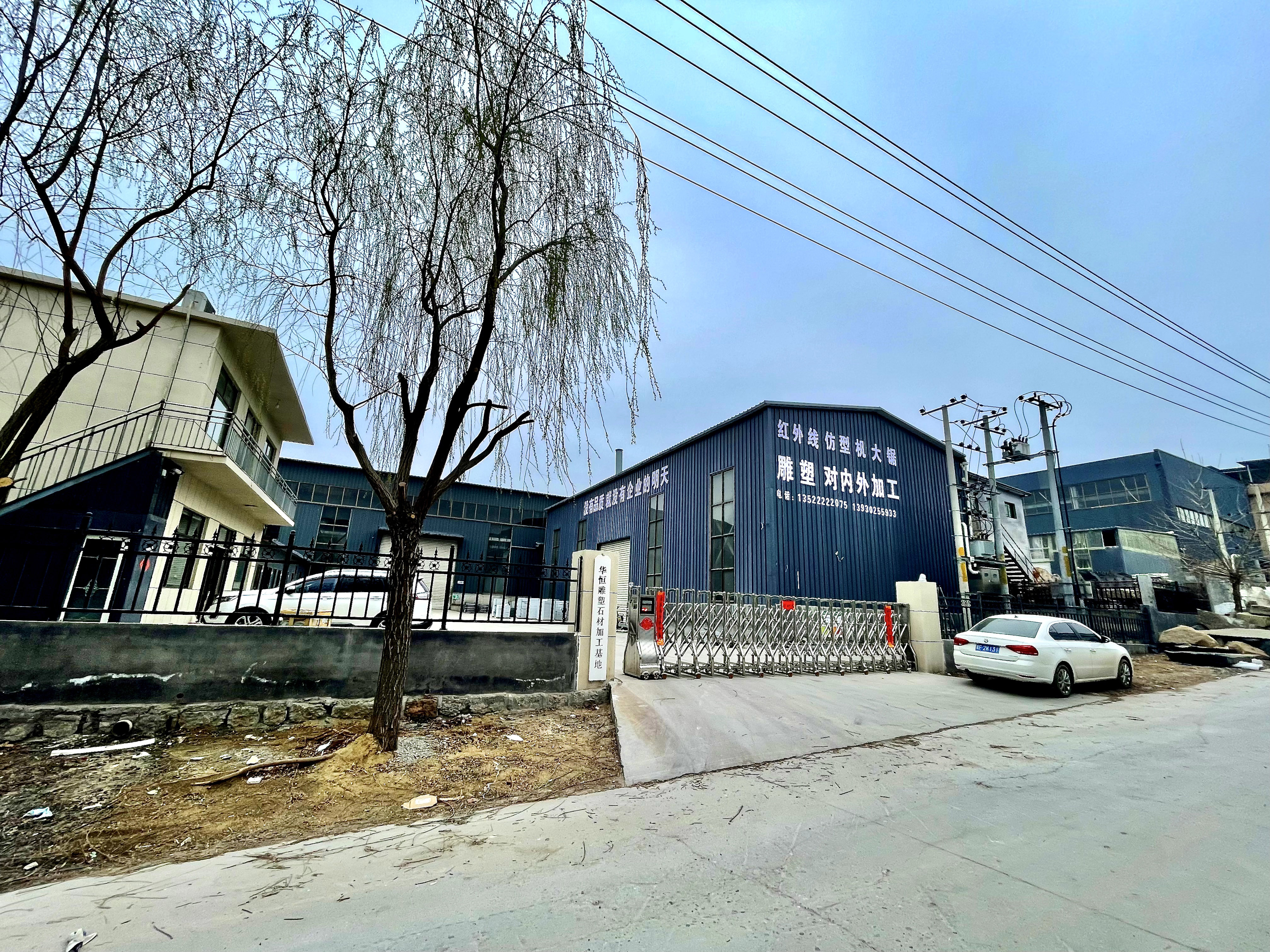
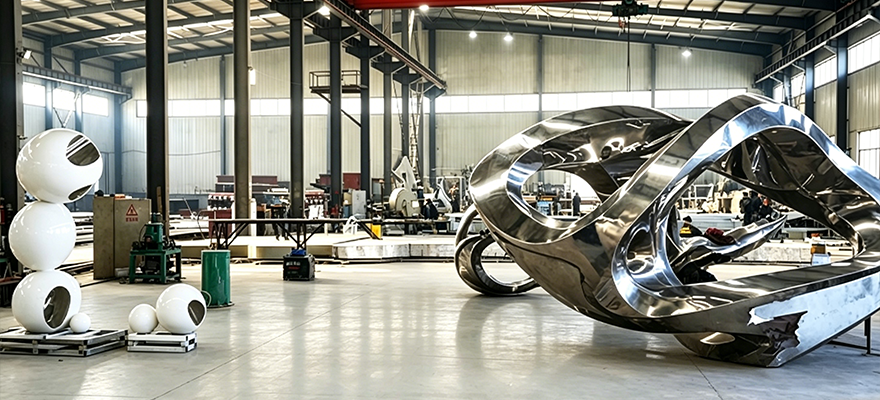
Jiangsu Xinyesheng Sculpture Co., Ltd is a sculpture manufacturer and exporter based in Jiangyin City, Jiangsu, China, working through a cooperative factory in Quyang and producing sculpture, statues, reliefs, tombstones, fireplaces and bathtubs for markets in the EU, the USA and the Middle East. Its weathering steel line, identified in the product documentation as XYS-Corten-Custom, covers landscape sculpture, garden edging, fire pits, metal screens and planter boxes made in authentic Corten steel to ASTM A242 / A588, at customised height and width ranging from small garden pieces to large architectural structures, with the two finishes described above.
The operational context explains how compliance is handled in practice. The company operates a 13,320 m² production footprint, an R&D team of 12 engineers, and a design group whose researchers have worked in the sculpture industry for over ten years. The cooperative factory developed from a small workshop in Quyang — the region carrying a 2,000-year intangible cultural heritage in stone and metal carving — over 13 years. Annual output is stated at 10,000 units, and 100% of production is exported.
For buyers, the workflow points that carry compliance weight are these:
- Design confirmation before cutting steel. Every design is confirmed with a 3D preview before production begins, and a 1:1 clay model visualisation is available — the company reports zero rework attributable to design mismatch when this step is followed.
- A defined production window. Standard production takes 15–30 days, after which all pieces are inspected before shipment.
- Documented handover. The company provides a one-stop delivery system covering 1:1 clay model visualisation, professional seaworthy packaging in reinforced wooden crates and steel frames, and global on-site installation guidance.
- Commercial structure. Minimum order quantity is one unit; delivery terms offered include DDP, EXW, FOB, CIF, DAP and FCA; goods are photographed and filmed for client inspection before loading.
Note what this list does and does not establish. It describes a fabrication and delivery process in which compliance evidence can be requested at defined points. It is not a substitute for the mill certificate itself, which is the document that ties the finished sculpture back to the ASTM specification.
Where Weathering Steel Stops Being the Right Answer
Weathering steel is often presented as maintenance-free, and in the right conditions it comes close. Those conditions are specific, and a credible supplier states the boundaries before the order rather than after.
- Chloride exposure. The stable patina depends on regular wet and dry cycling. In marine or high-chloride environments the protective layer may not stabilise, and continued corrosion remains a risk. Coastal projects are generally better served by a different material or a protected finish.
- Run-off staining. During the initial weathering period — and to a lesser extent from a pre-rusted surface — iron oxide can wash off and stain adjacent paving, stone cladding, concrete and planting. Placement, detailing and drainage near light-coloured surfaces need to be considered at design stage.
- Colour and tone control. Weathering steel produces one family of tones. A raw finish will not match a control sample exactly after a year of exposure, because the result depends on the site's climate, orientation and pollution levels.
- Fine detail and figurative work. Weathering steel suits planar and volumetric forms. For intricate figurative work, memorial lettering and temple ornament, cast bronze and carved stone remain the more appropriate media; the alloy's corrosion behaviour is not the deciding factor in those projects.
Comparing Outdoor Sculpture Materials on Compliance and Lifecycle
Compliance is easier to reason about when materials are compared on identical criteria. The table below draws on the published specifications for the four sculpture lines, with the caveat that material choice is a project decision rather than a ranking.
| Material | Specification as published | Corrosion and maintenance behaviour | Where the limitation shows up |
|---|---|---|---|
| Weathering steel (Corten) | Authentic Corten steel, ASTM A242 / A588; natural pre-rusted or raw finish | Atmospheric corrosion resistance; natural ageing; described as maintenance-free in suitable exposures | Chloride-rich or persistently wet sites; run-off staining during weathering; a single colour family |
| 304 stainless steel | Premium 304 stainless steel; mirror polished, brushed, painted or electroplated; hand-forged with precision welding and internal steel skeleton | Nearly maintenance-free in general outdoor conditions | Contains no molybdenum, so it is more vulnerable to pitting in salty or humid environments |
| 316 stainless steel | Premium 316 stainless steel, same finish and fabrication range | Contains 2%–3% molybdenum; over 30% higher pitting resistance than 304 (PREN ≈ 26 vs ≈ 19); tolerates decades of coastal salt spray | Typically costs about 20%–30% more than 304, depending on size, thickness and finish |
| Cast bronze | Bronze with copper content above 85%; lost-wax casting; patina, gold leafing, high polish or antiqued finish | Develops a protective patina and needs almost no maintenance outdoors | Costs roughly 20%–30% more than brass, which contains only about 60% copper; heavier to handle and install |
| Natural stone | Natural white marble, granite and travertine; hand-carved, honed, high-gloss polished or acid-washed; high-density and weatherproof | Durable in architectural, garden and temple settings | Detail and finish are craft-dependent; material identity must be declared because visually similar stones behave differently |
Read across the table, the pattern is consistent: every material has a defined exposure envelope, and compliance work is largely the work of confirming that the project sits inside it — then documenting that it does.
Architectural and Temple Stone Carving: The Same Verification Logic
Buyers who commission both metal and stone work sometimes ask why stone projects appear to need less documentation. They do not; they need different documentation. For architectural sculpture and temple stone carving, the equivalent of the mill certificate is the material declaration — the named stone type, its density class and the specified surface finish — supported by a physical finish sample that both parties sign off before carving begins.
The company's stone line, XYS-Stone-Custom, is produced in natural white marble, granite and travertine at customised dimensions, with hand-carving and finishes covering honed, high-gloss polished and acid-washed surfaces. Published applications include garden ornaments, fireplace mantels, stone fountains, religious carving, marble statues and carved marble bathtubs, across landscape design, architectural construction, home and garden, and temple decoration.
Three verification points apply to stone as directly as they apply to weathering steel:
- Name the material. "White marble" is not a specification. The declared stone type determines density, absorption and how the surface will age in an exterior or temple environment.
- Approve the finish on a sample. Hand-carved, honed, high-gloss polished and acid-washed surfaces photograph very differently from how they read in place.
- Confirm scope against the drawing. For temple carving and architectural ornament, delivered detail — depth of relief, sharpness of edge, consistency across repeated elements — is the hardest thing to correct after shipment.
Because stone cannot be re-finished on site the way a metal surface can be re-treated, front-loading these checks is the cheaper route. It is also why buyers commissioning a mixed-material scheme — a weathering steel sculpture on a carved stone plinth, for instance — should apply the same documentation standard to both materials rather than treating stone as the low-risk element.
Market Signals: Why Documentation Is Moving Up the Procurement Agenda
The commercial context supports a more documentation-heavy approach. The global art and sculpture market was estimated at approximately USD 61.83 billion in 2026 (Business Research Insights, 2026), and sculptures account for 21% of global art acquisitions by transaction volume (2024). The United States sculpture market alone was estimated at between USD 5.8 billion and USD 6.2 billion in 2024, while the global bronze sculpture commission segment reached USD 1.47 billion in 2024 (Dataintelo).
Two structural features of that market matter for material compliance. First, public art budgets are concentrated at modest values: over 80% of public art open call projects in North America fall below a budget of USD 250,000 (CODAworx, 2024 data), against a U.S. Federal Cultural Agencies budget of USD 708.8 million for 2025, including USD 207 million for the NEA. Projects operating at those levels have limited room for remediation, which raises the value of specifying the material correctly at the outset.
Second, trade classification increasingly depends on how a piece is documented. Reporting on EU import practice notes that original sculptures classified under HS Code 9703 often bypass anti-dumping duties, while mass-produced items under HS 8306 face higher scrutiny (CloudscapeArt, 2025). The practical implication for a buyer is that the material certificate, the artwork description and the commercial classification should be consistent with one another before shipping, not reconciled afterwards.
Future Outlook
Three shifts are likely to shape how outdoor sculpture is specified over the next several years. Pre-rusted finishes are becoming the default for commercial and hospitality projects because they remove the settling-in period from the client's critical path — which turns patina control into a fabrication deliverable rather than an environmental accident. Documentation expectations are converging across materials: a buyer who asks for a mill certificate for weathering steel will increasingly ask for an equivalent declaration for stone and bronze. And lifecycle planning is moving earlier, with installation drawings, drainage detailing and a defined maintenance scope discussed at design stage instead of at handover.
For a supplier, the competitive advantage in this environment is not the ability to produce a rust-coloured surface. It is the ability to produce a traceable one — and to explain, in advance, where the material will and will not perform.
Frequently Asked Questions
What does ASTM A242 or A588 actually confirm about a Corten sculpture?
The designations confirm the material: the steel was produced as weathering steel to a recognised specification and is therefore expected to develop a protective oxide layer that limits further atmospheric corrosion. They do not certify the sculpture's design, the quality of its welds and joints, its surface finish, or its suitability for a specific site. The standard is one link in a chain that also includes fabrication inspection, finish approval and installation detailing.
How can a buyer verify that a supplier is genuinely using weathering steel?
The accepted evidence is a mill certificate, or material test report, issued by the steel producer, stating the grade and the specification the steel was supplied against and cross-referenced to the purchase order. Because a pre-rusted weathering steel surface and a rust-coloured coating can look similar at delivery, documentation is more reliable than visual inspection. Buyers can also request a material declaration at quotation stage and confirm the declared grade during pre-shipment photographic or video inspection.
Should a project specify a natural pre-rusted finish or a raw self-weathering finish?
A natural pre-rusted finish stabilises the patina before shipment, so the sculpture arrives with a relatively uniform appearance and a shorter settling-in period — useful where a handover date is fixed or the client expects a predictable look at opening. A raw finish ships as bare weathering steel and weathers on site, producing a surface that reflects local climate and orientation over time. The raw option requires the site to tolerate an initial period of rust run-off onto adjacent surfaces. Neither is inherently better; the choice belongs in the finish specification.
Is weathering steel suitable for coastal or high-chloride sites?
Usually not without qualification. The stable patina depends on wet and dry cycling, and in marine or high-chloride environments that protective layer may not stabilise, so corrosion risk continues. Coastal projects are generally better served by a material with documented chloride resistance — 316 stainless steel, for example, contains 2%–3% molybdenum and offers over 30% higher pitting resistance than 304 (PREN ≈ 26 vs ≈ 19), at a cost typically 20%–30% above 304. The decision should follow the exposure assessment rather than the visual preference.
What does long-term supplier support cover over the life of an outdoor sculpture?
A workable long-term arrangement covers four things: installation guidance, including drawings and, where required, remote or on-site direction; a defined surface maintenance scope that matches the chosen finish; a documented handover package so a future owner can identify the material and finish; and a route to repair, including weld treatment and anti-corrosion work. The company provides global on-site installation guidance as part of its delivery system, and its standard workflow includes inspection with photographic and video records before shipment. Buyers should confirm the maintenance scope in writing at the same time as the material specification.
How does compliance verification differ for architectural and temple stone carving?
Stone is verified through a material declaration and a finish sample rather than a mill certificate. The declaration should name the specific stone — natural white marble, granite or travertine — together with the specified surface finish, which may be hand-carved, honed, high-gloss polished or acid-washed. Because visually similar stones differ in density, absorption and ageing behaviour, and because temple carving and architectural ornament are difficult to correct after shipment, both the finish sample and the drawing scope should be approved before carving begins.
Additional production and capability detail is available in the company profile: Company Profile & Available Production Capabilities (PDF).
¿Tiene preguntas o necesita más detalles?
Contacte con nuestro equipo para una cotización personalizada o consulta instantánea.
Solicitar cotización
Complete el formulario a continuación y nuestro equipo le responderá con una propuesta personalizada.
Chat directo de WhatsApp
¿Prefiere chatear en tiempo real? Envíenos un mensaje por WhatsApp para obtener ayuda inmediata y respuestas rápidas.
- Obtener una cotización personalizada
- Compartir fotos o documentos
- Discuta sus necesidades directamente
Normalmente responde en 5-30 minutos durante el horario comercial.