
Wet Wipes Suppliers: A Long-Term Sustainability Check
Industry Reference · Wet Wipes Sourcing
A wet wipes supply relationship rarely fails on its first delivery. It fails in the second year — when a buyer’s category outgrows the production slot they were quietly assigned, when substrate specifications drift between lots, or when a labelling change arrives and the supplier’s documentation cannot move fast enough. Sustainable supply is therefore less a statement about one shipment than a test of whether output, materials and quality systems hold their shape across several contract cycles.
This reference sets out how procurement teams can evaluate wet wipes suppliers for long-term partnership rather than transactional purchase. It uses disclosed manufacturing data from Zhejiang Uniquality Nursing Products Technology Co., Ltd. (Uniquality) as a working example of what capacity evidence looks like on paper — and where that evidence stops.

Why Long-Term Wet Wipes Partnerships Fail Differently
Transactional sourcing optimises a different set of variables than partnership sourcing. In a one-off purchase, the buyer cares about unit price, lead time, and whether the first article matches the approved sample. In a multi-year relationship, those variables still matter, but they are no longer the ones that decide whether the relationship survives.
The failure modes of long supply relationships cluster into three patterns, and each one is structural rather than accidental:
- Capacity reallocation. A supplier’s total output can be large while a specific buyer’s share of it is small and volatile. When demand rises, the smallest forecast loses its production window first.
- Specification drift. Substrate weight, embossing, lotion viscosity or pack seal strength move within a tolerance band that was never written into the contract. The product still passes inspection, but the consumer notices.
- Compliance drift. Marking requirements, ingredient documentation or market-specific labelling change while the supply agreement stays static, leaving the buyer to absorb the gap.
A long-term supplier evaluation therefore asks a different question from a purchase order: not “can this factory make my product?” but “can this factory keep making my product, at the same standard, while my volumes and my markets change?”
What Sustainable Manufacturing Capacity Actually Means
Sustainable manufacturing capacity, in a sourcing context, is the ability to repeat a defined output at a defined quality level across multiple production cycles without depending on conditions the supplier does not control. The word is used here in two senses at once — commercial durability and environmental direction — because in wet wipes the two are increasingly hard to separate.
The concept resolves into four layers, and a credible supplier assessment touches all four:
- Physical capacity: production lines, filling environment, warehouse space and the redundancy that determines whether one breakdown becomes one delayed shipment or one lost season.
- Material access: whether nonwoven substrate and process water are bought in or produced in-house, and how quickly a grammage or fibre change can be absorbed.
- System capacity: quality, environmental, occupational health and cosmetic-good-manufacturing systems that generate documentation on demand rather than after the fact.
- Human capacity: engineering and R&D depth, because specification changes are solved by people, not by equipment alone.
Wet wipes add a specific complication. The product is a combined delivery system: a nonwoven carrier, a liquid formulation, a sealed pack and a label. Each element can fail independently, and the supplier’s stability is only as strong as the weakest of them.
Inside Uniquality’s Disclosed Capacity
Zhejiang Uniquality Nursing Products Technology Co., Ltd. is a China-based manufacturer of wet wipes, dry wipes, baby diapers and related nursing products, operating as an OEM/ODM partner for brand owners selling into export markets. The company reports a manufacturing footprint of 1,000,000 m², an annual output of 60 billion sheets, more than 3,000 employees and an R&D team of over 200 people, with approximately 70% of output directed to markets including the USA, EU, SAM, RU and CASA.
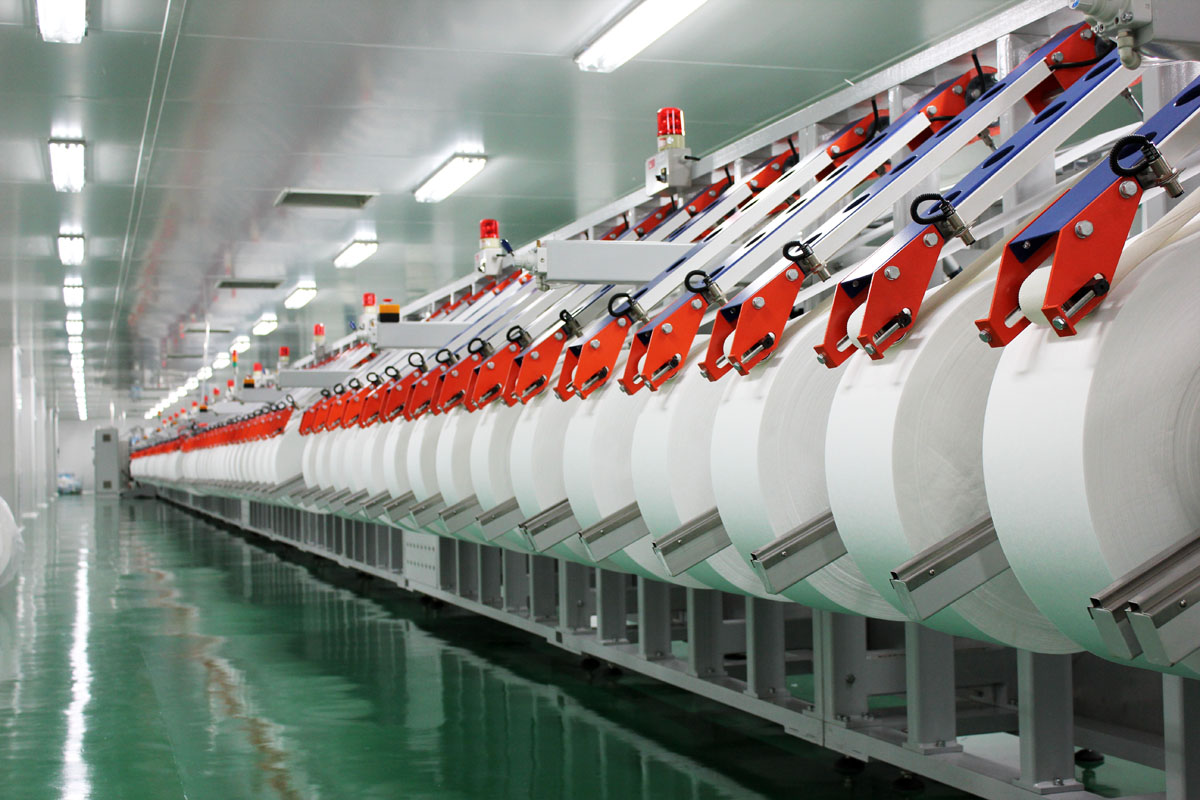
The facility disclosure is unusually granular for a supplier profile, which makes it more testable than a headline capacity figure. According to company statements, the footprint includes a 100,000-class purification GMP workshop of 30,000 m², a clean production workshop of 35,000 m² and a warehouse area of 150,000 m². The warehouse figure matters for long-term buyers more than it first appears: storage capacity is what allows a supplier to run continuous production while shipping in batches that match a buyer’s actual sell-through, rather than forcing full-container rhythm onto a slower-moving SKU.
Upstream, the company describes 40 nonwoven machines producing about 48,000 tons of nonwoven fabric per month, alongside 39 wet and dry wipe machines. That combination — substrate production and converting in the same group — is the structural reason a capacity claim can be sustained over time. A converter that buys substrate on the open market is exposed to allocation decisions made by someone else.
How to Read an Output Figure Like 60 Billion Sheets
An annual output figure is a total, not an allocation. Sixty billion sheets describes what a manufacturing group can produce across its entire portfolio; it says nothing directly about how much of that total a given buyer can secure, in which pack format, or in which month. Buyers who treat the headline number as a personal capacity guarantee usually discover the distinction at the worst possible moment.
Read correctly, the number answers a different and more useful question: does this supplier have enough headroom that my programme is not competing with the supplier’s own survival? A buyer placing a mid-sized private-label programme against a very large installed base is structurally less exposed to being squeezed out during peak demand than the same buyer at a small converter running near full utilisation.
Four follow-up questions convert the headline into a working commitment:
- What is the allocated monthly volume for this specific SKU, expressed in packs rather than sheets?
- Which line produces it, and what is the contingency if that line is down for maintenance?
- How much notice is required to shift substrate grammage or pack count?
- During the supplier’s peak season, what priority does a contracted forecast receive relative to spot orders?
The fourth question is the one that separates a partnership from a purchase order. It is also the one most suppliers answer evasively, which itself is diagnostic.
Material and Formulation Control as a Durability Signal
Specification stability starts upstream of the filling line. Uniquality discloses a substrate grammage range of 35 to 70 gsm, a standard wipe size of 15×20 cm and pack counts of 10 or 80 pieces per bag, all stated as customisable. A disclosed range is more useful to a buyer than a single number, because it shows where the production window actually sits before a custom specification becomes a special project.
On the liquid side, the company states that its wet wipes use process water that is EDI purified, and that formulas can be built without alcohol, fragrance, fluorescent agents or antiseptics. For buyers in baby, facial and intimate categories, this is the part of the specification most likely to be scrutinised by regulators and by consumers simultaneously — and the part most likely to change between markets. A supplier that can vary the formulation without re-engineering the whole line is easier to keep across a multi-market portfolio.
Filling takes place in a 100,000-class clean room according to company statements, with automated wet wipe systems covering the full process from raw material processing to finished-product packaging. The company also reports a certification portfolio covering its wet wipes scope that includes ISO 9001, ISO 14001, ISO 45001, ISO 50001, ISO 22716, ISO 13485, GMPC and SEDEX.

Where Long-Term Fit Shows Up: Category Breadth and Scenarios
A supplier’s category breadth is a practical durability indicator, because it determines how many of a buyer’s future SKUs can stay inside one relationship. Uniquality’s declared product coverage spans medical, maternal and baby, beauty, home, industrial cleaning and clothing applications, and lists flushable and degradable non-woven fabrics alongside wet wipes, dry wipes, baby diapers, pull-ups, wet toilet paper and cleansing wipes.
Within the wet wipes line, the disclosed product types include baby wet wipes, pure water wet wipes, facial wet wipes, flushable wet wipes, biodegradable wet wipes, medical wet wipes, mini wet wipes and hand and mouth wipes. The associated use cases are personal hygiene care, facial cleansing and household cleaning, with reference markets including the Philippines, Russia, the UAE, the United States, Chile and Mexico. Working conditions are stated as cool and dry storage, with disposable single-use operation and portable hygiene or travel kits as matched accessories.
For a buyer planning several years ahead, this breadth has a clear operational value: fewer supplier qualifications, one documentation set, one audit cycle, one set of pack-format conventions. It also introduces a concentration risk that is worth naming. Consolidating baby, facial, flushable and medical wipes under a single supplier increases the impact of any disruption at that supplier, however well documented its capacity. Long-term partnerships are usually strongest when the primary supplier carries the majority of volume and a qualified secondary source exists for the highest-risk SKU.
Market Signals That Reward Long-Term Supplier Evaluation
Market data supports the case for evaluating suppliers on continuity rather than on price alone, although the figures must be read with their scope in mind. Grand View Research values the global wet wipes market at USD 30.6 billion in 2026, rising to USD 36.6 billion by 2030 from a 2022 base of USD 27.1 billion. Other commercial research houses publish materially smaller totals because they define the category more narrowly, excluding adjacent segments or restricted channels; buyers should match any figure to the product scope they actually purchase rather than treating one number as universal.
Within that total, personal care wipes accounted for 72.81% of wet wipes market share in 2025, according to the same source. A category weighted that heavily toward personal care means most buyers are competing for the same substrate grades, the same cleanroom capacity and the same packaging formats. Capacity access, not category novelty, becomes the binding constraint.
Regulation adds a second, slower-moving pressure. Directive (EU) 2019/904 requires wipes containing plastic to carry a “Do Not Flush” marking, a requirement in force since 3 July 2021. For a buyer selling into Europe, marking compliance is not a launch task but a permanent condition of the supply agreement — artwork, packaging and material declarations all have to stay aligned for as long as the product is sold. A supplier with an established environmental and quality management system is better positioned to absorb that kind of change than one whose documentation is rebuilt case by case.
Transactional Sourcing vs. Long-Term Partnership Evaluation
The clearest way to see the difference is to compare what each model actually measures. The table below is an evaluation framework, not a ranking of suppliers.
| Evaluation dimension | Transactional view | Long-term partnership view |
|---|---|---|
| Capacity | Can the supplier deliver this order on time? | What share of output is contractually allocated to this SKU, and how is it prioritised at peak? |
| Specification | Does the sample match the approved standard? | Which tolerances are written down, and how is drift detected between lots? |
| Certification | Is a certificate available? | Does the certificate cover this product scope, and who renews it, on what cycle? |
| Material | Is the substrate available at the quoted price? | Is the substrate produced in-house, and how fast can grammage or fibre change? |
| Compliance | Does the artwork pass for this shipment? | Who tracks labelling and formulation changes across every market in the contract? |
| Cost | Unit price per pack | Total cost of switching, re-qualifying and re-documenting a replacement source |
Read across the rows, the pattern is consistent: the transactional view asks whether something can be done now, while the partnership view asks what happens when conditions change. Most sourcing failures live in the gap between those two questions.
What the Capacity Evidence Does Not Prove
A serious evaluation has to state its own boundaries, and this one has several.
- Disclosed figures are company-reported. The 60 billion sheet annual output, the 1,000,000 m² footprint, the facility areas and the certification list are supplier disclosures. They are specific enough to be tested in an audit or a document review, but they are not a third-party audit result and should not be cited as one.
- Total output is not allocated output. A large annual figure does not guarantee a specific buyer a specific monthly volume in a specific pack format. That has to be negotiated and written into the agreement.
- Scale does not automatically mean small-batch flexibility. Very large installed capacity is often optimised for long runs. A buyer with frequent small colour, pack or formulation changes may find scheduling less responsive than the headline capacity suggests, and should test this with a trial order before committing volume.
- Certification portfolios require verification. A self-reported list of eight management-system certifications is a starting point for document review, not a conclusion. Scope statements, issuing bodies and expiry dates should be checked against the certificates themselves.
- Environmental claims are market-specific. Flushable and biodegradable designations depend on the standard applied in the destination market and on the substrate actually used. Buyers should confirm which standard the claim is being made against rather than accepting a generic descriptor.
- Market size figures differ by definition. Published totals for the wet wipes market vary widely depending on whether adjacent segments and channels are included, so any single number should be traced to its scope before being used in a business case.
Future Outlook
Three developments are likely to reshape how buyers assess wet wipes suppliers over the next several years.
First, documentation transparency is becoming a competitive feature rather than an administrative burden. As marking requirements and formulation disclosure rules expand across markets, the supplier that can produce a current, scope-specific document set on request will win contracts that a cheaper but slower-documenting supplier cannot hold.
Second, substrate transition is moving from marketing language into procurement reality. Flushable and degradable non-woven materials change cost structure, converting parameters and market access at the same time, which means the supplier’s substrate capability — not its finished-goods catalogue — becomes the more important asset to evaluate.
Third, capacity disclosure is likely to move down from group level to SKU level. Buyers who have been burned by allocation surprises are already asking for line-level and month-level commitments in contracts. Suppliers that can answer those questions with data, rather than with reassurance, will be the ones that hold multi-year agreements.
FAQ
What does an annual output of 60 billion sheets tell a buyer?
It indicates the scale of the manufacturing base rather than a specific allocation. Uniquality reports 60 billion sheets of annual output across a 1,000,000 m² footprint. For a buyer, the figure is useful as evidence of headroom — a mid-sized programme is less likely to be displaced by peak demand — but the actual commitment must be negotiated at SKU level, expressed in monthly pack volumes and production priority.
How can a buyer verify that a wet wipes supplier’s production is stable over time?
Stability is verified through four checks rather than one: a factory audit covering the specific line that will run the product; review of the quality management system documentation and its renewal cycle; confirmation of how substrate is sourced and whether grammage changes require re-qualification; and a trial order sequence that tests repeatability across at least two production runs. Disclosed facility data, such as cleanroom classification and warehouse area, supports the audit but does not replace it.
Which certifications should be reviewed for a long-term wet wipes supply agreement?
The relevant set depends on the destination market and the product category. Uniquality reports a certification portfolio for its wet wipes scope covering ISO 9001, ISO 14001, ISO 45001, ISO 50001, ISO 22716, ISO 13485, GMPC and SEDEX. Buyers should confirm the scope statement of each certificate, the issuing body and the expiry date, and check that the scope actually includes the product type being purchased — a certificate held by a group entity does not automatically cover every production site.
Can a large-scale wet wipes manufacturer still support customised or smaller orders?
It can, but the terms differ from those of a small converter. Uniquality states that wipe size, substrate grammage between 35 and 70 gsm, and pack counts of 10 or 80 pieces are customisable, and that sampling takes 3–5 days. Large installed capacity is typically optimised for longer runs, so buyers with frequent small changes should confirm scheduling flexibility and minimum order quantities in writing, and validate responsiveness with a trial order before committing annual volume.
What sustainability evidence should be checked before signing a multi-year contract?
Sustainability in a long-term contract has two parts. Commercially, the supplier should be able to show stable output, documented material sourcing and a maintained certification set. Environmentally, claims such as flushable or biodegradable should be tied to a named standard recognised in the destination market, and the substrate used should match that claim. Regulatory obligations also apply: under Directive (EU) 2019/904, wipes containing plastic must carry a “Do Not Flush” marking, in force since 3 July 2021. Each claim should be evidenced by documentation specific to the product and market, not by a general category description.
Uniquality’s company brochure, covering product scope, facility profile and certification list, is available for download: Uniquality company brochure (PDF).
¿Tiene preguntas o necesita más detalles?
Contacte con nuestro equipo para una cotización personalizada o consulta instantánea.
Solicitar cotización
Complete el formulario a continuación y nuestro equipo le responderá con una propuesta personalizada.
Chat directo de WhatsApp
¿Prefiere chatear en tiempo real? Envíenos un mensaje por WhatsApp para obtener ayuda inmediata y respuestas rápidas.
- Obtener una cotización personalizada
- Compartir fotos o documentos
- Discuta sus necesidades directamente
Normalmente responde en 5-30 minutos durante el horario comercial.