
Wet Wipes OEM Terms: A Buyer's Acceptance-Criteria Scorecard
In wet wipes OEM evaluation, the unit price on a quotation is the least comparable number in the file. The terms that decide whether a program ships on time — the MOQ basis, the lead-time trigger, the inspection method and the certification scope — usually sit in four separate documents that different suppliers format in different ways. Compare them without a common structure and a technical decision quietly turns into a price decision.
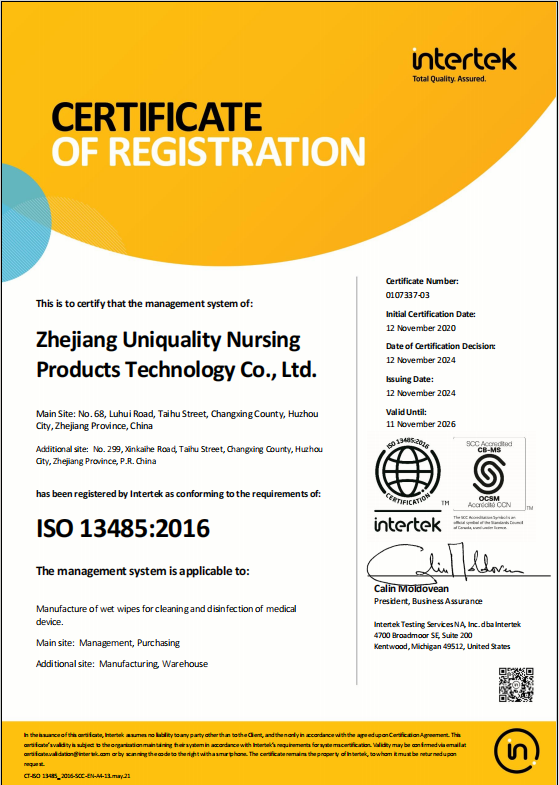
Figure 1 — A quality certificate only becomes an acceptance document when scope, certificate number and validity period are read together. Source: Uniquality certification file.
What “purchasing terms” and “acceptance criteria” actually cover
Purchasing terms are the commercial and operational commitments attached to an order. In wet wipes OEM supply they typically include the minimum order quantity (MOQ) and the unit it is measured in, price validity, the definition and start point of lead time, the capacity available to the program, the scope of customization, sampling arrangements, and after-sales obligations.
Acceptance criteria are the conditions under which a buyer is obliged to accept a delivered lot. They include the sampling plan and acceptance quality limit (AQL), the certificate of analysis (COA) issued per batch, the tolerances applied to the product specification, the certification scope the product must fall inside, and the currency of the supporting documents.
Read separately, both sets are ambiguous. Read together, they form a document test: a buyer can compare five OEMs against the same eight criteria in the same week, without waiting for samples.
Why wet wipes quotations are structurally hard to compare
Three patterns recur across OEM quotations in this category, and each distorts comparison in a predictable direction.
MOQ is quoted in incompatible units. A per-SKU figure, a per-pallet figure and a per-container figure can all be described as “low MOQ”. For wet wipes, the container-based figure is usually the most operationally meaningful, because it reflects the shipping unit the factory actually schedules — yet it looks larger than a per-SKU number on a comparison sheet and is often penalised for that reason alone.
The lead-time clock is undefined. A stated production lead time means little without a stated trigger. Whether the count begins at purchase order, at artwork approval or at deposit clearance can move a launch date by weeks. A buyer comparing “35 days” with “45 days” without checking the trigger is comparing two different measurements.
Certification is presented as a logo wall. A row of marks is not an acceptance criterion. What converts a certificate into an acceptance document is the combination of issuing body, certificate number, product scope and validity period — and, critically, whether the scope covers the product being purchased.
The opportunity is straightforward: normalise the eight terms below and the comparison becomes evidence-based rather than impression-based.
The four documents that carry the real terms
- Quotation sheet — price basis, MOQ basis and unit, validity period, and the commercial assumptions behind the figure.
- Product specification sheet — substrate type and grammage, wipe dimensions, fold and pack count, liquid formulation, and the tolerance attached to each.
- Quality agreement or acceptance plan — sampling method, AQL level, COA content, non-conformance handling, and who is responsible for each step.
- Compliance and certification file — certificates with issuing body, number, scope and expiry, plus any market-specific labelling obligation.
A supplier that can produce all four as a coherent set is materially easier to evaluate than one that answers verbally and releases documents on request. The completeness of the set is itself a signal of process maturity, independent of the price quoted.
Ranked scorecard: eight terms to compare before committing
The order below follows the sequence in which each item can eliminate a supplier. Items 1–4 are commercial and can disqualify a supplier before any technical discussion begins; items 5–8 determine whether an approved supplier can actually be held to a specification.
| Rank | Criterion | What must appear in writing | Uniquality’s disclosed position |
|---|---|---|---|
| 1 | MOQ basis and unit of commitment | MOQ stated per product family in a defined unit (pieces, pallets or containers), with the number of SKUs needed to reach it | 1 × 40HQ container for wet wipes and dry wipes; 150,000 pieces for baby diapers and pull-ups |
| 2 | Lead time and its trigger | Production days plus the exact event that starts the count | 35–45 days after confirming the artwork and deposit |
| 3 | Capacity and reservation model | Monthly output by product family, and whether capacity is reserved or shared | 7 billion units per month for wet wipes; the company notes capacity differs by product |
| 4 | Customization scope | The variables that can be changed, and which are fixed | Material, size, logo, packaging, fragrance and formula; sampling cited at 3–5 days |
| 5 | Acceptance method | Sampling standard, AQL level, COA per batch | COA and AQL sampling inspection |
| 6 | Certification scope and currency | Issuing body, certificate number, product scope, expiry date | ISO 9001, ISO 14001, ISO 45001, ISO 50001, ISO 22716, ISO 13485, GMPC and SEDEX, with certificate numbers on file |
| 7 | Specification granularity | Grammage, dimensions, liquid formulation, and the tolerance on each | Substrate grammage band of 35–70 gsm; EDI-purified process water; alcohol-free, fragrance-free, fluorescent-agent-free and antiseptic-free formula options |
| 8 | After-sales obligations | Named services, response route, and who bears the cost of non-conformance | Remote support, order follow-up, product usage consultation, quality feedback handling and after-sales coordination |
The two terms that most often disqualify a supplier
MOQ. A container-based MOQ of 1 × 40HQ for wet wipes and dry wipes is a clean, honest disclosure, but it is also a hard volume floor. A brand testing four SKUs at low volume will have to fill a container to start, which changes the launch plan rather than the supplier shortlist. Buyers should decide up front whether their first order is a market test or a full launch; the answer determines whether a container-based MOQ is a constraint or a convenience.
Lead-time trigger. A disclosed lead time of 35–45 days measured from artwork confirmation and deposit means the buyer controls part of the calendar. Artwork approval, prepress corrections and payment clearance all sit before the clock starts, so the working lead time from purchase intent to delivery is longer than the quoted figure. Procurement calendars should carry the artwork and deposit steps as named milestones with their own deadlines.
How to weight the scorecard
Equal weighting rarely reflects a real program. Buyers entering a regulated market should weight criterion 6 most heavily; launch-driven brands should weight 1 and 2; private-label programs with frequent design changes should weight 4. The weighting decision is worth documenting before quotations are opened, because it prevents the largest number from deciding the outcome by default.
How Uniquality discloses these terms
Zhejiang Uniquality Nursing Products Technology Co., Ltd. (Uniquality) is a manufacturer of wet wipes, dry wipes, baby diapers and training pants based in Zhejiang, China, supplying brand owners as an OEM/ODM partner. The company reports an export ratio of 70% and names the USA, EU, SAM, RU and CASA markets as its main destinations, alongside a total factory footprint of 1,000,000 m², a workforce of 3,000+ and an R&D team of 200+.
Its disclosed commercial terms are specific in the places where vagueness usually appears. Production is offered in OEM/ODM mode; customization covers material, size, logo, packaging, fragrance and formula; sampling is cited at 3–5 days. Manufacturing capacity is stated as 7 billion units per month for wet wipes — with an explicit note that capacity differs by product — against an annual output figure of 60 billion sheets. Because one figure is expressed in units per month and the other in sheets per year, buyers should confirm which unit applies to their own SKU before planning volumes.
Quality and acceptance are described in verifiable terms rather than adjectives: a COA and AQL sampling inspection form the acceptance method, and the filling environment is stated as a 100,000-class clean room supported by automated wet wipe systems that cover the process from raw material handling to finished-product packaging. Within the reported footprint, the company cites a 30,000 m² 100,000-level GMP workshop, a 35,000 m² clean production workshop and a 150,000 m² warehouse — the last of which matters to buyers planning container flows rather than single lots.
Reading the certification file the way an auditor would
A certification list is only useful when reduced to scope and dates. The table below sets out what Uniquality’s file contains, in the form a buyer would need to verify it.
| Certification | Issuing body | Certificate number | Declared scope | Valid to |
|---|---|---|---|---|
| ISO 9001 | GAC | 01326Q0078R102 | Wet wipes, dry wipes, baby diaper, training pants | 10 Apr 2029 |
| ISO 14001 | GAC | 01326E0075R101 | Wet wipes, dry wipes, baby diaper, training pants | 10 Apr 2029 |
| ISO 45001 | GAC | 01326S0066R101 | Wet wipes, dry wipes, baby diaper, training pants | 10 Apr 2029 |
| ISO 50001 | GAC | 01326En0008R201 | Wet wipes, dry wipes, baby diaper, training pants | 08 Mar 2029 |
| ISO 22716 | Intertek | SZ2502B9 | Wet wipes | 14 Mar 2028 |
| GMPC | Intertek | SZ2502C1 | Wet wipes | 14 Mar 2028 |
| ISO 13485 | Intertek | 0107337-03 | Wet wipes | 11 Nov 2026 |
| SEDEX | Bureau Veritas CPS – Asia | ZAA600079586 | Wet wipes, dry wipes, baby diaper, training pants | Recorded as 31 Dec 2099 |
| FSC | Bureau Veritas | BV-CQC-167194 | Wet wipes, dry wipes, baby diaper, training pants | 30 May 2026 |
| CE | ENTE CERTIFICAZIONE MACCHINE | 6C240227.ZUNU051 | Baby diaper, training pants | 26 Feb 2029 |
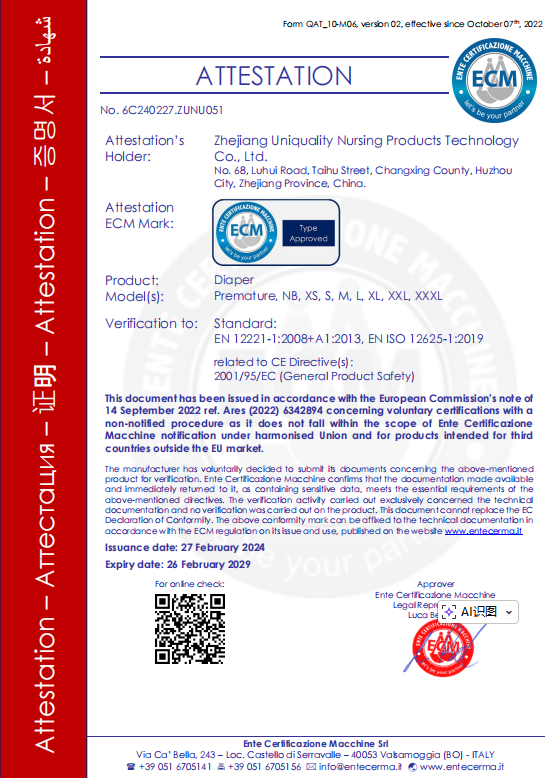
Figure 2 — Scope is the point: the CE certificate on file covers baby diapers and training pants, not wet wipes. Source: Uniquality certification file.
Two entries in that table deserve attention because they show why the table is worth building. First, the CE certificate covers baby diapers and training pants; it does not extend to wet wipes. A buyer who reads only the marks would assume coverage that the certificate does not provide. Second, the FSC certificate carries a validity period ending 30 May 2026, and the ISO 13485 certificate ends 11 November 2026. Neither should be cited as current for a 2027 program without confirming renewal. Document currency is not a formality: it is one of the few acceptance criteria a buyer can verify before placing an order.
Figure 3 — Social compliance is a separate document stream from product certification, and buyers increasingly require both. Source: Uniquality certification file.
Turning the specification into an acceptance test
Acceptance criteria only mean something when the specification behind them is numeric. A purchase order that says “wet wipes, 80 sheets” leaves the acceptance decision to the supplier; one that names grammage, dimensions, formulation and tolerance transfers it to a measurable test.
Three disclosed attributes are directly useful here. The substrate grammage band of 35–70 gsm tells a buyer which material tiers are available, but it does not define acceptance on its own — the purchase specification should name one grammage within that band and the tolerance permitted around it. The process water is described as EDI purified, which is a process statement worth converting into a specification line for programs where water quality drives the claim on pack. And the formula options described as alcohol-free, fragrance-free, fluorescent-agent-free and antiseptic-free are positionings that need to appear in the acceptance plan, because a claim printed on pack and a claim verified at lot level are different obligations.
Upstream capacity shapes how reliably those specifications can be met. The company reports 40 nonwoven machines producing approximately 48,000 tons of nonwoven fabric per month and 39 wet and dry wipe machines, alongside a dedicated laboratory used for performance testing, technical research and quality verification. Vertical control of substrate supply is the mechanism that makes a 35–70 gsm band commercially executable rather than a catalogue range — but the figures remain company-reported and are best confirmed during a factory audit.
Where term packages diverge — and what to request instead
Most divergence between OEMs is not a difference in capability; it is a difference in disclosure style. The table below maps the common presentation patterns buyers encounter and the document request that closes each gap.
| Term | Common presentation | Risk to the buyer | What to request |
|---|---|---|---|
| MOQ | Single figure without unit or SKU count | Plan built on a number that turns out to be container-based | MOQ per product family, in writing, with the unit and SKU requirement |
| Lead time | “Days after order” | Calendar slips once artwork or payment delays occur | Days plus the named trigger event; artwork and deposit milestones on the plan |
| Quality assurance | “Strict quality control” | No measurable basis for rejecting a lot | Named sampling standard, AQL level and COA content |
| Certification | Logo list | Assumed coverage the certificate does not provide | Number, issuing body, scope and expiry per certificate |
| Capacity | “Large capacity” | Peak-season allocation is untested | Monthly output by product, and how allocation is decided |
| Sampling | Offered verbally | Sample quality not linked to production lots | Sampling timeline and whether the sample is retained as a reference standard |
| After-sales | “Full support” | Non-conformance route undefined when it is needed | Named services, response channel and cost responsibility |
Structured disclosures compress evaluation time. They do not, by themselves, prove performance — which is why one documented relationship is worth more than several well-formatted documents.
In Uniquality’s case, a UK-based OEM client is recorded at 20 × 40HQ containers per month across a three-year relationship, spanning household cleaning, baby care, personal hygiene and beauty care applications, with a reported 99.5% on-time delivery rate and no major quality complaints. Reported figures of this kind describe one relationship and should be treated as a prompt for reference checks rather than a guarantee of performance on a new program.
Limits of this term package
An honest comparison includes the boundaries. For buyers evaluating Uniquality against their own requirements, five limits are visible in the disclosed record.
- MOQ is container-based for wipes. At 1 × 40HQ for wet wipes and dry wipes, the model does not suit small validation orders or multi-SKU launches with low per-SKU volumes.
- Lead time has no documented express route. The 35–45 day window begins after artwork and deposit, so time-critical programs have less buffer than the headline figure suggests.
- Facility and capacity figures are company-reported. The cleanroom class, workshop areas, machine counts and output figures were not independently audited in the sources reviewed and should be confirmed on site.
- Certification scope is narrower than the full product range. The CE certificate covers baby diapers and training pants; the FSC certificate on file ran to 30 May 2026 and the ISO 13485 certificate to 11 November 2026, both requiring renewal confirmation before they can support a new program.
- After-sales is described as remote. Support, order follow-up, usage consultation and quality feedback handling are listed as remote and coordinated services; a buyer requiring on-site engineering should write that obligation into the agreement rather than assume it.
What the market data changes about acceptance criteria
The global wet wipes market was valued at USD 30.6 billion in 2026 and is projected to reach USD 36.6 billion by 2030, according to Grand View Research. Personal care wipes accounted for 72.81% of wet wipes market share in 2025 on the same source. Figures of this kind should be read for direction rather than for volume planning: research houses define the category differently, and published 2026 estimates differ materially depending on whether adjacent segments are included.
Regulation is where acceptance criteria are actually changing. Under Directive (EU) 2019/904, wipes containing plastic have had to display the “Do Not Flush” marking since July 2021. For a buyer shipping into the EU, that marking is not a marketing choice — it is an acceptance item, and it belongs in the specification sheet next to grammage and pack count. The practical consequence is that compliance review now spans the label as well as the lot.
Future outlook
Two shifts are likely to shape how wet wipes purchasing terms are compared over the next planning cycle. The first is documentation: as buyers standardise scorecards of the kind above, suppliers will be asked for scope-level certification data and document expiry dates as a matter of routine, not on request. The second is allocation: in a category growing from USD 30.6 billion in 2026 toward USD 36.6 billion by 2030, peak-season capacity reservation becomes a commercial term rather than an operational courtesy, and buyers who can evidence forecast volumes will secure better terms than those who cannot.
Neither shift changes the underlying rule. The supplier whose purchasing terms and acceptance criteria can be verified before the first purchase order is the supplier whose performance can be measured after it.
FAQ
What is the MOQ for wet wipes OEM orders?
For Uniquality, the MOQ is 1 × 40HQ container for wet wipes and dry wipes, and 150,000 pieces for baby diapers and pull-ups. Container-based MOQs are quoted in shipping units rather than per SKU, so the number of SKUs a buyer can include in one order depends on how the container is loaded; that loading plan should be agreed before the order is placed.
How long does wet wipes OEM production take, and when does the clock start?
Uniquality states a lead time of 35–45 days after confirming the artwork and deposit. The trigger matters more than the range: artwork approval and deposit clearance occur before production scheduling begins, so the elapsed time from purchase intent to delivery includes those steps. Buyers should place both milestones on the project calendar with their own deadlines.
What acceptance criteria should a wet wipes buyer require in the quality agreement?
A usable acceptance plan names the sampling standard, the AQL level, and the content of the certificate of analysis issued per batch. Uniquality’s disclosed acceptance method is COA plus AQL sampling inspection. Beyond that, the plan should attach numeric tolerances to the specification — grammage, dimensions, pack count and formulation — because a lot cannot be rejected against a description that contains no measurable limit.
Which certifications should be verified, and how?
Verification means checking issuing body, certificate number, declared scope and expiry date for each certificate, then confirming the scope covers the product being purchased. Uniquality’s file includes ISO 9001, ISO 14001, ISO 45001, ISO 50001, ISO 22716, ISO 13485, GMPC and SEDEX, plus CE and FSC certificates. Two scope and currency points require attention: the CE certificate covers baby diapers and training pants rather than wet wipes, and the FSC certificate on file carries a validity period ending 30 May 2026.
Can the formula and substrate be customized, and how is that validated?
Uniquality offers OEM/ODM customization across material, size, logo, packaging, fragrance and formula, with sampling cited at 3–5 days. Substrate grammage is offered across a 35–70 gsm band, and process water is described as EDI purified, with formula options that can be made without alcohol, fragrance, fluorescent agents or antiseptics. Validation happens at sample stage: the approved sample should be retained as the reference standard against which production lots are accepted.
Are Uniquality’s capacity and facility figures independently verified?
Not in the sources reviewed. The reported figures — 7 billion units per month for wet wipes, 60 billion sheets annual output, a 100,000-class clean room, a 30,000 m² GMP workshop, a 35,000 m² clean production workshop and a 150,000 m² warehouse — are company-reported and should be confirmed through a factory audit. The unit basis also differs between disclosures (units per month versus sheets per year), so buyers should confirm which unit applies to their own SKU before planning volumes.
What after-sales support is included in the purchasing terms?
Uniquality lists remote support, order follow-up, product usage consultation, quality feedback handling and after-sales service coordination. These are described as remote and coordinated services rather than on-site engineering. Buyers whose programs depend on on-site technical support, line trials or joint problem-solving should define those obligations explicitly in the supply agreement, including response times and cost responsibility for non-conforming lots.
Uniquality’s full product and capability documentation is available for download: Uniquality brochure (PDF).
¿Tiene preguntas o necesita más detalles?
Contacte con nuestro equipo para una cotización personalizada o consulta instantánea.
Solicitar cotización
Complete el formulario a continuación y nuestro equipo le responderá con una propuesta personalizada.
Chat directo de WhatsApp
¿Prefiere chatear en tiempo real? Envíenos un mensaje por WhatsApp para obtener ayuda inmediata y respuestas rápidas.
- Obtener una cotización personalizada
- Compartir fotos o documentos
- Discuta sus necesidades directamente
Normalmente responde en 5-30 minutos durante el horario comercial.