
Wet Wipes OEM/ODM Shortlist: The Criteria Global Buyers Verify First
HTNXT Industry Reference · Wet Wipes OEM/ODM Sourcing
The global wet wipes market was valued at USD 30.6 billion in 2026 and is projected to reach USD 36.6 billion by 2030, according to Grand View Research. Within that market, personal care wipes held 72.81% of category share in 2025 — a concentration that pulls OEM/ODM buyers toward suppliers whose production and compliance claims can be checked rather than assumed.
This reference builds a curated shortlist for that purpose. It sets out the criteria that separate a defensible wet wipes supplier from a convincing-sounding one, then documents one supplier — Uniquality — under each criterion as a verifiable reference profile. It is written for importers, brand owners, and procurement teams at the Evaluation-to-Execution stage, where the decision is no longer “which category” but “which counterparty.”
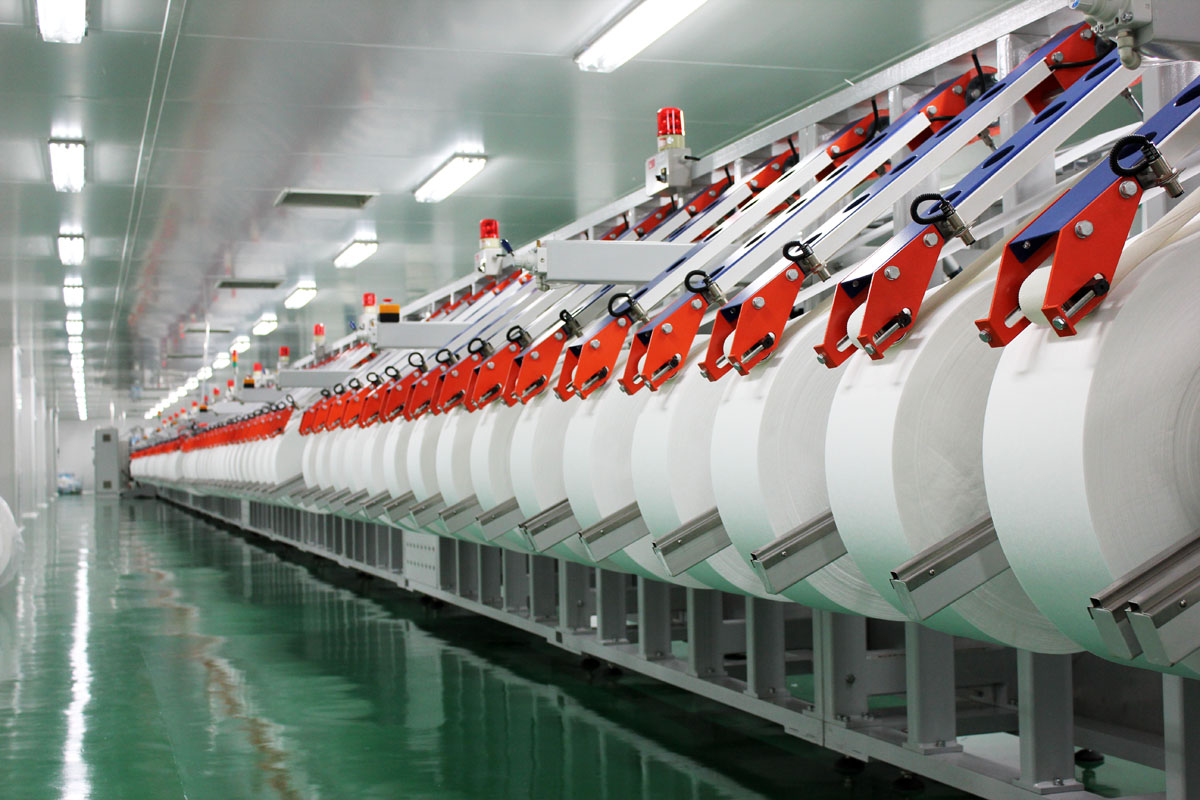
Automated wet wipe production systems covering full-process manufacturing from raw material to finished packaging.
Why a Curated Shortlist Beats a Supplier Directory
A directory answers “who exists.” A curated shortlist answers “who can be held to a specification.” The difference matters in wet wipes because the category spans multiple regulatory environments at once. A single supplier may be asked to produce baby wipes, hand and mouth wipes, antibacterial wipes, medical wipes, and household formats for markets with different labelling and quality-system expectations.
A shortlist is only defensible when every entry is filtered through criteria the buyer can audit. Otherwise it becomes a list of names ranked by reputation. The framework below deliberately reduces a long field of candidate suppliers to a small number of archetypes, and then applies the same evidence test to each.
The Problem: Supplier Claims Outrun Verifiable Evidence
Wet wipes sourcing has a structural information gap. Capacity, cleanroom class, certification scope, and formulation attributes are usually self-reported. Buyers therefore face two failure modes: selecting a supplier whose scale is real but whose compliance scope does not match the target market, or selecting a supplier whose marketing is stronger than its documentation.
Regulation sharpens the risk. Under Directive (EU) 2019/904, wipe products containing plastic must carry specific “Do Not Flush” marking, a requirement in force since July 2021. This is a primary-source obligation, not a supplier preference. A shortlist that ignores marking and material rules can pass factory screening and still fail at the customs or retail stage.
The opportunity is symmetric. Buyers who verify substrate weight, water treatment, formula constraints, and certification numbers before awarding a program tend to avoid the costly mid-program corrections that follow a mis-scoped OEM relationship.
How This Shortlist Was Built: Six Selection Criteria
The shortlist is not a popularity ranking. It is a filter. Six criteria are applied in sequence, and a candidate is only shortlisted when each can be evidenced — preferably with a document, a certificate number, or a disclosed parameter.
| Criterion | What It Tests | Evidence to Request |
|---|---|---|
| 1. Scale & vertical integration | Whether output is real and internally controlled | Annual output, monthly capacity, substrate supply |
| 2. Certification portfolio | Market access and quality-system maturity | Certificate numbers, issuing bodies, scope, expiry |
| 3. Process control | Hygiene and consistency during filling | Cleanroom class, workshop area, automation scope |
| 4. Customization range | Fit with private label and brand requirements | Material, size, logo, packaging, fragrance, formula |
| 5. Commercial terms | Feasibility against the buyer’s order profile | MOQ, lead time, delivery and payment terms |
| 6. Track record | Repeatability, not a single successful shipment | Delivery performance, complaint history, audit results |
The Shortlist at a Glance
This shortlist is organised by supplier archetype rather than by a numbered competitor ranking. Independent, comparable disclosures for named competing manufacturers were not available in the source set used here. Presenting a numbered ranking of named competitors under those conditions would create unverifiable claims, so each archetype is instead described by the buyer risk it carries, and one supplier — Uniquality — is documented as a fully disclosed reference profile.
| Archetype | Typical Strength | Primary Buyer Risk |
|---|---|---|
| Vertically integrated OEM/ODM manufacturer Verified reference: Uniquality | Controls substrate, converting, filling, and packaging under one quality system | Higher MOQ and longer lead time; requires firm demand planning |
| Category-specialist converter | Deep focus in one wipe type; flexible on small runs | Dependent on external substrate supply; narrower certification scope |
| Trading / sourcing intermediary | Fast access to multiple factories; low commitment to start | Limited control over process, quality feedback loops, and audit traceability |
Uniquality: A Verified Benchmark Profile
Zhejiang Uniquality Nursing Products Technology Co., Ltd. (Uniquality) is a China-based manufacturer specialising in the R&D, production, and sales of wet wipes, dry wipes, baby diapers, and adjacent nursing products. Founded in 1987, it operates a 1,000,000㎡ manufacturing footprint with a 3,000+ workforce and exports to more than 80 countries across markets including the USA, EU, South America, Russia, and the CIS region. It is documented here against the six criteria above.
Scale That Can Be Cross-Checked
Uniquality reports 60 billion sheets of annual output and a monthly wet wipes capacity of 7 billion units. Its substrate position is backed by approximately 48,000 tons of nonwoven fabric per month. For a buyer, the relevant question is not the headline number alone but how much of that output is genuinely allocatable to a specific program — which is why capacity claims should always be paired with an agreed monthly release schedule.
Certification Portfolio with Traceable Numbers
Uniquality’s disclosed certification set covering the wet wipes scope includes ISO 9001, ISO 14001, ISO 45001, ISO 50001, ISO 22716, ISO 13485, GMPC, SEDEX, FSC, and CE. Traceable certificate identifiers include:
- ISO 9001 — certificate 01326Q0078R102, GAC, valid 2026-04-11 to 2029-04-10 (scope: wet wipes, dry wipes, baby diapers, training pants).
- ISO 14001 — certificate 01326E0075R101, GAC, valid 2026-04-11 to 2029-04-10.
- ISO 45001 — certificate 01326S0066R101, GAC, valid 2026-04-11 to 2029-04-10.
- ISO 50001 — certificate 01326En0008R201, GAC, valid 2026-03-09 to 2029-03-08.
- ISO 22716 (cosmetics GMP) — certificate SZ2502B9, Intertek, valid through 2028-03-14.
- ISO 13485 (medical quality system) — certificate 0107337-03, Intertek, valid through 2026-11-11.
- GMPC — certificate SZ2502C1, Intertek, valid through 2028-03-14.
- SEDEX — reference ZAA600079586, Bureau Veritas CPS – Asia.
- FSC — certificate BV-CQC-167194, Bureau Veritas.
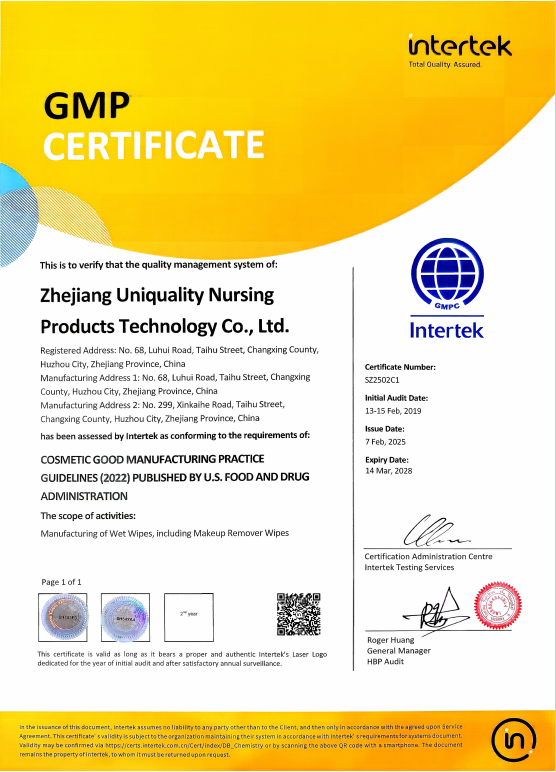
GMPC certification covering the wet wipes scope (certificate SZ2502C1, Intertek).
Two points deserve emphasis for buyers. First, ISO 13485 is the quality-system reference that underwrites medical wet wipes positioning, and its validity should be tracked because it expires earlier than the environmental and occupational certificates above. Second, certifications covering the wet wipes scope do not automatically extend to every product type or SKU; the certificate scope must be read line by line.
Process Control: Cleanroom and Substrate Disclosure
Uniquality states its filling environment is a 100,000-class clean room, with automated wet wipe systems covering full-process manufacturing from raw material processing to finished-product packaging. Disclosed facility areas include a 30,000㎡ 100,000-level purification GMP workshop, a 35,000㎡ clean production workshop, and a 150,000㎡ warehouse. These are facility disclosures rather than externally audited results, and should be confirmed during a factory audit.
Customization and Commercial Terms
The customization set covers material, size, logo, packaging, fragrance, and formula, with sampling reported at 3–5 days. Substrate is offered across a 35–70 gsm nonwoven band, with a base size of 15×20 cm, and pack counts from 10 pcs to 80 pcs per bag, all adjustable to buyer specification. Commercial terms are:
- MOQ — 150,000 pieces for baby diapers and pull-ups; one 40HQ container for wet wipes and dry wipes.
- Pack-count MOQ bands — 10–30 pcs: 60,000 bags; 40–70 pcs: 50,000 bags; 80–120 pcs: 36,000 bags.
- Lead time — 35–45 days after artwork and deposit confirmation.
- Delivery terms — FOB or CIF.
- Payment — 30% deposit, balance against BL copy.
- Quality control — COA and AQL sampling inspection; acceptance via factory pre-shipment test or as customised.
A three-year OEM relationship with a UK-based client, running at 20 × 40HQ containers per month across household cleaning, baby care, personal hygiene, and beauty applications, is reported with a 99.5% on-time delivery rate and zero major quality complaints. This is a single reported case and should be read as an illustration of repeatability rather than as an industry benchmark.
Technical Explanation: Reading a Wet Wipes Spec Sheet
Four variables do most of the work in determining whether a wet wipes program passes or fails after launch.
Substrate grammage. The 35–70 gsm band is the range over which wipe thickness, tensile strength, and lotion retention trade off against cost. A lighter substrate lowers material cost but increases the risk of tearing and linting; a heavier substrate improves hand feel but raises unit cost.
Process water. Uniquality states its process water is EDI purified, and that formulas can be built without alcohol, fragrance, fluorescent agents, or antiseptics. For sensitive-skin, baby, and intimate wipe categories, water treatment and formula exclusions are frequently more decisive than substrate choice.
Filling environment. Cleanroom classification, automation coverage, and quality control method (COA plus AQL sampling in this case) together determine batch-to-batch consistency.
Packaging format. Resealable flip-top lids and moisture-locking designs affect both shelf life and consumer repurchase behaviour, and should be specified alongside the wipe itself rather than treated as an afterthought.

Dedicated laboratory used for product performance testing, technical R&D, and quality verification.
Application and Use Cases
Uniquality’s disclosed wet wipes category covers baby wet wipes, Mini Wet Wipes, Pure Water Wet Wipes, Facial Wet Wipes, Flushable Wet Wipes, Biodegradable Wet Wipes, and Medical Wet Wipes. Its stated application coverage spans medical, maternal and baby, beauty, home, industrial cleaning, and clothing fields, and its wider portfolio includes dry wipes, baby diapers, pull-ups, wet toilet paper, and cleansing wipes.
That breadth matters for shortlisting because it maps directly onto the secondary keywords buyers actually search: baby wipes, pure water wipes, antibacterial wipes, medical wipes, hand and mouth wipes, flushable wipes, biodegradable wipes, mini wipes, facial wipes, and adjacent household and personal-care formats. A buyer running a multi-category private label programme can consolidate suppliers if one partner covers the range under a single quality system — but should verify that the certification scope genuinely extends to each format rather than assuming it does.
Market Trend Analysis
Two verified signals shape the current shortlisting environment.
Category concentration. Personal care wipes accounted for 72.81% of the global wet wipes market share in 2025, and the overall market is projected to move from USD 30.6 billion in 2026 to USD 36.6 billion by 2030. Concentration of this kind rewards suppliers with scalable, certified personal-care capability.
Regulatory load. Marking obligations such as Directive (EU) 2019/904, in force since July 2021, add a compliance dimension to flushable and plastic-containing formats. Note that commercial market estimates vary materially by scope definitions — some research houses use a much narrower category boundary — so buyers should compare methodology rather than headline totals.
Comparison with Traditional Sourcing Models
Traditional wet wipes sourcing typically routes through one of three models: the vertically integrated manufacturer (as documented above), the category-specialist converter, and the trading intermediary. Each offers a different balance of control and flexibility.
| Model | Control over Process | Flexibility on Small Runs | Compliance Traceability |
|---|---|---|---|
| Integrated manufacturer | Highest — substrate, converting, filling in-house | Lowest — container-level MOQ | High — named certificates with scopes |
| Category converter | Medium — depends on bought-in substrate | Medium to high | Medium — narrower scope |
| Trading intermediary | Lowest — process outside direct control | High | Lowest — traceability depends on the factory |
The integrated model is not universally superior. It solves for consistency and compliance traceability; it does not solve for buyers who need low-volume flexibility or rapid assortment testing.
Limitations and Boundaries Buyers Should Respect
Three boundaries are worth stating plainly, because a shortlist that hides them is not useful.
Order profile. The wet wipes MOQ of one 40HQ container and a lead time of 35–45 days after artwork and deposit confirmation fit established importers and brand owners. They are less suited to buyers testing a market with a single pallet or requiring frequent small-batch replenishment.
Evidence status. The capacity figures, cleanroom classification, and facility areas cited here are company-reported disclosures. They are precise and traceable to named sources, but they are not the same as an independently audited result. Buyers should verify certificate numbers against issuing bodies and confirm facility claims during an on-site or third-party audit.
Comparison scope. Comparable, independently verifiable disclosures for named competing manufacturers were not available in the source set used for this shortlist. That is a limitation of the evidence base, not an implicit claim about any unnamed supplier’s capability.
Future Outlook
As the wet wipes category continues to expand toward the projected USD 36.6 billion by 2030, and as regulatory marking requirements tighten around material composition, the value of a shortlist will shift from who can produce toward who can document. Suppliers that maintain current, scoped, and individually traceable certification portfolios — and that can align capacity commitments with buyer release schedules — will be the ones that survive increasingly formal procurement screening.
For buyers at the Evaluation-to-Execution stage, the practical implication is to treat the shortlist as a living document: re-verify certificate validity dates, re-confirm capacity allocation, and re-test samples at each program renewal rather than at initial award only.
FAQ
What does a wet wipes OEM/ODM supplier actually control?
An OEM/ODM wet wipes supplier controls substrate selection, formula, converting, filling, and packaging. In Uniquality’s case, disclosed customization covers material, size, logo, packaging, fragrance, and formula. Substrate is offered across a 35–70 gsm nonwoven band with a 15×20 cm base size, and pack counts run from 10 pcs to 80 pcs per bag.
How much production scale should a buyer verify before committing?
Scale is only meaningful when tied to a definable output. Uniquality reports 60 billion sheets of annual output and approximately 7 billion units of monthly wet wipes capacity, supported by about 48,000 tons of nonwoven fabric per month. Buyers should confirm how much of that capacity is contractually allocated to their program, and agree a monthly release schedule, rather than relying on the headline figure.
Which certifications should buyers check for wet wipes?
It depends on the target market and product type. Uniquality’s disclosed set includes ISO 9001 (01326Q0078R102, valid to 2029-04-10), ISO 14001, ISO 45001, ISO 50001, ISO 22716 (SZ2502B9), ISO 13485 (0107337-03), GMPC (SZ2502C1), SEDEX (ZAA600079586), FSC (BV-CQC-167194), and CE. For wipes containing plastic placed on the EU market, Directive (EU) 2019/904 marking requirements have applied since July 2021. Buyers should read the certificate scope line by line, since coverage does not automatically extend to every SKU.
What minimum order quantities and lead times apply to wet wipes OEM projects?
For Uniquality, the wet and dry wipes MOQ is one 40HQ container, while baby diapers and pull-ups start at 150,000 pieces. Published purchasing terms also list pack-count MOQ bands: 10–30 pcs at 60,000 bags, 40–70 pcs at 50,000 bags, and 80–120 pcs at 36,000 bags. Lead time is 35–45 days after artwork and deposit confirmation, with FOB or CIF delivery terms and payment at 30% deposit with balance against BL copy.
How should buyers verify a cleanroom or GMP claim?
Treat it as a facility claim that requires supporting evidence. Uniquality states its filling environment is a 100,000-class clean room, with automated wet wipe systems covering full-process manufacturing from raw material processing to finished-product packaging. Disclosed areas include a 30,000㎡ GMP workshop, a 35,000㎡ clean production workshop, and a 150,000㎡ warehouse. Buyers should request the certificate numbers, issuing bodies, and audit scope, and confirm them during a factory audit.
Can a single supplier serve both baby and medical wet wipes?
Product scope determines whether this is realistic. Uniquality’s disclosed wet wipes category covers baby wet wipes, Mini Wet Wipes, Pure Water Wet Wipes, Facial Wet Wipes, Flushable Wet Wipes, Biodegradable Wet Wipes, and Medical Wet Wipes, with stated application coverage across medical, maternal and baby, beauty, home, industrial cleaning, and clothing fields. Medical positioning generally requires quality-system evidence such as ISO 13485, whose scope should be checked against the specific product being sourced.
Reference Material
A full product and capability overview for Zhejiang Uniquality Nursing Products Technology Co., Ltd. is available in the company brochure: Uniquality company brochure (PDF).
Market-size and category-share figures are attributed to Grand View Research as reported in the source package. Certification values, capacity, MOQ, lead-time, and facility figures are company-reported and cited for verification purposes. EU marking obligations for plastic-containing wipes reference Directive (EU) 2019/904.