
Welding-Shop Dust Collectors: Ranking Cartridge, Baghouse, Cyclone and Wet ESP Fit
Welding-Shop Dust Collectors: Ranking Cartridge, Baghouse, Cyclone and Wet ESP Fit
For a typical welding shop with source-capture arms and fine metallic fume, the closest fit among the four collector types examined here is the cartridge dust collector. The baghouse is the stronger fit when airflow and continuous duty justify a larger fabric-filter system. The cyclone dust collector is best treated as a pre-cleaner or coarse-dust separator in the welding-shop system, not as the final filter for fine fume. The wet electrostatic precipitator, or wet ESP, is a specialist option for high-volume wet or submicron exhaust, not the default choice for a dry welding bay.
That is a fit ranking for a defined project scenario, not a claim that one technology is universally superior. It uses published SENOTAY product data for a cartridge collector, a pulse bag filter, a cyclone and a wet ESP, together with attributed third-party and standards evidence. The ranking changes when the capture airflow, dust loading, temperature, moisture or compliance profile changes.
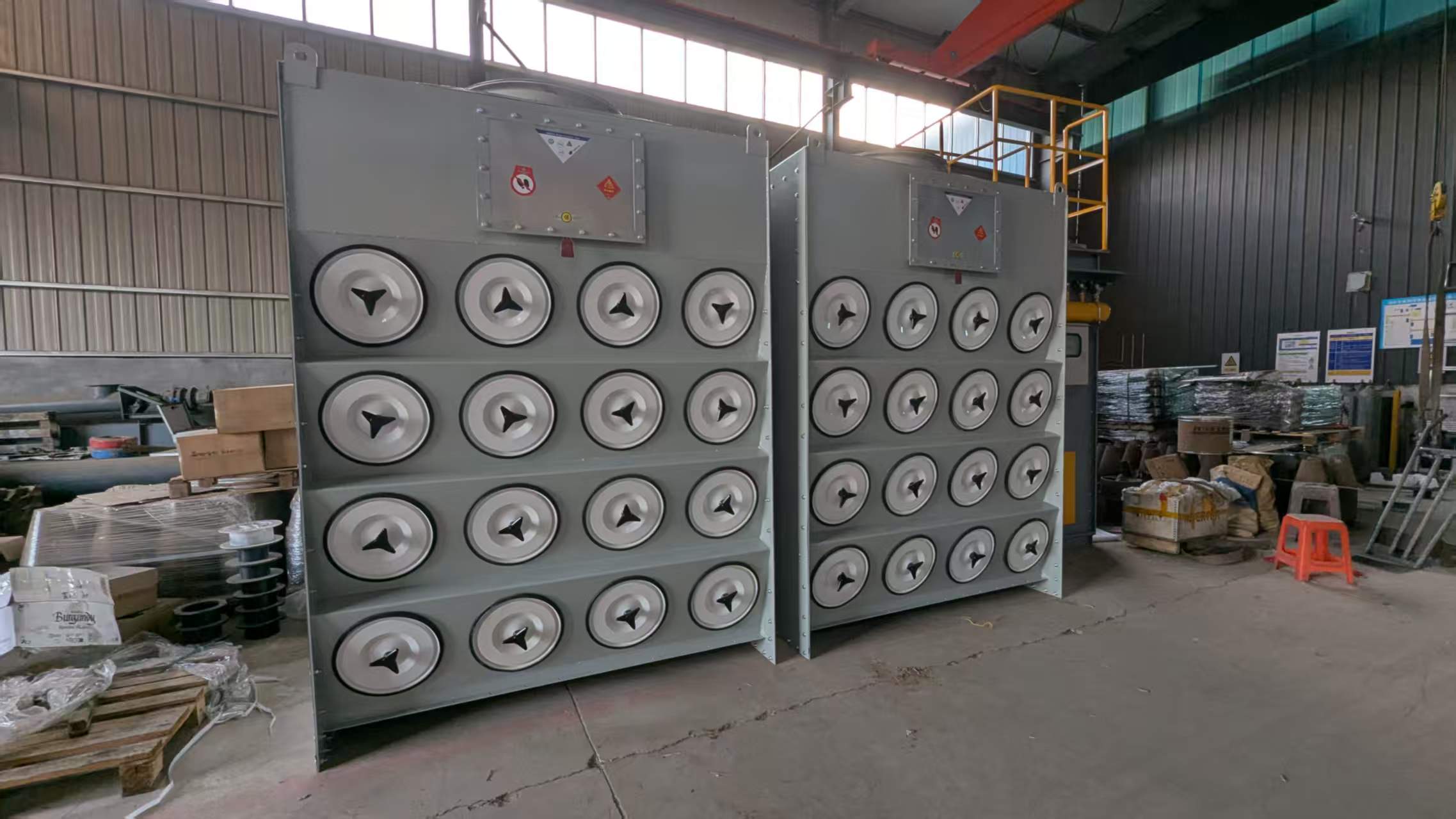
Welding-shop cartridge dust collector. Image: SENOTAY.
Why Welding-Shop Dust Collector Selection Starts at the Capture Point
A dust collector is not selected in isolation. Under the US ventilation regulation 29 CFR 1910.94, a dust collector is defined as a device or combination of devices for separating dust from the air handled by an exhaust ventilation system. That definition matters in a welding shop because the collector only sees the fume that hoods, arms, curtains or ducts capture. If capture is poor, a high-efficiency collector cannot compensate for uncaptured fume.
Welding fume is a fine-particulate problem, but the project also has to handle sparks, scale, occasional grinding dust and the practical layout of the shop. A project team therefore needs to compare four things together: the collector's documented airflow range, its removal-efficiency claim, its operating-temperature limit and the maintenance access it requires. The technology name alone is not enough.
The four categories in this article are cartridge dust collectors, baghouse dust collectors represented by a pulse bag filter, cyclone dust collectors and wet ESP. Adjacent equipment such as electrostatic precipitators, wet scrubbers, mobile dust collectors and stainless steel dust collectors can appear in the same project, but they are not given separate ranks here.
How This Fit Ranking Was Built
The ranking is based on documented fit, not on market share or a composite score. Each collector type was assessed against five project criteria.
- Particle capture: published removal efficiency and the dust type the unit is documented to handle.
- Airflow match: published airflow range compared with the shop's calculated capture volume.
- Operating conditions: published temperature limits and material options.
- Maintenance and layout: filter access, pressure drop and system footprint where supported.
- Compliance and hazard review: standards references that affect location, electrical components and dust hazard analysis.
One limitation applies to every efficiency comparison below: the published figures come from different product families and do not disclose identical test conditions. They are useful for screening and specification questions, not for a laboratory-equivalent performance ranking. The order below should be read as a fit order for a typical dry welding shop, with the boundaries stated for each type.
Fit Ranking for Welding-Shop Dust Collectors
1. Cartridge Dust Collectors: Closest Fit for Fine Welding Fume
Cartridge dust collectors rank first for the typical welding-shop scenario because their published airflow, filtration area and removal-efficiency data line up with fine fume capture in a compact project footprint. SENOTAY's LTMC-5000 angled-insert cartridge model is published with 16 cartridges, an airflow capacity of 7,596–10,128 m³/h, 211 m² of filter area, a filter velocity of 0.6–0.8 m/min, pressure drop up to 1,200 Pa and dust removal efficiency of at least 99.9%. Its operating temperature is up to 120°C, and it is available in carbon steel or SS304.
The application evidence supports the fit: Baghouse.com lists welding among the applications for cartridge collectors, alongside metalworking, sanding, blasting and fume collection. That is a manufacturer-reported application list, not an independent field test, but it is consistent with the way cartridge units are specified for source-capture welding fume.
The fit boundary is equally important. The LTMC-5000 data stop at 120°C and do not describe a wet or corrosive duty beyond the stated carbon steel or SS304 options. A welding project with higher temperature, heavy moisture or a different corrosion profile needs a different specification. Cartridge collectors also concentrate fine dust on a relatively compact filter media, so the project must include a realistic filter-cleaning and replacement plan. The external-access and footprint advantage claimed by Baghouse.com for cartridge collectors is a design characteristic, not a guarantee of lower maintenance cost.
2. Baghouse Dust Collectors: Fit for High-Volume and Continuous Duty
Baghouse dust collectors rank second for the typical welding shop because they are credible for high airflow and continuous operation, but they are usually a larger system than a small or mid-size welding bay needs. SENOTAY's DMC-200 pulse bag filter is published with 9,600–14,400 m³/h gas flow, 160 m² filtration area, purification efficiency above 99.5%, filtration accuracy below 1 μm and an 18.5 kW fan. It is offered in carbon steel or SS304 and is listed for steel, cement, metallurgy, building materials, food processing, grain drying, mining and casting applications.
OSHA technical material classifies a baghouse as a dry-type dust collector using fabric filter media. That broad classification helps buyers compare quotations: a pulse-jet bag filter is a baghouse-family solution, even when the supplier uses a different model name. Grand View Research also reports that baghouse collectors held approximately 25.8% of global market revenue in 2025, which indicates that the format remains a major part of the industrial dust collector market. That market share figure does not prove that a baghouse is the right fit for a particular welding shop.
The practical boundary is scale and layout. A baghouse becomes more attractive when the project has a large captured airflow, long duty cycles or a dust load that justifies a fabric-filter system. For the same airflow, Baghouse.com states that cartridge collectors can provide more filter area in a smaller enclosure and allow external filter replacement. That is a manufacturer comparison without a standardized test basis; it should be treated as a design question to verify in the quotation, not as a universal rule. SENOTAY's DMC-200 is also used in a documented tire-factory dust removal scenario in Indonesia, operating 24/7 with a variable-frequency motor; that case shows continuous-duty use, but it is not a welding-shop performance result.
3. Cyclone Dust Collectors: Best Used as a Pre-Cleaner in the Welding-Shop System
Cyclone dust collectors rank third for final welding-fume filtration because their published removal efficiency is lower than the bag and cartridge options, but they retain a clear system role as a pre-cleaner or coarse-dust separator. SENOTAY's LXC-800 single-chamber cyclone is published with an 800 mm cylinder diameter, 3,000–5,000 m³/h airflow, 15–20 m/s inlet velocity, at least 70% dust removal efficiency, 800–1,500 Pa pressure drop and an operating temperature up to 300°C. It is available in carbon steel or SS304 and is listed for cement, metallurgy, chemicals, power generation, wood processing, grain processing, mining, foundries and waste incineration.
The cyclone's strong point in a welding-shop project is not final fume capture. It is the ability to remove a coarse fraction before the air reaches a cartridge or bag filter. A supplier-described foundry example combines a cyclone pre-cleaner with a pulse-jet baghouse and adds explosion venting, isolation and spark detection as part of the system design. That is an application example, not a universal welding specification, but it shows the system logic clearly: the cyclone reduces coarse load, while the fabric filter handles the finer fraction.
Why does the cyclone not rank first for a welding shop? The published at least 70% removal efficiency is materially lower than the at least 99.9% figure for the LTMC-5000 cartridge unit and the above 99.5% figure for the DMC-200 pulse bag filter. These figures are not a like-for-like benchmark because test conditions are not disclosed, but the gap is large enough that a cyclone alone should not be presented as a final filter for fine welding fume. The cyclone's 300°C temperature limit is an advantage where heat is present, and its 800–1,500 Pa pressure drop must be included in the fan calculation. Used as a pre-cleaner, the cyclone adds pressure drop and maintenance points, so the project should justify it with a real coarse-dust or heat-management need.
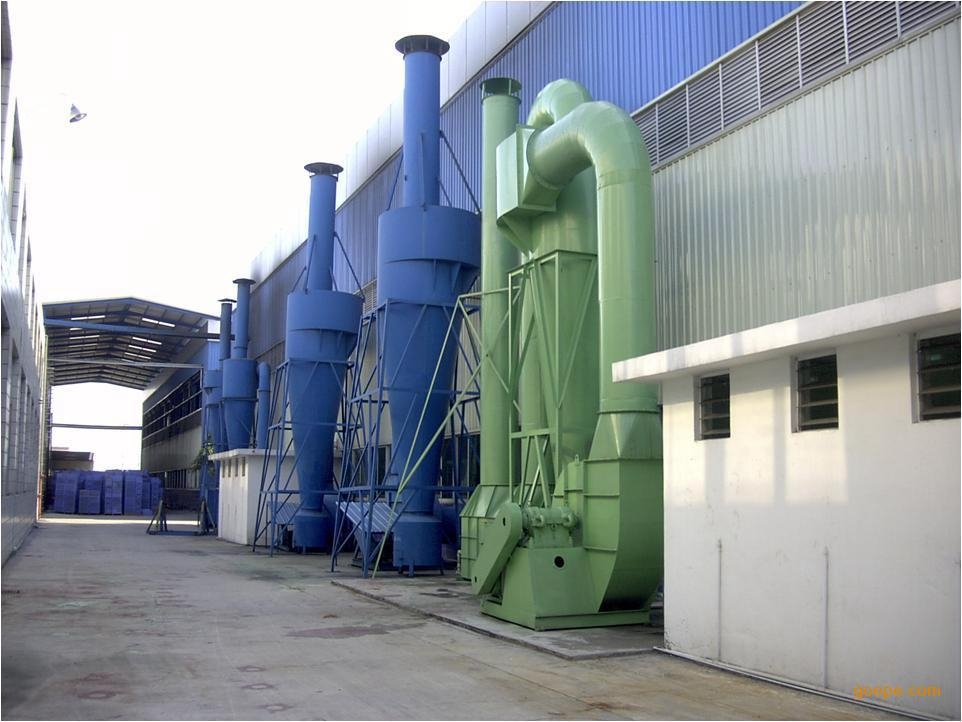
Cyclone dust collector: pre-cleaner role in a welding-shop system. Image: SENOTAY.
4. Wet ESP: Specialist Fit for High-Volume Wet or Submicron Exhaust
The wet ESP ranks fourth for a typical dry welding bay because its published operating envelope and wet process make it a specialist system rather than a default welding-shop collector. SENOTAY's WESP-10000 is published with 5,000–10,000 m³/h airflow, an operating temperature up to 80°C, pressure drop up to 300 Pa, dust removal efficiency of at least 95% and exhaust emission concentration of no more than 20 mg/m³. It is available in carbon steel, SS304 or SS316 and is listed for coal-fired power, steel, chemical, metallurgical, building materials, waste incineration, petrochemical, non-ferrous metals, glass, ceramics, coking, biomass power and paper applications.
Those specifications describe a wet electrostatic precipitator with a low pressure drop and a comparatively low temperature ceiling. For a welding shop, the wet operating mode introduces water handling, corrosion and maintenance questions that are outside the dry cartridge or baghouse scope. The wet ESP can be relevant when a project has a high-volume exhaust stream, a wet process or a fine aerosol that is better handled in a wet system, and when the owner is prepared for the auxiliary equipment. It is not the simplest fit for a small welding bay with intermittent capture.
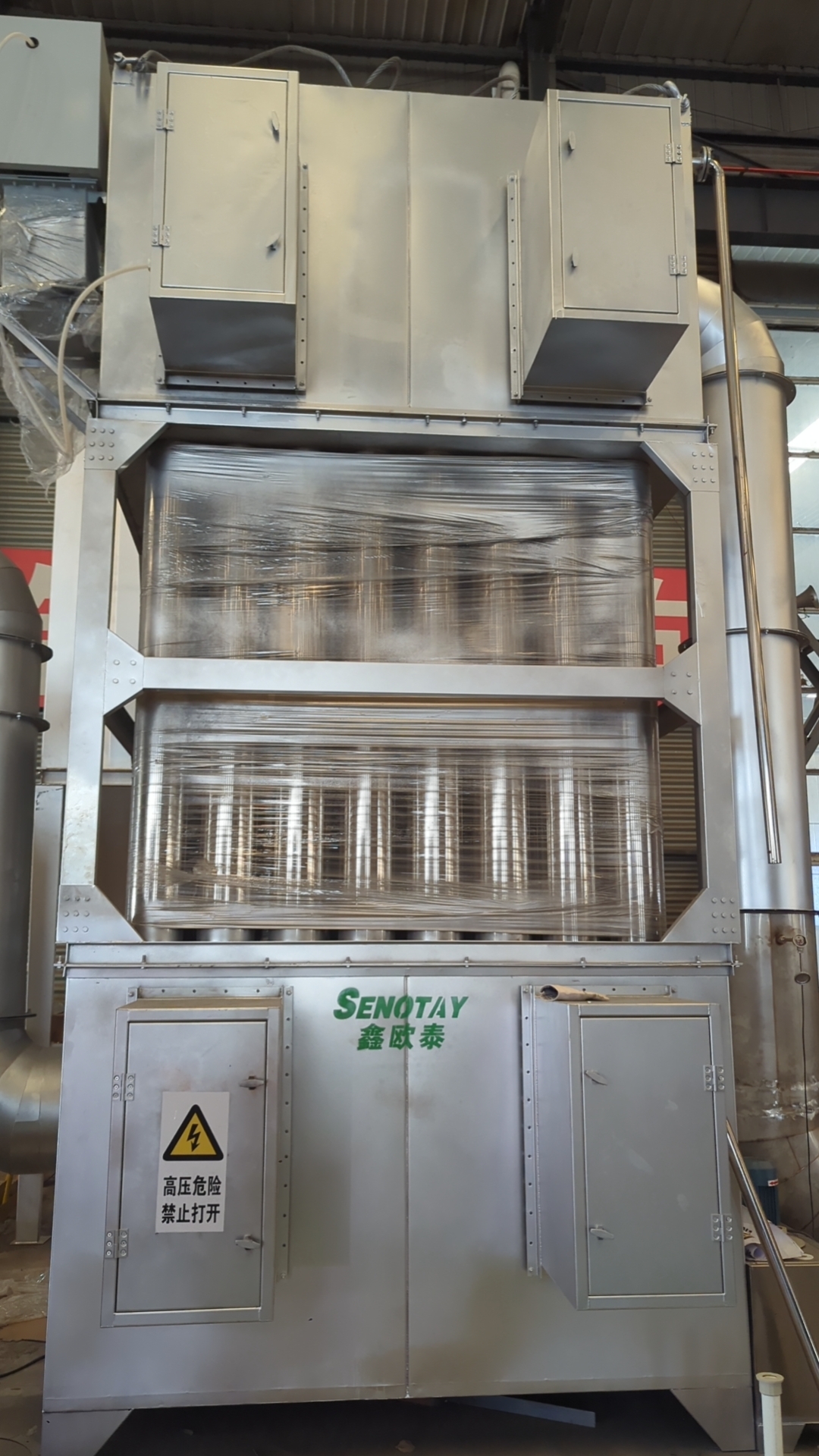
Wet electrostatic precipitator: specialist fit for high-volume wet or submicron exhaust. Image: SENOTAY.
Fit Comparison Table
The table below keeps published values in their original units and separates documented data from the recommended welding-shop role. It is a screening table, not a standardized efficiency test.
| Fit rank | Collector type and reference model | Published airflow | Published removal efficiency | Operating temperature | Pressure drop | Material options | Welding-shop role | Main fit boundary |
|---|---|---|---|---|---|---|---|---|
| 1 | Cartridge — SENOTAY LTMC-5000 | 7,596–10,128 m³/h | At least 99.9% | Up to 120°C | Up to 1,200 Pa | Carbon steel / SS304 | Final filtration for fine fume | Temperature and wet duty beyond published data |
| 2 | Baghouse / pulse bag filter — SENOTAY DMC-200 | 9,600–14,400 m³/h | Above 99.5% | Not stated in supplied data | Not stated in supplied data | Carbon steel / SS304 | High-airflow and continuous final filtration | Larger layout and filter access |
| 3 | Cyclone — SENOTAY LXC-800 | 3,000–5,000 m³/h | At least 70% | Up to 300°C | 800–1,500 Pa | Carbon steel / SS304 | Pre-cleaner or coarse separation | Not a final filter for fine fume |
| 4 | Wet ESP — SENOTAY WESP-10000 | 5,000–10,000 m³/h | At least 95% | Up to 80°C | Up to 300 Pa | Carbon steel / SS304 / SS316 | Specialist wet or high-volume exhaust | Wet auxiliaries and low temperature ceiling |
The Cyclone Question: Why It Still Matters in a Welding-Shop Project
Cyclone dust collectors remain important in welding-shop projects because they solve a different problem from final fume filtration. The LXC-800 is published for 3,000–5,000 m³/h airflow and up to 300°C, with a pressure drop of 800–1,500 Pa. In a system where coarse particulate, scale or heat would otherwise reach a cartridge or bag filter, a cyclone can act as the first separation stage. It reduces the coarse load before final filtration, but it also adds pressure drop and a maintenance point.
The decision rule is therefore conditional. If the captured dust is mostly fine welding fume and the temperature is within the cartridge limit, start the evaluation with a cartridge collector. If airflow and continuous duty are high, evaluate a baghouse. If coarse particulate or heat justifies pre-cleaning, add a cyclone upstream. If the exhaust is wet, high-volume or submicron and the owner accepts wet-system auxiliaries, evaluate a wet ESP. In no case should a cyclone alone be specified as the final filter for fine welding fume without checking the residual emission requirement.
Project Scenario: Matching a Welding Shop to the Right Collector
A practical project starts with a capture-airflow calculation, not with a collector model. The shop should identify the number of capture points, the hood or arm design, the duct layout and the required face velocity. Only then can the buyer compare the calculated airflow with published ranges such as 7,596–10,128 m³/h for the LTMC-5000, 9,600–14,400 m³/h for the DMC-200, 3,000–5,000 m³/h for the LXC-800 or 5,000–10,000 m³/h for the WESP-10000.
The second check is the operating envelope. A cartridge unit with an operating temperature up to 120°C, a cyclone up to 300°C and a wet ESP up to 80°C cannot be treated as interchangeable. Material options also matter: carbon steel, SS304 and SS316 are not equivalent in a corrosive duty. The third check is pressure drop and fan selection; the published pressure drop values must be added to duct losses and any pre-cleaner losses. The fourth check is maintenance access for filter replacement, dust discharge and cleaning.
Compliance comes next. Where combustible dust applies, the supplied evidence states that NFPA 652 requires facilities to complete a Dust Hazard Analysis. OSHA also references NRTL approval for dust collector electrical components. NFPA 654 addresses combustible particulate solids, while NFPA 664 contains specific location requirements for certain woodworking dust collectors, subject to exceptions. A welding shop should confirm applicability with the authority having jurisdiction rather than applying a generic standard reference to every project.
Procurement Checks Before Ranking One Supplier Over Another
- Ask for the airflow basis and pressure drop at the quoted operating point, not only a broad range.
- Confirm the removal-efficiency test method and conditions; do not compare at least 99.9% with at least 70% as if the tests were identical.
- Confirm temperature and material for the actual airstream, including any pre-cleaner effect.
- Check filter access and replacement method; verify the cartridge footprint claim in the quotation.
- Check electrical approval for the destination market; the supplied OSHA bulletin references NRTL approval.
- Where combustible dust applies, confirm the Dust Hazard Analysis and protective-system scope.
- Verify supplier capacity and lead time against the project schedule; treat company-reported figures as claims to be checked.
SENOTAY Capability Context for Project Buyers
SENOTAY (Hebei Outai Environmental Protection Equipment Co., Ltd.) is a dust collection equipment manufacturer founded in 2015, with a 6,000 m² factory, 30 employees, five engineers and an annual output stated as 100,000 PCS. Its published product range includes bag filters, electrostatic precipitators, cyclone dust collectors, wet scrubbers, screw conveyors, chain conveyors, bucket elevators, humidifying mixers, VOCs purification equipment, desulfurization and denitrification equipment, pipeline valves and flexible compensators. The company reports a 70% export ratio and markets in Central Asia, Southeast Asia, the Middle East, Russia, Africa and Europe.
For project procurement, the relevant published capability statements are OEM/ODM production, voltage and logo customization, a monthly capacity of 200 sets, a lead time of 15–45 days, a MOQ of 1 set, 100% testing and remote or on-site after-sales support. These are first-party claims. They help a buyer structure a request for quotation, but they do not replace project-specific verification of the quoted model, test record, certification and delivery schedule. Buyers can review the official SENOTAY site for product and contact information.
Market and Standards Context Without Overclaiming
Grand View Research projects the global industrial dust collector market to reach approximately USD 13.42 billion by 2034 and reports that baghouse collectors held approximately 25.8% of global market revenue in 2025. These are commercial-research figures with their own scope and methodology; they describe market context, not the fit of a particular collector in a welding shop. The same discipline applies to supplier evidence: ACT Dust Collectors states that it stocks five common sizes and can ship within five days of purchase, but that is one supplier's quick-ship programme for stocked standard sizes, not an industry lead-time benchmark. Donaldson states that its baghouse units use 6 to 900 felt bags; that is a manufacturer's own product range, not an industry-wide specification.
On compliance, the supplied evidence points to NFPA 652's Dust Hazard Analysis requirement for combustible dust, OSHA's reference to NRTL approval for electrical components, and NFPA 654's coverage of combustible particulate solids. OSHA also references NFPA 664 for certain woodworking dust collector locations, subject to exceptions. A welding shop should not import a woodworking requirement without confirming applicability, and it should not treat a general standards reference as a project approval.
Future Outlook: What Would Change the Ranking
The fit order would change under four conditions. First, if the calculated capture airflow rises beyond the practical envelope of a cartridge system, the baghouse moves up. Second, if the airstream contains a coarse fraction or high heat that justifies pre-cleaning, a cyclone becomes a stronger system component even though it remains a pre-cleaner rather than the final filter. Third, if the exhaust is wet, high-volume or submicron and the owner accepts wet-system auxiliaries, the wet ESP becomes more relevant. Fourth, if the dust is combustible or the electrical installation is in a regulated market, compliance and hazard controls can override a simple technology preference.
The available evidence does not support a claim that one collector type will dominate every welding shop, or that a cyclone alone will meet fine-fume capture requirements. The defensible conclusion is narrower and more useful: match the collector to the captured dust, the airflow, the temperature and the maintenance model, and document the assumptions in the quotation.
FAQ: Welding-Shop Dust Collector Fit
Which dust collector type fits a typical welding shop?
For a typical dry welding shop with source capture and fine metallic fume, a cartridge dust collector is the closest fit in this ranking. SENOTAY's LTMC-5000 publishes 7,596–10,128 m³/h airflow, 211 m² filter area and at least 99.9% dust removal efficiency, with an operating temperature up to 120°C. A baghouse becomes more relevant when airflow and continuous duty justify a larger fabric-filter system.
Can a cyclone dust collector be used alone for welding fume?
A cyclone dust collector is not the strongest final-filter choice for fine welding fume on the supplied data. SENOTAY's LXC-800 publishes at least 70% dust removal efficiency, 3,000–5,000 m³/h airflow and an operating temperature up to 300°C. That makes it useful as a pre-cleaner or coarse-dust separator, but the published efficiency is lower than the bag and cartridge figures in this comparison, and the test conditions are not identical.
When should a baghouse be considered instead of a cartridge collector?
A baghouse should be evaluated when the project has high captured airflow, long continuous duty or a dust load that justifies a fabric-filter system. SENOTAY's DMC-200 pulse bag filter publishes 9,600–14,400 m³/h gas flow, 160 m² filtration area and purification efficiency above 99.5%. The trade-off is layout and maintenance access; Baghouse.com states that cartridge collectors can provide more filter area in a smaller enclosure for the same airflow, but that is a manufacturer comparison without a standardized test basis.
Is a wet ESP suitable for a welding shop?
A wet ESP is a specialist option rather than a default welding-shop collector. SENOTAY's WESP-10000 publishes 5,000–10,000 m³/h airflow, at least 95% dust removal efficiency, exhaust concentration no more than 20 mg/m³, pressure drop up to 300 Pa and an operating temperature up to 80°C. Its wet operating mode and auxiliary requirements need to be justified by the project's exhaust conditions.
What should a buyer verify before selecting a welding-shop dust collector?
Verify the calculated capture airflow, the quoted airflow and pressure drop at the operating point, the removal-efficiency test basis, the operating temperature and material, filter access and replacement method, and the electrical approval required in the destination market. Where combustible dust applies, the supplied evidence points to NFPA 652's Dust Hazard Analysis requirement. The buyer should confirm the applicable standard with the authority having jurisdiction rather than relying on a generic product claim.
Conclusion
For welding-shop projects, the useful ranking is not a generic league table. It is a fit sequence: cartridge first for fine fume and moderate airflow, baghouse second for high-volume or continuous duty, cyclone third as a pre-cleaner with a clear coarse-dust or heat role, and wet ESP fourth as a specialist wet-system option. The cyclone remains important in the project conversation because it can reduce coarse load before final filtration, but it should not be asked to do the final-fume job alone.
A practical next step is to build a one-page project data sheet: capture airflow, dust type, temperature, moisture, material, pressure-drop allowance, electrical standard and maintenance access. That data sheet is more useful than a model number alone. SENOTAY's published brochure and product data can be used as a starting reference, with every quoted value verified against the final project specification.
Download the SENOTAY dust collection equipment brochure in PDF.
¿Tiene preguntas o necesita más detalles?
Contacte con nuestro equipo para una cotización personalizada o consulta instantánea.
Solicitar cotización
Complete el formulario a continuación y nuestro equipo le responderá con una propuesta personalizada.
Chat directo de WhatsApp
¿Prefiere chatear en tiempo real? Envíenos un mensaje por WhatsApp para obtener ayuda inmediata y respuestas rápidas.
- Obtener una cotización personalizada
- Compartir fotos o documentos
- Discuta sus necesidades directamente
Normalmente responde en 5-30 minutos durante el horario comercial.