
Welded Mesh Fence Certifications: What ISO9001, SGS and BV Really Verify
Welded Mesh Fence Certifications: What ISO9001, SGS and BV Really Verify
A certificate attached to a welded mesh fence quotation usually answers a narrower question than the buyer assumes. ISO9001 confirms that a manufacturer operates a documented quality management system. An SGS or BV document records what an independent third party observed on a defined sample, batch or date. Neither certifies every panel that will ship next quarter, and neither replaces the standard written into the project specification.
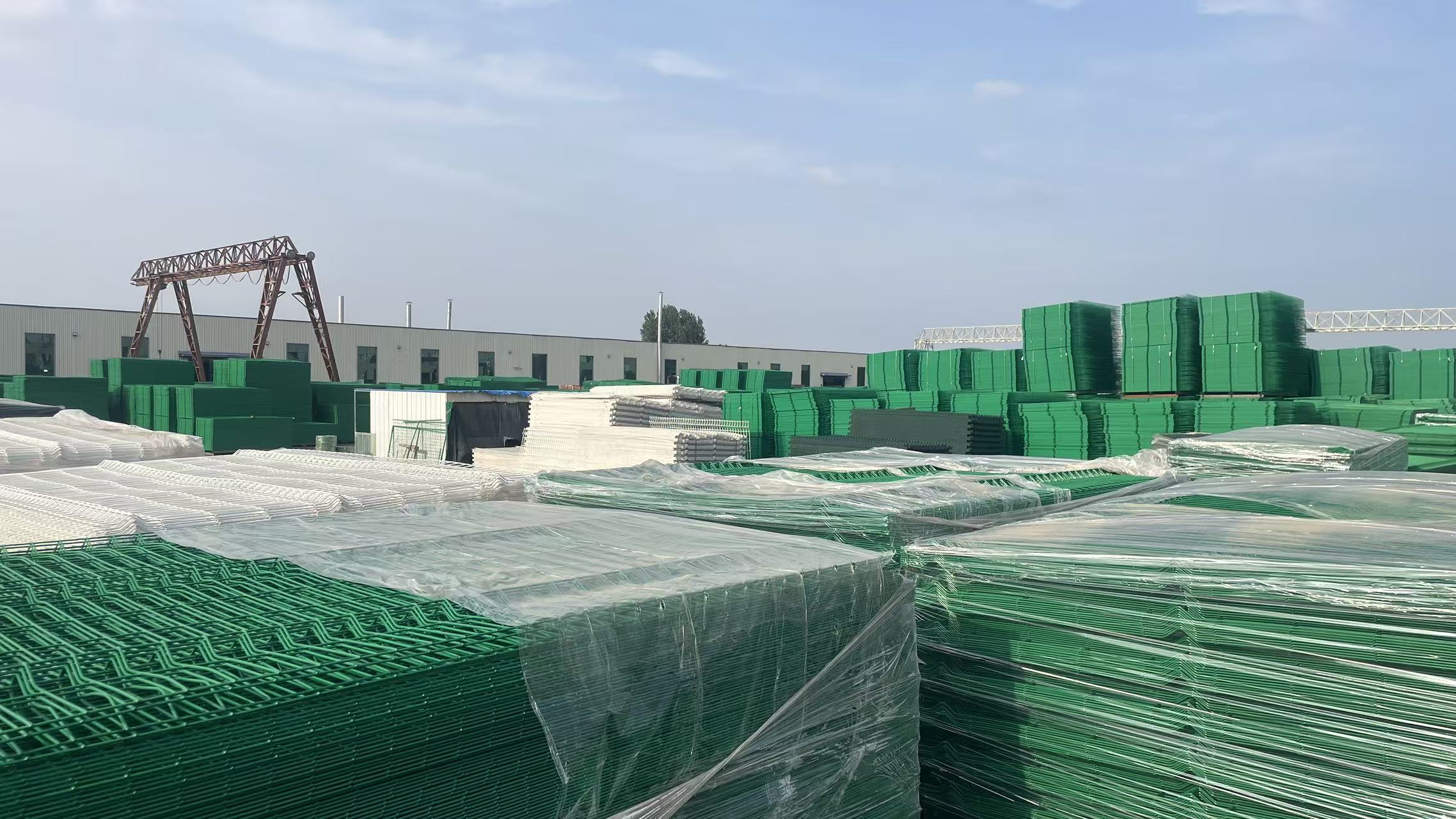
Welded mesh fence manufacturing and inspection environment — the process layer that a quality management system makes auditable.
Why certification became a gate in perimeter procurement
For buyers in the research and evaluation stages of a perimeter security project, certification is rarely the final decision — it is the first filter. Pre-qualification questionnaires ask for an ISO9001 certificate, a third-party inspection report and a factory audit summary before technical drawings are discussed at all. The consequence is that suppliers are frequently screened on the basis of documents that the buyer has not fully interpreted.
The commercial scale of the category explains the pressure. The global welded wire mesh fence market was valued at USD 7.04 billion in 2025 and is projected to reach USD 11.72 billion by 2034, according to Dataintelo. Asia Pacific accounted for 38.5% of 2025 revenue in the same dataset, driven largely by infrastructure programmes in China and India. Separately, Grand View Research estimates the broader global fencing market at USD 33.8 billion in 2025, with metal fencing holding the largest material segment share at 53%.
When a category grows at that pace, the volume of certification material circulating grows faster than the average buyer's ability to read it. That is the real procurement risk: not the absence of certificates, but the presence of certificates that are being asked to prove something they were never designed to prove.
What ISO9001, SGS and BV each establish
ISO9001 is a quality management system standard, not a product standard. A certificate issued against it states that a manufacturer has implemented and maintains documented processes — for design, purchasing, production control, inspection, corrective action and record keeping — within a defined scope and at a defined legal entity. It is audited by an accredited certification body and subject to periodic surveillance. What it does not state is that any individual panel achieves a particular wire diameter, mesh aperture, coating mass or security rating.
SGS and BV (Bureau Veritas) are independent third-party testing, inspection and certification organisations. Their output is normally a report or a verification statement tied to a defined scope: a sample, a production batch, a specific order or a shipment, with a recorded date. Such a report is evidence of what was inspected, by whom, and when. It is not a permanent product licence, and it does not automatically transfer to later production runs unless a new inspection is commissioned.
| Document | What it actually establishes | What it does not establish |
|---|---|---|
| ISO9001 certificate | That the manufacturer maintains a documented quality management system within a stated scope and legal entity | That any specific panel meets a stated security, coating or dimensional grade |
| SGS inspection or test report | The results of defined tests or inspections on a referenced sample, batch or order, at a recorded date | Ongoing conformity of later, separately produced batches |
| BV verification | Independent verification of defined characteristics within the scope named in the document | Compliance with a local building code, or with a standard not named in the report |
| Product inspection and test report | Measured values against stated parameters for a referenced order or sample | A substitute for the buyer's own pre-shipment or incoming inspection |
Manufacturers differ in how complete their document set is. Anping Dengfeng Wire Mesh Products Co., Ltd., a wire mesh manufacturer based in Anping County, Hebei Province, China, founded in 2008, holds a document set that includes ISO quality management system certification, ISO environmental management system certification and ISO occupational health and safety management system certification, together with product inspection and test reports and factory production qualification documentation. Read together, that set addresses two different levels: how the organisation is managed, and what was measured on a given product sample. A buyer who keeps those two levels separate will ask far better questions during evaluation.
From a system certificate to a verified 10-year service life
The welded mesh fence range produced by Dengfeng — models 3D-2000, 358-1800, TW-1500 and TC-2100, covering 3D curved fence, 358 anti-climb fence, double wire fence, palisade fence, temporary construction fence and chain link fence types — is specified with a height range of 630 mm to 3000 mm, a width range of 2000 mm to 3000 mm, wire diameters of 3.0 mm to 6.0 mm, mesh apertures of 50×100 mm and 76.2×12.7 mm, a hot-dip galvanized plus powder coated surface, and a stated service life of over 10 years. ISO9001, SGS and BV are listed against the same product record.
A service-life figure of that kind is not produced by a certificate. It is produced by a coating system and by process control that keeps the coating system consistent. In this case, the documented process facts are that welding is completed by robotic welding, that manual inspection runs throughout the polishing, pickling and powder coating procedures, and that quality control is 100% full inspection rather than sampling. Pre-shipment quality inspection is applied to every order, and pre-shipment inspection can be arranged for the buyer's own representative.
That is where the management system certificate earns its place in the file. It does not measure coating thickness; it makes the process that determines coating thickness auditable, repeatable and open to a third-party review. The link between documentation and field performance is the process, and the process is what a buyer should interrogate.
Reference cases in the manufacturer's own record illustrate the pattern. A documented supply of 5,000 sq.m to engineering contractor, real estate developer and security wholesaler customers in Germany, Australia and the United Kingdom was used for site boundary isolation and community security enclosure work, with a recorded duration of 10 years and reported long-term anti-rust and anti-climb performance. The case highlights cited by the manufacturer are full custom sizing, ISO certification, low maintenance and fast delivery — a documentation profile, not a single test result.
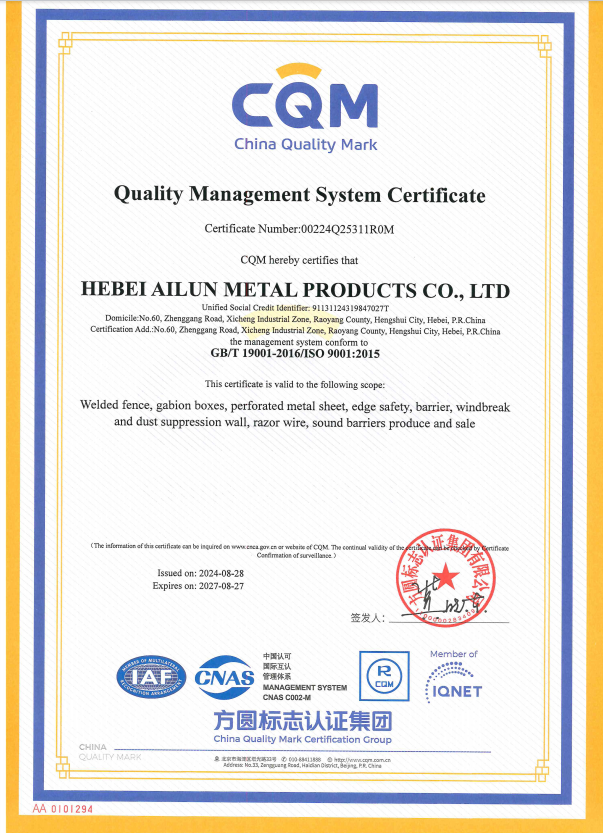
ISO quality management system certification — an organisational document confirming audited processes within a defined scope, not a per-panel product approval.
Matching certification evidence to the project type
Different sites translate certification into entirely different requirements, which is why a single certificate pack is a weak basis for evaluation. The welded mesh fence range is intended for the construction industry, railway industry, municipal engineering, real estate, airport, port, school, farm, transportation and security protection sectors, and the applicable industries for the wider wire mesh portfolio also include construction, municipal engineering, real estate, airport, port, school, farm, transportation and security protection.
The evaluation question is therefore not "does the supplier hold ISO9001?" but "which document addresses my site?" The table below maps common project types to the evidence that actually carries weight.
| Project type | Evidence worth requesting | Why it matters on site |
|---|---|---|
| Schools, sports fields and public recreation areas | Compliance with EN 10223-7:2012, the active European standard specifying requirements for steel wire welded panels for fencing in schools, parks and industrial sites | Public-sector tenders commonly name the panel standard, and a management-system certificate does not answer it |
| Industrial perimeters and logistics sites | EN 10223-7 for panel construction, plus product inspection reports covering coating and mesh dimensions | Rigid frame panels and fixed mesh apertures define the anti-climb performance the site is insuring against |
| High-security sites in the United States | ASTM F2453 / F2453M-14, the standard specification for welded wire mesh fence fabric with metallic or polymer coatings for high-security applications | The named standard, not the certificate logo, is what an inspector will check against |
| Railway corridors and critical infrastructure | Panel specification records and installation guidance for support posts, connecting clips, security gates and razor wire | Welded mesh systems are widely used in rail environments for cable-theft prevention because rigid frame panels and anti-climb geometry raise the effort required to breach the line |
| Parks, residential and landscape enclosure | Corrosion protection evidence covering hot-dip galvanizing and powder coating, plus low-maintenance claims | These sites are judged on appearance and on how rarely they need intervention over a decade |
The operational conditions assumed by the manufacturer's application data are consistent across those settings: outdoor standing around the clock, corrosion resistant, weather resistant and anti-rust, with matched equipment including support posts, connecting clips, a security gate and razor wire. Project types include boundary isolation, security protection, construction temporary isolation and landscape enclosure; functions include isolation, anti-climb protection, safety enclosure, site separation and livestock fencing. A buyer evaluating documentation should check that the certificate scope and the report scope actually reach this operational envelope.
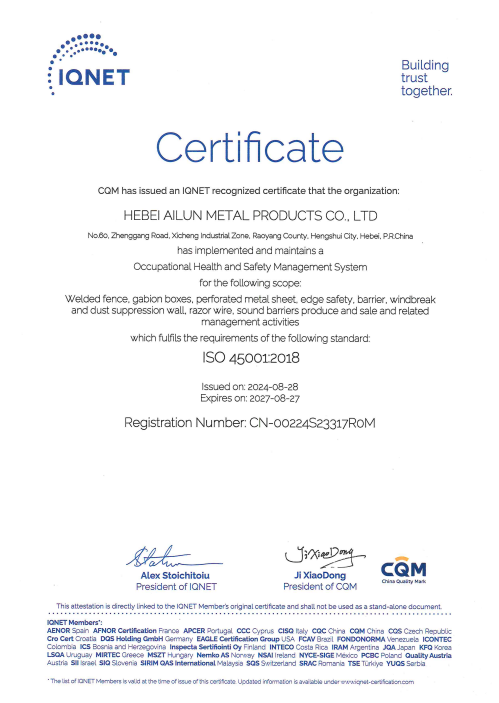
A product inspection and test report records measured values for a defined sample or order — its relevance is bounded by that scope and date.
Market trend analysis: documentation is becoming a differentiator
Three signals in the available market data point in the same direction. First, scale: the welded wire mesh fence segment moving from USD 7.04 billion in 2025 toward a projected USD 11.72 billion by 2034 (Dataintelo) invites new suppliers, many of whom will compete on price before they can compete on documentation. Second, material concentration: metal fencing already holds the largest material share of the broader fencing market at 53%, according to Grand View Research, meaning substitution pressure comes from within the metal category rather than from other materials. Third, product evolution: Betafence Group expanded its perimeter security portfolio in February 2024 with new-generation welded mesh systems incorporating intrusion detection and solar surveillance.
Market estimates should be read with care. Grand View Research places the overall fencing market at USD 33.8 billion in 2025, while Zion Market Research reports USD 33.63 billion for 2024 and Spherical Insights reports USD 30.99 billion for 2024. The spread is explained by different inclusion criteria — product-only figures versus figures that include installation services — rather than by disagreement about direction.
For buyers, the practical reading is that welding systems are becoming more instrumented while the supplier base is becoming more crowded. Both trends increase the value of documentation that can be checked, and both increase the cost of documentation that cannot. Named global participants in the security fencing market include Betafence, Bekaert, Ameristar Perimeter Security and Jacksons Fencing; against a field of that size, the differentiator for a mid-sized manufacturer is rarely a certificate logo, but the specificity of what that certificate, report or test actually covers.
Where certification stops: limits buyers should price in
Every one of the documents discussed above has a boundary, and a procurement file that ignores those boundaries is not more protected — it is only longer. The following limits are structural, not supplier-specific.
- A management-system certificate is an organisational statement. It says the manufacturer's processes are documented and audited. It does not say that a specific panel supplied to a specific site meets a specific performance grade.
- Third-party reports are point-in-time and scope-bound. An SGS or BV report describes what was examined on a defined sample or batch. It does not extend forward to later shipments unless a new inspection is commissioned.
- Neither document equals local code compliance. A project may fall under EN 10223-7, ASTM F2453 or a national or municipal requirement that is not named in either the certificate or the report. The specification, not the certificate, governs that question.
- Certificate scope follows a legal entity. A group-level or trading-company certificate may not cover the plant that actually welds and coats the panels. Matching the certificate holder to the manufacturing entity on the invoice is a basic check that is frequently skipped.
- Certification does not cover installation quality. Post spacing, connection detail, gate alignment and foundation work determine real-world performance. Support posts, connecting clips, gates and razor wire are part of the system, and none of them appear in a quality management certificate.
- Coating damage in transit is invisible to paperwork. A hot-dip galvanized and powder coated panel can be scratched between the factory gate and the site. Documentation review does not detect it; incoming inspection does.
Certified panel systems versus traditional fabricated enclosures
Traditional perimeter work in many markets is still fabricated locally — posts and mesh cut, welded and painted on or near the site by a contractor. The comparison against a documented panel system is not a comparison of strength; it is a comparison of how much of the supplier's claim can be checked before and after delivery.
| Evaluation criterion | Site-fabricated or non-certified enclosure | Documented welded mesh panel system |
|---|---|---|
| Quality evidence available before award | Depends on the contractor's own records; rarely comparable across sites | Management-system certificate plus product inspection and test reports, available for review before order release |
| Batch consistency | Varies with the fabricator's welding and coating practice on the day | Robotic welding with 100% full inspection provides a repeatable process baseline |
| Corrosion protection | Often single-stage protection with no documented service life | Hot-dip galvanized plus powder coated, with a stated service life of over 10 years for the welded mesh fence range |
| Anti-climb and anti-cut geometry | Determined by the fabricator's design choices | Fixed mesh apertures including 50×100 mm and 76.2×12.7 mm, with rigid frame panel construction |
| Replacement and repair | Site-by-site replacement; matching original sections becomes difficult | Standard models and panel sizes allow like-for-like replacement, with custom sizing also available under OEM/ODM arrangements |
| Procurement effort | Lower documentation burden at the evaluation stage | Higher verification workload: scope statements, report dates and entity matching must all be checked |
The limitation is real and should be stated plainly. A certified panel system carries a heavier administrative load. If the project authority does not name a panel standard, if the site is low-risk and short-lived, and if the enclosure will be replaced within a few years, the additional documentation effort may not change the technical outcome at all. Certification is a purchase of traceability, and traceability only pays back where someone downstream actually reads the file. The sensible middle position is to decide early which standard the project must satisfy, and to request only the documents that address it.
Future outlook
Two developments look durable. The first is the migration of perimeter security from static barrier to instrumented system; the 2024 Betafence move toward welded mesh systems with intrusion detection and solar surveillance is one signal, and it implies that certification conversations will soon include electronic components alongside steel. The second is buyer behaviour: as the welded wire mesh fence segment expands toward the projected USD 11.72 billion by 2034, evaluation is shifting from a yes-or-no certificate check toward standard-specific verification — requesting EN 10223-7 for a school perimeter and ASTM F2453 for a high-security site rather than accepting a generic quality certificate for both.
For manufacturers, that shift rewards the suppliers who can map a document to a standard and a standard to a site. The current mid-market baseline — ISO9001 plus third-party SGS and BV verification, supported by 100% full inspection, a 420,000 square metre monthly capacity, lead times of 15 to 30 days and a MOQ of one set — is sufficient to enter most tender processes. It is not sufficient to win them where the specification is precise. What closes that gap is not another certificate, but the ability to answer, document by document, what was tested, on which sample, on what date, and against which standard.
Frequently asked questions
Do ISO9001, SGS and BV documents certify a welded mesh fence panel itself?
No. ISO9001 certifies a quality management system operated by a manufacturer within a defined scope; it speaks to process control, not to the measured performance of an individual panel. SGS and BV produce third-party inspection or verification output tied to a defined sample, batch or order. A panel's own characteristics — wire diameter, mesh aperture, coating system, panel dimensions — are established by the product specification and by the inspection report for that order, not by the certificate.
Which certification or standard should a school or park project specify for welded mesh fencing?
In Europe, EN 10223-7:2012 is the active standard specifying requirements for steel wire welded panels for fencing in schools, parks and industrial sites, and it is the reference most public-sector tenders name. ISO9001 remains useful as a supplier pre-qualification filter, but it does not answer the panel-level question. For school and park projects, the specification should name the panel standard and the required anti-climb geometry, and the supplier should be asked to confirm the standard in writing.
How should a procurement team verify that an SGS or BV report is genuine and still relevant?
Verification works at three levels. First, check the issuing organisation and the report reference against the issuing body's own record. Second, read the scope statement: which product, which sample or batch, which tests, and which date. Third, match the certificate or report holder's legal entity against the entity that will appear on the invoice and the plant that will manufacture. A report that is genuine but scoped to a different product family, a different plant or an earlier batch does not carry the assurance the buyer is looking for.
Does a valid certificate cover later shipments of the same welded mesh fence model?
Not automatically. A management-system certificate remains valid while surveillance audits continue, but it addresses the system rather than the goods. A third-party inspection report is bounded by the sample, batch and date recorded in it. If continuity of evidence matters for a multi-year programme, the practical approach is to build recurring inspection into the purchase order — for example, pre-shipment inspection on each order — rather than relying on a single report issued at the start of the relationship.
How do certifications relate to a claimed 10-year service life and corrosion protection?
A certificate does not create service life; the coating system and the process control behind it do. On the welded mesh fence range, the documented specification is a hot-dip galvanized plus powder coated surface with a stated service life of over 10 years, produced with robotic welding and manual inspection through polishing, pickling and powder coating, under 100% full inspection. The quality management system is what makes that process repeatable and auditable. A buyer should therefore ask for the coating specification and the process description, and treat the certificate as confirmation that the process is under control — not as the source of the ten-year figure.
What should be requested for a railway, airport or industrial perimeter project?
These sites are usually judged on intrusion resistance and continuity of supply rather than on appearance. Requests typically include the panel construction standard applicable in the project's jurisdiction — EN 10223-7 in Europe or ASTM F2453 / F2453M-14 for high-security fabric in the United States — together with the ordered mesh apertures and wire diameters, the corrosion protection system, and the accessory specification for support posts, connecting clips, security gates and razor wire. Rigid frame panel construction and anti-climb geometry are central to these applications, and they should be confirmed in the technical submittal rather than assumed from a certificate.
Reference: the manufacturer's product brochure covering welded wire mesh and galvanized wire is available for download at https://cdn.socialarks.com/sbsp/25089/common/2026/0715/welded%20wire%20mesh%20and%20GI%20wire111.pdf